
Showing all posts about Saturn
The next giant leap for humanity: landing on a moon of Mars
27 October 2026
JAXA, being the Japan Aerospace Exploration Agency, last week launched a probe towards Mars, with the ambitious aim of landing on Phobos, one of the red planet’s moons.
The probe, called the Martian Moons eXploration mission (MMX), will collect samples from Phobos’ surface, and return them to Earth for study. The whole mission is expected to take five years.
Astronomers have long wondered if Phobos, and no doubt Deimos, Mars’ other moon, are asteroids captured billions of years ago. That seems like a reasonable assertion, given the solar system’s asteroid belt is located between Mars and Jupiter.
If it can be ascertained the “moons” are asteroids snared by the fourth planet, perhaps then we could give thought to demoting both satellites to the status of captured object, rather than moon.
If Pluto can be reduced to dwarf planet status, the same ought to apply to moons, or so-called moons, unless they adhere to a certain criteria in terms of size and shape, among other things.
I’m not — by the way — singling out Mars either.
Saturn is said to have over two-hundred-and-seventy moons. But only if you consider a gloried rock to be a moon. Only handful of these satellites could be said to have the… stature of Earth’s Moon.
RELATED CONTENT
astronomy, Mars, Pluto, Saturn, science
When is an exomoon not an exomoon? When it orbits a failed star, not a planet
29 July 2026
Astronomers may have discovered the first moon, or satellite, outside the solar system, about seventy-three light years from Earth.
Plenty of exoplanets, planets orbiting stars other than the Sun, have been found, but this might be the first time a moon accompanying one of these bodies has been located.
But there’s a problem. The apparent exoplanet in question is a brown dwarf. These unusual Jupiter size objects often referred to as failed stars. But they are neither planet nor star.
That’s not all though. The brown dwarf hosting the would-be exomoon, is it self orbiting another star. The situation has scientists puzzled. From what I can understand, the moon of the brown dwarf has some substance. It is of a decent size. It is a real moon.
Quite unlike, for instance, the multitude of pebble-size excuses of “moons” orbiting Saturn.
RELATED CONTENT
No planet has two hundred and seventy plus moons, not even Saturn
15 March 2025
Saturn’s moon count leapt a few days ago, after the International Astronomical Union (IAU) decided to classify an additional one-hundred-and-twenty-eight objects orbiting the ringed planet, as moons. It must be quite the feat of achievement for Saturn to boast it has the most number of satellites, by far, of any other planet in the solar system.
These new moons now mean Saturn is possessed of two-hundred-and-seventy-four satellites. But let’s be serious here. No planet has that many moons, real moons. All of Saturn’s new “moons” are just tiny rocks. They count as moons though, because they have a “proven orbit” around Saturn:
Most of the moons are irregular and tiny, just a few miles across. By comparison, our moon has a diameter of 2,159 miles (3,475 kilometers). But they do have proven orbits around Saturn, which is a key element of official moon candidacy.
Former planet Pluto has a proven orbit around the Sun, yet it is now considered a dwarf planet. This because it no longer meets the IAU’s definition of a planet. We can have different types of planets, it seems, but a moon is always a moon, even it is pet rock size.
But if planetary bodies need to fulfil a certain criteria to be deemed a (real) planet, then a tighter classification of what constitutes a moon, a real moon, is long overdue. If we use our moon, the Moon, as a benchmark, then perhaps Saturn has half a dozen or so “real” moons. The rest would be, as I wrote of Mars’ so-called moons in 2014, merely captured objects.
ETA: on the subject of Saturn, the planet’s fabulous rings will seem to disappear later this month, as far as observers on Earth are concerned. This is because the rings will be edge-on to us, a phenomenon called ring plane crossing, something that happens about every fifteen years.
The rings will become become visible again later in the year though. Who knows, without the rings to distract astronomers on Earth, maybe another batch of moons will be found orbiting Saturn.
RELATED CONTENT
astronomy, Pluto, Saturn, science
Bits of Saturn, a Twitter account posting Cassini probe images
27 August 2022
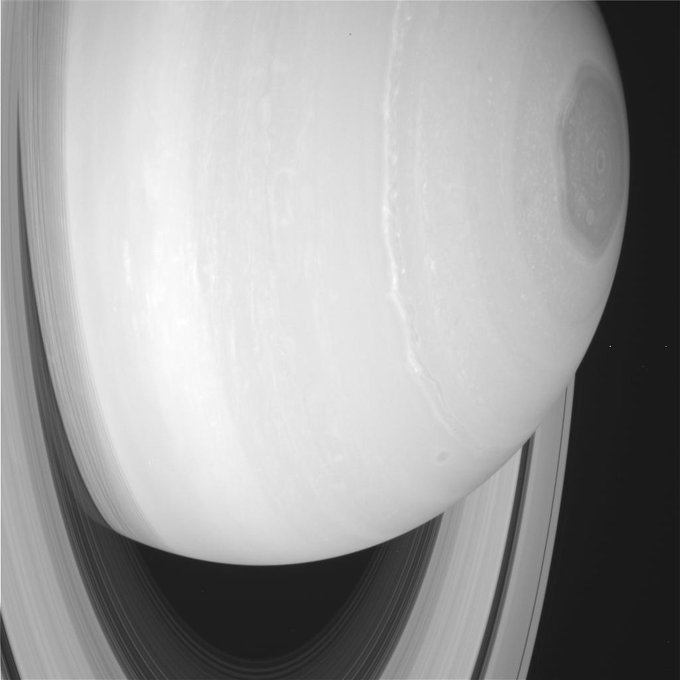
Speaking of Twitter, while a number of accounts may be automated or bots, they’re not all bad. Bits of Saturn, which posts raw images of the ringed planet, taken by NASA’s Cassini probe, between 2004 and 2017, is one you should follow.
RELATED CONTENT