
Showing all posts about coffee
More price rises are on the way for coffee drinkers
9 August 2024
Bad weather continues to hit coffee growers in Brazil and Vietnam, forcing Australian coffee suppliers to warn of shortages, and more price increases.
It’s been a tough few years for coffee producers. When I wrote about production problems almost three years ago, droughts in Brazil were impacting harvest yields, causing a reduction in supply. Labour shortages, occasioned by the pandemic, saw growers in NSW also struggling to harvest.
By early 2022, there were fears coffee might be on the way to seven dollars a cup. Mercifully, that dire prediction has yet to come to pass.
A large cup of takeaway coffee costs five dollars at the places I usually go to. It’s a sensible price, especially if paying with cash, as I sometimes do. I’ve become quite used to having no small change rattling around in my pocket, even if current coffee prices are leaving me more, er, out of pocket.
If the cost of a cup were to press on towards the six dollar mark, I’d start becoming seriously worried about the viability of many coffee shops. Surely some customers would start cutting back, though there is the argument that consumers continue to make smaller comfort purchases, while forgoing other, more costly, outgoings.
And check out the image in this ABC News article, which breaks down the cost of a cup of coffee in Australia. For a small cup, coffee beans only constitute about twelve percent of the total cost. The rest of the money goes elsewhere. But perhaps we should be thankful in Australia after all. A cup of coffee costs about eight dollars in San Francisco, while people in parts of Switzerland pay ten dollars. Five dollars must seem a like a joke to coffee drinkers in those locations.
RELATED CONTENT
The three main processes used to produce decaffeinated coffee
31 July 2024
Tangentially related to the previous post. Do you drink decaffeinated coffee? Did you know there are three common methods used by decaf coffee producers to extract caffeine: the carbon dioxide method, Swiss water process, and finally, solvent-based methods.
Not all methods are one-hundred percent effective though, as minute quantities of caffeine remain in the finished product.
Michael W. Crowder, professor of Chemistry and Biochemistry at Miami University, writing for The Conversation, details each method, and their overall effectiveness. Here I was all this time thinking to-be-decaffeinated coffee beans were simply left out in the sun for a while, or something.
RELATED CONTENT
Coffee happy hour, discount prices for early bird customers
31 July 2024
Coffee happy hours at cafes? This is the first I’ve heard of the idea, but I like it. A growing number of Australian cafes are offering coffees priced at about three dollars a cup, for a couple of hours daily. This compared to the current average cost of about five dollars.
Cafe owners concede happy-hour prices are not making them a whole lot of money, but are hoping the deal will bring in a few new customers.
It’s a smart move, given coffee shop owners are not only competing with numerous other operators, but cheaply priced machine brewed coffee, priced at about two dollars a cup. Coffee making machines are common at service/petrol stations, and convenience stores, and the resulting brew is sometimes not bad. All the more so when there are no cafes to be found.
Their coffee and donut combination deals can also be hard to look passed as well…
RELATED CONTENT
The health benefits of giving up drinking coffee
21 May 2024
As with many things we consume, the science on coffee can be conflicted. One decade caffeine consumption is a no-no, the next it seems coffee is quite beneficial. Regular readers will know I’m a coffee drinker, but in — what I consider to be — moderation: two (large serve) cups per day.
But some people struggle with coffee addiction. And the same people say their general health, and mental well-being, much improved when they stopped drinking coffee all together. Jesse Downes, based on Queensland’s Sunshine Coast, says he used to drink seven cups of coffee a day, before giving up completely about three months ago:
Three months into his coffee-free life, Mr Downes is noticing some changes. “The anxiety levels generally seem to be more managed, or reduced, if you like, and I would have to say there’s a sustained energy level,” he said.
Good for him. Just because many people enjoy something, doesn’t mean everyone will. I guess we all have our no-no vices. Mine would be alcohol and soft drink, both of which I only partake of a couple of times a year.
RELATED CONTENT
Third best coffee on Earth? Sydney. Tenth best? Melbourne…
11 April 2024
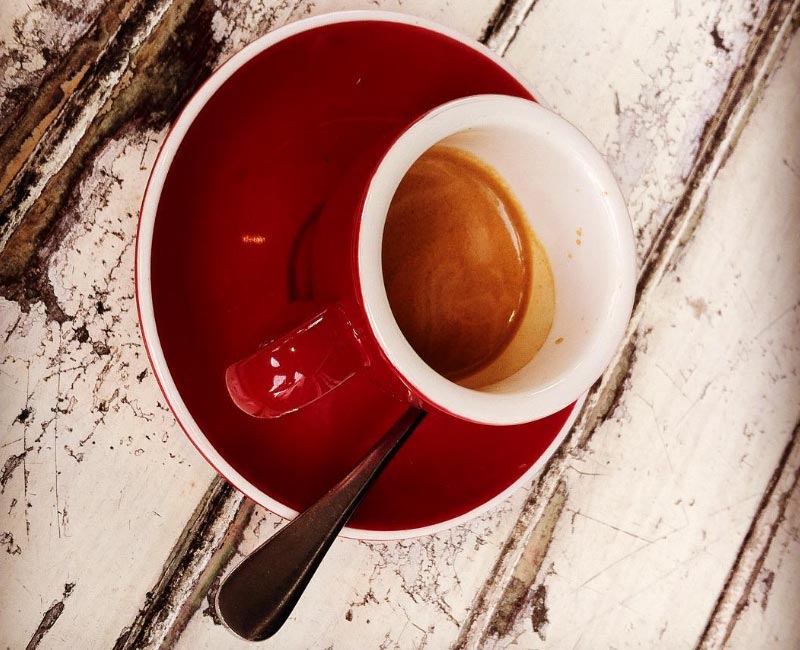
Espresso, brewed by Crepe & Coffee Co, photo by John Lampard.
Sydney has been adjudged the third best city in the world for coffee, this according to American magazine, Food & Wine. Copenhagen, perhaps unsurprisingly, comes in at number one, followed by Tokyo in second place. But here’s where things may get contentious: Melbourne — perhaps surprisingly — ranks at number ten on the list.
Number ten? How can that be? Did not Melbourne birth McCafe, the McDonald’s hamburger restaurant coffee-shop off-shoot? Isn’t Melbourne where the rest of Australia supposedly draws all ideas and inspiration coffee related from? Not that I’m trying to stoke up any Melbourne versus Sydney antagonism, or rivalry, here.
Not me. After all, I’m officially based almost two-hours drive north of Sydney. But when it comes to coffee consumption elsewhere, I’ve had more Sydney coffee than I have Melbourne. And besides, I like both cities. But they’re different places, they’re not cookie-cutter replicas of each other.
Objectively, how then could one possibly be better than the other? Let me illustrate, while keeping the theme victual. Years ago, a chef (whose name escapes me), described the differences between the two cities, thusly. When you go out for dinner in Sydney, it’s for a quick bite, because you’re on the way somewhere else.
That’s true. Sydney never stands still.
On the other hand, when you go out for dinner in Melbourne, it’s an occasion. People dress up, and stay seated at the table for hours. And sometimes we like doing both. But let’s avoid any further Melbourne versus Sydney discord, and take solace in the fact Australia is a country that embraces independent coffee brewers, and has little time for multinational coffeehouse chains.
RELATED CONTENT
Australia, coffee, Melbourne, Sydney, trends
Workers using cafes as offices may reduce their profitability
3 April 2024
Malcolm Knox, writing for The Sydney Morning Herald:
Then there are rents, insurance, equipment and other fixed costs. In a Sydney suburb near me, a new cafe is paying $5000 a week in rent. At $1000 per 7am-to-1pm shift, they need to be selling 300 coffees a day to make it worth their while. That’s nearly one a minute. They don’t often make money on food, which requires more infrastructure such as cooking, storing, plates and so on. It’s all down to their coffee price.
Cafes are a great stand-by for the WFH crowd, an office away from the home office. They’re somewhere to work, be in the company of others, while enjoying a coffee. Or two. Or three. In fact, the more the merrier, so far as the cafe is concerned.
But as much as I love the idea of working in a cafe, I do so infrequently. And then in short bursts — an hour tops — and I will buy at least one coffee and a cake — valued at maybe a little more than ten dollars — to make my stay at least partially worthwhile for the cafe. But even then, I’m short-changing the owners, as they’re hoping to earn closer to forty dollars an hour on the table I occupy.
Running a cafe you see, is an expensive undertaking, and WFH workers who buy a single cup of coffee, and expect to have the same table to themselves all day, are doing the cafe a distinct disservice. I’m fortunate to have a couple of hot-desk options if I don’t want to work at home, virtually negating the need to use a cafe, something I’m sure owners are grateful for. Instead, I’ll come by for a take-out coffee, and be on my way.
RELATED CONTENT
coffee, economics, technology, trends, work
Australian cafes feel brunt of rising inflation, interest rates
17 July 2023
Australian cafes are among those bearing the brunt of the cost of living crisis. Many are dealing with rising overheads, and reduced revenue, as their customers — who are negotiating increased rent or mortgage payments, among other things — feel compelled to reduce discretionary spending.
As a result, many cafes are going out of business:
About one-sixth of cafes advertised for sale now will close down before finding a buyer. In May, ASIC data showed business insolvencies were at the highest monthly rate in eight years. So far the insolvencies have been dominated by construction firms, but hospitality is expected to overtake it in 2024, credit reporting agency CreditorWatch said.
At a large shopping centre I visit in Sydney’s east, I’ve seen about half a dozen coffee shops close in perhaps the last twelve months. While myriad factors could account for this, including a noticeable decline in foot traffic in the centre, rising interest rates and inflation are surely also to blame.
It’s sad to see. For many people, operating a cafe is one way of realising the dream of owning a small business and being self-employed, together with creating work opportunities, both direct and indirect, for other people.
RELATED CONTENT
For a hard boiled brew try deep fried coffee beans
3 December 2022
Instead of roasting some coffee beans, the more usual process for preparing beans for brewing, British coffee connoisseur James Hoffmann decided to deep fry a batch.
Like Hoffmann, I was unsure why anyone would actually, or ever want to, deep dry coffee beans, but his experiment is purely in the name of curiosity. After the beans have been fried, Hoffmann prepared two brews to sample. One by filter, the other by shot. All very interesting I’m sure, but I might stick to drinking roasted bean coffee…
RELATED CONTENT
Anthony Douglas barista of the year World Coffee Championships
6 October 2022
The 2022 World Coffee Championships were held in Melbourne, Australia, during the last week of September, and local coffee-brewer Anthony Douglas was named Barista of the Year.
Here’s some video footage of Douglas in action. But whoever thought that coffee making could be a spectator event?
RELATED CONTENT
Dumpster diving, finding food when prices are rising
27 July 2022
Inflation is back. Prices are rising — sharply in some cases — adding to the cost of living. My go-to — highly anecdotal of course — inflation indicator is the price of a large sized takeaway cappuccino. While rises in the price of coffee have been on the cards for some time, I paid A$5.20 for a cup in Kogarah, a southern suburb of Sydney the other week, the first time I’ve seen the cost exceed five dollars.
But the price of household staples, not just coffee, have also been rising steadily in recent months, imposing financial hardship on many people. Despite this, some Australian supermarkets are engaging in what is surely the unconscionable practice of disposing of food products before their use by date, or fruit and vegetables that simply don’t look saleable, without even offering them at a reduced price beforehand.
But savvy consumers, including Sydneysider Brenden Rikihana, are countering this wasteful process by taking to dumpster diving. That is, going around to the dumpster bin area at a supermarket, and sifting through them for food that is still safe to eat. And if Rikihana’s Facebook page is anything to go by, dumpster divers are truly spoilt for choice at the moment. In fact Rikihana collects so much usable food, he gives a lot away to others.
Dumpster diving can’t be without its hazards. There’s obviously a danger to sifting through waste bins. Broken glass, other sharp objects, not to mention who knows exactly what’s been put in the dumpster. Then there’s the legalities. Some of the bins are probably on private property, so trespass may be a factor. I doubt few people rummage through dumpsters out of choice though. And that’s the problem at the moment. For many it’s not about choice, it’s about necessity.
RELATED CONTENT