
Showing all posts about art shows
You can learn a lot about work when working at an art gallery
11 December 2024
Henrik Karlsson worked for several years at an art gallery in Denmark. The work seems more varied, and entrepreneurial, than some of us might think:
Ie. you don’t say, “This is my job and that thing is outside my area”—no, if the value you are trying to promote requires you to go outside your role and learn new skills and politick to get the authority to go ahead: then that is your job.
RELATED CONTENT
A few random ideas for naming your next art exhibition
5 July 2022
The Random Exhibition Title Generator was a bit of a favourite in the earlier version of disassociated, when I originally linked to it in 2011. While choosing a name for an exhibition is probably the least of an artist’s worries — because I expect just about every other aspect of putting on an art show is onerous — apparently more than a few people found it useful. I hope you too find it helpful.
RELATED CONTENT
The 2022 MS Virtual Art Show
2 June 2022
The 2022 MS Virtual Art Show is currently in progress and features the work of more than one hundred artists from the Australian Multiple Sclerosis community. I’m not sure how long the show lasts, except that it will only be online for a limited time, so be sure to check it out.
RELATED CONTENT
art, art shows, Australian art
Dancing With No Music art show at aMBUSH Waterloo Sydney
27 May 2022
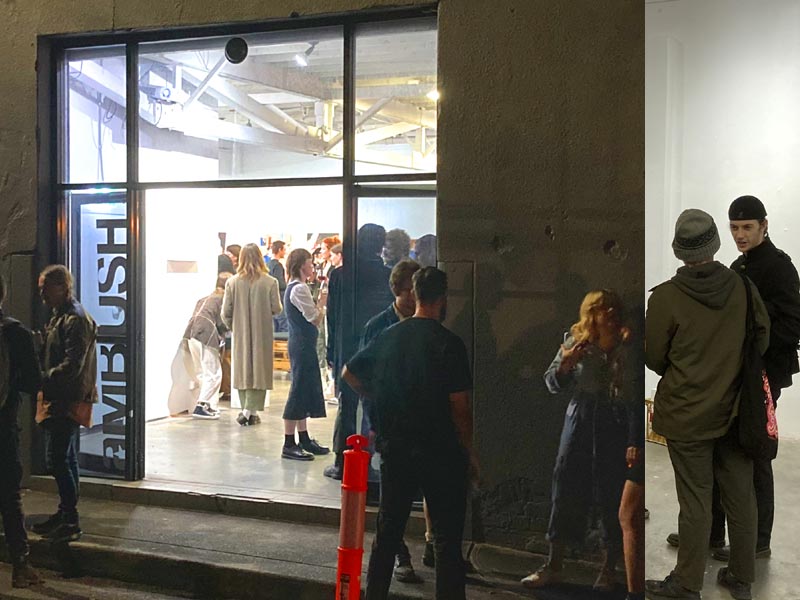
The Dancing With No Music art exhibition opened at aMBUSH Gallery in the Sydney suburb of Waterloo last night. On show was the work of National Art School second year Master of Fine Art students, including Jessica Callen, Emily Ebbs, Joseph Christie Evans, Daniel McClellan, Nina Radonja, Wolfgang Saker, Kansas Smeaton, Jack Thorn, and Elle Wickens.
The diverse works in Dancing With No Music are anchored and inspired by a quote from German philosopher, Friedrich Nietzsche, “And those who were seen dancing were thought to be insane by those who could not hear the music.” Through their varied painting practices, it explores the concept that in making art, individuals conjure up certain methods, inspired by their own ‘music’. Much like the artists’ varying perspectives, when creating their work the ‘dance’ is to their own music and not a collective rhythm.
The exhibition closes on Sunday 29 May 2022. Check out a few more of my photos from the opening night here.
RELATED CONTENT
art, art shows, Australian art, exhibitions
Une Fête dans le Papier, an exhibition by Penelope Benton and Alexandra Clapham
10 January 2011
Penelope Benton, a Sydney based photography, performance and installation artist, and Alexandra Clapham, combine to present a representation of a Versailles-inspired ballroom made entirely out of cardboard.
In this recent collaboration Benton and Clapham propose to marry royalty by birth and royalty by imagination, constructing a Versailles-inspired ballroom entirely out of cardboard such as is associated with the early life of Basquiat the street-artist/dreamer: Basquiat’s cardboard box for a bed, Marie Antoinette’s palace.
In this necessarily flimsy set the two will hold a dinner party, a feast of unimaginable scope, which will be in full view of the public (most likely consisting of starving artists and hangers-on) who will be invited to later riot over the leftovers of the important guests in a literal free-for-all.
The exhibition opens at The Paper Mill, 1 Angel Place, Ash Street, Sydney, on Tuesday, 11 January, 2011 at 6pm, and concludes on the following Saturday, 15 January.
Originally published Monday 10 January 2011, with subsequent revisions, updates to lapsed URLs, etc.
RELATED CONTENT
Alexandra Clapham, art, art shows, Australian art, legacy, Penelope Benton
Tips for artists arranging their own art exhibition and opening
8 March 2010
Ask anyone what they like the best about going to an art show and most people will tell you it’s the opening night party.
And who can blame them, after all what better way is there to spend an evening, than enjoying some brand new art while partying?
So while from a show-goer’s point of view the opening night party seems like a straightforward process — placing a collection of artworks in a gallery and then laying on refreshments and live music — there’s a lot more to staging an exhibition, even a smaller show, than meets the eye.
Months, possibly years, of planning and organising go into some shows and their opening night party, so in the interests of imbuing the curious with an appreciation of the process, here it is, a step by step guide to planning and staging an exhibition.
Planning
You might be surprised at the amount of planning an exhibition requires. Factors such as venues, budgets, funding, sponsorship, advertising and promotion, catering, and possibly insurance, all need careful consideration.
Lead times can vary greatly as a result, with some shows taking a year or more to set up, while others can be arranged within a couple of months.
Budgets, sponsorship, and funding
Staging an exhibition can be expensive, and you will need to ensure you have sufficient funding, whether private, or through sponsorships, to cover the cost of things like catering, promotion, printing, and gallery space.
While established artists may be able to find sponsors to cover costs, as their larger following ensures a reasonable degree of exposure for their backers, new or emerging artists may not be so fortunate, and will have to rely on savings, or help from family or friends.
Check around though.It may be possible to obtain funding through arts grants, and sometimes municipal councils or community groups may offer some assistance staging a show, whether it be providing a venue, or publicity.
Artists at some exhibitions I have been to sometimes ask a for small (gold coin) contribution to help cover costs, a portion of which they usually donate to charity.
Finding a gallery
Gallery space is competitive, and can be hard to secure, especially if you want to exhibit at an established, well known, venue.
You will also need to weigh-up the amount, nature, and size, of work to be exhibited, against the availability of suitable galleries.
Other things to consider are whether the gallery operates on a commission basis, taking a percentage on works sold, or charges a fixed fee for holding a show.
Also, depending on your location, since regulations vary from place to place, are insurance matters, both public liability, and cover for items on show.
Look out also for alternative venues, such as cafes or bookshops for instance, which may offer wall space, and would surely be happy to collect a commission on any works sold.
Given the potential for publicity and custom, cafe and bookshop owners may possibly be prepared to provide other forms of support for your show as well.
A theme and a name for the exhibition
Your show will need a name and a theme. It’s worth taking some time to think this over.
Pricing your artworks
This is one of the more difficult steps in the process of planning an art show.
The amount you can ask for an artwork will depend on a number of factors including your reputation or standing as an artist. Obviously the more regarded your work, the more you can ask.
Another is the arrangement you have with the gallery exhibiting your work. Most galleries take a commission on works sold during an exhibition. While this cut varies, sometimes greatly, rates of about twenty-five to up to fifty percent are reasonably common.
Don’t be afraid to negotiate on the commission either. If you believe you will sell a lot of your work, you may be able to haggle a slightly lower rate.
To set a price you will need to work out much you would like to receive, against how much you think someone will pay, less the commission asked for by the exhibiting gallery.
Printing
Once you have funding, a venue, and a theme worked out, you can start arranging the printing of promotional flyers and brochures, title cards, and a list or catalogue of items you’ll be exhibiting.
If money is tight you may be able to reduce some printing costs by doing some of the work yourself.
Great looking catalogues and title cards can be produced with a word-processor, the use of good fonts, some careful page layout, and a reasonable quality printer.
If you know someone with calligraphy skills see if they can make title cards for your works.
Promote and advertise
There’s quite a few options when it comes to promoting shows, many of which are low-cost, or free.
Social networking sites, such as Facebook, make it easy for members to create pages for events, such as an exhibition opening, and issue invitations to their contacts.
There’s also art focused discussion forums, and you could even consider approaching arts bloggers to see if they will help the spread the word. Be careful not to wear out your welcome, or take anything for granted here though.
Setting up a page on a photo-sharing site, such as Flickr, and posting photos of your work is also a good way to generate some ongoing profile.
If your budget permits, consider printing flyers to post on community notice boards. Local shops may also be happy to display these for you. Also think about writing a press release to send to local and community magazines and newspapers.
I’ve received a number of invitations to exhibition openings through (snail) mail, so if time and money allows, have some invitations printed and then gather up a list of people to post them to.
Finally, invite as many people as you can, however you can, to the opening. Not only will they appreciate a drink and snack, they’ll also add some atmosphere, and make your attendance numbers look good. Nothing says success more than a well attended show opening.
Food, beverages, and catering
A big part of the opening night of any exhibition is the food, drink and party atmosphere, but you don’t need to go overboard.
Offering guests a choice between a red and white wine, and water (and juice or soft drinks, if you really want to push the boat out) is quite acceptable.
If you have a generous sponsor, or even just a catering sponsor, you may also be able to lay on beer and some finger food.
Other entertainment
Many of the openings I’ve been to have some sort of live music, and given the atmosphere a DJ, or even a band, can add to proceedings, this is something well worth thinking about.
If money, or floor space dictates otherwise, the only option may be background music. Whatever you do, choose music that is light and upbeat, and generates a good vibe.
Opening times
Most of the shows I go to usually open on Wednesdays, Thursdays, or Fridays. Thursday seems to be the most common day, it’s not too early in the week, and not too close to the weekend.
If possible, avoid weekend openings, or early in the week, times that people usually have other plans.
An early evening opening of around 6pm is probably a good all round time. Most your guests will be on the way home form work by then, yet it is still early enough for them to fit your show in around other plans they have for later in the evening.
Photos
You will definitely want a photographic record of the opening, so try and arrange for someone to take photos through out the evening.
Post the photos to your Flickr or Facebook pages, and also use them when you write about about the opening on your blog later.
And enjoy
The opening night, and exhibition itself, will probably be over in what feels like no time, especially when compared to the months of prior planning and preparation, so be sure to take a little time out to enjoy your own exhibition.
Good luck with it.
Originally published Monday 8 March 2010, with subsequent revisions, updates to lapsed URLs, etc.
RELATED CONTENT
art, art shows, artists, legacy