
Showing all posts about astronomy
Video of a solar eclipse on Mars, Phobos occults the Sun
30 August 2022
Footage of a solar eclipse on Mars, filmed by NASA roving probe Curiosity. Eclipses on Mars are a little different to those we are treated to on Earth though, with the speed of the red planet’s “moontatoes” making the phenomenon more of a blink and you’ll miss it occasion.
Mars’ moons Phobos (“fear” in Ancient Greek) and Deimos (“dread”) circle Mars every 7.65 and 30.35 hours respectively, a relative blink compared to the 27-day orbit of Earth’s moon. They’re also a lot smaller than the Moon, and considerably more lumpy – little moontatoes, rather than the nice round disk we see shining so argently in our night sky.
It makes me think. If Pluto doesn’t make the grade as a “proper” planet, why should the so-called satellites of Mars be regarded as moons? Surely “captured objects” would be a more apt classification.
RELATED CONTENT
astronomy, Mars, science, video
Bits of Saturn, a Twitter account posting Cassini probe images
27 August 2022
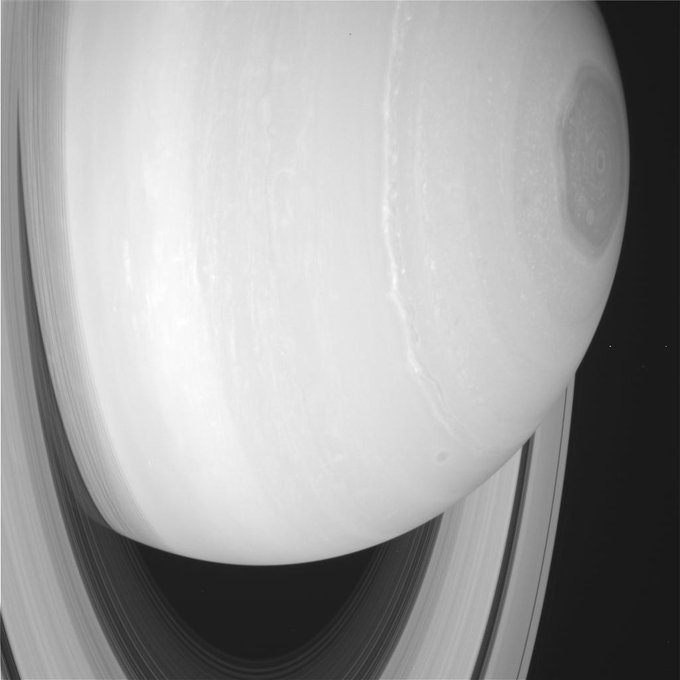
Speaking of Twitter, while a number of accounts may be automated or bots, they’re not all bad. Bits of Saturn, which posts raw images of the ringed planet, taken by NASA’s Cassini probe, between 2004 and 2017, is one you should follow.
RELATED CONTENT
The sound of the Perseus galaxy cluster black hole
25 August 2022
NASA have again been applying sound, or musical notes, to the data they’ve collected from objects in the universe — a process called sonification — this time a black hole located about two-hundred-and-forty million light years away in the Perseus galaxy cluster.
People have variously likened the droning sound produced by the black hole to wailing ghosts or grumbling, hungry, stomachs. Somehow I think of water draining down a plughole.
The Perseus galaxy cluster is intriguing of itself being, according to Wikipedia, one of the most massive objects in the known universe, containing thousands of galaxies immersed in a vast cloud of multimillion-degree gas. I doubt we’ll be sending our star ships too close to that cluster…
RELATED CONTENT
5000 exoplanets pinpointed and given a sound signature
23 August 2022
Prior to 1992 exoplanets — being planets orbiting stars other than the Sun — were unheard of. While scientists believed they existed, thirty years ago none had been found. Today though exoplanets are the rule rather than the exception with over five thousand such bodies having been identified so far.
And with an estimated one-hundred-thousand-million stars in our galaxy, the Milky Way, it is likely many, many, more exoplanets will come to light. This nifty animation and sonification produced by NASA pinpoints the location of stars hosting exoplanets, while a pitch or chime conveys other information about the planet.
This animation and sonification tracks humanity’s discovery of the planets beyond our solar system over time. Turning NASA data into sounds allows users to hear the pace of discovery, with additional information conveyed by the notes themselves. As each exoplanet is discovered, a circle appears at its position in the sky. The size of the circle indicates the relative size of the planet’s orbit and the color indicates which planet detection method was used to discover it. The music is created by playing a note for each newly discovered world. The pitch of the note indicates the relative orbital period of the planet. Planets that take a longer time to orbit their stars are heard as lower notes, while planets that orbit more quickly are heard as higher notes.
The question now is how many exoplanets are capable of supporting life (as we know it), and is life present on any of these bodies.
RELATED CONTENT
astronomy, exoplanets, science, video
Super clear photos of Jupiter taken by the Juno probe
3 August 2022

Image courtesy of NASA/Juno spacecraft.
A selection of some of the clearest photos taken so far, of Jupiter, the largest planet in the Solar System, by NASA’s Juno spacecraft. This stunning image dates from 2019. Juno has been photographing the gas giant since 2016, on a mission originally expected to last five years. NASA is hopeful however the probe will remain operational until 2025.
More of Juno’s photos can be seen here.
RELATED CONTENT
astronomy, Jupiter, photography, science
Astronomers call for James Webb Space Telescope to be renamed
21 July 2022
While the images being collected by the newly operational James Webb Space Telescope have been stunning, some people are questioning whether the telescope should be named in honour of James Webb. Webb was NASA administrator from 1961 until 1968, and during his tenure he oversaw preparations for the early Apollo Moon flights.
But some astronomers and scientists are calling for NASA to rename the space telescope in light of allegations Webb persecuted LGBTQIA+ people, during, and before, his time as NASA administrator.
The telescope’s name has been criticised by many scientists amid allegations that Webb was linked to persecution of LGBTQ+ people in the 1950s and 1960s. The Lavender Scare witch-hunt resulted in the mass dismissal of gay and lesbian people from the US government service in the mid-20th century.
To date NASA has refused to yield, claiming there is no evidence supporting the allegations against Webb.
In September last year, NASA announced it would not change the telescope’s name. “We have found no evidence at this time that warrants changing the name of the James Webb space telescope,” NASA’s current administrator Bill Nelson said in a statement in September.
RELATED CONTENT
First images from the James Webb Space Telescope
14 July 2022
NASA released the first images captured by the brand new James Webb Space Telescope (JWST), on Tuesday, and they did not disappoint.
The first operational JWST photo is of the SMACS 0723 galaxy cluster, which is a little over five billion light years distant. Incredible isn’t it? The cluster seems far closer. What we’re really seeing here though is a snapshot of the cluster as it appeared five billion years ago.
Check out the red streak, that looks a little like a forward-slash towards the bottom centre. According to Rebecca Allen, an astronomer at Swinburne University of Technology, this was a galaxy with many of its stars still forming. Five billion years later, it might look like our galaxy, the Milky Way, today.
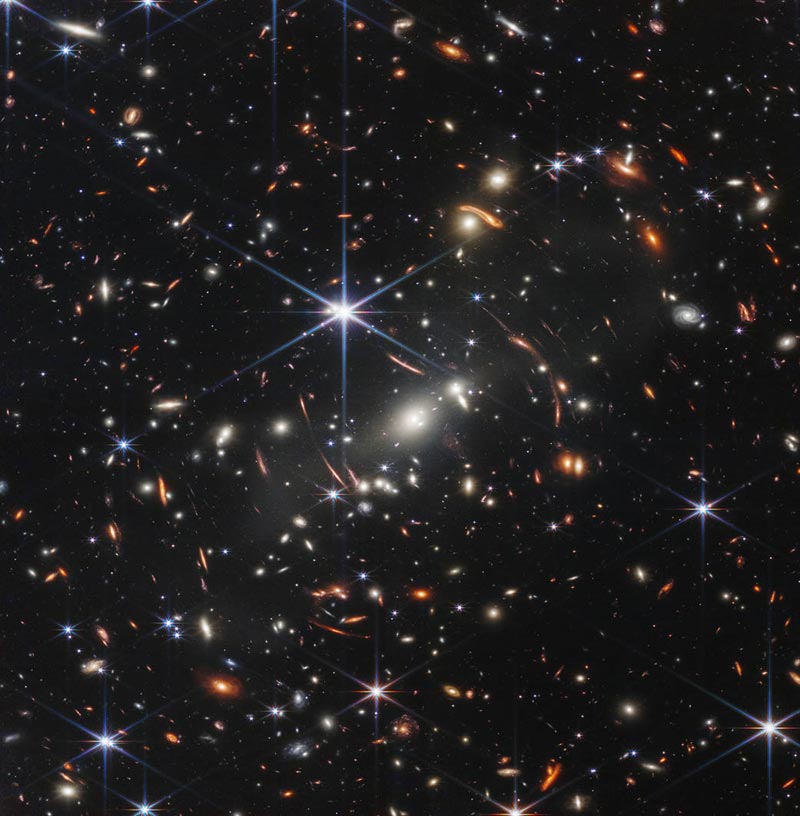
Image courtesy NASA, ESA, CSA, STScI, Webb ERO.
This picture of the Southern Ring Nebula, also known as Eight-Burst Nebula, and Caldwell 74, depicts the death throes of a binary star. The cloud of dust, hydrogen, and ionised gas, surrounding the binary is about half a light year across.
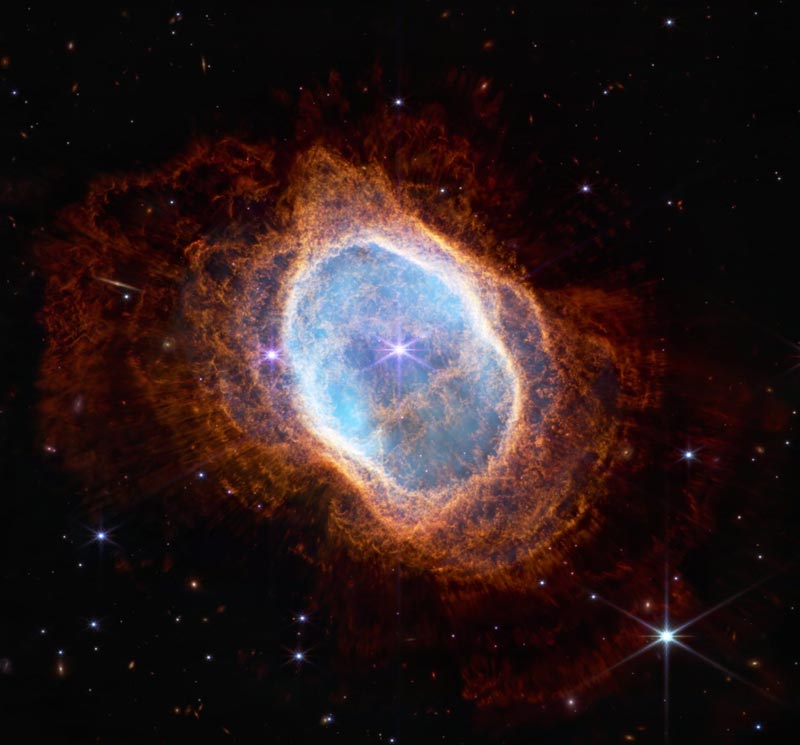
Image courtesy NASA, ESA, CSA, and STScI.
The Carina Nebula, situated some 8500 light years from Earth, is the sort of image we love seeing from deep space telescopes. Brimming with colour, pearly bright stars in the foreground, and intrigue, these nebulae are akin to intricate tapestries.
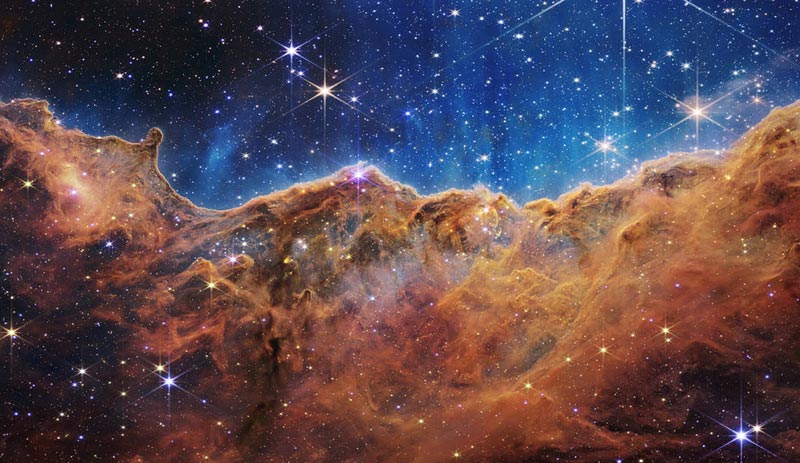
Image courtesy NASA, ESA, CSA, and STScI.
Hands up who’s hanging out for the next batch of JWST images…
RELATED CONTENT
astronomy, photography, science
What next after finding the goddamn Higgs boson particle?
14 July 2022
The Large Hadron Collider (LHC) is being fired up again after an extensive upgrade, and expectations are high the revamped particle collider will yield further of the universe’s secrets. Australian journalist Sherryn Groch has written about what scientists hope to learn in the next round of LHC experiments, as part of the Sydney Morning Herald Explainer series of articles.
For many people the LHC is most notable for finally confirming the existence of the elusive Higgs boson, nicknamed the goddamn particle by some scientists, on account of the difficulty they had finding it. The discovery though wasn’t quite the missing piece of the puzzle physicists expected it to be, says Dr Mitesh Patel, a lead researcher at CERN, giving rise to the possibility a fifth force of nature may exist, over and above the presently accepted four.
And then there’s the Higgs boson itself: it’s much lighter than expected. “It doesn’t really make sense on its own,” Patel says. “Everything about it tells us its mass should be much heavier. So, is something keeping it low? That’s what makes us think there’s something else.”
But the plot thickens. Shortly before the LHC was deactivated for upgrade, Patel and his team were struggling to make sense of data they had gleaned from older LHC experiments. What they were seeing didn’t stack up against the tenets of the Standard Model of physics, used to account for the four forces of nature, being electromagnetism, the weak force, the strong force, and gravity, even if the Standard Model does not actually explain gravity.
In the subatomic realm, particles interact and change all the time. And, according to the standard model, those known as beauty quarks should decay as often into muons as they do into electrons. But on the CERN team’s measurements, they became electrons 15 per cent more often than the muons, suggesting something could be tipping the scales.
Scientists are hoping further LHC experiments will also tell them more about dark matter, which coupled with dark energy, makes up ninety-five percent of the universe. But gravity remains the mystery. Standard Model does not account for it, and scientists are puzzled as to why it is far weaker than the other forces of nature. But they have some mind-boggling suggestions as to why:
[Some] speculate whether dark matter is really the effects of matter in another universe – gravity leaking through a multiverse into our own. It sounds like a Marvel film but Patel says “there are decent foundations” for the theory, namely that scientists still don’t understand why gravity is so much weaker than the other three forces of nature. “So people have speculated that maybe gravity behaves differently because it’s spread out in other dimensions in addition to our own”.
It is possible insights into these puzzles may be forthcoming sooner rather than later, once the LHC is up and running again. This I am looking forward to.
RELATED CONTENT
Saturn’s rings and moons silhouette woodcut by Agnes Giberne
12 July 2022
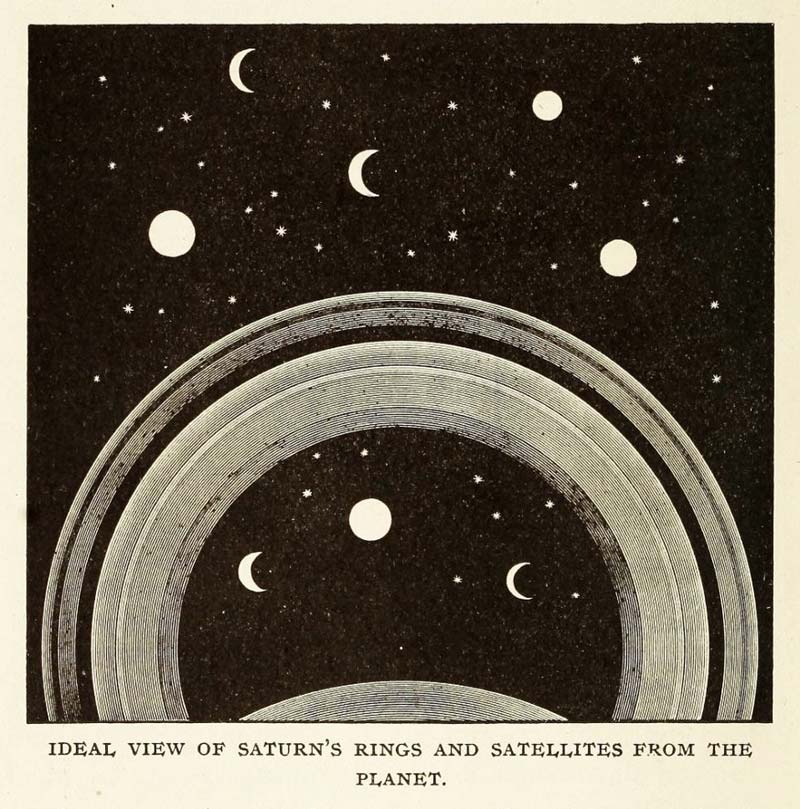
The things you find while trawling through the The Public Domain Review… Agnes Giberne was a British novelist and science writer, who died aged 93 in 1939. As a writer her output was prolific.
Wikipedia lists one hundred and thirty books published under her name during her lifetime. On top of her writing though, Giberne was also an accomplished artist and illustrator.
The above illustration, titled “Ideal view of Saturn’s rings and satellites from the planet” is a silhouette woodcut from her book, Sun, Moon, and Stars: A Book for Beginners, which was published in 1898.
RELATED CONTENT
Agnes Giberne, art, astronomy, illustration
2022 astronomy photographer of the year shortlist
7 July 2022
The 2022 astronomy photographer of the year shortlist was unveiled on Tuesday 5 July. The award, organised by the Royal Observatory Greenwich is in its thirteenth year, and the entries, as usual, never fail to amaze. Shortlisted images are on display at London’s National Maritime Museum until Sunday 7 August 2022, with the winners being announced on Thursday 15 September 2022.
RELATED CONTENT