
Showing all posts about climate change
Forests now cover two percent of Iceland thanks to replanting
22 July 2022
In the distant past, forests and trees covered large parts of Iceland, about forty percent of the country. But when permanent settlers arrived over a thousand years ago, much of this growth was cleared to make way for agriculture and grazing, and firewood. Efforts to replant trees since the 1990s though have seen forest areas return to two percent of the country today.
That number may not seem like much, but since 1990, the surface area covered by forest or shrubs in Iceland has increased more than six times over – from 7,000 hectares to 45,000. In 20 years, the number is expected to be 2.6%.
Every little bit helps. It’s a hopeful reminder that it’s not too late to take steps of any sort to deal with climate change.
RELATED CONTENT
climate change, environment, Iceland, nature
Don’t plant trees to combat climate change plant mini-forests
15 July 2022
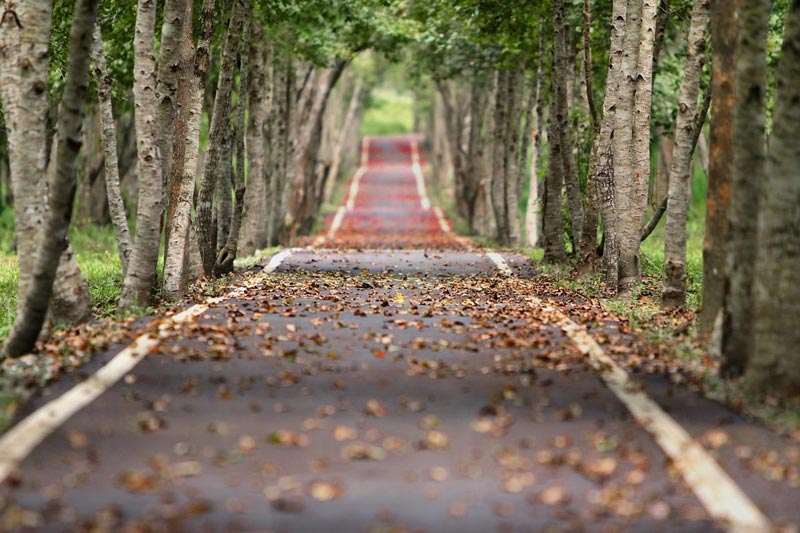
Image courtesy of 二 盧/uniquedesign52.
Planting trees is one way of mitigating the impact of climate change, but planting mini-forests is a more effective alternative, says American nature and conservation writer Hannah Lewis.
Mini-forests are more likely to nurture ecosystems, rather than single trees planted here and there, and, as a result, live longer. And better still, mini-forests can be established anywhere, even in densely populated urban areas, where there’s even a few spare square metres of land available.
A mini-forest is a small ecologically robust forest that can be planted by communities in parks and cities, in schoolyards and churchyards, and beside busy roads. It’s flipped traditional landscaping on its head. You get more biodiversity and a different appearance. It’s a dense band of multi-layer trees as opposed to the elegant but less ecologically useful line of single species down the side of the street.
Lewis’ call is based on the work of late Japanese botanist Akira Miyawaki, who advocated the planting of small forests with native species, as a way of fostering the emergence of ecosystems.
RELATED CONTENT
climate change, environment, nature
Human tolerance to high temperature, humidity, lower than thought
2 July 2022
New research from Pennsylvania State University (PennState) shows human tolerance to temperatures — in situations where humidity is at one hundred percent — isn’t as high as previously thought. And that’s for younger people in good health.
For those not in that category, temperatures of 31°C (wet-bulb) would be far too high. Such temperatures are a regular occurrence in many parts of the world, certainly areas of Australia during the height of summer, so temperatures in the high thirties, or even forties, with one hundred percent humidity, pose a danger for just about everyone.
But in their new study, the researchers found that the actual maximum wet-bulb temperature is lower — about 31°C wet-bulb or 87°F at 100% humidity — even for young, healthy subjects. The temperature for older populations, who are more vulnerable to heat, is likely even lower.
RELATED CONTENT
Space bubbles a Dyson sphere like solution to global warming?
15 June 2022
Dyson spheres are hypothetical mega-structures highly advanced planetary civilisations might construct around their host star to harness as much solar energy as possible to power their needs. Seen from a distance, a Dyson sphere would look like a massive shell almost completely encompassing a star.
It’d be like constructing a giant display case for the Sun. Needless to say building a Dyson sphere is no small undertaking, and would require an enormous quantity of resources, technological smarts, plus an unprecedented level of international cooperation. A single superpower could not take on an engineering feat of this scale alone, it’d be a team effort.
Dyson spheres have been in the news relatively recently. Fluctuations in the light of Tabby’s Star, located about 1,470 light-years from Earth, were puzzling astronomers, and the existence of a Dyson sphere was advanced as a possible explanation, though later ruled out.
While Dyson spheres, something late British American mathematician and physicist Freeman Dyson first wrote about in 1960, are unlikely to feature in our future anytime soon, the concept may help us combat global warming.
A team of MIT scientists have devised a solar filter of sorts, they call space bubbles. In short, a small structure made up of numerous of these space bubbles could be used to form a shield, deflecting a small, though sufficient amount of solar radiation away from the Earth.
The MIT scientists propose placing the space bubbles at the Lagrange point between the Earth and the Sun. Put simply, a Legrange point, is an area between two celestial objects, say the Earth and the Sun, where the gravity of both objects balance each other. For example if a satellite were placed at this Legrange point, it would stay put, and wouldn’t fall towards either the Earth or Sun.
Once in place, the space bubbles would act like an eclipsing body, in this case permanently blocking, or more like filtering, a small amount of the Sun’s rays reaching the Earth. While the proportion of solar radiation “blocked” would be minuscule, the MIT team say if just under two percent of “incident solar radiation” was deflected, current global warming could be fully reversed.
RELATED CONTENT
astronomy, climate change, science
Earth’s climate change black box
9 December 2021
An aircraft’s black box contains data that may help investigators piece together what caused an accident, and hopefully ensure there isn’t a repeat of whatever went wrong. What then to make of Earth’s Black Box? It is a quadrilateral-like shaped structure that will stand in a geologically stable location, on the west coast of Tasmania, and collect climate data. Like an aircraft flight recorder, the information Earth’s black box stores is intended to one day guide a future civilisation, should global warming spell the demise of ours. Thank you, and have a nice day.
RELATED CONTENT
Burning, a documentary by Eva Orner
9 November 2021
Burning (trailer) is a documentary by Los Angeles based Australian filmmaker Eva Orner about the Black Summer bush fires that ravaged parts of Australia in 2019 and 2020. The two-minute trailer is shocking, but being in the path of the flames must have been terrifying. Burning is scheduled for release later this month.
RELATED CONTENT
climate change, Eva Orner, film, trailer
Forty four degrees Celsius, I think that is a record for Sydney
1 January 2006
It’s almost midnight in Sydney. I think it’s safe to go outside now. Earlier today temperatures hit 44° Celsius. The last time I was in place that hot was Aswan, in Egypt.
44°C. That must be an all-time record for Sydney.
In other news, I’m pleased to report last night’s festivities were indeed festive. Seems quite a party was had at my apartment building too. When I arrived home today someone had ripped a fire extinguisher off the wall and sprayed most the common areas with it.
There’s fine white powder all over the stairs and on the roof top area.
Other than that I spent the day tinkering with disassociated, and slipping cool, cool beverages. Too hot for anything else, trust me. Happy New Year 🙂
Originally published Sunday, 1 January 2006.
RELATED CONTENT