
Showing all posts about Milky Way
Milky Way might not collide with Andromeda, Milkomeda might not form
4 June 2025
Some recently revised calculations, based on some more recent data, have shown our galaxy, the Milky Way, may not collide, or if you prefer merge, with Andromeda, a large galaxy presently about two and a half million light years away.
Astronomers have long believed a merger/collision to be inevitable. Although heading towards to each other — at an eye watering speed of about one-hundred kilometres per second — there’s close to a fifty-fifty chance both galaxies will simply sail passed each other.
Milkomeda, the name given to the would-be merged entity, and something I’ve written a bit about in the past, may never come to pass after all. But then again it might, no one can be one-hundred percent sure. Uncertainty is the only certainty.
If you’re stilling gunning for the formation of Milkomeda though, here’s an animation of the what the collision might look like, from the perspective of a far distant observer. Events play out over ten billion years, but are compressed to a minute, meaning things won’t be quite as violent as they look.
Even if Earth were still around at this point — which seems unlikely in five billion years time — the merger/collision of the two galaxies would probably make little difference to anyone still here. Aside from an upheaval in the way the night sky looks, that is.
Despite appearances, galaxies are mainly made up of empty space, meaning the chances of a star from Andromeda barging into the solar system would be pretty remote.
RELATED CONTENT
astronomy, milkomeda, Milky Way, physics, science
A supermassive black hole is set to collide with the Milky Way
21 February 2025
It’s true: a supermassive black hole is on a collision course with our galaxy. But the happening is at least two billion years away.
And even then it may not be a black hole, but rather a “massive invisible object” thought to lurk within the Large Magellanic Cloud (LMC), a smaller galaxy that presently orbits the Milky Way, but which is slowly falling towards us. Once the LMC collides — though merge is probably a more apt word — with the Milky Way, the black hole, or whatever the invisible body that the LMC hosts, will make a bee-line for Sagittarius A*, the supermassive black hole at the centre of our galaxy.
When those two objects eventually collide — an event that will unfold at a likewise cosmologically glacial pace — the result will be the formation of an even more monstrous black hole.
While the black hole merger process may be drawn out, assuming a black hole indeed resides inside the LMC, it will no doubt be a bumpy ride for whatever interstellar objects lie in the path of the two, as they fuse together. Perhaps the solar system will find itself in harm’s way here. The only consolation there is it’s something we won’t be around to see.
RELATED CONTENT
An app that points to centre of the Milky Way galaxy
26 March 2024
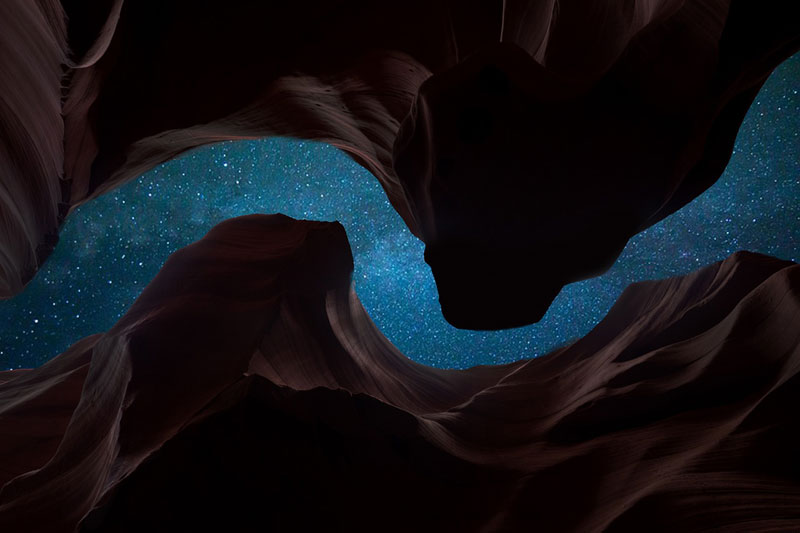
Image courtesy of Pexels.
Tangentially related to my previous post… product designer and technologist Matt Webb has created an app, named Galactic Compass (link to Apple app store), that points to the centre of the galaxy.
When on the (far less light polluted) NSW Central Coast, I can kind of look down from the tail of the constellation Scorpius (the scorpion), and be observing the right patch of the night sky.
When back amongst the super bright lights of Sydney though, that can be a little trickier. Like, find a star, any star, let alone the Scorpius constellation.
Read also Galactic Compass’ origin/development story, the app was built with help from ChatGPT.
RELATED CONTENT
artificial intelligence, astronomy, Milky Way, science, technology
When galaxies collide, coming to the night sky in four billion years
4 June 2012
Several billion years hence our galaxy, the Milky Way, will collide with galactic neighbour Andromeda, and form a new entity some are calling Milkomeda. This NASA image depicts key steps in the process, and if nothing else will transform the night sky into a visual spectacle.

Not that anyone will probably be around to think about it anyway, but the night sky will have far less appeal once the merger is complete. The bright white haze (in the last frame) that will eventually take the place of the Milky Way (first frame) looks a little bland to me.
Via NASA Science.
Originally published Monday 4 June 2012.
RELATED CONTENT
astronomy, legacy, milkomeda, Milky Way