
Showing all posts about science
The people we spend time with changes throughout our life
8 August 2022
A breakdown of the time we spend with the people in our lives: parents, siblings, friends, partners, colleagues… and ourselves, put together by Our World in Data. The findings are based on surveys conducted between 2009 and 2019 in the United States.
- As you age you tend to spend more time alone. This does not necessarily mean you’d be lonely though
- Once you leave home the time spent with parents and siblings plummets
- Once settled in a career, time spent with friends also decreases
- In fact the only person you spend more time with, excluding children if you have any, is your partner
RELATED CONTENT
data, lifestyle, psychology, science
Days getting shorter, Earth spinning faster these days
6 August 2022
Scientists are perplexed by a slight increase in the speed of the Earth’s rotation in recent years. It’s all the more puzzling because as time has passed, Earth’s spin has been ever so gradually slowing down. This has required leap seconds to be added to clocks from time to time, which are separate to the leap day that needs to be added to the calendar every four years.
Since the first leap second was added in 1972, scientists have added leap seconds every few years. They’re added irregularly because Earth’s rotation is erratic, with intermittent periods of speeding up and slowing down that interrupt the planet’s millions-of-years-long gradual slowdown.
“The rotation rate of Earth is a complicated business. It has to do with exchange of angular momentum between Earth and the atmosphere and the effects of the ocean and the effect of the moon,” Levine says. “You’re not able to predict what’s going to happen very far in the future.”
But in the past decade or so, Earth’s rotational slowdown has … well, slowed down. There hasn’t been a leap second added since 2016, and our planet is currently spinning faster than it has in half a century. Scientists aren’t sure why.
While the speed increase is barely noticeable, the shortest day since the advent of atomic clocks was recorded on Wednesday 29 June 2022, when the day was 1.59 milliseconds shorter than the usual twenty-four hours.
A millisecond or so is small fry though. In the distant past, Earth’s years were made up of four-hundred-and-twenty days, considerably more that the three-hundred-and-sixty-five we’re accustomed to. But it could be worse. If say the Earth spun twice as fast as it presently does, life would be quite different.
RELATED CONTENT
Super clear photos of Jupiter taken by the Juno probe
3 August 2022

Image courtesy of NASA/Juno spacecraft.
A selection of some of the clearest photos taken so far, of Jupiter, the largest planet in the Solar System, by NASA’s Juno spacecraft. This stunning image dates from 2019. Juno has been photographing the gas giant since 2016, on a mission originally expected to last five years. NASA is hopeful however the probe will remain operational until 2025.
More of Juno’s photos can be seen here.
RELATED CONTENT
astronomy, Jupiter, photography, science
Astronomers call for James Webb Space Telescope to be renamed
21 July 2022
While the images being collected by the newly operational James Webb Space Telescope have been stunning, some people are questioning whether the telescope should be named in honour of James Webb. Webb was NASA administrator from 1961 until 1968, and during his tenure he oversaw preparations for the early Apollo Moon flights.
But some astronomers and scientists are calling for NASA to rename the space telescope in light of allegations Webb persecuted LGBTQIA+ people, during, and before, his time as NASA administrator.
The telescope’s name has been criticised by many scientists amid allegations that Webb was linked to persecution of LGBTQ+ people in the 1950s and 1960s. The Lavender Scare witch-hunt resulted in the mass dismissal of gay and lesbian people from the US government service in the mid-20th century.
To date NASA has refused to yield, claiming there is no evidence supporting the allegations against Webb.
In September last year, NASA announced it would not change the telescope’s name. “We have found no evidence at this time that warrants changing the name of the James Webb space telescope,” NASA’s current administrator Bill Nelson said in a statement in September.
RELATED CONTENT
First images from the James Webb Space Telescope
14 July 2022
NASA released the first images captured by the brand new James Webb Space Telescope (JWST), on Tuesday, and they did not disappoint.
The first operational JWST photo is of the SMACS 0723 galaxy cluster, which is a little over five billion light years distant. Incredible isn’t it? The cluster seems far closer. What we’re really seeing here though is a snapshot of the cluster as it appeared five billion years ago.
Check out the red streak, that looks a little like a forward-slash towards the bottom centre. According to Rebecca Allen, an astronomer at Swinburne University of Technology, this was a galaxy with many of its stars still forming. Five billion years later, it might look like our galaxy, the Milky Way, today.
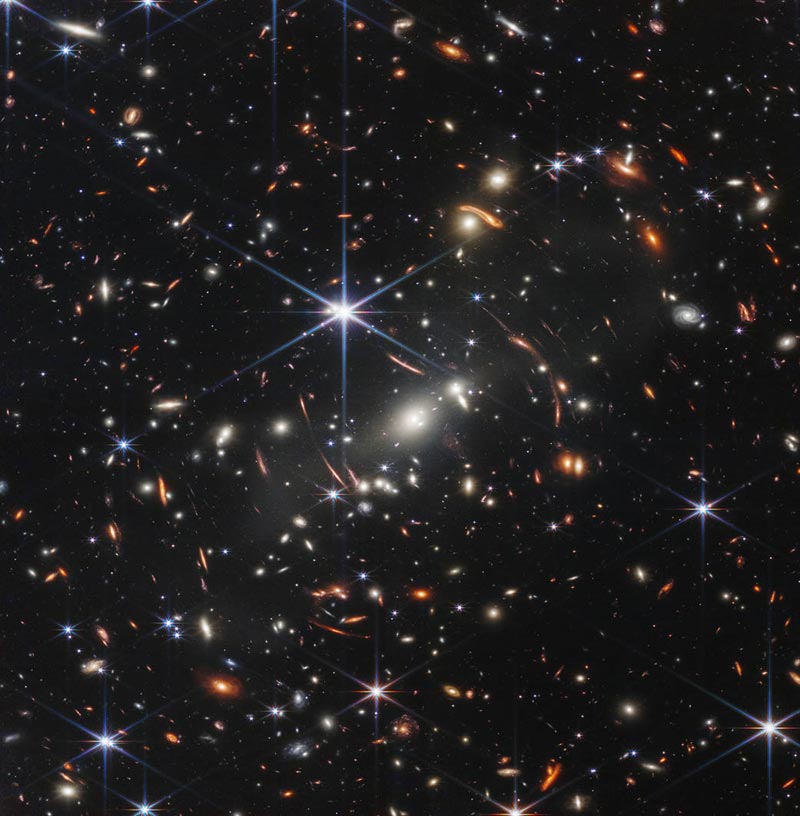
Image courtesy NASA, ESA, CSA, STScI, Webb ERO.
This picture of the Southern Ring Nebula, also known as Eight-Burst Nebula, and Caldwell 74, depicts the death throes of a binary star. The cloud of dust, hydrogen, and ionised gas, surrounding the binary is about half a light year across.
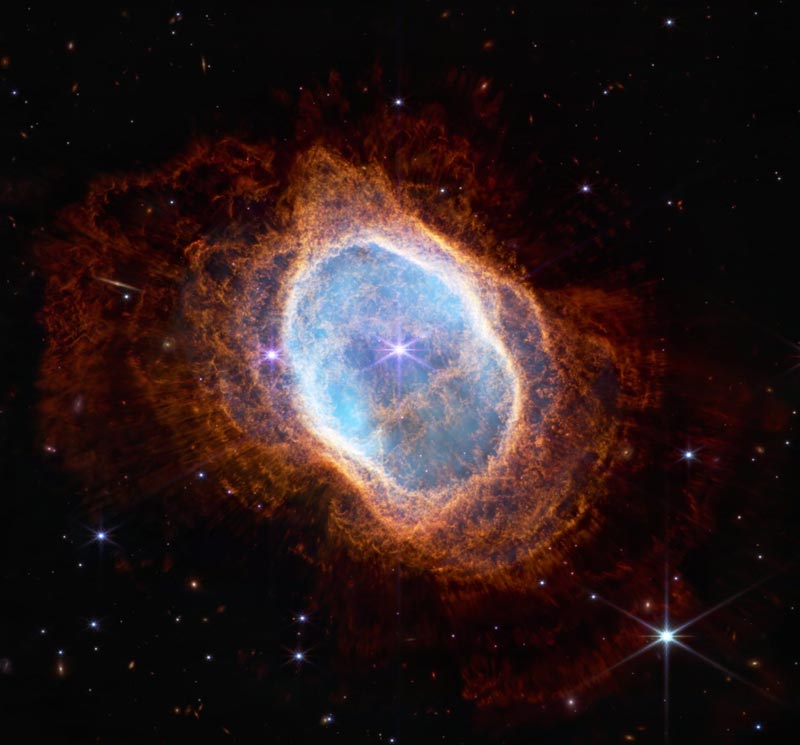
Image courtesy NASA, ESA, CSA, and STScI.
The Carina Nebula, situated some 8500 light years from Earth, is the sort of image we love seeing from deep space telescopes. Brimming with colour, pearly bright stars in the foreground, and intrigue, these nebulae are akin to intricate tapestries.
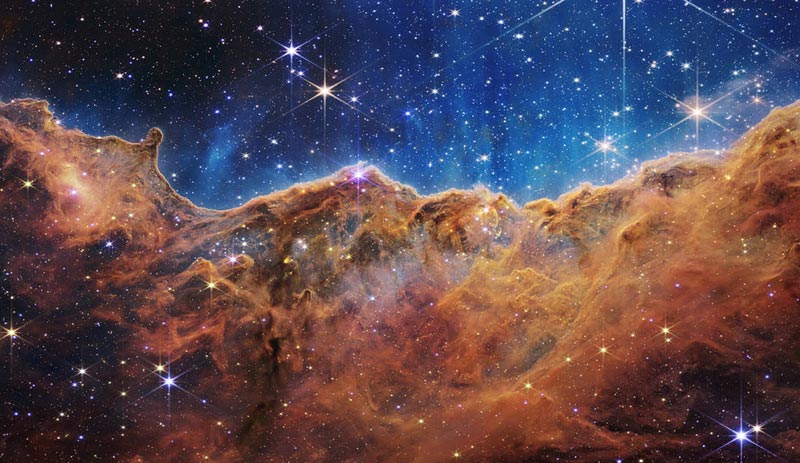
Image courtesy NASA, ESA, CSA, and STScI.
Hands up who’s hanging out for the next batch of JWST images…
RELATED CONTENT
astronomy, photography, science
What next after finding the goddamn Higgs boson particle?
14 July 2022
The Large Hadron Collider (LHC) is being fired up again after an extensive upgrade, and expectations are high the revamped particle collider will yield further of the universe’s secrets. Australian journalist Sherryn Groch has written about what scientists hope to learn in the next round of LHC experiments, as part of the Sydney Morning Herald Explainer series of articles.
For many people the LHC is most notable for finally confirming the existence of the elusive Higgs boson, nicknamed the goddamn particle by some scientists, on account of the difficulty they had finding it. The discovery though wasn’t quite the missing piece of the puzzle physicists expected it to be, says Dr Mitesh Patel, a lead researcher at CERN, giving rise to the possibility a fifth force of nature may exist, over and above the presently accepted four.
And then there’s the Higgs boson itself: it’s much lighter than expected. “It doesn’t really make sense on its own,” Patel says. “Everything about it tells us its mass should be much heavier. So, is something keeping it low? That’s what makes us think there’s something else.”
But the plot thickens. Shortly before the LHC was deactivated for upgrade, Patel and his team were struggling to make sense of data they had gleaned from older LHC experiments. What they were seeing didn’t stack up against the tenets of the Standard Model of physics, used to account for the four forces of nature, being electromagnetism, the weak force, the strong force, and gravity, even if the Standard Model does not actually explain gravity.
In the subatomic realm, particles interact and change all the time. And, according to the standard model, those known as beauty quarks should decay as often into muons as they do into electrons. But on the CERN team’s measurements, they became electrons 15 per cent more often than the muons, suggesting something could be tipping the scales.
Scientists are hoping further LHC experiments will also tell them more about dark matter, which coupled with dark energy, makes up ninety-five percent of the universe. But gravity remains the mystery. Standard Model does not account for it, and scientists are puzzled as to why it is far weaker than the other forces of nature. But they have some mind-boggling suggestions as to why:
[Some] speculate whether dark matter is really the effects of matter in another universe – gravity leaking through a multiverse into our own. It sounds like a Marvel film but Patel says “there are decent foundations” for the theory, namely that scientists still don’t understand why gravity is so much weaker than the other three forces of nature. “So people have speculated that maybe gravity behaves differently because it’s spread out in other dimensions in addition to our own”.
It is possible insights into these puzzles may be forthcoming sooner rather than later, once the LHC is up and running again. This I am looking forward to.
RELATED CONTENT
When will the last human be born? Not as soon as you think
8 July 2022
When will the last human be born and how many people will there ever be?
With the way things are in the world at the moment, who can help but think the last human might be born sooner rather than later. But in taking on the question, Kurzgesagt argues we may be among the first humans born, especially if our species goes on to survive and flourish over the next billion years. A whole lot depends on that eventuality, but what’s wrong with some optimism?
The future of humanity seems insecure. Rapid climate change, political division, our greed and failings make it hard to look at our species with a lot of optimism and so many people think our end is in sight. But humans always thought they lived in the end times. Every generation assumes they’re important enough to witness the apocalypse and then life just goes on. This is a problem because it leads to short term thinking and prevents us from creating the best world for ourselves and our descendants. What makes this worse is that we actually may live at an extremely critical moment in human history.
RELATED CONTENT
Absurd instances of the trolley problem by Neal Agarwal
8 July 2022
Most people have heard of the trolley problem. In short, you’re standing beside a rail line, near a railroad switch. A train is coming along the track, but there are five people tied to the track, in its path. You have the option to pull the switch lever, sending the train along a side line.
But another person is tied and bound to the side line. What should you do? Stand there, do nothing, and allow the train run over the five people? Or send the locomotive down the side line, where one person will be killed? Presumably there is not time to free any of the people, so you are left with the difficult choice. Do five people perish, or one?
This format of the trolley problem was created by Philippa Foot, a British philosopher, in 1967, while Judith Thomson, a philosopher at MIT, devised the quandary’s name. American creative coder and developer Neal Agarwal, meanwhile, has thought of a few more, absurd, trolley problem instances.
RELATED CONTENT
Space bubbles a Dyson sphere like solution to global warming?
15 June 2022
Dyson spheres are hypothetical mega-structures highly advanced planetary civilisations might construct around their host star to harness as much solar energy as possible to power their needs. Seen from a distance, a Dyson sphere would look like a massive shell almost completely encompassing a star.
It’d be like constructing a giant display case for the Sun. Needless to say building a Dyson sphere is no small undertaking, and would require an enormous quantity of resources, technological smarts, plus an unprecedented level of international cooperation. A single superpower could not take on an engineering feat of this scale alone, it’d be a team effort.
Dyson spheres have been in the news relatively recently. Fluctuations in the light of Tabby’s Star, located about 1,470 light-years from Earth, were puzzling astronomers, and the existence of a Dyson sphere was advanced as a possible explanation, though later ruled out.
While Dyson spheres, something late British American mathematician and physicist Freeman Dyson first wrote about in 1960, are unlikely to feature in our future anytime soon, the concept may help us combat global warming.
A team of MIT scientists have devised a solar filter of sorts, they call space bubbles. In short, a small structure made up of numerous of these space bubbles could be used to form a shield, deflecting a small, though sufficient amount of solar radiation away from the Earth.
The MIT scientists propose placing the space bubbles at the Lagrange point between the Earth and the Sun. Put simply, a Legrange point, is an area between two celestial objects, say the Earth and the Sun, where the gravity of both objects balance each other. For example if a satellite were placed at this Legrange point, it would stay put, and wouldn’t fall towards either the Earth or Sun.
Once in place, the space bubbles would act like an eclipsing body, in this case permanently blocking, or more like filtering, a small amount of the Sun’s rays reaching the Earth. While the proportion of solar radiation “blocked” would be minuscule, the MIT team say if just under two percent of “incident solar radiation” was deflected, current global warming could be fully reversed.
RELATED CONTENT
astronomy, climate change, science
In ten billion years the universe will double in size
28 May 2022
The Hubble constant expresses the rate at which the universe is expanding. The problem is though, no one has been able to nail down a precise value for the constant. That is, until now.
When the Hubble Space Telescope was launched in 1990 the universe’s expansion rate was so uncertain that its age might only be 8 billion years or as great as 20 billion years. After 30 years of meticulous work using the Hubble telescope’s extraordinary observing power, numerous teams of astronomers have narrowed the expansion rate to a precision of just over 1%. This can be used to predict that the universe will double in size in 10 billion years.
That’s mind blowing. To say the least. The already enormous cosmos will one day be twice its present size. Too bad no one here today will be around to see it. But what does it matter anyway? Well, you’d be surprised. Given some two point two million new books are published every year, one can only imagine how many more publications there’ll be in ten billion years’ time.
With a much larger universe by then, it’s comforting to know there will be space to put them somewhere…
RELATED CONTENT