
Showing all posts about science
Video of a solar eclipse on Mars, Phobos occults the Sun
30 August 2022
Footage of a solar eclipse on Mars, filmed by NASA roving probe Curiosity. Eclipses on Mars are a little different to those we are treated to on Earth though, with the speed of the red planet’s “moontatoes” making the phenomenon more of a blink and you’ll miss it occasion.
Mars’ moons Phobos (“fear” in Ancient Greek) and Deimos (“dread”) circle Mars every 7.65 and 30.35 hours respectively, a relative blink compared to the 27-day orbit of Earth’s moon. They’re also a lot smaller than the Moon, and considerably more lumpy – little moontatoes, rather than the nice round disk we see shining so argently in our night sky.
It makes me think. If Pluto doesn’t make the grade as a “proper” planet, why should the so-called satellites of Mars be regarded as moons? Surely “captured objects” would be a more apt classification.
RELATED CONTENT
astronomy, Mars, science, video
The sound of the Perseus galaxy cluster black hole
25 August 2022
NASA have again been applying sound, or musical notes, to the data they’ve collected from objects in the universe — a process called sonification — this time a black hole located about two-hundred-and-forty million light years away in the Perseus galaxy cluster.
People have variously likened the droning sound produced by the black hole to wailing ghosts or grumbling, hungry, stomachs. Somehow I think of water draining down a plughole.
The Perseus galaxy cluster is intriguing of itself being, according to Wikipedia, one of the most massive objects in the known universe, containing thousands of galaxies immersed in a vast cloud of multimillion-degree gas. I doubt we’ll be sending our star ships too close to that cluster…
RELATED CONTENT
5000 exoplanets pinpointed and given a sound signature
23 August 2022
Prior to 1992 exoplanets — being planets orbiting stars other than the Sun — were unheard of. While scientists believed they existed, thirty years ago none had been found. Today though exoplanets are the rule rather than the exception with over five thousand such bodies having been identified so far.
And with an estimated one-hundred-thousand-million stars in our galaxy, the Milky Way, it is likely many, many, more exoplanets will come to light. This nifty animation and sonification produced by NASA pinpoints the location of stars hosting exoplanets, while a pitch or chime conveys other information about the planet.
This animation and sonification tracks humanity’s discovery of the planets beyond our solar system over time. Turning NASA data into sounds allows users to hear the pace of discovery, with additional information conveyed by the notes themselves. As each exoplanet is discovered, a circle appears at its position in the sky. The size of the circle indicates the relative size of the planet’s orbit and the color indicates which planet detection method was used to discover it. The music is created by playing a note for each newly discovered world. The pitch of the note indicates the relative orbital period of the planet. Planets that take a longer time to orbit their stars are heard as lower notes, while planets that orbit more quickly are heard as higher notes.
The question now is how many exoplanets are capable of supporting life (as we know it), and is life present on any of these bodies.
RELATED CONTENT
astronomy, exoplanets, science, video
How did Electric Eels develop their electric charge?
22 August 2022
How did electric eels become… electric? It’s an intriguing question. After all, the seabed isn’t littered with the recharge stations electric vehicles use, so what’s the deal? Israel Ramirez, a retired biopsychologist, explains:
It isn’t hard to produce slight electric currents. Most animal cells keep sodium out and potassium in. Regulating the flow of these substances across the membranes of their cells produces a slight electric current because sodium and potassium have a positive charge. Each cell produces only a slight current, but you can get many volts by stacking cells in the same way people stack low voltage batteries to get a higher voltage.
RELATED CONTENT
Tasmanian Tiger de-extinction is a fairy tale science
22 August 2022
While a group of scientists believe they could revive Tasmanian Tigers — the species has been extinct since 1936 — and have the creatures roaming forests within a decade, not all scientists are convinced. In fact some believe the notion of bringing back the thylacine, is little more than a publicity stunt:
“De-extinction is a fairytale science,” Associate Professor Jeremy Austin from the Australian Centre for Ancient DNA told the Sydney Morning Herald, adding that the project is “more about media attention for the scientists and less about doing serious science”.
Time will tell.
RELATED CONTENT
nature, science, Tasmania, Tasmanian tiger
The people we spend time with changes throughout our life
8 August 2022
A breakdown of the time we spend with the people in our lives: parents, siblings, friends, partners, colleagues… and ourselves, put together by Our World in Data. The findings are based on surveys conducted between 2009 and 2019 in the United States.
- As you age you tend to spend more time alone. This does not necessarily mean you’d be lonely though
- Once you leave home the time spent with parents and siblings plummets
- Once settled in a career, time spent with friends also decreases
- In fact the only person you spend more time with, excluding children if you have any, is your partner
RELATED CONTENT
data, lifestyle, psychology, science
Days getting shorter, Earth spinning faster these days
6 August 2022
Scientists are perplexed by a slight increase in the speed of the Earth’s rotation in recent years. It’s all the more puzzling because as time has passed, Earth’s spin has been ever so gradually slowing down. This has required leap seconds to be added to clocks from time to time, which are separate to the leap day that needs to be added to the calendar every four years.
Since the first leap second was added in 1972, scientists have added leap seconds every few years. They’re added irregularly because Earth’s rotation is erratic, with intermittent periods of speeding up and slowing down that interrupt the planet’s millions-of-years-long gradual slowdown.
“The rotation rate of Earth is a complicated business. It has to do with exchange of angular momentum between Earth and the atmosphere and the effects of the ocean and the effect of the moon,” Levine says. “You’re not able to predict what’s going to happen very far in the future.”
But in the past decade or so, Earth’s rotational slowdown has … well, slowed down. There hasn’t been a leap second added since 2016, and our planet is currently spinning faster than it has in half a century. Scientists aren’t sure why.
While the speed increase is barely noticeable, the shortest day since the advent of atomic clocks was recorded on Wednesday 29 June 2022, when the day was 1.59 milliseconds shorter than the usual twenty-four hours.
A millisecond or so is small fry though. In the distant past, Earth’s years were made up of four-hundred-and-twenty days, considerably more that the three-hundred-and-sixty-five we’re accustomed to. But it could be worse. If say the Earth spun twice as fast as it presently does, life would be quite different.
RELATED CONTENT
Super clear photos of Jupiter taken by the Juno probe
3 August 2022

Image courtesy of NASA/Juno spacecraft.
A selection of some of the clearest photos taken so far, of Jupiter, the largest planet in the Solar System, by NASA’s Juno spacecraft. This stunning image dates from 2019. Juno has been photographing the gas giant since 2016, on a mission originally expected to last five years. NASA is hopeful however the probe will remain operational until 2025.
More of Juno’s photos can be seen here.
RELATED CONTENT
astronomy, Jupiter, photography, science
Astronomers call for James Webb Space Telescope to be renamed
21 July 2022
While the images being collected by the newly operational James Webb Space Telescope have been stunning, some people are questioning whether the telescope should be named in honour of James Webb. Webb was NASA administrator from 1961 until 1968, and during his tenure he oversaw preparations for the early Apollo Moon flights.
But some astronomers and scientists are calling for NASA to rename the space telescope in light of allegations Webb persecuted LGBTQIA+ people, during, and before, his time as NASA administrator.
The telescope’s name has been criticised by many scientists amid allegations that Webb was linked to persecution of LGBTQ+ people in the 1950s and 1960s. The Lavender Scare witch-hunt resulted in the mass dismissal of gay and lesbian people from the US government service in the mid-20th century.
To date NASA has refused to yield, claiming there is no evidence supporting the allegations against Webb.
In September last year, NASA announced it would not change the telescope’s name. “We have found no evidence at this time that warrants changing the name of the James Webb space telescope,” NASA’s current administrator Bill Nelson said in a statement in September.
RELATED CONTENT
First images from the James Webb Space Telescope
14 July 2022
NASA released the first images captured by the brand new James Webb Space Telescope (JWST), on Tuesday, and they did not disappoint.
The first operational JWST photo is of the SMACS 0723 galaxy cluster, which is a little over five billion light years distant. Incredible isn’t it? The cluster seems far closer. What we’re really seeing here though is a snapshot of the cluster as it appeared five billion years ago.
Check out the red streak, that looks a little like a forward-slash towards the bottom centre. According to Rebecca Allen, an astronomer at Swinburne University of Technology, this was a galaxy with many of its stars still forming. Five billion years later, it might look like our galaxy, the Milky Way, today.
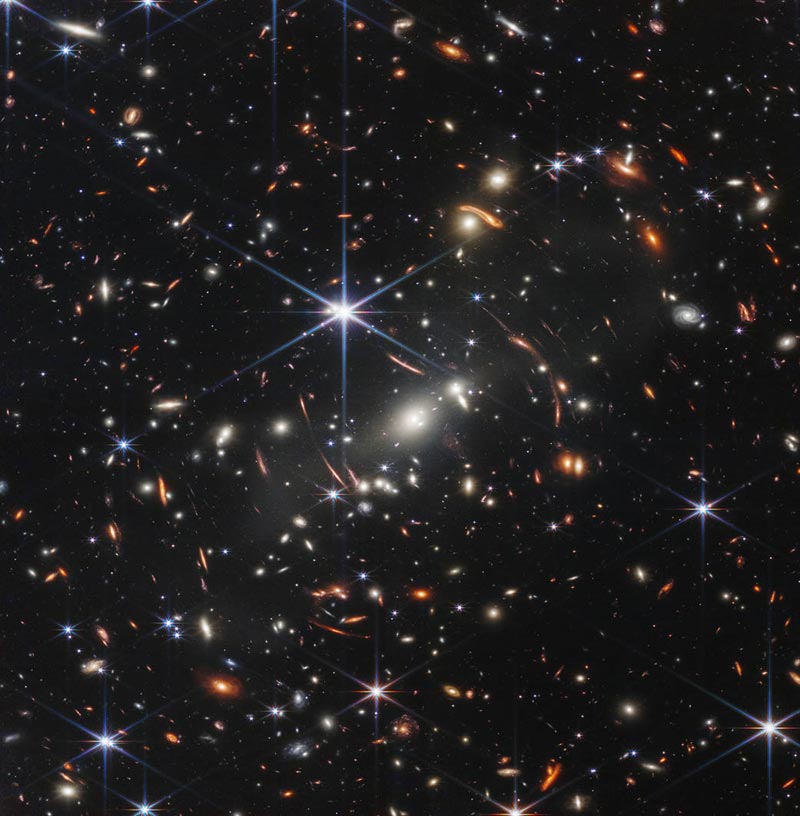
Image courtesy NASA, ESA, CSA, STScI, Webb ERO.
This picture of the Southern Ring Nebula, also known as Eight-Burst Nebula, and Caldwell 74, depicts the death throes of a binary star. The cloud of dust, hydrogen, and ionised gas, surrounding the binary is about half a light year across.
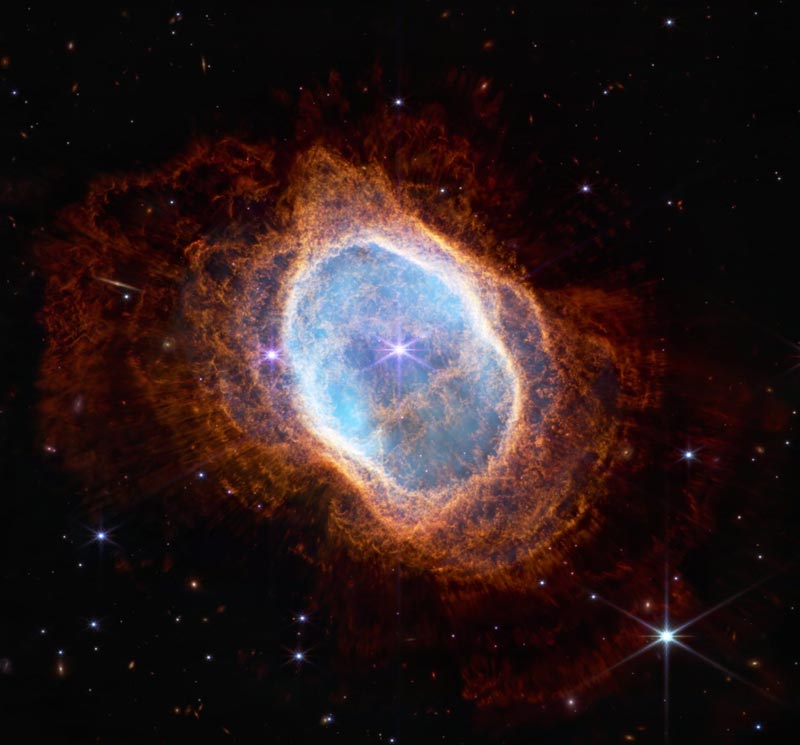
Image courtesy NASA, ESA, CSA, and STScI.
The Carina Nebula, situated some 8500 light years from Earth, is the sort of image we love seeing from deep space telescopes. Brimming with colour, pearly bright stars in the foreground, and intrigue, these nebulae are akin to intricate tapestries.
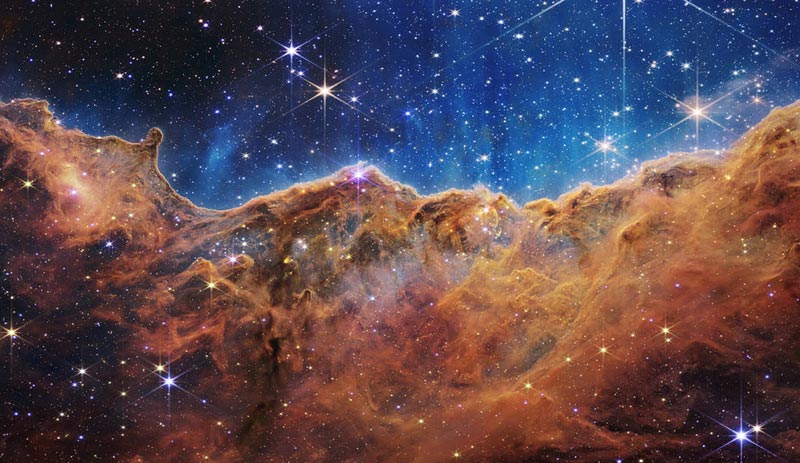
Image courtesy NASA, ESA, CSA, and STScI.
Hands up who’s hanging out for the next batch of JWST images…
RELATED CONTENT