
Showing all posts about travel
Buying a car is the biggest purchase you make not a house
17 August 2022
Buying property is the biggest purchase most people will make. The process is given thorough due-diligence. And rightly so. In Australia, depending where exactly you buy, a free-standing house can cost near on one million dollars. You don’t commit to a million dollar obligation without understanding the ins and outs of the undertaking.
Of course a house you paid one million dollars for will end up costing closer to one million four hundred thousand dollars, if you had to fully finance the property, and pay an average interest rate of two and half percent over the course of a thirty year mortgage. Things like maintenance and insurance will also add to the overall cost. But usually that’s ok. Houses are generally assets that appreciate over time, so you’ll recoup the costs when you eventually sell, and, with any luck, make a tidy profit.
But here’s something, buying a house is not the biggest purchase many people will make. Owning a car will be. In Australia, owning a car could end up costing over two million dollars, were a driver to own a succession of vehicles over a sixty year period. How though can a car — even a small vehicle, going for maybe A$25,000 at the dealership — possibly turn out costing two million dollars? Ongoing running costs, which most vehicle owners grossly underestimate, is why.
Berlin based YouTuber TechAltar looked at the long-term costs of car ownership, and made the following conclusions:
- Car owners typically underestimate car running costs by fifty-two percent
- Thirty to forty percent of semi skilled and unskilled workers incomes will go into their cars, assuming they own vehicles for at least fifty years
- Societies subsidise drivers by €5000 each year, so it’s not only car owners who pay
In Germany, a Volkswagen Golf typically costs the owner €7,657 per year to own and run. This includes depreciation, petrol, taxes, maintenance and so on. Based on a conservative study from a few years ago, if you own and use a car of that size over 50 years, it comes to a total cost of €403,179. If we stretch that to 60 years and apply a more realistic inflation rate of 2.5%, that small Golf will incur a lifetime cost of €1,579,583! On a medium income, that’s 30-40% of every euro earned, ever.
To convert those numbers to Australian dollars, a Volkswagen Golf, or an equivalent vehicle, would cost $11,075 each year. Over fifty years the cost is $583,286 (you could buy a modest size apartment for that). Over sixty years of ownership, and applying an inflation rate of 2.5 percent, the cost works out at $2,285,029. $2,285,029: with that sort of money you could buy a house, being, as we all know, an appreciating asset.
While fuel costs, vehicle taxes, and on the road costs might vary between Germany and Australia, I’d say the numbers would be pretty similar. And don’t forget to add in parking and traffic-offence fines. While car ownership is an unavoidable necessity for some people, those with young families among them, remind me again why anyone would otherwise want to own a car. Especially those living in centres with good public transport and cycling infrastructure.
Via Dense Discovery, a weekly, Australian produced newsletter, which I highly recommend you follow.
RELATED CONTENT
Before cars arrived there was no such thing as jay walking
11 August 2022
Streets and roadways used to be the purview of people on foot, not motor vehicles, writes Clive Thompson. Jaywalking — whereby a pedestrian can be penalised for not crossing a street at the correct location — he tells us, is a misdemeanour created by the car industry.
If you travelled in time back to a big American city in, say, 1905 — just before the boom in car ownership — you’d see roadways utterly teeming with people. Vendors would stand in the street, selling food or goods. Couples would stroll along, and everywhere would be groups of children racing around, playing games. If a pedestrian were heading to a destination across town, they’d cross a street wherever and whenever they felt like it.
Maybe the solution, and to return roads to people on foot, is to lay down light rail or tram tracks on the streets. I was in the centre of Sydney recently where a number of once busy traffic thoroughfares are now light rail routes through the city.
Aside from trams trundling along the way every few minutes, pedestrians largely have free rein. The light rail lines have quite transformed parts of Sydney’s CBD in the last few years.
RELATED CONTENT
Thilo Vogel, engineer, digital nomad, and portrait photographer
1 February 2017
Thilo Vogel describes himself as a photographer, engineer, digital nomad, and rooftop tent camper. That’s quite the mix. But check out his portrait photography. He certainly has a way of bringing out his subject’s — in this case Fabian Freigeist — individuality. Am I right, or am I right?
Originally published Wednesday 1 February 2017.
RELATED CONTENT
The island hut on the Drina River, an island paradise to call our own
18 March 2013

Photo by Tanja Mitrovic (CC BY-SA 4.0).
Forty-five years ago some people swimming in the Drina River, in western Serbia, decided that a small island in the middle of the river needed to offer more than merely somewhere to relax mid-swim. Eventually they went on to build a one room house on the rock-island.
Despite appearing to perch quite precariously on the island, the house is quite sturdy, and has withstood numerous severe storms and floods.
Originally published Wednesday 18 March 2013, with subsequent revisions, updates to lapsed URLs, etc.
RELATED CONTENT
Panoramas that take you in circles around the Moscow Metro
19 May 2011
A collection of panoramic photos of stations, and even tunnels, that are part of Moscow’s Metro, or underground train system, by Russos.
Originally published Thursday 19 May 2011, with subsequent revisions, updates to lapsed URLs, etc.
RELATED CONTENT
Flip from left to right when driving from Hong Kong to China
16 June 2010
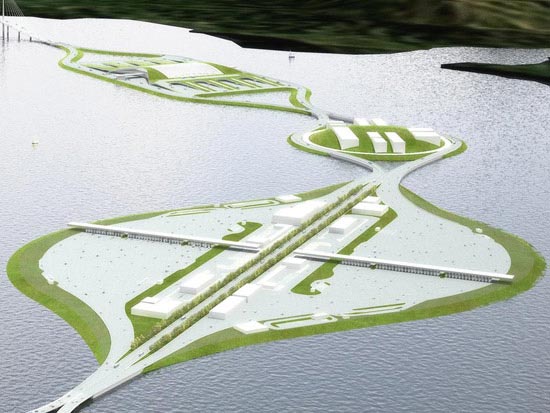
A proposal by Dutch designers, NL architects, could result in the construction of a far from ordinary bridge roadway connecting Hong Kong to the Chinese mainland, which would include artificial islands serving as car parks and bus stations.

Under the proposal, a “flipper” would be incorporated along the connecting roadway, allowing Hong Kong motorists – who drive on the left – to switch safely and effortlessly to the right, the side Chinese drivers use, and vice versa.
Originally published Wednesday 16 June 2010.
RELATED CONTENT
China, design, Hong Kong, legacy, travel
Farewell Concorde, we will miss you, but not your booming engines
24 October 2003
The supersonic aircraft is no more, after making one final, much hyped, flight.
While some people will find this ending of an era a little sad, others may see things somewhat differently. My aunt in London lives under one of the flight paths into Heathrow airport, and there was no missing the twice daily flights of Concorde.
The whole house literally shook as the aircraft prepared to touch down. This was no sonic boom though, just the engines operating normally. But after a few days of hearing Concorde approaching Heathrow, other aircraft noise seemed positively inaudible in comparison.
And here I refer to the likes of those massive, lumbering, Boeing 747’s…
Originally published Friday 24 October 2003, with subsequent revisions, updates to lapsed URLs, etc.
RELATED CONTENT