
Showing all posts about astronomy
Black hole stars, a weird cosmic entity and Soundgarden song
18 December 2022
Black hole stars, sometimes called quasi-stars, were a hypothetical star that may have existed in the earliest days of the universe, up to about half a billion years after the Big Bang.
They were larger — far larger — than any star known to be present in the universe today, and were capable of outshining entire galaxies. And, as the name suggests, they were part black hole. We know some stars become black holes at the end of their lives, but for the two to somehow co-exist, star and black hole, without one destroying the other? How can such a thing even happen?
In 1927, British-Indian scientist J. B. S. Haldane, in an essay titled Possible Worlds wrote the oft quoted sentence: “now, my own suspicion is that the universe is not only queerer than we suppose, but queerer than we can suppose.” It was Haldane’s way of saying we’re unlikely to ever make sense of the universe, no matter how much we learn about it. Black hole stars, in their bizarre weirdness, only add to the wonder.
And, as a bonus, American rock/grunge act Soundgarden’s 1994 track, Black Hole Sun, written by the late Chris Cornell, takes on a whole (er, no pun intended) new meaning in this context.
RELATED CONTENT
astronomy, music, science, video
Could flight of the bird propulsion power deep space travel
11 December 2022
It may be possible to construct deep space vessels capable of (eventually) reaching speeds equal to two percent of the speed of light:
Scientists have proposed a dazzling new mission to travel to the stars that is inspired by the elegant flights of seabirds, such as albatrosses, reports a new study. The interstellar concept mission would harness shifting winds generated by the Sun in order to accelerate a spacecraft to as much as 2 percent the speed of light within two years, allowing it to soar into the vast expanse beyond our solar system.
But two percent the speed of light, a velocity that would take some time to attain anyway, isn’t all that speedy considering the vast distances between celestial objects, such as the Sun, and the nearest star to us, Proxima Centauri.
If we round off the speed of light at 300,000 kilometres (km) per second, two percent of that is six thousand km per second. That’s 360,000 km per minute, and 21,600,000 km per hour. 518,400,000 km per day. If my maths is on spec — not always guaranteed — the journey to Proxima Centauri, some 40,208,000,000,000 km distant, would take 77,561 days, or about 213 years.
On the other hand, if Pluto is an average of 5,300,000,000 km from Earth — sometimes it is closer, sometimes more distant — it would take about ten days to travel there. Assuming such speeds could be attained at relatively close proximity to the Sun, that is. This method of deep space travel seems reasonable for reaching points in and near the solar system, but might be out of the question for interstellar voyages carrying people.
RELATED CONTENT
Alcyoneus a sixteen million light year long radio galaxy
4 December 2022
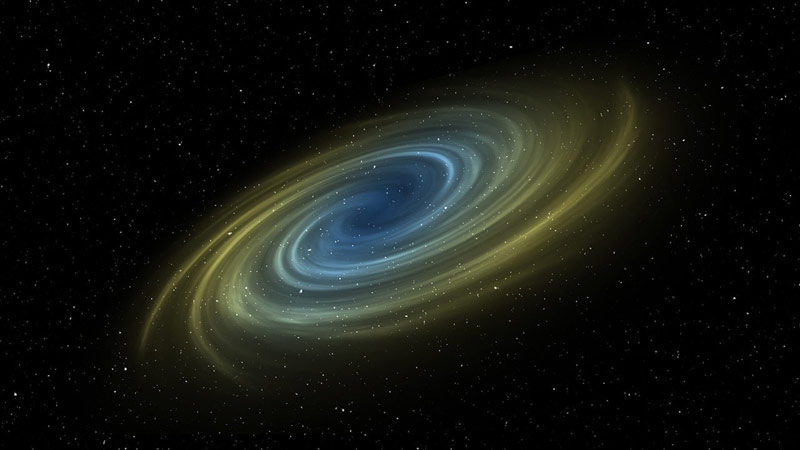
Image courtesy of A Owen.
Alcyoneus, a galaxy located some three and a half billion light years from Earth, at over sixteen million light years in length, is — without putting too fine a point on it — staggeringly huge. Our home galaxy, the Milky Way, at a mere one hundred thousand light years long, is positively minuscule in comparison.
But Alcyoneus isn’t a sixteen million light year long container of stars and whatever else fills a galaxy. Alcyoneus is what’s known as a radio galaxy, and the bulk of its length comes from radio lobes, which are a little like jets of radio energy, that fire out from opposite sides, into the surrounding space.
At its starry core Alcyoneus, which is likely an elliptical galaxy (unlike the image of the spiral type galaxy I’ve featured above), may not be all that much larger than the Milky Way. And that’s probably a relief for members of Alcyoneus’ galactic council, who only have to travel several hundred thousand light years to visit their constituents, rather than multiple millions.
If radio galaxies intrigue you though, Universe Guide has put together this explainer.
RELATED CONTENT
The Sun will not go supernova but it may still drive us away
25 November 2022
In five billion years, hopefully long after a, hopefully, still extant humanity have departed the solar system for a new home somewhere among the stars, the Sun will become a red giant star. In this late phase of its life, the Sun will expand in size to engulf all the solar system’s inner planets.
While this part of the Sun’s lifecycle will be relatively short-lived — some estimates suggest a mere one billion years — our home planet will have well and truly been obliterated, by the time the Sun shrinks in size again. Unless of course any of our descendants, who stayed home, succeeded in moving Earth further out into the solar system.
The idea has been mooted previously. Even before the Sun becomes a red giant, its gradually increasing heat output, or luminosity, will, in time, make living on Earth ever more uncomfortable.
Such as undertaking will be quite the feat of astronomical engineering. Being able to move the planet will be an achievement in itself, to say nothing of navigating to a suitable spot elsewhere, clear of the larger outer planets. But what happens when the Sun shrinks and cools off again? Do we try and send Earth sunwards again? Perhaps our efforts would be better served finding a Earth-twin planet to live on, orbiting a younger star. And, while we’re at it, figuring out a way of reaching said location in a reasonable timeframe.
At least it’s not something we need concern ourselves with right this minute though. Likewise, the prospect of the Sun exploding as a supernova. It’s something that cannot happen. But what about another star — one in the approximate proximity of the solar system — going supernova? That could be a whole another story.
That’s the question the people at Kurzgesagt explore this month, in their latest video presentation. Again the prospect of a relatively nearby star exploding is not something that will occur any time soon. At present, IK Pegasi, a binary star some one hundred and fifty four light years away, is the nearest possibility, though by the time it is projected to explode, it will be more like five hundred light years distant.
Still as Kurzgesagt explains, risks remain, and even supernovas occurring at some distance could have an impact, no matter how minor, on Earth.
RELATED CONTENT
Tune into the aftermath of the Big Bang on television
21 November 2022
If you’re still using an aerial (is that still a thing?) instead of cable (is that still a thing?) or internet, to watch TV, and — presumably — still possess an old school (think rabbit ears) TV, you may be able to pickup remnants of the Big Bang, the force of cosmic nature, that brought the universe into being.
Like COBE, WMAP scans the sky over and over again, soaking up the ancient light from the Big Bang known as the cosmic microwave background. Microwaves are a low-energy form of radiation but higher in energy than radio waves. The cosmic microwave background blankets the universe and is responsible for a sizeable amount of static on your television set–well, before the days of cable. Turn your television to an “in between” channel, and part of the static you’ll see is the afterglow of the big bang.
All you’d see is static, some of which may be post Big Bang microwaves bouncing around the cosmos, but it might be more interesting than some of what is broadcast on the terrestrial channels.
RELATED CONTENT
astronomy, history, science, technology
If the International Space Station orbited at 3000 metres
9 November 2022
What if the International Space Station orbited at a height of just three thousand metres? Benjamin Granville decided to find out. The answer to many “what-if” questions are often perfectly implausible, but some sure are worth asking. The scenario makes for quite the ride for those aboard the station…
RELATED CONTENT
DART helping to protect Earth from off planet threats
29 September 2022
It could be argued we’re not doing as much as we could to avert potential catastrophes on the planet. Climate change and global conflict would be two examples. When it comes countering possible threats from outside though, some progress is being made.
The test of an asteroid defence system, whereby a NASA probe was sent to collide with Dimorphos, a celestial object, to effect a change, albeit minor, in its trajectory, is one instance.
NASA did not send this probe to observe this asteroid or even scoop some samples from its surface to bring back to Earth, as other missions have done. The agency dispatched the spacecraft with the explicit hope of crashing it and changing the asteroid’s trajectory. This is a test run, but a future version of this mission could save Earth from a catastrophic impact by deflecting an asteroid on a collision course. A little bit of practice never hurts.
While Dimorphos does not pose a threat to Earth — at least not at the moment — another asteroid such as the one that brought about the demise of the dinosaurs, might in the future.
RELATED CONTENT
Sydney to host the 2025 International Astronautical Congress
26 September 2022
With a number of planets, particularly Jupiter, dominating the eastern night sky of Australia at the moment, what better time to make mention that the 2025 International Astronautical Congress (IAC) will be held in the NSW capital, Sydney.
Founded in 1951, the International Astronautical Federation (IAF) is the world’s leading space advocacy body with around 460 members in 72 countries, including all leading space agencies, companies, research institutions, universities, societies, associations, institutes and museums worldwide. The Federation advances knowledge about space, supporting the development and application of space assets by promoting global cooperation.
The last time Australia hosted an IAC event was in 2017, when the International Astronautical Federation conference took place in Adelaide, South Australia.
On the subject of astronomical matters, check out If the Moon were only one pixel, by American interactive art director and designer Josh Worth. Now we can see why they call it space…
RELATED CONTENT
astronomy, events, science, Sydney
UFO sightings surge in skies above Ukraine recently
16 September 2022
Astronomers in Ukraine have observed an uptick in unidentified flying objects over the country in recent months. While it seem obvious there would be more aerial activity with a war raging in the region, scientists are adamant what they’re seeing in Ukrainian skies are not military vessels.
Ukraine astronomers have reported a slew of UFOs observed in the country’s airspace. They’ve reported their findings in a preprint paper published by Kyiv’s Main Astronomical Observatory Ukraine’s National Academy of Science. Remember, UFOs don’t necessarily mean extraterrestrial spaceships from other planets. Perhaps they are advanced military aircraft from much closer to home, like even from one of Ukraine’s (ahem) neighbors.
All the more curious given recent reports from US Navy pilots who say they’ve seen unidentified flying objects during flight operations. Are unidentified flying objects drawn to areas where military craft are operating?
RELATED CONTENT
Video of a solar eclipse on Mars, Phobos occults the Sun
30 August 2022
Footage of a solar eclipse on Mars, filmed by NASA roving probe Curiosity. Eclipses on Mars are a little different to those we are treated to on Earth though, with the speed of the red planet’s “moontatoes” making the phenomenon more of a blink and you’ll miss it occasion.
Mars’ moons Phobos (“fear” in Ancient Greek) and Deimos (“dread”) circle Mars every 7.65 and 30.35 hours respectively, a relative blink compared to the 27-day orbit of Earth’s moon. They’re also a lot smaller than the Moon, and considerably more lumpy – little moontatoes, rather than the nice round disk we see shining so argently in our night sky.
It makes me think. If Pluto doesn’t make the grade as a “proper” planet, why should the so-called satellites of Mars be regarded as moons? Surely “captured objects” would be a more apt classification.
RELATED CONTENT