
Showing all posts about J. R. R. Tolkien
Stephen Colbert overshadows The Lord of the Rings Shadow of the Past sequel
31 March 2026
A sequel to New Zealand filmmaker Peter Jackson’s The Lord of the Rings movie trilogy, made between 2001 and 2003, is in the works.
Much of the interest in the story to date though has centred on Stephen Colbert, who is to be one of the screenwriters. Colbert will collaborate with Peter McGee, his son, and Philippa Boyens, co-writer of the earlier film trilogy screenplays.
Colbert is presently host of The Late Show, an American TV talk show, but his tenure concludes this May. It is said that participating in writing the screenplay is a dream come true for Colbert.
And while the point has been raised, not quite so much has been said about the source material for the proposed sequel, being several chapters — three to eight — from The Fellowship of the Ring.
The Fellowship of the Ring is the first of the three volumes in J.R.R. Tolkien’s The Lord of the Rings novel. In other words, the sequel to The Lord of the Rings films will be based on events occurring relatively early in the epic.
The new film, tentatively titled Shadow of the Past, will be set about fourteen years after The Return of the King, the final part of the series. The story will reportedly see several characters recount some of the adventures of the departed Hobbit, Frodo Baggins.
There’s a clever way to contrive a sequel to story, where one doesn’t really exist. But Stephen Colbert is co-writing the screenplay. We shouldn’t be thinking about anything else.
Why though can we not write new stories all together, without the need to rehash and remix, ones that have already been told? Of course we know. The Lord of the Rings, along with the likes of Star Trek, and Star Wars, have captive audiences who can’t get enough of these stories.
The thing is Star Trek and Star Wars are set in large universes (galaxies) where there is latitude — within some degree of reason — for storylines to unfold in numerous directions.
The Lord of the Rings is something else though, and the story seems complete with the existing novels. Even Tolkien was against the idea, having tried to write a sequel himself, but later abandoning the attempt. Why can we not defer to Tolkien’s judgement in this regard?
RELATED CONTENT
film, film production, J. R. R. Tolkien, Peter Jackson, trends
First edition of The Hobbit by J R R Tolkien sells for £10000
14 July 2023
News articles mentioning first edition publications of well-known books have been featuring in the news feeds I read recently, and here’s another one.
This time, a first edition copy of The Hobbit, the 1937 novel written by J. R. R. Tolkien, sold for ten-thousand British pounds on eBay last year, after being donated to a charity shop in Dundee, a city in Scotland. The book had been sitting in a back room at the shop, and despite being well looked after, the store manager was at first doubtful it could be offered for sale.
The price realised is not the highest figure a first edition copy of The Hobbit has fetched in an auction sale before, but it says a lot about what might be quietly lurking on the shelves of charity shops.
RELATED CONTENT
books, J. R. R. Tolkien, literature
Trailer for The Lord of the Rings: The Rings of Power
18 July 2022
A teaser/trailer for the upcoming Amazon produced TV series The Lord of the Rings: The Rings of Power. Although a continuation of The Hobbit and The Lord of the Rings stories, written by late British author J. R. R. Tolkien, which are set during the Third Age of Middle-earth, events of The Rings of Power take place thousands of years earlier, in the Second Age.
[The Rings of Power] begins during a time of relative peace and covers all the major events of Middle-earth’s Second Age: the forging of the Rings of Power, the rise of the Dark Lord Sauron, the fall of the island kingdom of Númenor, and the last alliance between Elves and Men.
While Tolkien didn’t write specifically about the Second Age, the series is based on mentions of the era featured in the appendices of The Lord of the Rings. And unlike Tolkien’s vision of the Second Age which spanned thousands of years, The Rings of Power will play out over a far shorter timeframe.
The biggest deviation the writers made from Tolkien’s works, which was approved by the estate and lore experts, was to condense these events from taking place over thousands of years into a short time period. This was to avoid the human characters frequently dying throughout the series due to their relatively short lifespans, and to allow major characters from later in the timeline to be introduced earlier in the series.
The first series of The Rings of Power goes to air on Friday 2 September 2022.
RELATED CONTENT
J. R. R. Tolkien, trailer, video
The Fall of Númenor, Middle-earth’s Second Age explored
28 June 2022
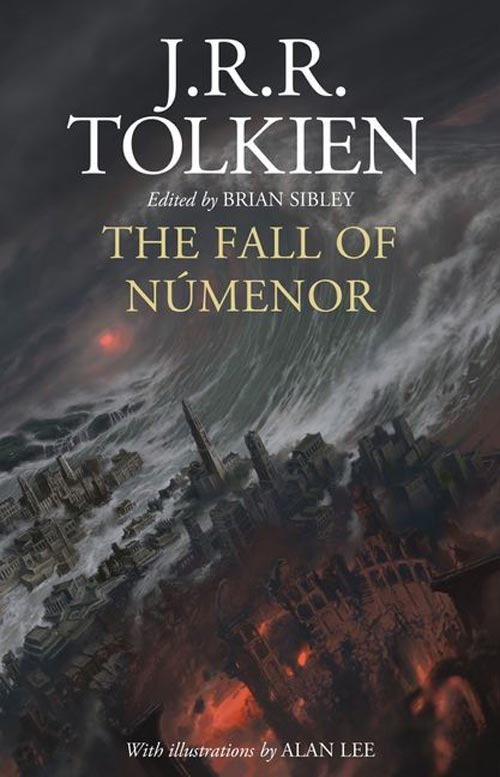
The Fall of Númenor (published by HarperCollins on 10 November 2022), edited by English writer Brian Sibley, explores the Second Age of Middle-earth, based on what J.R.R. Tolkien — author of the The Lord of the Rings, which, incidentally, is set in the Third Age — wrote of the era.
It was not until Christopher Tolkien published The Silmarillion after his father’s death that a fuller story could be told. Although much of the book’s content concerned the First Age of Middle-earth, there were at its close two key works that revealed the tumultuous events concerning the rise and fall of the island of Númenor. Raised out of the Great Sea and gifted to the Men of Middle-earth as a reward for aiding the angelic Valar and the Elves in the defeat and capture of the Dark Lord Morgoth, the kingdom became a seat of influence and wealth; but as the Númenóreans’ power increased, the seed of their downfall would inevitably be sown, culminating in the Last Alliance of Elves and Men.
RELATED CONTENT
J. R. R. Tolkien, literature, writing
The Tolkien Estate, a repository of J. R. R. Tolkien’s work
23 March 2022
The Tolkien Estate looks to be the ultimate resource of the work and life of British author, poet, and academic J. R. R. Tolkien, writer of The Lord of the Rings, and other works. It’s incredible to think — given the depth and scope of his writing output — that Tolkien worked mainly as a teacher at Oxford University, instead of a full time author.
RELATED CONTENT
J. R. R. Tolkien, literature, writing