
Showing all posts about novels
Sci-fi and fantasy novels with disabled characters
11 December 2021
Kit Kavanagh-Ryan, a presenter of The Book Show, has put together a selection of five science fiction and/or fantasy novels featuring central characters who are disabled.
Sometimes, however, speculative fiction creates a space where readers and writers get to imagine ‘crip futures’ in our fiction: spaces real or imagined where we question our idea of what ‘normal’ bodies and minds look like – what normal means at all.
Maybe it’s the sort of novels I read, titles usually found on literary award shortlists, but now that I think about it, few of them include people with disabilities.
RELATED CONTENT
Good Weekend’s Christmas reading guide 2021
8 December 2021
I’m sure we’re going to be seeing a few of this lists over the next few weeks, but the 2021 reading guide from Good Weekend, contains some choice titles, fiction and non-fiction.
RELATED CONTENT
Australia’s lending rights scheme needs to recognise ebooks
6 December 2021
In Australia, when you borrow a print novel from a library, the author is eligible to receive a small payment, as a compensation for missed book sales. Surprisingly though, if you loan one of their titles through a library ebook service, such as Libby, writers are not recompensed. This is because Australia’s lending rights scheme does not – yet – recognise electronic books and audiobooks, despite – in some cases – an eighty percent increase in ebook lending in recent years. It is a situation Olivia Lanchester, CEO of the Australian Society of Authors, says needs to be rectified.
“If it only remains applicable to the print world, and libraries are increasingly reducing their print collection, then over time our fear is that the payments will go to fewer and fewer Australian authors,” Lanchester said. “We want it to be a broad-based scheme that really captures everyone whose books are being read via libraries.”
RELATED CONTENT
Books men should read
2 December 2021
Seven books to buy for men in your life, by Sheree at Keeping Up With The Penguins. Unlike similarly titled lists you may see published by book-sellers at certain times of the year, this is one you want to look at.
So, why on earth am I making a list of books to buy for men? Well, I’ve noticed that people do actually pay attention to these recommendations, and the “books to buy for men” page is almost always almost exclusively populated with books written by men. What about the books by women, the ones that might “normally” find a large audience of women, but would actually really benefit cis-men?
I could probably say more about the matter of why the “for him” recommendations issued by book-sellers, are filled with titles by men, about men, when there’s a stack of awesome novels written by women they could also be reading. If the question is asked enough though, perhaps more people will think about it.
RELATED CONTENT
Sarah Winman’s Still Life wins Dymocks Book of the Year award
1 December 2021
Some late news to hand… Still Life by London based British author Sarah Winman, was recently named winner of the Dymocks 2021 Book of the Year. Still Life is averaging a tad over four stars in reader ratings on Goodreads, which means the title should be on your to-be-read list.
RELATED CONTENT
Are fiction readers ready for novels about the Covid pandemic?
30 November 2021
Fiction writers were always going to incorporate the current Covid pandemic into their work at some stage, and possibly some may have wondered when exactly that would be appropriate. Given there is doubt as to whether the virus will ever completely disappear though, many writers have decided waiting for a “better time” is futile, if a look at new and recent publications is anything to go by.
But Lara Feigel, writing for The Guardian, questions whether readers are ready to see pandemic-related plots featuring in the work of their favourite authors.
When lockdown hit last March, some writers offered their services as delivery drivers or volunteered at Covid test centres. Others attempted to make progress with preexisting projects, blanking out the new world careering into being in front of them. But nothing written in the past 18 months can be entirely free of Covid, with its stark blend of stasis and fear. And now, as we see the work made by writers who confronted it head on, questions emerge. Do we really want to read about the pandemic while it is still unfolding? Do we risk losing sight of the long view in getting too caught up with the contemporary?
For my part, I think it’s going to come down the tastes of different readers, and their personal experiences of Covid. The pandemic is prominent in a number of novels I’ve written about in the last couple of months, including Wish You Were Here, by Jodi Picoult, The Black Dress, by Deborah Moggach, and The Sentence, by Louise Erdrich, while Covid — in the form of another viral outbreak — is alluded to in The Quiet at the End of the World, by Lauren James, Scary Monsters, by Michelle de Kretser, and The Animals in That Country, by Laura Jean McKay.
RELATED CONTENT
Three new e-readers from Kobo and Kindle reviewed
30 November 2021
Reviews of three brand new e-readers by Jason Snell at Six Colors, for anyone considering upgrading their current reader.
But change is coming to the e-reader world this fall, in the form of three brand-new readers. From upstart challenger Rakuten Kobo come the Kobo Sage and the Kobo Libra 2. And from the big dog, Amazon, comes the 11th-generation Kindle Paperwhite.
The Australia Reads 2021 National Reading Survey, which I wrote about yesterday, indicates up to two-thirds of Australian book readers peruse e-books to some degree. Currently about half the novels I read are e-books, though at the moment I’m still mainly using my smartphone rather than a reader.
RELATED CONTENT
Results of the Australia Reads 2021 National Reading Survey
29 November 2021
According to the recently published findings of Australia Reads 2021 National Reading Survey, one in four Australians did not engage with a book, either by reading or listening to one, in the eighteen months to June 2021. So much for thinking people would leap at the chance to read more, given many have had lockdown enforced downtime on their hands recently. I know I would’ve if I’d not been required to pretty much work continually throughout the most recent lockdown.
But 64% of respondents found the lure of movies and television too tempting, while 46% of people said perusing social media, and browsing the internet took up much of their time. Of the some three-thousand survey participants, about a third were general readers, being the proverbial average person on the street, while the remainder were considered to be “engaged” readers, generally being people subscribed to news updates from publishing houses, and who no doubt can be found on Bookstagram.
I’m not sure if three-thousand or so people makes for a particularly representative sample, but the findings are nonetheless fascinating reading. A few items caught my eye as I looked through the data. For instance:
- 38% of Australians think they read more books during the pandemic, versus 53% who didn’t. 9% thought they read less.
- Of engaged readers, 37% are considered to be obsessed readers, typically reading at least one book per week.
- Many “obsessed readers” have numerous book in their TBR stack, and read two or three titles simultaneously.
- 52% of respondents have never listened to an audio book.
- 54% of Australians give up on (DNF) a book if they don’t quickly become interested in it.
- 43% prefer a book recommendation from family and friends, while…
- … less than 12% of respondents trust recommendations via social media.
- And, 3% of Australians think they spend too much time reading.
Encouragingly though, becoming a regular reader, for all the associated benefits, isn’t too difficult. If a person were to read for ten minutes a day, assuming a rate of three-hundred words per minute, that would equate to ninety-thousand words (the average novel’s word-count) a month, or twelve titles a year.
RELATED CONTENT
Who is M in The Shut Ins by Katherine Brabon?
25 November 2021
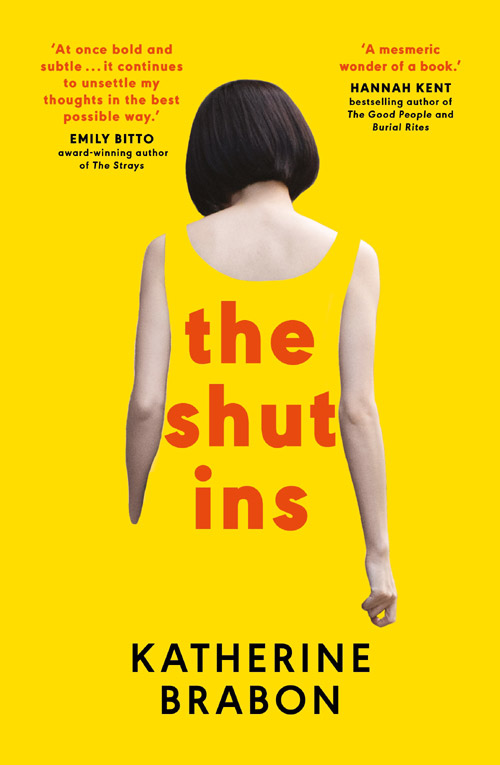
NOTE: this article is choke full of SPOILERS for The Shut Ins by Katherine Brabon. If you haven’t read the novel, bookmark this page and come back when you have.
The Shut Ins is the second novel by Melbourne based Australian author Katherine Brabon, following up her 2016 Vogel Award winning debut, The Memory Artist. Mainly set several years ago in Japan, The Shut Ins recounts five people’s varying experiences of hikikomori, a Japanese term used to describe those who, for whatever reason, feel compelled to cut off all contact with the outside world, and confine themselves to their room. Sometimes they stay locked away for years before leaving their self-imposed internment.
Through the thoughts of five characters, Brabon takes us into one person’s hikikomori journey, a man in his late twenties, called Hikaru Sato, who has stayed in a room at his parent’s apartment for three years. We first learn of Hikaru’s story through Mai Takeda, an old classmate of his, who one evening after work runs into his mother, Hiromi Sato, ten years after Mai last saw him at high school. Long story short, Hiromi asks for Mai’s help in persuading Hikaru to leave his room. But Mai has problems of her own.
She recently married a conservative salaryman, known only as J, who expects her to give up working and start a family with him. When we meet Mai, she is anything but enthusiast about the prospect, and seems, if anything, to have a closer emotional bond to the reclusive Hikaru, whom she hasn’t seen or spoken to in a decade. In addition to Mai’s perspective, we hear from Sadako, a young woman working in Tokyo as a hostess, who entertains J – presumably without Mai’s direct knowledge – while he’s on week-long business trips to the Japanese capital.
The stories of Hiromi, and in the third act, her son Hikaru, are also explored, along with the thoughts of an unnamed Australian woman, who is travelling alone in Japan, and is interested in hikikomori. But perhaps the most intriguing character in the book, is one we don’t meet, a woman known only as M. The Australian traveller, who I’ll refer to as the Narrator, said she and M, who is Japanese, lived in the same share house, while they were studying at a university in Melbourne. But who is M, and why is she referred to only by the letter M? Is M a pseudonym for Mai, Mai Takeda? It’s tempting to think so for several reasons.
Mai’s name starts with the letter m, while the Narrator refers to her friend as M. How obvious. We also know Mai went missing at some point in 2014. Meanwhile the Narrator – who may or may not be an alter-ego of Brabon’s – writes that M, who becomes known to us through the Narrator’s notes, “no longer lives in Japan.” But unlike the stories of Mai, Hikaru, Hiromi, and Sadako, which are dated during 2014, we don’t know when the Narrator penned her notes. It may have been several years later. To illustrate this point, an ABC article tells us Brabon visited Japan in 2014, and 2017, while The Shut Ins was published in 2021.
It’s reasonable then to believe Mai made her way to Australia, as she created a new life for herself, and spent several years studying there. We later hear that M left Australia, and was working as a translator in Malta. She certainly didn’t seem keen to return to Japan. But there are other clues. At the time M and the Narrator were flatmates, we learn M had recently left a relationship. Could that be Mai’s marriage to J? M told the Narrator she had, until arriving in Melbourne, only seen herself through the “mirror” of other people.
Could this have been a reference to the expectations Mai’s family, and J, had placed on her? To marry – before she was “too old” – and have children. The Narrator also makes the comment that M’s long dark hair touched her elbows. We were also told Mai’s hair had been equally as long, when she was at high school. There really seems to be little doubt. M is Mai. And after reading about her somewhat cloistered life in Japan, we’re left hoping Mai did escape, and make a new start. But it’s not that straightforward.
In an interview at Theresa Smith Writes, Brabon said she has a friend called Mio who lives in the Japanese city of Shizuoka. In her notes, the Narrator tells us she stayed with M’s parents in Shizuoka. Mai, however, and her parents, lived in Nagoya, although Mai was born in the Gifu Prefecture. But it is possible Mai’s parents later moved to Shizuoka. What’s not so plausible perhaps is their “forgiving” Mai for leaving her marriage to J, something they had expected of her, to say nothing of her skipping the country to live as she chose.
Does it then seem likely her parents would go so far as to accommodate a friend of hers, such as the Narrator, who they may have viewed as aiding Mai in achieving her ambitions? At this point M and Mai are beginning to look like quite different people. But what then of M’s unnamed Japanese male friend, whom she suggested the Narrator meet whilst in Japan, as he could tell her more about achiragawa, a term meaning “the other side”. Achiragawa may be a place, one safer than their present environment perhaps, that hikikomori, in a sense, aspire to reach.
Could M’s male friend be Hikaru? If anyone could talk about achiragawa, that would surely be Hikaru. The male friend, who now lives in America (the other side?), happened to be visiting Japan at the same time the Narrator was there. We learned Hikaru liked America, it was one of the few topics he discussed with Mai, while they were at high school together. In emails to the Narrator, M’s male friend spoke of his “long new life” in America. This suggests the existence a previous “old” life, perhaps one he wanted to distance himself from.
But if the male friend is Hikaru, and M isn’t Mai, how does she know about Hikaru? Could that connection be through M’s mother, who was a social worker? Possibly her mother’s work involved helping rehabilitate shut-in people like Hikaru, after they decide to return to a more normal life. While M’s parents resided in Shizuoka, and Hikaru lived in Nagoya, it is possible M’s mother travelled to Nagoya for work, or it might be Hikaru stayed in a facility in Shizuoka after leaving, or more to the point, being removed from his room.
The Narrator also tells us “I was in Japan, alone, when the story of Mai Takeda came to me.” That also would suggest M and Mai are different people, but not necessarily. It could be M spoke more about her past life once the Narrator landed in Japan, since she was potentially meeting Hikaru. But in the end, we’re left with a satisfying mystery as to whether M is Mai, and M’s male friend is Hikaru. The Narrator and the male friend had planned to meet each other, but at the last minute, literally as she was approaching the appointed meeting place, the Narrator decided not to go ahead.
She had alluded to a reluctance to meet face to face, having become comfortable with her more anonymous, though in-depth, email correspondence, with M’s male friend. It is also a savvy outcome on Brabon’s part. Because the in-person meeting doesn’t proceed, we do not establish that M’s male friend is actually Hikaru, nor by extension do we ascertain that M is Mai. This looks to be a question we will continue wondering about.
RELATED CONTENT
books, Katherine Brabon, novels
One hundred Notable Books of 2021
24 November 2021
One hundred Notable Books of 2021, compiled by The New York Times. Quite a few titles I recognise, many I don’t. Be nice to see more Australian work making the cut, particularly in the fiction segment, but overall an impressive list of books, spanning fiction, non-fiction, poetry, and memoir categories.
RELATED CONTENT