
Showing all posts about writing
The Animals in That Country, by Laura Jean McKay
7 October 2021
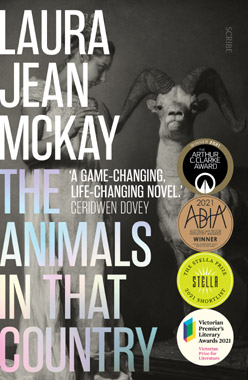
A flu of pandemic proportions is sweeping the country, and there seems to be little humanity can do to quell it, try as we might. That’s the somewhat familiar premise of The Animals in That Country (published by Scribe Publications, March 2020), the debut novel of New Zealand based Australian writer Laura Jean McKay.
But this disease had an odd symptom: those who become infected are possessed of the ability to understand the languages of animals. While having a conversation with their pets is probably something many people would cherish, that’s not quite the way this flu works. The infected become privy to the thoughts of every last creature. And for some people the result is an unbearable form of information overload. They die a slow death by madness, from an avalanche of once mute voices.
For straight-talking grandmother Jean, who works in a remote Australian wildlife park, the illness is a blessing in disguise. With the exception of Kimberly, her granddaughter, she much prefers the company of animals anyway. But when Lee, her son, leaves with Kimberly, in a bid to escape the outbreak, Jean, accompanied by a dingo named Sue, sees little choice but to go in search of them.
RELATED CONTENT
fiction, Laura Jean McKay, TBR list, writing
The Midnight Library, by Matt Haig
6 October 2021
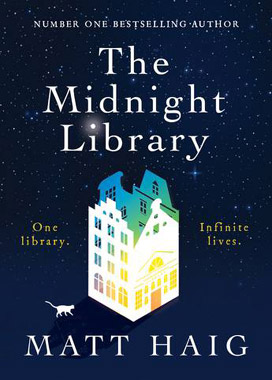
If we live in an infinite universe, or an infinite collection of universes, then all things are possible. There may be alternate versions of you and me, somewhere out there, living lives completely different to the ones we recognise as our present reality. Relative to this universe, that is.
The Midnight Library (published by Allen & Unwin, September 2020), the seventh novel of British author Matt Haig concerns itself with similar themes. In the absence, perhaps, of a multiverse, there is the Midnight Library. It is a place located on the edge of our universe, containing an infinite number of books.
One book is an account of the life you currently lead. Then there is another title, where you can read how your life might be, had you made different choices. It is to this far-flung story repository that Nora, a troubled young woman comes to, after she attempts to end her life. Nora has the chance to read the many stories her life could have been, had she decided to do something else.
Through these books, Nora goes on a tour of her mistakes and regrets, and sees where she went wrong. We all know the drill. Should I have taken the other job? Married someone else instead? It’s a charming, enviable, premise. To be able to undo all those bad decisions, and do the “right” thing. If only it were that simple. But if such a notion does appeal to you, maybe The Midnight Library will too.
RELATED CONTENT
fiction, Matt Haig, TBR list, writing
Miles Franklin Literary Award, 2022
6 October 2021
Good morning. Submissions for the 2022 Miles Franklin Literary Award opened yesterday. Writers, please submit your work ASAP as my to-be-read list, already made up of who knows many dozens of titles, isn’t long enough. Thank you.
RELATED CONTENT
Australian literature, writing
Postcards From Abroad, video conversations with writers
5 October 2021
The borders may be closed, but postcards can still get through… tune into Postcards From Abroad, a series of video conversations with well-known authors from across the world, hosted by the Wheeler Centre. From this evening you’ll be able to tune-in to California based American writer Jonathan Franzen for the next week.
RELATED CONTENT
Homegoing, by Yaa Gyasi
5 October 2021
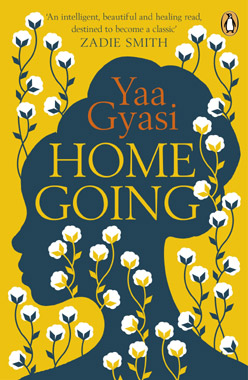
Homegoing (published by Penguin Books Australia, June 2017), by Brooklyn, New York based Ghanaian-American writer Yaa Gyasi, is a story spanning seven generations and two continents. In the eighteenth century Effia marries an Englishman, and they move into his Cape Coast mansion in Ghana.
Unbeknownst to Effia, her half-sister Esi, who was born in another village in Ghana, is being held captive in the cells below the house, waiting to be sold into slavery. Esi is later sent to a plantation in America. As time moves forward, the stories of both branches of the family are explored through the descendants of Effia and Esi.
Effia’s side of the family contends with long-running wars in Ghana, while Esi’s children and descendants manage to escape slavery, eventually making their way into the jazz clubs of twentieth century Harlem. The violence, hardships, and racism that both sides of the family confront are narrated by Effia and Esi, and six descendants of each.
Despite spanning several centuries, and being seen through the eyes of fourteen different people, Homegoing weighs in at a none too hefty three hundred and twenty pages. It is a brilliance that has seen the book nominated for a slew of literary awards, including the American Book Award, and the International Dublin Literary Award.
RELATED CONTENT
fiction, TBR list, writing, Yaa Gyasi
Ghosts, by Dolly Alderton
1 October 2021
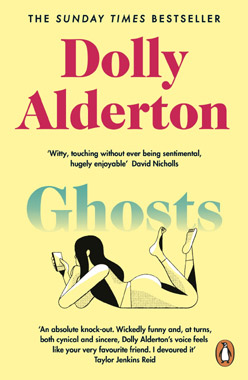
When I first heard the term ghosting, almost ten years ago, it referred to leaving social gatherings without saying goodbye to anyone present, even the host. A person might mutter they were going outside to make a “quick phone call” as a pretext for leaving the room, and bang, they were gone. While ghosting’s context is wider today, it is most commonly applied to situations where someone abruptly ends an intimate relationship, without warning or explanation.
It is a phenomenon that strikes thirty-something Nina, a successful food writer, with everything going for her, in Ghosts (published by Penguin Books Australia, July 2021), the second book by London based journalist and author Dolly Alderton. While her friends are marrying and settling down with families, single Nina feels left behind until she meets Max, the man who seemingly has it all, and wants – so he says – to make a life with her.
But minutes after declaring their love for each other, Max vanishes without a trace. He doesn’t offer a goodbye, nor any reason for breaking off the relationship. But when Nina goes looking for support from her friends and family, no-one’s there. Her friends are distracted by their children, her mother is busy making a new life for herself, while her father is tragically slipping into the mist of dementia.
RELATED CONTENT
Dolly Alderton, fiction, TBR list, writing
The Midnight Watch, by David Dyer
30 September 2021
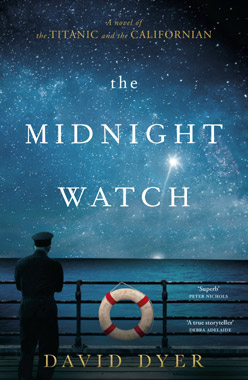
The tragic 1912 sinking of the RMS Titanic has intrigued and fascinated me for as long as I can remember. At age ten or eleven I found a battered copy of the late Clive Cussler’s 1976 novel Raise the Titanic!, in a box of books left out on the street, and then a short time later saw the 1953 film of the vessel’s sinking, although all I recall of that now is its haunting ending.
While it’s been sometime since I watched or read anything Titanic related, The Midnight Watch (published by Penguin Books Australia, February 2017), by Sydney based Australian former ship’s officer, and lawyer, turned teacher and writer David Dyer, recently caught my eye. The story is a fictionalised recounting of events on board the SS Californian, one of the ships in the vicinity of the ill-fated Titanic as it was sinking.
While the captain and senior officers of the Californian were aware the Titanic was in distress – it fired numerous distress flares into the night – they chose to keep their distance, even though they were close enough to see the stricken vessel. Why the Californian stayed put is a question The Midnight Watch attempts to resolve, and it is difficult not to wonder how many lives might have been saved had it rendered assistance.
RELATED CONTENT
David Dyer, fiction, TBR list, Titanic, writing
The Ghostlights, by Gráinne Murphy
29 September 2021
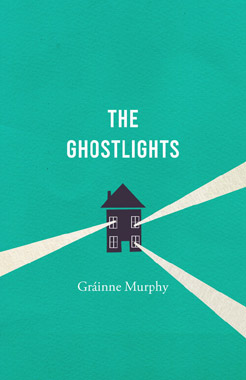
Life can become routine and monotonous. The day-in and the day-out. Often it happens gradually, creeps up from behind, you’re simply too busy to notice. You settle into a pattern, kid yourself you’re content, and believe it. It’s called getting into the zone; the comfort zone. And there you might stay, until something comes along and shakes you out of your self-induced stupor.
Ethel owns a guesthouse in rural Ireland, but leaves its management to Liv, one of her daughters, in The Ghostlights (published by Legend Press, September 2021), the second novel by Cork based Irish writer Gráinne Murphy. Meanwhile her other daughter, Marianne, who is disillusioned with life, returns from Dublin, for some time out. Her homecoming coincides with the arrival of a guest, a man named Fred.
A few days later, Fred is found drowned in a nearby pond, his death a suicide. The tragedy brings the local community together, but the demise of the elderly guest takes a toll on Ethel, Liv, and Marianne. While their neighbours mourn Fred’s passing, the three women find themselves pondering their relationships, their place in the scheme of things, some poor life decisions, and just where it is that they are going.
RELATED CONTENT
fiction, Grainne Murphy, TBR list, writing
How many banned books have you read? More than you think
28 September 2021
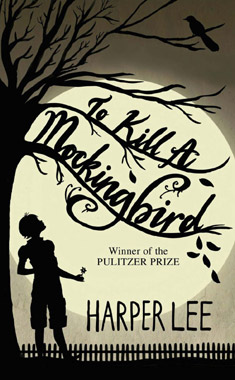
Lock the doors, lower the blinds, switch off your phone, we’re flying below the radar now. All because it’s Banned Books Week, and, well, who wants to be caught in possession of literary contraband? Not that I thought for a second I might be violating statutes by reading Harper Lee’s To Kill a Mockingbird, or The Handmaid’s Tale, by Margaret Atwood.
Attempts to keep To Kill a Mockingbird out of circulation didn’t surprise me. I expect in 1960, when first published, it may have offended some sensibilities, but efforts to prohibit the title are far more recent. The Handmaid’s Tale, meanwhile, has likewise been challenged or banned since its release in 1985, for content deemed to be vulgar, violent, and sexually explicit.
Other books to receive similar treatment include The Adventures of Huckleberry Finn by Mark Twain, The Catcher in the Rye, by J.D. Salinger, The Color Purple, by Alice Walker, and, yes, even Fear and Loathing in Las Vegas, by Hunter S. Thompson. Yet I read each blissfully ignorant of the controversy they once stirred up, or still are. For that, I’m eternally thankful to live in the time and place I do.
Update: for the daring: banned book bingo by Keeping Up With The Penguins.
RELATED CONTENT
She Drives Me Crazy, by Kelly Quindlen
28 September 2021
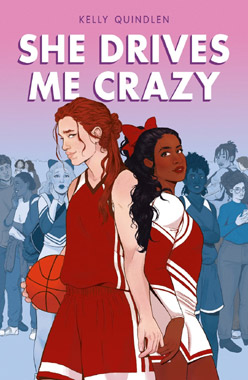
American young adult author Kelly Quindlen knew she wanted to write from the age of six. In comparison, I was a late bloomer. My English teacher in my final year of high school told me he thought my essays were a notch or two above the rest of the class, and suggested I consider a career involving writing. Maybe you could call the Oblong Obsession project another step towards that aspiration.
Maybe then it’s apt I’m writing today about She Drives Me Crazy (published by Roaring Brook Press/Macmillan, April 2021). Quindlen’s third novel is framed around two high-schoolers, Scottie and Irene, who begin fake dating despite barely liking each other. But Scottie is desperate to get back at her toxic ex-girlfriend, Tally, and being seen at the beautiful Irene’s side is the perfect way to bring this about.
Meanwhile, the cash-strapped Irene is happy to take money from Scottie to go along with the charade. But as can happen when apparent polar opposites, with a disdain for each other, are pushed together, the pair begin to develop feelings for each other. But will that be enough? Can Scottie get over Tally? The road is never smooth though, as was the case for the rom-com stories of the 1980s and 90s, which She Drives Me Crazy pays homage to.
RELATED CONTENT