
Showing all posts about Aaron Sorkin
AI, absence of Eisenberg, Fincher, see The Social Reckoning flop
16 October 2026
Brent Lang writing for IndieWire:
With only one member of its creative team returning, Sony Pictures shied away from selling it as a sequel, but the studio still sprinkled bits of “The Social Network’s” DNA into promotional materials.
The Social Reckoning, directed by Aaron Sorking, a continuation of sorts of 2010’s The Social Network, is poorer, it seems, for the absence of David Fincher, and Jesse Eisenberg. Fincher’s obligations to Netflix kept him away, while Eisenberg, among other things, didn’t want to repeat himself.
Recent controversies surrounding AI, the Hugging Face hack, and claims the technology could result in humanity’s extinction, have also apparently proved to be significant distractions.
You can’t do anything without AI somehow meddling. Despite The Social Reckoning not doing too well at the box office, I’d still like to see it, though that will probably be by streaming.
RELATED CONTENT
Aaron Sorkin, David Fincher, Facebook, film, Jesse Eisenberg, social networks
Trailer for The Social Reckoning, the bleak follow-up to The Social Network
31 August 2026
A trailer for The Social Reckoning, directed by Aaron Sorkin, which opens in Australian cinemas on Thursday 8 October 2026, and follows-up 2010’s The Social Network, which Sorkin co-wrote.
As I wrote a few months ago, The Social Reckoning is a far darker continuation of the Facebook story. That said, hints of what were to come, namely co-founder Mark Zuckerberg’s megalomaniac tendencies, were seeping through in The Social Network.
In this instalment, Jeremy Strong, instead of Jesse Eisenberg, portrays the Meta CEO, and does so with a callous, robotic demeanour, as if Zuckerberg were no more than an AI entity of Meta’s making.
If recent headlines featuring Meta haven’t already, The Social Reckoning may well turn a few people away from Facebook, and social media generally. This would be no bad thing.
RELATED CONTENT
Aaron Sorkin, Facebook, film, Jeremy Strong, social networks, trailers
Teaser for The Social Reckoning, a film by Aaron Sorkin, follow-up to The Social Network
12 June 2026
Although hints of what was to come were there to see, The Social Network, the 2010 dramatisation of the founding of Facebook, had the hallmarks of a feel-good story.
At least from the perspective of would-be entrepreneurs, whose next-big-thing idea, had, against the odds (of course), become the next-big-thing.A lot has happened in sixteen years though, and there’s not much left in the Facebook story for many people to feel good about today.
Aaron Sorkin, who co-wrote the screenplay for the David Fincher directed 2010 feature, has tapped into the darkness pervading the world’s largest social network, to write and direct a follow-up to the 2010 film, titled The Social Reckoning.
Sorkin initially floated the idea of a sequel in 2024. At that point the American playwright and screenwriter sought to cast a critical light on the part he felt Facebook played in the January 6 insurrection of 2021, in the United States.
But Sorkin’s focus has changed. In The Social Reckoning the negative impact on users mental health is among subject matter explored. As is co-founder and CEO Mark Zuckerberg’s seeming dictatorial style of management.
Darkness permeates the teaser/trailer. Gloom is banished, but only momentarily, by the glare of bright spotlights shining in our faces. There are no frat-house parties, or swimming pool high-jinks, in this chapter of the social network’s story. This is a bleak world indeed we now find ourselves in.
RELATED CONTENT
Aaron Sorkin, David Fincher, Facebook, film, social networks
Were David Fincher and Aaron Sorkin right about Mark Zuckerberg in The Social Network?
12 February 2025
American actor Jesse Eisenberg played Meta/Facebook co-founder Mark Zuckerberg in The Social Network, David Fincher’s 2010 dramatisation about the founding of Facebook. The screenplay, written by Aaron Sorkin, was based on Ben Mezrich’s 2009 book, The Accidental Billionaires.
Despite being part fiction, Zuckerberg was not impressed with his portrayal, saying Fincher and Sorkin were only accurate with his wardrobe. Think the hoodie, and those fuck you flip-flops.
For those who have not seen The Social Network, the now Meta CEO comes across as a brash, arrogant individual, who has virtually no regard for authority, and little respect for anyone other than himself. Particularly women, and the people he called friends. But Zuckerberg’s upset was understandable; few people would relish being presented in such a light.
Perhaps Fincher and Sorkin recognised that by way of one of the final lines in the film, delivered by Marylin Delpy (Rashida Jones), a lawyer acting for Zuckerberg, who said: “You’re not an asshole Mark, but you’re trying so hard to be one.” In other words, Fincher and Sorkin were trying to give a young Zuckerberg — as someone who’d become a little too obsessed with his ambitions for the the fledgling social network — the benefit of the doubt.
Some of Zuckerberg’s recent actions however may have removed any doubts. Revising Meta’s fact checking and content moderation policies, and scaling back the company’s diversity, equity, and inclusion (DEI) recruiting programs, among them. Some people may be thinking Fincher and Sorkin had nailed Zuckerberg’s character from the get go.
Even Eisenberg, whose portrayal of Zuckerberg was, I thought, pure class, seems to be of the same opinion. Speaking recently, while promoting his new film, A Real Pain, Eisenberg said he didn’t want to be thought of as being associated with the Meta CEO:
These people have billions upon billions of dollars, like more money than any human person has ever amassed and what are they doing with it? Oh, they’re doing it to curry favour with somebody who’s preaching hate. That’s what I think… not as like a person who played in a movie. I think of it as somebody who is married to a woman who teaches disability justice in New York and lives for her students are going to get a little harder this year.
RELATED CONTENT
Aaron Sorkin, current affairs, David Fincher, film, Jesse Eisenberg, social networks
Aaron Sorkin penning a sequel to The Social Network in response to January 6
3 May 2024
I squeezed in two screenings of The Social Network — the 2010 film by David Fincher and Aaron Sorkin, dramatising the founding of Facebook — on the day it was released in Australia. I went up to the local cinema the morning it opened, so I could write about it here, then returned to the same cinema for an evening viewing.
Don’t get me wrong here, I’m no fan of Facebook itself, but various trailers, and the pre-opening hype, had me excited. Facebook was once a start-up, a small business, and the dramatisation of the early days promised to be a doozy. The movie sits in my home library now, and I still look forward to rolling it out once or twice a year.
Even today, I still wait in anticipation for the night-club scene, where Justin Timberlake’s character Sean Parker, utters the line this is our time. The track playing during the scene, Sound Of Violence, by Dennis De Laat, is still on my Spotify favourites playlist.
There’s no two ways: I’m a fan of The Social Network.
And news the other day that the film’s co-screenwriter Aaron Sorkin, was penning a sequel, saw me getting euphoric all over again. But I suspect the sequel, of “some kind”, will strike a far more sombre tone than the original. This because Sorkin believes Facebook played some part in the 2021, January 6 insurrection, in the United States:
Sorkin would not answer why he blamed Facebook for Trump supporters storming the U.S. Capitol, but he teased: “You’re going to need to buy a movie ticket.” “I’m trying [to write a movie about it],” Sorkin elaborated. “Facebook has been, among other things, tuning its algorithm to promote the most divisive material possible.”
I wonder if the original cast, Jesse Eisenberg (as Mark Zuckerberg), and Andrew Garfield (as Eduardo Saverin), among them, would reprise their earlier roles? It’d make for a great opportunity to catch up with some of the key players, and see what they’re up to nowadays. It might also add a lighter touch to what could otherwise be sullen proceedings.
As such, I see a role for the Winklevoss twins here. They’ve been busy since The Social Network days. In addition to rowing in the 2008 Olympics, they founded a cryptocurrency exchange, and a venture capital company. But that’s not all. They also formed a band, Mars Junction, which they describe as “a hard-hitting rock band”.
Check out this short clip of them performing at a gig about two years ago. Perhaps, in the proposed sequel, it could be imagined the Winklevoss’ had bought a house next door to Zuckerberg’s, and both parties find themselves in conflict again. This time though, over loud Mars Junction band practice sessions that annoy the hell out of Zuckerberg.
Of course, I can’t see that happening, but I can dream. Whatever, I’ll be looking out for the sequel once it is released.
RELATED CONTENT
Aaron Sorkin, film, music, politics, social networks
Being the Ricardos, by Aaron Sorkin
15 December 2021
Being the Ricardos (trailer), by American playwright and filmmaker Aaron Sorkin, brings the life of late comedian Lucille Ball to the big screen. While early reviews of the film – which opened in Australian cinemas last week – have so far been mixed, Australian actor Nicole Kidman portrayal of Ball has been praised by some critics. Simran Hans, for example, writing for The Guardian, describes Kidman as “brilliant.”
RELATED CONTENT
The Social Network, a film dramatisation of the founding of Facebook, by David Fincher
29 October 2010
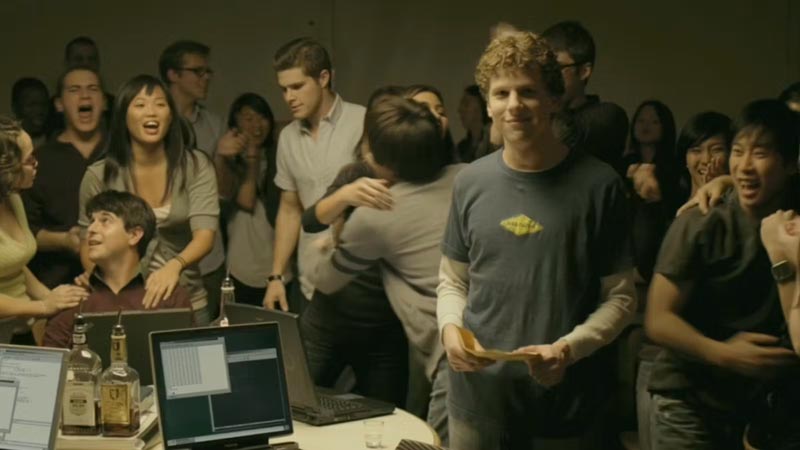
A scene from The Social Network, a film by David Fincher.
The Social Network (trailer), directed by David Fincher, is based on Ben Mezrich’s book The Accidental Billionaires, which he penned with the help of Eduardo Saverin (Andrew Garfield), one of the co-founders of social network Facebook, who later fell out with CEO Mark Zuckerberg (Jesse Eisenberg).
Bookended between numerous litigation sessions in lawyers’ offices, The Social Network pieces together the early days of Facebook through a series of flashbacks. The story focuses mainly on the roles of Zuckerberg and Saverin in creating the network, and how they dealt with raising money and profile, while fending off people claiming they had stolen the Facebook idea from them.
After his girlfriend, Erica Albright (Rooney Mara), ends their relationship, Zuckerberg, a technically brilliant but emotionally cold Harvard University computer science student, hastily builds Facemash. It’s a hot-or-not style website that compares female Harvard students with each other. Zuckerberg sources the photos Facemash needs by effortlessly hacking the databases of Harvard’s colleges.
Although Facemash is quickly shut down, word of Zuckerberg’s programming and hacking skills spread, and he’s soon approached by twins, and fellow students, Cameron and Tyler Winklevoss (both played by Armie Hammer). They have an idea for an exclusive Friendster/MySpace clone, but want to restrict membership to only those with Harvard email addresses.
They ask Zuckerberg to help, but after agreeing he instead creates the first version of Facebook, then called The Facebook. His friend and roommate, Saverin, puts up one thousand dollars to cover web hosting in return for a thirty percent share in the venture, and role of CFO.
The Facebook proves a hit with Harvard students, and other universities in the US and Britain are soon admitted to the fold. Meanwhile Napster founder Sean Parker (Justin Timberlake) hears about The Facebook and arranges hefty financial funding for Zuckerberg. Saverin however sees Parker as a threat to his influence, which quickly becomes a source of tension between him and Zuckerberg.
Any dramatisation about an organisation as ubiquitous as Facebook is certain to be of interest to a large number of people. Unlike many highly anticipated films that might play on the hype surrounding their subject matter though, The Social Network does not create false expectations.
Facebook made clear before the film’s release that neither they, nor Zuckerberg, had any involvement in the production of The Social Network. And while Zuckerberg does not present as a villain per se, his portrayal by Eisenberg is far from flattering.
Facebook has certainly had a controversial history (are stories of the early days of Friendster and MySpace anywhere near as colourful?) and it seems every other week brings news of another alleged privacy breach, or a new court action of some sort. Is it therefore a portent of things to come that the final scene plays out in a lawyer’s office?
Originally published Friday 29 October 2010.
RELATED CONTENT
Aaron Sorkin, Andrew Garfield, Armie Hammer, David Fincher, Facebook, film, Jesse Eisenberg, legacy