
Showing all posts about science
Can an algorithm assess the quality of a novel manuscript?
18 December 2022
It pays to follow Australian scientist and writer Dr Karl Kruszelnicki (aka Dr Karl) on Twitter (as long as Twitter continues to permit such behaviour), especially if you are writing a novel.
The other day he posted a link to an article published in 2014, about a literary algorithm that is apparently capable of quickly assessing the quality of an unpublished novel manuscript. The article expounds upon research conducted (PDF) by Stony Brook University into the matter:
Regarding lexical choices, less successful books rely on verbs that are explicitly descriptive of actions and emotions (e.g., “wanted”, “took”, “promised”, “cried”, “cheered”, etc.), while more successful books favor verbs that describe thought-processing (e.g., “recognized”, “remembered”), and verbs that serve the purpose of quotes and reports (e.g,. “say”). Also, more successful books use discourse connectives and prepositions more frequently, while less successful books rely more on topical words that could be almost cliche, e.g., “love”, typical locations, and involve more extreme (e.g., “breathless”) and negative words (e.g., “risk”).
Fascinating, no? Remember though, don’t let the algorithm write the book, let it guide you in writing the book. But if you wish to avoid algorithms all together, look at the way Irish author Sally Rooney — for one — does things.
RELATED CONTENT
publishing, science, technology, writing
Could flight of the bird propulsion power deep space travel
11 December 2022
It may be possible to construct deep space vessels capable of (eventually) reaching speeds equal to two percent of the speed of light:
Scientists have proposed a dazzling new mission to travel to the stars that is inspired by the elegant flights of seabirds, such as albatrosses, reports a new study. The interstellar concept mission would harness shifting winds generated by the Sun in order to accelerate a spacecraft to as much as 2 percent the speed of light within two years, allowing it to soar into the vast expanse beyond our solar system.
But two percent the speed of light, a velocity that would take some time to attain anyway, isn’t all that speedy considering the vast distances between celestial objects, such as the Sun, and the nearest star to us, Proxima Centauri.
If we round off the speed of light at 300,000 kilometres (km) per second, two percent of that is six thousand km per second. That’s 360,000 km per minute, and 21,600,000 km per hour. 518,400,000 km per day. If my maths is on spec — not always guaranteed — the journey to Proxima Centauri, some 40,208,000,000,000 km distant, would take 77,561 days, or about 213 years.
On the other hand, if Pluto is an average of 5,300,000,000 km from Earth — sometimes it is closer, sometimes more distant — it would take about ten days to travel there. Assuming such speeds could be attained at relatively close proximity to the Sun, that is. This method of deep space travel seems reasonable for reaching points in and near the solar system, but might be out of the question for interstellar voyages carrying people.
RELATED CONTENT
Alcyoneus a sixteen million light year long radio galaxy
4 December 2022
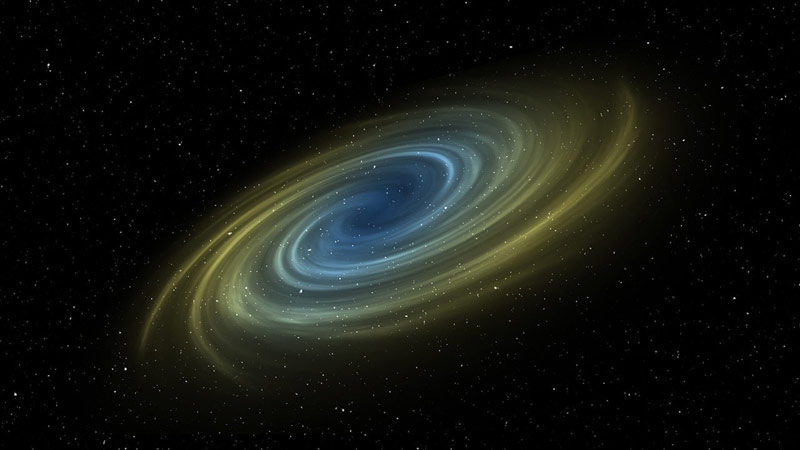
Image courtesy of A Owen.
Alcyoneus, a galaxy located some three and a half billion light years from Earth, at over sixteen million light years in length, is — without putting too fine a point on it — staggeringly huge. Our home galaxy, the Milky Way, at a mere one hundred thousand light years long, is positively minuscule in comparison.
But Alcyoneus isn’t a sixteen million light year long container of stars and whatever else fills a galaxy. Alcyoneus is what’s known as a radio galaxy, and the bulk of its length comes from radio lobes, which are a little like jets of radio energy, that fire out from opposite sides, into the surrounding space.
At its starry core Alcyoneus, which is likely an elliptical galaxy (unlike the image of the spiral type galaxy I’ve featured above), may not be all that much larger than the Milky Way. And that’s probably a relief for members of Alcyoneus’ galactic council, who only have to travel several hundred thousand light years to visit their constituents, rather than multiple millions.
If radio galaxies intrigue you though, Universe Guide has put together this explainer.
RELATED CONTENT
The Sun will not go supernova but it may still drive us away
25 November 2022
In five billion years, hopefully long after a, hopefully, still extant humanity have departed the solar system for a new home somewhere among the stars, the Sun will become a red giant star. In this late phase of its life, the Sun will expand in size to engulf all the solar system’s inner planets.
While this part of the Sun’s lifecycle will be relatively short-lived — some estimates suggest a mere one billion years — our home planet will have well and truly been obliterated, by the time the Sun shrinks in size again. Unless of course any of our descendants, who stayed home, succeeded in moving Earth further out into the solar system.
The idea has been mooted previously. Even before the Sun becomes a red giant, its gradually increasing heat output, or luminosity, will, in time, make living on Earth ever more uncomfortable.
Such as undertaking will be quite the feat of astronomical engineering. Being able to move the planet will be an achievement in itself, to say nothing of navigating to a suitable spot elsewhere, clear of the larger outer planets. But what happens when the Sun shrinks and cools off again? Do we try and send Earth sunwards again? Perhaps our efforts would be better served finding a Earth-twin planet to live on, orbiting a younger star. And, while we’re at it, figuring out a way of reaching said location in a reasonable timeframe.
At least it’s not something we need concern ourselves with right this minute though. Likewise, the prospect of the Sun exploding as a supernova. It’s something that cannot happen. But what about another star — one in the approximate proximity of the solar system — going supernova? That could be a whole another story.
That’s the question the people at Kurzgesagt explore this month, in their latest video presentation. Again the prospect of a relatively nearby star exploding is not something that will occur any time soon. At present, IK Pegasi, a binary star some one hundred and fifty four light years away, is the nearest possibility, though by the time it is projected to explode, it will be more like five hundred light years distant.
Still as Kurzgesagt explains, risks remain, and even supernovas occurring at some distance could have an impact, no matter how minor, on Earth.
RELATED CONTENT
Tune into the aftermath of the Big Bang on television
21 November 2022
If you’re still using an aerial (is that still a thing?) instead of cable (is that still a thing?) or internet, to watch TV, and — presumably — still possess an old school (think rabbit ears) TV, you may be able to pickup remnants of the Big Bang, the force of cosmic nature, that brought the universe into being.
Like COBE, WMAP scans the sky over and over again, soaking up the ancient light from the Big Bang known as the cosmic microwave background. Microwaves are a low-energy form of radiation but higher in energy than radio waves. The cosmic microwave background blankets the universe and is responsible for a sizeable amount of static on your television set–well, before the days of cable. Turn your television to an “in between” channel, and part of the static you’ll see is the afterglow of the big bang.
All you’d see is static, some of which may be post Big Bang microwaves bouncing around the cosmos, but it might be more interesting than some of what is broadcast on the terrestrial channels.
RELATED CONTENT
astronomy, history, science, technology
Mental time travel makes time travellers of us all
12 November 2022
Do you often recall events from your past? Things that happened days ago, or decades earlier? Do you frequently visualise your future? This could involve thinking about where you’ll be living in five years, or where you might be working in twenty years time.
It’s a phenomenon known as mental time travel, and if your mind wanders back and forth through time, you wouldn’t be the only one. While mental time travel may seem like a waste of time, mere daydreaming, there can be an upside. For instance, if enough people had a positive outlook on the future, the future may well become the place we hope it will be.
RELATED CONTENT
If the International Space Station orbited at 3000 metres
9 November 2022
What if the International Space Station orbited at a height of just three thousand metres? Benjamin Granville decided to find out. The answer to many “what-if” questions are often perfectly implausible, but some sure are worth asking. The scenario makes for quite the ride for those aboard the station…
RELATED CONTENT
Not all work and no play as busy bumble bees play ball
31 October 2022
Researchers at London’s Queen Mary University have found bumble bees like to play, and accordingly, experience positive feelings. Despite there being no purpose to the activity, groups of bees rolled small wooden balls, sometimes repeatedly, around a chamber, for what researchers could only determine was fun.
Study first-author, Samadi Galpayage, Ph.D. student at Queen Mary University of London says that “it is certainly mind-blowing, at times amusing, to watch bumble bees show something like play. They approach and manipulate these ‘toys’ again and again. It goes to show, once more, that despite their little size and tiny brains, they are more than small robotic beings.”
This is reportedly the first instance of playful activity being observed in any insect species.
RELATED CONTENT
The Taupo Volcano and supervolcanoes a Kurzgesagt dissection
20 October 2022
Last month the alert level for the volcano below Lake Taupō in New Zealand’s North Island was raised from zero to one. A swarm of relatively small earthquakes this year prompted geologists to make the adjustment. But as scientists monitoring the recent seismic activity noted, the change in alert status is more down to improved surveillance techniques. In other words it seems such activity is relatively normal, but has simply gone undetected previously.
Let’s hope there’s nothing to be concerned about, as supervolcanoes are truly a force of nature. An eruption at Taupō over twenty-six thousand years ago was the largest known volcanic eruption in the world in the past seventy-thousand years. With a rating of eight on the Volcanic Explosivity Index, the blast caused temperatures across the entire southern hemisphere to plummet. If such an eruption were repeated today, we’d all notice the fallout no matter where on Earth we were.
It’s timely then Kurzgesagt’s latest video examines so-called supervolcanoes, and puts our minds at ease in terms of the likelihood of such an eruption anytime in the near-ish future.
RELATED CONTENT
How can nothing unreal exist in a not locally real universe?
10 October 2022
In addition to Annie Ernaux being named the Nobel Prize literature laureate , John Clauser, Alain Aspect, and Anton Zeilinger, received the Nobel for their contributions to physics this year. I studied physics in high-school for an ill-fated year, and struggled to make sense of any of it. Way too mathematical. And maybe way too weird.
All the more so, given the Nobel award winning work of Clauser, Aspect, and Zeilinger, effectively “overthrows reality as we know it.” This outcome spans the previous study of a whose-who of household names in the realm of physics, including John Stewart Bell, Boris Podolsky, Nathan Rosen, John von Neumann, and of course, Albert Einstein.
Quantum mechanics’ problem of nonlocal realism would languish in a complacent stupor for another three decades until being decisively shattered by Bell. From the start of his career, Bell was bothered by the quantum orthodoxy and sympathetic toward hidden variable theories. Inspiration struck him in 1952, when he learned of a viable nonlocal hidden-variable interpretation of quantum mechanics devised by fellow physicist David Bohm — something von Neumann had claimed was impossible. Bell mulled the ideas over for years, as a side project to his main job working as a particle physicist at CERN.
RELATED CONTENT