
Showing all posts about novels
Goodreads Choice Awards 2021
19 November 2021
The first round of voting is open in the 2021 Goodreads Choice Awards. From now until Saturday 28 November 2021, Goodreads members will be able to vote for their favourite title of twenty books, across seventeen categories, including fiction, romance, horror, science fiction, nonfiction, memoir, graphic novels, and young adult.
In the second round of voting, which will be open from 30 November to 5 December, titles will be whittled down to ten books per category, and members will be able to vote for their preferred book in each. The winners of each category will be announced on Thursday 9 December (which is less than three weeks now hereabouts).
Books published in the United States in English, including works in translation and other significant rereleases, between November 18, 2020, and November 16, 2021, are eligible for the 2021 Goodreads Choice Awards.
The Goodreads Choice Awards are said to be the only major book awards decided by readers.
RELATED CONTENT
Klara and the Sun and AFs. What are AFs, and why are they needed?
12 November 2021

WARNING: while there are no explicit spoilers here (for instance I don’t describe how Klara and the Sun ends) this article does give away some story points…
Klara, the titular character of Kazuo Ishiguro’s 2021 novel Klara and the Sun, is an AF. She is an artificial friend. AFs are robots that are able to walk, talk, think, and perceive the world around them. In the near-future universe Ishiguro has crafted in his eighth novel, AFs, who appear to be similar in appearance to humans, are highly intelligent companions for teenagers. Despite their human-like qualities though, AFs are easily distinguishable from people. But Klara is said to differ from her AF contemporaries by way of her keen perception and curiosity.
As narrator of the story, Klara often describes in great detail what she sees, or hears, even if she doesn’t always fully comprehend what she has witnessed. Early in the story, as she sits in the display window of a store selling AFs, she watches two older people – a man and a woman – run into each other on the outside street. Their joy at meeting for what may be the first time in decades, is palpable, but Klara is confused by the obvious pain the two people also appear to experience.
While then we may be walking into a future where children will one day have keenly smart and perceptive android-like friends, the question remains as to why there is a need for AFs in the first place. In an introduction to the story’s plot on the Klara and the Sun Wikipedia page, we are told children are schooled at home by tutors through tablet devices (objects Klara refers to as oblongs). For this reason, families who can afford it, buy an AF for their housebound children, as opportunities to socialise with people the same age are said to be limited. But is that really the case?
Soon after coming into the service of a teenage girl called Josie, Klara meets many of her (human) friends at a gathering called an interaction party, hosted by Josie’s mother. The name alone suggests such gatherings are standard, but not necessarily. The dynamic among Josie’s guests implies most the teenagers know each other well. While interaction parties, by virtue of their name, sound like regular affairs, that the event takes place at Josie’s house is notable. For one thing, she lives in a remote region, restricting opportunities to interact with people her age.
But what of her friends? Do they also live in similar circumstances? It seems unlikely every last one does, meaning many would be able to see other teenagers living nearby, outside of schooling hours, thus negating the need (and cost) of an AF. It is also obvious Klara is something of a novelty to some of Josie’s friends. While they’re familiar with AFs, and the attributes of models like Klara, few have actually seen one before. This suggests AF ownership is an exception, most people don’t need them, as they probably live relatively close to others.
For instance, at one point Klara travels with Josie and her mother, Chrissie, to the city where they stay at the apartment of a family friend. While there are vaguely alluded to significant problems in the world Klara and Josie inhabit, they have not resulted in a mass exodus from large urban centres, nor their abandonment. People continue to live and work in cities as usual. Those residing in remote areas then do so by choice. And while we know Josie is ill, and may not get out as much as other teenagers, the need for a carer for her alone would not be reason enough to fill the world with AFs.
It is through this illness – the unfortunate side effect of what seems to be a common genetic modification procedure some teenagers go through – we come to realise Chrissie, Josie’s mother, has another possible purpose in mind for Klara. But again this idea is not the usual intended function of an AF. We’re still left wondering why there is an apparent wide need for AFs such as Klara. Might they then be there to undertake tasks or parental obligations that some parents are unable, or unwilling, to fulfil themselves? For example we know Klara acted as a chaperone at times.
When Rick visited the bedbound Josie in her room, Klara was told to always be present. While she sat with her back to Josie and Rick, Klara could still hear what they were saying and doing. When once asked to leave Josie’s room during one of Rick’s visits, Klara initially resisted, saying she’d been “instructed to ensure against hanky-panky.” But that directive had been issued by the ever-present, live-in, housekeeper, Melania. If she, and by extension Chrissie, was so concerned about “hanky-panky”, surely Melania could’ve been present during Rick’s relatively short visits.
So far there’s little an AF can do that another person – be it a friend, or family member – couldn’t. Josie certainly had plenty of both in her life. Perhaps then AFs were a vanity item. Something you had to have, so you stood apart from other people. A must have, though ultimately dispensable, gimmick. Or was an AF’s unswerving loyalty and devotion the reason they came into being? Like an artificial intelligence chatbot, “someone” who’s always there, who’s always ready to listen, and someone who is never offended no matter how badly they are treated?
What a world to live in…
RELATED CONTENT
For your to-be-read list, November 2021
8 November 2021
They’re making it easy on us this month, ABC literary writers and reviewers have suggested just five books for our reading consumption this month. Mind you, we’re already a week into the eleventh month, meaning we’ve lost eight reading days, so that might be a small problem. Anyway, I’m liking the look and sound of Byobu, by Ida Vitale, a 98 year old Uruguayan author, although Byobu was actually published in 2004 when she was eighty. Never let anyone say you’re too old to start a career as a writer.
RELATED CONTENT
books, Ida Vitale, literature, novels
No Hebrew translation for Sally Rooney’s “Beautiful World, Where Are You”
15 October 2021
From a statement issued by the author of Beautiful World, Where Are You, Rooney’s most recent novel:
“I understand that not everyone will agree with my decision, but I simply do not feel it would be right for me under the present circumstances to accept a new contract with an Israeli company that does not publicly distance itself from apartheid and support the UN-stipulated rights of the Palestinian people.”
RELATED CONTENT
How many banned books have you read? More than you think
28 September 2021
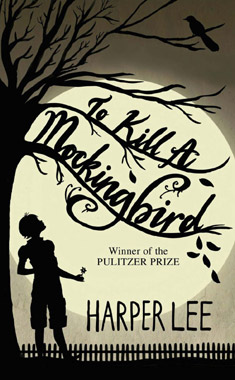
Lock the doors, lower the blinds, switch off your phone, we’re flying below the radar now. All because it’s Banned Books Week, and, well, who wants to be caught in possession of literary contraband? Not that I thought for a second I might be violating statutes by reading Harper Lee’s To Kill a Mockingbird, or The Handmaid’s Tale, by Margaret Atwood.
Attempts to keep To Kill a Mockingbird out of circulation didn’t surprise me. I expect in 1960, when first published, it may have offended some sensibilities, but efforts to prohibit the title are far more recent. The Handmaid’s Tale, meanwhile, has likewise been challenged or banned since its release in 1985, for content deemed to be vulgar, violent, and sexually explicit.
Other books to receive similar treatment include The Adventures of Huckleberry Finn by Mark Twain, The Catcher in the Rye, by J.D. Salinger, The Color Purple, by Alice Walker, and, yes, even Fear and Loathing in Las Vegas, by Hunter S. Thompson. Yet I read each blissfully ignorant of the controversy they once stirred up, or still are. For that, I’m eternally thankful to live in the time and place I do.
Update: for the daring: banned book bingo by Keeping Up With The Penguins.
RELATED CONTENT
The subtle art of asking a friend to critique your manuscript
22 September 2021
The subtle (and not so subtle) art of giving feedback to a writer, by London based Scottish cartoonist and illustrator Tom Gauld.
Writers know one of the scenarios Gauld envisages is going to play out. But it started me thinking; what if you’re an aspiring author, in other words, unpublished. How do you go about seeking feedback for the manuscript you’ve possibly spent years toiling over, when you don’t have the luxury of being able to call on an editor?
Should you ask friends? It’s probably what most people would think of. But if what a bunch of people agree to take a look, and you end up hearing nothing back? How do you interpret that? To mean your writing is subpar? That’s what I might think. On the other hand, it could be your friends are time-poor, like everyone else.
Expecting someone to read and digest one hundred thousand words and supply commentary, especially in the space of say a week, is a big ask by any standard. Perhaps a more graduated approach is a better idea, something Chicago based writer and filmmaker Jennifer Peepas suggests:
If someone volunteers to read your novel, send them the first chapter or so. If they write back to you wanting more, you have good feedback from that act alone: You wrote a good first chapter, you hooked them, they do actually want to read it, and they will likely give you notes.
That’s not a bad idea. But let’s get to the nitty-gritty. A friend has sent you their writing for critique, and it… it’s terrible. How do you respond? Without causing offence, and destroying the friendship? Freelance editor and writer Meg Dowell thinks the prospective author should put themselves in their friend’s position before sending anything. Long story short, maybe it’s best you don’t ask in the first place:
As humans often do, I turned this question back on myself and tried to imagine myself as the bad writer friend dreaming big. Would I want someone to tell me my writing kind of sucked? Or would I have a better experience continuing to write to my heart’s content and chase my dreams even if it wasn’t likely they’d come true? I’m not sure I would want to know if my writing was terrible. At least, I’m not sure I’d want to hear it from someone close to me. If I were passionate enough about writing to work hard in an attempt to make it, having my dreams crushed before my eyes … I don’t know how I would handle that.
I’m not sure anyone could tell a friend their would-be novel sucked though. More likely they’d say they really liked it, and they’re looking forward to the book launch. After all, that’s what friends are for. This is a matter requiring of further research, and follow-up. In the meantime, go and look at more of Tom Gauld’s work. It’s stellar, unlike asking friends to critique your writing.
RELATED CONTENT
Booker Prize 2021 short list announced
16 September 2021
The work of Nadifa Mohamed, Anuk Arudpragasam, Damon Galgut, Patricia Lockwood, Richard Powers, and Maggie Shipstead, have been shortlisted for this year’s Booker Prize. The winner will be announced on Wednesday, 3 November 2021.
RELATED CONTENT
The Banksia House Breakout, by James Roxburgh
16 September 2021
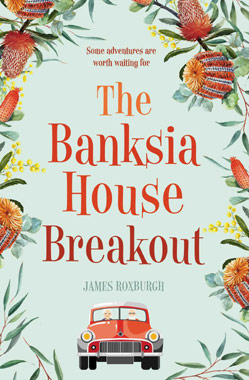
It’s a breakout, but not the sort of breakout you’re thinking of. Eighty-something widow Ruth Morris has been moved into Banksia House, a retirement home in Sydney, by her son, Michael. While the name of Ruth’s new abode may sound homely, Ruth instead feels homesick and isolated, as she pines for her past life of independence.
But when Ruth receives word her best friend Gladys is unwell, she hatches an escape plan in The Banksia House Breakout (published by Simon & Schuster, September 2021); the debut novel of Sydney based Australian writer and audiologist James Roxburgh. And with some help from her new found friends at Banksia House, Ruth makes a dash for Queensland.
But the journey is filled with trials and tribulations as Ruth, Beryl, and Keith, head north, hoping they’ll reach Gladys in time. While dealing with all sorts of problems on the road, the trio has to constantly outwit the home, and their families, lest they be stopped. Blending humour with the stark reality of aged care living, here’s another title for your reading list.
RELATED CONTENT
books, fiction, James Roxburgh, literature, novels, TBR list
The Phone Box at the Edge of the World, by Laura Imai Messina
15 September 2021
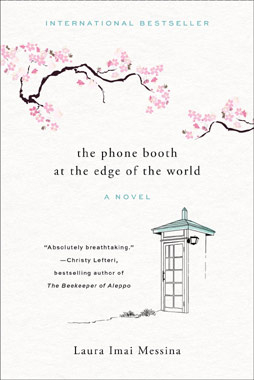
Imagine there were a way to contact your deceased loved ones. To feel you’d conversed with them, and perhaps found some comfort in the wake of their passing. But what might you say if it were possible? If it were as simple as picking up a phone and talking? If you can make your way to the Japanese city of Otsuchi, you might be able to do that.
In a garden there, is an old, disconnected, telephone box, called the phone of the wind. Those grieving the loss of loved one go there to seek solace, and Japan based Italian author Laura Imai Messina’s new novel, The Phone Box at the Edge of the World (published by Allen & Unwin, July 2020) is based on Otsuchi’s phone of the wind.
Yui lost her mother and daughter in the tsunami of 2011. Despite her grief she does what she can to carry on. After hearing about the phone in Otsuchi, she travels there. But she cannot pick up the phone and speak. But there Yui meets Takeshi, whose young daughter stopped talking when his wife died, and the two begin to form a bond.
RELATED CONTENT
books, fiction, Laura Imai Messina, literature, novels, TBR list
Everyone in This Room Will Someday Be Dead, by Emily Austin
14 September 2021
Gilda, a woman in her late twenties, is a person with a few problems. She has a dread of death. She’s depressed. So much so she can’t deal with washing the dishes, showering, or even turning up for work. Unsurprisingly then she finds herself seeking another job, and is inadvertently hired as a receptionist at a Catholic church.
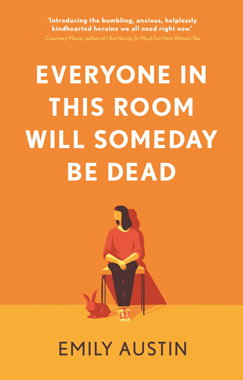
But Gilda is not Catholic, nor is she even religious. She is also gay. In addition though to lying about who she is, and pretending to be familiar with the workings of the Church, she also becomes obsessed with her late predecessor, Grace. Certain her passing was no accident, Gilda commences her own investigation into Grace’s death.
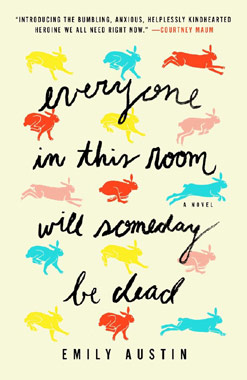
Could then Everyone in This Room Will Someday Be Dead, (published by Allen & Unwin, August 2021) possibly have a more apt title? Early reviews for the debut novel of Canadian author Emily Austin look promising. Buzzfeed described it as “the perfect blend of macabre and funny“, while The Skinny found it “funny, dark and harrowing.”
RELATED CONTENT