
Showing all posts about social networks
#BookThreads, a name for the book community on Threads?
15 July 2023
Threads banner image, by Meta.
If Threads, Meta’s recently launched micro-blogging app, takes off and becomes as popular as the likes of Twitter and Instagram, a community of book readers and fans is bound to form. As was the case on Instagram, Threads’ Meta owned stablemate, where a thriving and lively book community interacts under the #Bookstagram hashtag.
But where there’s a social network, there’ll be an active community of book lovers. On rival micro-blogging network, Twitter, the bookish use the #BookTwitter hashtag to label their tweets, making them visible and searchable for fellow literary mavens, while on while on TikTok, BookTokers share book content using the #BookTok tag.
Presently hashtags are not functional on Threads, but they, along with a bevy of other features, are on the way. It’s therefore only a matter of time before book readers will be able to connect with bookworms on Threads. That’s good though, it gives the bookish time to devise a community name and hashtag to use on Threads. But that’s hardly going to be difficult.
The hashtags used by the book reading communities on Twitter, Instagram, and BookTok, are simple and to the point, and the same will doubtless apply on Threads. Which makes BookThreads the logical choice. I first saw the term used by Australian book publisher Pan Macmillan Australia on their Instagram page, though someone else may well have used the moniker before.
So #BookThreads it is, at least if you ask me. And just because hashtags still aren’t functional on Threads doesn’t mean you can’t use them. I’ve sporadically been including them on posts, probably through habit, as I imagine others have to, and I’ve used #BookThreads on at least one of my Threads posts. But by adding #BookThreads to your bookish Threads posts now, means you’ll be immediately be visible to the Threads book community, when hashtags become operational.
But what are your thoughts on a hashtag and title for a potential Threads book community? Does BookThreads make sense, or is it a terrible idea? Do you have alternative suggestion? Let me know in the comments below, which will be open for a week or so after this article is posted.
RELATED CONTENT
books, social media, social networks, Threads
Threads revenue tipped to reach $8 billion by 2025
15 July 2023
Threads, Meta’s micro-blogging app, may only be a week old, and boast a relatively small membership of one-hundred million, but some analysts are already predicting, boldly perhaps, the Twitter clone may draw in revenues of eight-billion dollar per annum by 2025:
Evercore ISI analysts reportedly said they expect Threads to add $8 billion to Meta’s annual revenue by 2025. Nevertheless, while marketers and brands are already experimenting with the app, they really want to know when ad formats will be available.
This is the eight-billion dollar question. Part of Threads’ present appeal is the relative absence of advertising. I think most people appreciate ads of some sort will need to make an appearance at some point — this playground Meta has made for us has an overhead after all — but the way they are deployed will be critical.
Any misstep could drive users away, and potentially bring an end to Threads. As a comparison, Twitter, with a membership of some 368 million daily active users, made four and a half billion dollars in 2022, chiefly from advertising. Whether we get to see the 2023 numbers remains to be seen.
Via Matt Fleury.
RELATED CONTENT
social media, social networks, Threads, trends, Twitter
Have Threads badges made my Instagram account valuable?
11 July 2023
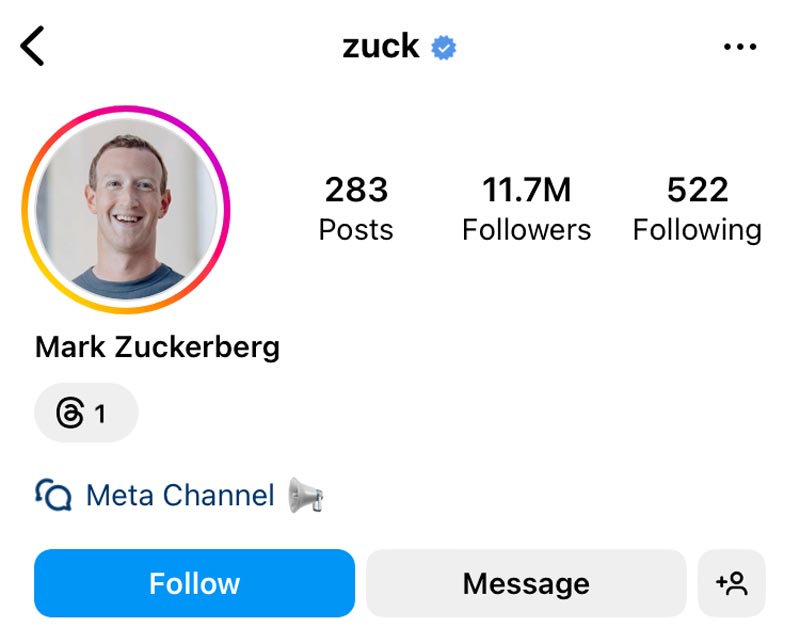
Mark Zuckerberg’s Instagram profile displaying his Threads badge.
The launch last week of Meta’s Twitter-like micro-blogging service Threads has been a riotous success, if the one-hundred million sign-ups in its first five days are any indication. Threads seems to have been the much wanted breath of fresh air micro-bloggers were waiting for. The Meta made app not only offers ease of use, but comes largely unencumbered by the baggage of Twitter, or the confusion some people have experienced with Mastodon, another micro-blogging contender.
Of course it is early days. Threads is not completely without its drawbacks. Privacy advocates have voiced concerns about some of the user data Threads is collecting. And compared to, say, Twitter, many features micro-bloggers are used to — hashtags for example — remain absent, though it sounds like more functionality is on the way.
Introducing the Threads badge
One feature however that may have surprised many Instagram users after signing up for Threads, is the appearance of a number on their Instagram account, situated just below their username. The image above, a screen grab of Facebook co-founder Mark Zuckerberg’s Instagram page, is an example of what I mean. From what I can gather, the symbol that looks a little like @1, is called a badge, or a Threads badge, though, in some cases, it could just as easily be called a badge of honour.
In short the badge, which can only be seen on the Instagram app, but not the website, tells the world what number member you are of Threads. It also links to your Threads page, and anyone tapping on the badge will be taken there, if they are a member themselves. It is of little surprise that Zuckerberg, as CEO of Meta, scored the surely much coveted badge number one. But aside from letting everyone know how quickly, or not, that you became a Threads member, might the badge have other value?
As in financial value? I mean, who wouldn’t want to have Threads badge number one adorning their Instagram page? While it is fair to say the chances of acquiring this particular badge number are pretty much non-existent, might other badge numbers become something people would be prepared to pay top dollar for?
Speculating on Threads badges, really?
Speculating on Threads badge numbers however would be fraught with difficulty. For one, Threads needs to take hold as a serious micro-blogging player, for the badges to accrue any value. As I said earlier, there has been a rush to sign up for Threads, but how many people will remain active on the platform long term? If the initial burst of enthusiasm wanes, Meta might decide to close Threads down, rendering the badges worthless.
But that’s not to say there might still be interest in the badges as a commodity. While the ultra-low badge numbers are probably in the hands of those who will not let them go, come what may, there may be people potentially interested in trying to acquire double, or three figure numbers. Or so-called “golden numbers” that may be higher, but are possessed of some subjective value to a would-be buyer, or even a Threads badge number speculator.
666, anyone? Or perhaps a year of birth? Or possibility any relatively low number that makes the owner look like they are an early adopter. But while someone may be interested in buying a particular Threads badge, that doesn’t mean the sale process would be straightforward. Even if the price was right. And the transfer were to evade Meta’s notice. Anyone selling their in demand Threads badge number would have a few things to think about.
Beware the pitfalls…
They would be giving up both their Instagram and Threads accounts, and may lose their possibly cherished username, and followers, in the process. While an arrangement might be reached with the buyer to give up the username, there’s the risk it might be snatched by someone else, if the seller doesn’t move quickly to re-secure it. The seller would also need to get their original followers on board at their new Instagram and Threads pages, something not necessarily straightforward.
Some sort of legally binding written agreement would also need to be in place to ensure each party to the transaction did what was required of them, at the requisite times. Buyer transfers money, seller surrenders account passwords, things like that. Perhaps a brokering service to cater for such a transaction could be engaged to oversee the sale. Maybe there’s a business opportunity for brokers, if the sale of Threads badge numbers becomes commonplace. Oh, the possibilities…
Or is it all a pipe dream?
But the prospect of a marketplace for badge numbers emerging, is likewise, pie in the sky possibility. That’s too bad, some of us might have been millionaires for a minute there, at least in the recesses of imagination. But also read this Mashable article by Sam Haysom. See that image as you start to scroll down. The image bearing the somewhat ominous notification, stating “this temporary badge lets your followers know that you’re on Threads and sends them to your profile if they have the app.”
What? The Threads badges are only temporary? Where’s the fun (and millions) in that? If then you do wish to cash in on your Threads badge number, move quickly. And whatever you do, don’t tell the buyer the badges are temporary…
RELATED CONTENT
social media, social networks, Threads, trends
Twitter claims Meta Threads is theft of their trade secrets
8 July 2023
Meta is possibly facing a lawsuit from Twitter, hours after the much hyped launch of Threads, its micro-blogging service, according to Semafor.
In a letter sent to Mark Zuckerberg, Twitter accuses Meta of poaching certain of its employees (presumably those who weren’t laid off), together with “systematic, willful, and unlawful misappropriation of Twitter’s trade secrets and other intellectual property.”
But haven’t we been here before, and isn’t there an answer to this? Anyone who saw American film director David Fincher’s 2010 movie The Social Network, will know what I mean. After all, a guy who builds a nice chair doesn’t owe money to everyone who ever has built a chair.
Is that right, or is that right? Time will tell I expect.
RELATED CONTENT
social media, social networks, Threads, trends, Twitter
Threads by Meta/Facebook has started rolling out
6 July 2023
Threads, the Meta/Facebook micro-blogging/discussion alternative to Twitter was ready to go when I came into the studio this morning. You can find me here.
Threads is pretty simple to set up, especially if you’re already on Instagram (IG), and there’s the option to import your IG profile data, if you don’t want to fill out the same information on your Threads page. You can also auto-follow everyone on your IG following list with a single click, or make individual selections.
From there, you’re pretty much ready to go. Instead of posting a tweet, as you do on Twitter, or a toot if on Mastodon, you post a thread every time you say something. It’s all very new, and early days, and I’m checking in on Threads as I do other things, but it looks like you’ll see a lot of threads from people you don’t directly follow, particularly influencers.
I’m interested to see what other Twitter-like features are, or will be, available, such as lists, and scheduling threads. Isn’t it fun though, something new, and perhaps not so encumbered with baggage, and general bad vibes. And another big one, fingers crossed Meta/Facebook don’t impose too much Meta/Facebook-ness upon us in Threads.
RELATED CONTENT
social media, social networks, Threads, trends, Twitter
Meta’s Twitter clone, Threads, said to be launching this week
4 July 2023
The much talked about Meta/Facebook Twitter-like micro-blogging application, reportedly called Threads, will be launched later this week, according to Bloomberg.
With well over one billion Instagram users, and approaching three billion Facebook members, Meta’s Twitter clone has tremendous potential traction.
RELATED CONTENT
social media, social networks, Threads, trends, Twitter
Arrivals offset departures as Twitter exodus seems to pause
18 February 2023
Elon Musk’s arrival at Twitter last October sparked a stampede for the doors, as members worried about where Musk might take the platform. But surprisingly, departures have been matched by arrivals, says Sarah Perez, writing for Techcrunch:
Worldwide mobile app installs are up by 3.7 million in January compared with September 2022. Notably, Twitter installs didn’t decline in November. Instead, it gained new downloads even as some of its users seemingly left for other apps. In other words, any Twitter exodus may have been offset by new Twitter arrivals. Active user data would tell a better story here, but Twitter is no longer a publicly traded company and it’s not clear that Musk is analyzing user data as Twitter had before, which would allow for a direct comparison. But his claims of a burst of November signups could be directionally true, as the month saw higher app installs than October.
There’s also the point that long term Twitter members, despite their disillusionment with the present direction of the platform, have a lot invested in the microblogging service.
Many have spent years, decades possibly, establishing a profile on Twitter, and wouldn’t be in any hurry to leave. Despite the uptake in alternatives, such as Mastodon, there’s still, I think, the hope among some Twitter members that things will eventually return to normal, or some semblance of normal.
RELATED CONTENT
social media, social networks, trends, Twitter
#BookTwitter and other Twitter communities fear for future
4 February 2023
For years now book aficionados, publishers, and literary agents, have been convening on #BookTwitter, a community similar to Instagram’s #Bookstagram posse of book lovers.
Like many other Twitter groups though, #BookTwitter’s future hangs in the balance, subject to the fickle whims of the social networking service’s present regime, leaving members concerned they’ll wake up one day and find it gone, along with Twitter itself:
The recent chaos at Twitter has left many communities on the platform wondering — what happens if we wake up tomorrow and the lights are off for good? One such community is “Book Twitter,” made up of writers, editors, agents, booksellers, publishers, literary organizations, and everyone in between. Recently, notable authors like John Green and Sarah MacLean have joined other prominent voices in either deleting or indefinitely locking their accounts, leaving many fearful that a slow bleed of influential players will eventually lead to the community’s demise — if Twitter’s code doesn’t blow up first.
RELATED CONTENT
books, literature, social media, social networks, Twitter
Not moving to Canada or Mastodon, I’ve been on Twitter too long
9 January 2023
Josh Nicholas, writing for The Guardian, about a recent decline in active members on social network Mastodon:
The number of active users on the Mastodon social network has dropped more than 30% since the peak and is continuing a slow decline, according to the latest data posted on its website. There were about 1.8 million active users in the first week of January, down from over 2.5 million in early December.
Aside from grumbles about Mastodon being difficult to use, I think a lot of people are wary of having to start over again somewhere else. If Twitter had ceased to exist, gone off-line, members who wished to remain active on a micro-blogging service would have no choice but to find a new platform, but that hasn’t (yet) been the case.
I joined Twitter in 2007, as did many of the people who follow me. Today some of those people have tens of thousands of followers, something that would’ve entailed considerable time and effort to achieve. The prospect of leaving that behind, and rebuilding their following on another service, would be daunting.
Despite Mastodon experiencing a growth surge in recent months, and making headlines in the process, membership peaked at about two and a half million accounts in December 2022. This compared to Twitter’s 368 million monthly active users at the same time. Some people moved on, but plenty stayed back.
Anyone then looking to start again would have found barely any of their Twitter followers on Mastodon, rendering a move questionable. So much for the Twitter members who threatened to depart, to “move to Canada” so to speak, after Elon Musk assumed ownership. In the same way some Americans, unhappy with the prospect of Donald Trump becoming U.S. President, declared they would migrate to Canada, in the event he won office. Ultimately few, if any, made the move.
While some Twitter users might have gone to Mastodon, or another micro-blogging service, or left social media behind all together, their numbers were limited by the looks of it. Staying on, rather than starting from scratch, turned out to be more appealing. Twitter had a way of retaining members, sitting — out of sight — up its sleeve, all along.
RELATED CONTENT
Mastodon, social media, social networks, technology, Twitter
Twitter 2.0 is not a start-up much as Elon Musk likes to believe it
25 November 2022
Tegan Jones, writing at Crikey, on Twitter owner Elon Musk’s… vision of the social media service being some sort of start-up, as of the minute he assumed control. Twitter was established in 2006, so we might be a little passed the development phase of the operation by now, no?
So no, Musk isn’t asking more of his remaining employees simply to improve the platform or make up for past financial woes. And it’s certainly not about overcoming the odds to build something together to change the world, which is oftentimes the north star of young start-ups. These employees are being asked, and in some cases coerced due to lack of options, to dedicate their lives to pay off a billionaire’s offensively large debt on a vanity project he didn’t even want. That is not start-up culture.
Despite Musk’s philanthropy, his wealth and privilege has bestowed him with a singular outlook of the world. While it’s unlikely he has much in the way of home duties, or family obligations — at least that’s the impression created — he could easily afford to outsource them anyway. Other Twitter employees are unlikely to be so fortunate. Instead, they’re simply expected to be hard core, and work until all hours of the night. Or be fired. Awesome.
RELATED CONTENT