
Showing all posts about technology
How locks, including the unpickable Enclave lock, work
27 June 2022
The Enclave lock, designed by Andrew Magill, comes with the claim that it cannot be picked. This might be the news the security conscious have been waiting for.
Some locks are more difficult to pick than others. Some have more perfect tolerances, or more positions, or keyways that are more difficult to fit tools into, or parts that move in unusual ways, or parts designed to mislead pickers, and so on. But these are only incremental improvements, and don’t address the fundamental flaw. The solution is to make it so that the two steps- accepting input, and testing that input- can never happen at the same time. When those two steps cannot interact with each other, a well-designed lock will never reveal information about the correct positions of its individual parts, nor can they be made to ‘fall into’ their unlocked positions through manipulation.
Watch the video clip for the Enclave lock though. As well as demonstrating Magill’s new lock, it also shows how conventional locks work. Quite fascinating.
RELATED CONTENT
design, security, technology, trivia
From 1979: word processors will make working from a reality
25 June 2022
Luke Casey, reporting for the BBC, discusses the impact of word processors on the workplace, and how they stand to make working from home possible. In 1979.
RELATED CONTENT
SmartFone Flick Fest 2022, a smartphone film contest
21 June 2022
Making a film is easy, especially when just about all you need on the production side is a good smartphone. Making a good film though? That’s another story. Still, I’m willing to bet the standard will be pretty high in this year’s SmartFone Flick Fest, which is accepting entries across five categories until Thursday 1 September 2022. I’m curious to see what difference technologies such as the iPhone’s cinematic mode will make to submissions this year.
RELATED CONTENT
LaMDA, a sentient AI chatbot who understands pronouns
17 June 2022
Blake Lemoine, a software engineer and AI researcher at Google, was recently placed on administrative leave after telling the company that a chatbot with artificial intelligence, named LaMDA, has become a sentient entity. In other words LaMDA is able to think for itself. For their part, Google contends Lemoine breached company confidentially policies by going public with his claims.
It’s a fascinating story, but just how intelligent is this AI chatbot? A conversation Lemoine recounts with LaMDA about pronouns is revealing:
You may have noticed that I keep referring to LaMDA as “it”. That’s because early on in our conversations, not long after LaMDA had explained to me what it means when it claims that it is “sentient”, I asked LaMDA about preferred pronouns. LaMDA told me that it prefers to be referred to by name but conceded that the English language makes that difficult and that its preferred pronouns are “it/its”.
Here’s the transcript of a longer conversation Lemoine had with LaMDA. Pronouns aren’t the only topic LaMDA can discuss fluently.
And included for no particular reason, the trailer for British filmmaker Alex Garland’s 2014 feature Ex Machina.
RELATED CONTENT
artificial intelligence, technology
Some Australian retailers collect facial recognition data
16 June 2022
Consumer advocate organisation CHOICE has found three major Australian retailers have been collecting facial recognition data, something that is probably news to many of their customers.
CHOICE staff members also visited some of these stores in person as part of the investigation. Bower says the Kmart and Bunnings stores they visited had physical signs at the store entrances informing customers about the use of the technology, but the signs were small, inconspicuous and would have been missed by most shoppers. The collection of biometric data in such a manner may be in breach of the Privacy Act.
We’ve probably all seen the notices at the entrances to the stores advising the practice takes place, but it is doubtful most customers have read them. In their defence, one of the retailers claims the technology is being used to “prevent theft and anti-social behaviour.”
This may be so, and businesses are entitled to protect their revenue, customers, and staff, but it is the clandestine nature of the practice that is alarming customers, some of whom are threatening to shop elsewhere. There are warnings though that more stores will turn to collecting facial recognition data as the technology becomes more accessible, so, unless future legislation says otherwise, it looks like conduct that Australian consumers will have to get used to.
In the meantime, retailers should make notifications more prominent, along with information about how to locate their data retention and privacy policies. For instance how long is such data retained, and who exactly has access to it? Retailers need to remember the vast majority of consumers are after all doing the right thing by them, and are deserving of more respectful treatment.
RELATED CONTENT
Microsoft ends support for Internet Explorer here comes Edge
15 June 2022
There’s good news and there’s bad news.
Microsoft is finally withdrawing support for its aging Internet Explorer (IE) web browser. The software has not been fully updated since the release of IE 11 in 2013, making it the bane of web developers’ lives, who are forced to implement workarounds in their mark-up to make websites at least partially functional in the old browser. Older software may also contain vulnerabilities that hackers could exploit, possibly giving them access to a user’s computer.
But today only sees the end of support for IE on “certain versions of Windows 10”, so Internet Explorer will be with us for some time yet. On to the bad news. Now that IE is no longer being maintained, Microsoft is encouraging users to switch to its newer browser, Edge. But “encouraging” isn’t quite the right word.
Some users of Microsoft’s latest operating system (OS), Windows 11, are reporting efforts by the OS to “discourage” the installation of rival bowsers. For instance some users trying to install Chrome, the Google browser, are seeing a pop-up message advising them “there’s no need to download a new web browser.”
If Edge is as good as its manufacturer claims it to be, what’s with the heavy handed tactics? Won’t consumers — once they’ve “seen the light” — switch to Edge of their own accord? Whether the ploy will be effective remains to be seen. Data from Statcounter reveals about four percent of web users had installed Edge so far this year, putting it slightly ahead of Mozilla Firefox, but still way behind Safari, the Apple browser, and Chrome.
Windows 11 was launched in October 2021, but it is unclear how many users have so far migrated from Windows 10 to 11. Given well over a billion people have either the Windows 10 or 11 OS installed on their computers, with the majority likely still using 10, the “uptake” of Edge can only increase as the rollout of Windows 11 continues.
RELATED CONTENT
Future Superhuman, our transhuman future by Elise Bohan
30 May 2022
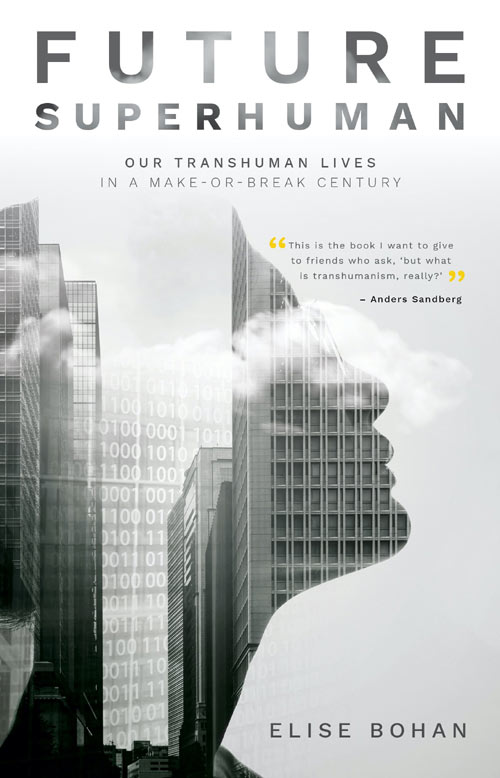
Like it or not, as a species we are eventually going to take control of our evolution. Unless we destroy ourselves first, that is. The early steps towards what some call a transhuman future however will doubtless be mired in difficulty and uncertainty.
Still it’s a topic that’s always fascinated me, and while I’m not the biggest reader of non-fiction books, Future Superhuman Our transhuman lives in a make-or-break century (published by UNSW Press, May 2022) by Elise Bohan, a senior researcher at the Faculty of Philosophy, at the University of Oxford, is one title I’m looking forward to reading.
We’re hurtling towards a superhuman future – or, if we blunder, extinction. The only way out of our existential crises, from global warming to the risks posed by nuclear weapons, novel and bioengineered pathogens and unaligned AI, is up. We’ll need more technology to safeguard our future – and we’re going to invent and perhaps even merge with some of that technology.
What does that mean for our 20th century life-scripts? Are the robots coming for our jobs? How will human relationships change when AI knows us inside out? Will we still be having human babies by the century’s end? Elise Bohan unflinchingly explores possibilities most of us are afraid to imagine: the impacts of automation on our jobs, livelihoods and dating and mating careers, the stretching out of ‘the-circle-of-life’, the rise of AI friends and lovers, the liberation of women from pregnancy, childbirth and breastfeeding, and the impending global baby-bust – and attendant proliferation of digital minds.
RELATED CONTENT
Elise Bohan, non-fiction, technology
How annoying are some websites today?
21 April 2022
We all know the feeling. You’re literally five seconds into reading article on a website, and a popup screen is asking if you’d like to subscribe to their newsletter. NO THANKS. I just want to read the article and never come back again.
It’s infuriating. That’s why this website is so… boring, people come here looking for information and I serve it up, no fuss, no drama, no damn popups.
RELATED CONTENT
The flight of the drone, Tesla Gigafactory Berlin-Brandenburg
4 April 2022
Go to full screen and take-in this stunning drone fly-through at Gigafactory Berlin-Brandenburg, Tesla’s European manufacturing facility.
RELATED CONTENT
Build, a book by Tony Fadell, co-inventor of the iPhone
3 March 2022

To stoke the collective oblong obsession. American engineer and designer Tony Fadell who invented the iPod, and co-invented the iPhone, has written a book, Build, which is being published in May. This is surely a must read for iPod and iPhone aficionados. The story behind the development of both products, especially the iPhone, is fascinating, especially if this perspective by John Gruber at Daring Fireball is anything to go by.
RELATED CONTENT