
Leaders should be readers, says Australian federal politician Andrew Leigh, who has compiled a list of reading suggestions for those in high office. Good to see a few fiction titles on the list, including Klara and the Sun by Kazuo Ishiguro, The Living Sea of Waking Dreams by Richard Flanagan, and One Hundred Days by Alice Pung.
Month: January 2022
Books people in government should be reading
12 January 2022
Man accused of stealing unpublished books arrested
10 January 2022
An Italian man who has been using deception for several years to obtain unpublished manuscripts from well-known authors, has been arrested. Targets of Filippo Bernardini, who works at a London publishing house, included Margaret Atwood and Sally Rooney.
In an interview with The Bookseller in 2019, Atwood confirmed there had been “concerted efforts to steal the manuscript” of her book The Testaments, before it was released. “There were lots of phoney emails from people trying to winkle even just three pages, even just anything,” she noted. According to The Guardian and The New York Times, author Sally Rooney and actor Ethan Hawke were also targeted in a similar manner.
Elizabeth Guy discusses Take Ink & Weep on SBS Russian
10 January 2022
Sydney based Australian writer and literature teacher Elizabeth Guy talks to Irina Burmistrova on the SBS Russian podcast about her novel Take Ink & Weep, a story set in 1915 about four Russian poets who believe their work will make the world a better place.
Combatting the spread of COVID-19 in Australia
10 January 2022
Australia needs to adopt a vaccine-plus strategy to combat the rapid spread of COVID-19, says C Raina MacIntyre, Professor of Global Biosecurity, at Sydney’s UNSW, writing for The Conversation.
Among other things, this includes expanding PCR testing capacity, making rapid antigen test kits freely available to everyone, ditto high quality face masks, and stepping up the vaccine booster program.
If there’s no change in policy, there will be a higher, faster peak that far exceeds available health care, which may then force a lockdown. If people who need simple measures like oxygen cannot get a hospital bed, the death rate will start rising. The other option is to use “vaccines-plus” to flatten the curve and ease the load on society and the health system.
The perception the Omicron strain of COVID-19 is mild — thinking that possibly resulted in Australian federal and state government leaving the virus to spread — while sounding comforting, is not necessarily the case, says MacIntyre:
The Omicron wave has made health systems buckle in most states, with NSW worst affected currently. Delta was twice as severe as previous variants, so if Omicron is 20-45% less severe than Delta, that’s still no laughing matter with low booster rates.
It’s food for thought, considering the long term effects of the virus are yet to be understood. It sounds like prevention is easier than cure, but prevention is not easy.
It’s worth doing everything we can to prevent COVID and the long term burden of illness it may cause. In addition to long COVID, SARS-CoV-2 lingers in the heart, brain and many other organs long after the acute infection, and we don’t know the long term impacts of this.
Sea of Tranquility, by Emily St. John Mandel
7 January 2022
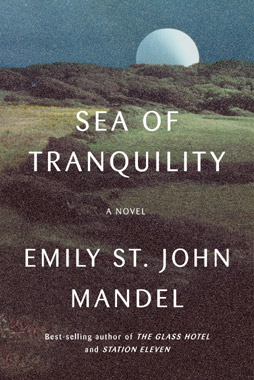
Where are we in time? Where is the motion of the cosmos taking us? Forwards or backwards? Possibly though, you feel you’re stuck in neutral, moving nowhere, yet keenly aware of each passing minute. The strange times we live in have left many of us displaced and confused.
Sea of Tranquility (published by Pan Macmillan Australia, May 2022), the sixth novel of Canadian author Emily St. John Mandel, may well be a microcosm of our pandemic dominated epoch. Gaspery-Jacques Roberts, a detective living in the twenty-fifth century, is asked to investigate a suspected anomaly in time.
But his search for answers is far from straightforward. The detective finds a young man, Edwin St. Andrew, who claims to be the son of a noble British family, who lived in the early twentieth century. And then there is Olive Llewelyn, an author unable to travel home because of a pandemic, who apparently lives in the twenty-third century.
What brings Edwin and Olive to the present day, and how? But is everything as it really seems to be in this usual world? Are Edwin and Olive who they claim to be, or is something else at play? Might the detective have stumbled upon some sort of switch junction in time, explaining the presence of Edwin and Olive?
Positive representations of disabled people in Australian fiction
7 January 2022
Social Queue by Kay Kerr, and Stars In Their Eyes, a graphic novel by Jessica Walton and Aśka, are among works of fiction by Australian authors featuring central characters with disabilities. In Social Queue, Kerr’s autistic protagonist Zoe navigates the world of dating, while in Stars In Their Eyes, queer disabled teen, Maisie, finds love at a fan convention. These works are welcome: in the past people with disabilities who have been part of a story have often assumed the antagonist’s role.
Gold, a film by Anthony Hayes
6 January 2022
Gold, trailer, by Australian actor and filmmaker Anthony Hayes, sees two men discover a giant nugget of gold in the middle of a blistering desert. So enormous is the find, they are unable to move it without heavy lifting equipment.
One of the men (Zac Efron) decides to remain behind in the searing heat, while his companion goes in search of the gear they need. But the billion dollar question, would you wait possibly days for that to happen?
Don’t let New Year’s resolutions interfere with your novel
6 January 2022
British cartoonist Tom Gauld’s take on writers and New Year’s resolutions. I might caption the first frame “write a good book”, and then have an editor tell me in the second frame to write a “better” book. Whatever you do, don’t bring the neighbours, or any friends, into the process.
The coin toss in cricket, should it change?
6 January 2022
Haris Aziz, Scientia Associate Professor at UNSW’s School of Computer Science and Engineering, has proposed a new way of managing the customary coin toss that precedes a cricket match. Presently the winner of the toss decides whether their team will bat or bowl first.
Depending on factors such as the state of the playing field, and anticipated weather conditions during the course of play — which can have an impact on the outcome of the game — the winner of the toss can have a substantial advantage.
Under this method, the toss takes place as normal, but instead of the winning captain choosing whether to bat or bowl first – and thus immediately gaining a potentially strong position – the losing captain would instead make a proposal. The losing captain would make his own determination on how many runs advantage he feels would be gained by batting first. For example, in a Test match, he may feel that a pitch that looks easy to bat on for the opening couple of days but might later produce turn, is effectively ‘worth’ an extra 100 runs to the team that bats first. To counter that advantage he then proposes an offer to the captain who won the toss, by way of a choice. Either bat first and give up 100 runs, or choose to bowl and take the 100 bonus runs for his own team.
I’d be interested to see this in action. In the meantime, in regards to the men’s cricket series currently in progress, well, anything that might for a slightly more even contest, I say.
Vale Craig Ruddy, artist and past Archibald Prize winner
6 January 2022
Sydney born Australian artist Craig Ruddy, who’s painting of late Australian actor and dancer David Gulpilil, won the 2004 Archibald Prize for portraiture, died on Tuesday this week, from COVID-19 complications. A sad loss for the Australian art community.