Every year the Next Chapter helps four emerging, unpublished, Australian writers bring their stories to a wider audience, through financial support and mentoring. Writers chosen to participate receive fifteen thousand dollars, and are given assistance to get their work published.
Past Next Chapter writers include Evelyn Araluen, winner of the 2022 Stella Prize with her collection of poetry, Dropbear, and Adam Thompson, who wrote short story collection Born Into This in 2021.
The initiative is organised by the Wheeler Centre, and aided by funding from the Australia Council for the Arts. Applications for the Next Chapter 2024 close on Friday 30 June 2023.
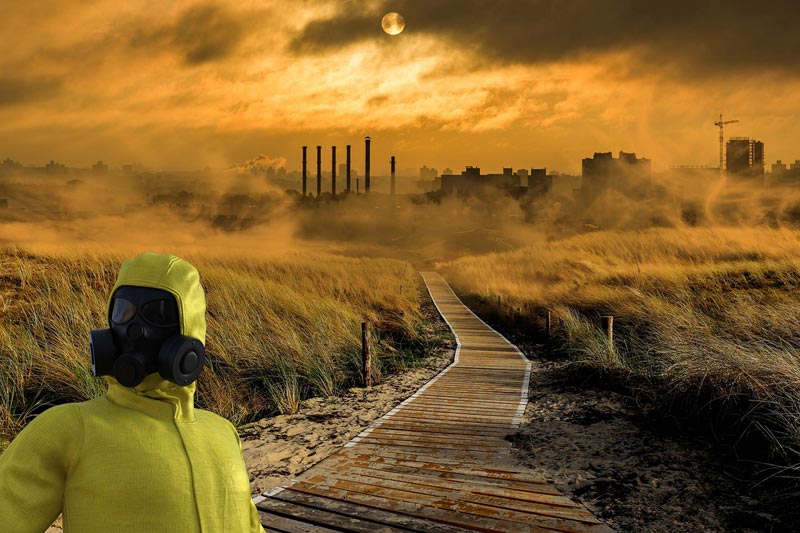
Image courtesy of Pete Linforth.
Warning: spoilers ahead. Return to this article once you’ve finished reading the novel.
Every Version of You, published by Affirm Press in 2022, is the debut novel of Melbourne based Australian author Grace Chan. Set in the late twenty-first century, primarily in Melbourne, Chan’s novel is about a young couple, Tao-Yi and her boyfriend Navin, and a momentous decision they need to make, which has life changing consequences.
Climate change has rendered Earth almost uninhabitable. Outdoor activities have become uncomfortable and dangerous. People need to don protective clothing and equipment before leaving the cocoon-like sanctuary of their dwellings. Body suits to block the Sun’s burning rays. Goggles and facemasks to combat dust, and other airborne irritants.
But the creation of a would-be new world, a “hyper-immersive, hyper-consumerist virtual reality” named Gaia, offers humanity an alternative to the world outside. And while this digital, artificial, macrocosm, mimics the old world in virtually every way, it also offers inhabitants a whole lot more.
Accessing Gaia, called logging in, is facilitated by climbing into a small, diving bell like chamber, filled with a gel-like liquid, called a neupod. While people’s bodies lie immersed in the pod’s gel, their minds roam free in Gaia, and they go about their lives, as normal. Except here, their presence takes the form of a digital avatar, one they are able to continually customise.
They go to work and school. They see friends and family. They engage in sporting and recreational activities. People “live” in Gaia just as they do in the real, outside, world. But within its realm, people can do more than live their old lives. They can venture to places they once only dreamed of, and become someone they could never have been otherwise.
Gaia, a promise of eternal life, but at a cost
Like everyone else, Tao-Yi and Navin switch back and forth between Gaia and the outside world, although Navin spends more time in Gaia than Tao-Yi. But one day a technology emerges allowing people to permanently meld with Gaia, through a process called “Uploading”.
In essence, Uploading, also known as mind uploading, allows a person to live forever within Gaia’s seemingly boundless domain. But there is a crucial caveat. Once uploaded, a person cannot return to the old world. Not, at least, as a corporeal entity. Uploading transforms a person into a conscious digital entity, through a procedure that extracts their every thought, memory, and personality.
A person’s no longer needed body is disposed of in manner they choose beforehand, once Uploading is completed. Despite Tao-Yi’s misgivings, Navin was a keen proponent. And not just because he saw himself as an early adaptor. Navin was also afflicted with a chronic illness, one that medicine could not alleviate. Uploading would allow Navin to live disease free.
And there were doubtless others in Navin’s position. Medical science could offer these people no hope, but Uploading, and becoming a digital version of themselves, would completely eliminate their ailments. For some, the decision to Upload was easy to make. They could enjoy full “health”, and also be free of the ravages of climate change. To say nothing of “living” forever.
Although in a minority, there were people — called holdouts — who refused to Upload. They wished to remain in the “meatspace”, a derogatory term given to the old world. Xin-Yi, Tao-Yi’s mother, was among them. And even Tao-Yi — for the benefits Uploading bestowed upon Navin — was far from convinced that permanently merging with Gaia was the right thing to do. And for good reason.
Gaia, a symbol of climate change denial
Tao-Yi knew Gaia was not a solution to climate change, only a means by which to escape it. To her, and other holdouts, Gaia was humanity’s way of signalling defeat in the battle to restore Earth’s environment to the way it once was. But not only that. Gaia, while being heralded as a new beginning for humanity, also potentially spelt the end of the line for humans.
Aside from a small number of holdouts braving life in the near inhospitable real world, all of humanity’s eggs were in the single basket that was Gaia. Its digital inhabitants had condemned themselves to eternal imprisonment on Earth. Gaia also left humanity all the more vulnerable to some sort of planet-wide calamity, such as the asteroid impact that brought about the end of the dinosaurs.
It was be hoped the tech savvy denizens of Gaia would eventually figure out a way to leave Earth, and at least put down roots elsewhere in the solar system. If not beyond. But a global catastrophe was not the only danger facing Gaia. The digital realm also depended on an army of (presumably self-replicating) robots to maintain its infrastructure.
There would be the hope the robots continued to serve, and replace themselves. But what if these maintenance droids infused themselves with an intelligence of their own? And what if they one day turned against their digital masters, and pulled the plug on them?
Some of these concerns — and could they be the basis for a sequel, or even an Every Version of You expanded universe? — are alluded to in the novel, even if they are beside the point. Gaia is a potent symbol of climate change denial, and the unwillingness, by some people, to do anything about it. Gaia might promise eternal life, but that could be an eternity spent regretting sacrificing Earth to climate change.
Gaia, why does the name sound familiar?
In Greek mythology Gaia is the goddess of Earth, and the mother of all life. She is one of the “primordial deities”, the first generation of Greek gods, and the grandmother of Zeus, god of sky and thunder, and later king of the cosmos, and the other Greek gods.
As a name for the digital realm humanity withdraws to, Gaia may also derive from the Gaia hypothesis, which was formulated by late British scientist and futurist James Lovelock in the 1970s. His theory proposes “living organisms interact with their inorganic surroundings on Earth to form a synergistic and self-regulating, complex system that helps to maintain and perpetuate the conditions for life on the planet.”
In Every Version of You, humanity has well and truly failed to “maintain and perpetuate the conditions for life on the planet.” But by creating a new, artificial, domain named Gaia, perhaps the people of the late twenty-first century — up to their eyes in denial — could claim to have succeeded in achieving this goal.
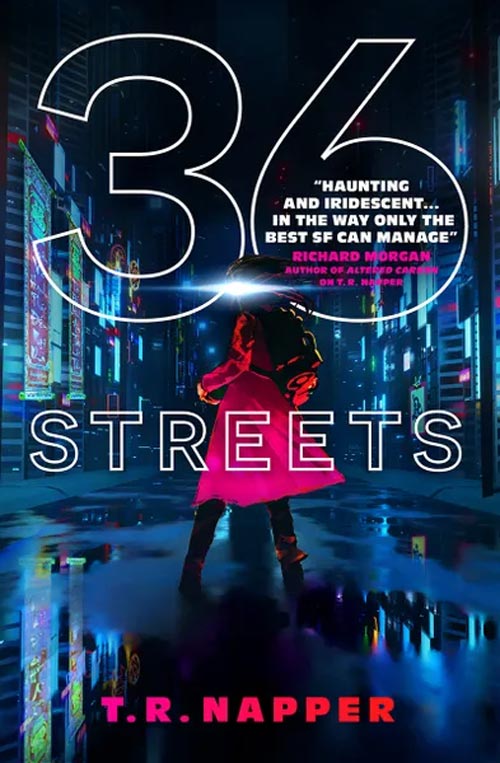
Book cover of 36 Streets, written by T R Napper.
Australian science fiction writer T. R. Napper was named winner of the Best Science Fiction Novel award, with 36 Streets, in the 2022 Aurealis Awards, at a ceremony in Canberra, last night.
The novel, Napper’s debut, is set in a futuristic version of Hanoi, the capital of Vietnam. In 36 Streets, the city is occupied by China, but residents seem to be preoccupied by a highly addictive stimulation of the American-Vietnamese war of the mid-twentieth century:
Lin ‘The Silent One’ Vu is a gangster in Chinese-occupied Hanoi, living in the steaming, paranoid alleyways of the 36 Streets. Born in Vietnam, raised in Australia, everywhere she is an outsider. Through grit and courage, Lin has carved a place for herself in the Hanoi underworld under the tutelage of Bao Nguyen, who is training her to fight and survive. Because on the streets there are no second chances.
Meanwhile the people of Hanoi are succumbing to Fat Victory, an addictive immersive simulation of the US-Vietnam war. When an Englishman — one of the game’s developers — comes to Hanoi on the trail of his friend’s murderer, Lin is drawn into the grand conspiracies of the neon gods: the mega-corporations backed by powerful regimes that seek to control her city.
Lin must confront the immutable moral calculus of unjust wars. She must choose: family, country, or gang. Blood, truth, or redemption. No choice is easy on the 36 Streets.
Established in 1995, the Aurealis Awards honour works of original speculative fiction written by Australian authors, which are published in the preceding calendar year. A full list of winners in the 2022 awards can be seen here.
The Australian premiere of the latest Wes Anderson feature, Asteroid City, takes place in less than a week on Thursday 8 June 2023, at the 2023 Sydney Film Festival.
If you need a little something to keep you occupied between now and then though, help contain the excitement and all, film social network Letterboxd is running the Asteroid City Scavenger Hunt for the next two weeks:
Every day for the next fourteen days, a new item will be hidden on Letterboxd somewhere in the extended Wes Anderson universe of films and their creators. We’ll drop daily clues on our social media, and once you have collected all fourteen items, you’re automatically in the draw to win the grand prize: a private screening of Asteroid City for you and your friends at your nearest cinema.
Letterboxd, in case you’ve not heard of it, was established in New Zealand in 2011, by Matthew Buchanan, and Karl von Randow, and I’ve been a member since 2012. If you’re looking for a place to discuss film, and film only, Letterboxd is where you need to be.
And here’s something, the screenplay for Asteroid City is available to buy in hardback book, or Kindle format, from Amazon on Tuesday 22 August 2023. I didn’t know that was a thing.