September is the month tech companies launch new products, and encourage consumers to buy up, giving rise to the portmanteau Techtember. You learn something new everyday. But instead of increasing our tech stack of stuff, Andreas at 82mhz suggests we shed excess paraphernalia.
I like the idea, and I would if I could, but my tech stack pretty much consists of a laptop, a smartphone, and some headphones. That’s it. No router (we tether), no printer, nor smartwatch even… who needs one when you can check the time on your phone or lappy?
I sit here churning out copy daily, and all I have to my name is a laptop. Go on, laugh, I don’t mind.
Happy Techtember then to all who celebrate it…
Mark Zuckerberg, a lawyer based in the US state of Indiana, has been banned from Facebook (FB) numerous times because the social network thinks he’s impersonating co-founder Mark Zuckerberg.
You couldn’t make this stuff up. Someone has the same name as Meta’s Mark Zuckerberg, and therefore they are up to no good. You would think a social network the size of FB would understand people do share the same first and last names. It’s hardly a rare occurrence either.
Soon after I signed up for FB, back in the days when I used to be active on the platform, I had a friend request from someone with the same name as mine. Looking at the person’s FB page, I could see he had connected with a number of other people with the same name.
It didn’t seem much unusual in the early days, there was a bit of people-sharing-the-same-names friending each other going on. A bit of harmless fun, back in the days when FB used to be fun.
Having the same name as the Meta CEO is sometimes far from fun though, as Zuckerberg the lawyer can attest to. He often receives massages from people who believe he is the FB co-founder, some of which are threatening. But Zuckerberg the lawyer now has his own website.
This is a smart move as anyone in the Indie/Small/Open web space can tell you. While a social media company can delete an account more or less because they feel like it, doing away with an independently hosted personal website is a little more difficult.
The final issue of the eighty-five year old quarterly magazine, will be published in December. The Melbourne University Press, which funds the publication, says the decision to stop production of the journal was made on financial grounds.
A veritable potpourri of Australian authors have written for Meanjin in the past. The move, as one author says, will be a blow to the present and future of Australian literature.
Woollahra, a suburb in Sydney’s east, is soon to have a train station. At first pass that doesn’t seem like a big deal. But the story is as long as the rail line is winding. Proposals to build a station in the affluent suburb are over a century old.
Then, in the 1970’s, as the Eastern Suburbs train line, AKA the T4, was being constructed, foundations for a station were laid. But work came to an abrupt halt when residents, unhappy at the prospect of a train station in their backyard, succeeded in stopping construction.
The partly built station sits between the stations at Edgecliff, and Bondi Junction, where the T4 line presently* terminates, a kilometre or two from the beach at Bondi. But with the housing situation in Sydney reaching dire proportions, the NSW State Government has revived plans to build the station, and then construct much needed high-density residences in the vicinity.
News of the station, and apartment blocks, has no doubt come as a double blow to locals.
Woollahra is far from apartment building free — an array of beautiful art deco style medium-density residences span Edgecliff Road — and the prospect of high density blocks will be causing alarm to some. But the reality is Sydney needs more residences, and it is unreasonable to expect all of these be built “somewhere” in the west of the city.
Or “the western side of ANZAC Parade”, a quip sometimes uttered by those residing on the eastern side of ANZAC Parade. ANZAC Parade being a major roadway running from inner Sydney through to La Perouse, at the southern end of the eastern suburbs.
Some Woollahra residents will argue the presence of high-rise dwellings will be at odds with the “character” of the suburb. Woollahra is possessed of houses built in the nineteenth century, quiet tree-lined streets (one or two rather steep), boutique shops, and a village-like ambience. It is a place many people would like to call home. The building proposals will bring significant changes.
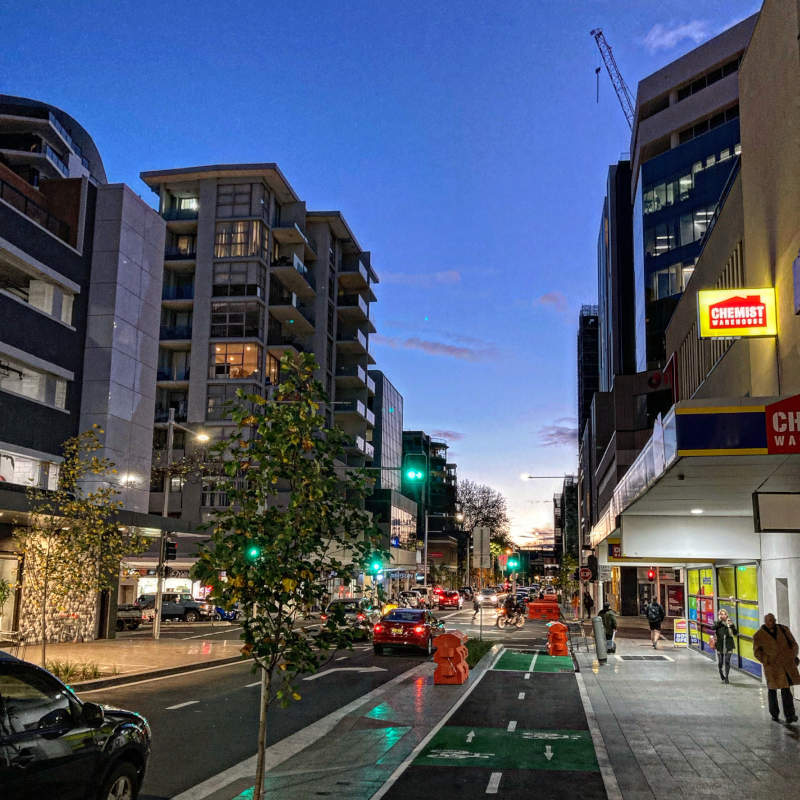
Spring Street, Bondi Junction, NSW, at dusk. Photo taken June 2021. Note the construction crane in the top right hand corner.
But such is life in the big city. Change is constant. Bondi Junction — where we stay when not on the NSW Central Coast — situated right next to Woollahra, has undergone a tremendous transformation in the last decade, particularly along parts of Oxford Street. While always a mixed commercial/retail and residential precinct, numerous high-density apartment blocks now line Oxford street.
Of course Bondi Junction, being a retail centre, and public transport hub, with the aforementioned T4 train line, and numerous bus services, seems an ideal place to build residences. That’s not to say everyone in Bondi Junction is happy with the prospect. Many feel the suburb has been over-developed. But again, housing shortages in the region have compelled governments to act.
Yet the “residential-isation” of Oxford Street, and surrounds, has not always been a bad thing. Bondi Junction is at once a quiet residential suburb, after the shops close, in the midst of a bustling commercial centre. People walk their dogs along Oxford Street in the evenings, a sight that would not have been seen ten years ago.
Despite this metamorphosis, perceptions of Bondi Junction have not changed.
Either within the eastern suburbs, or elsewhere in Sydney. As far as other residents of the eastern suburbs are concerned, the junction is “ugly”. Meanwhile people outside the eastern suburbs think Bondi Junction is full of rich snobs. But nahsayers of the junction are looking at the wrong suburb when identifying ugly, or seeking to point out “rich snobs”.
But I digress. I’m not saying high-density residential blocks in Woollahra, full of dog owners, will bring about any sort of catharsis to existing residents who are going to be subject to possibly decades of disruptive construction work. They had all of that in Bondi Junction, and will probably continue to, but the world did not end.
Whether we like it or not, high-density accommodation is one of the solutions to the shortage of housing, and is something everyone in Sydney needs to get used to.
* there were proposals to extend the train line to Bondi Beach, but residents rallied to oppose the idea.
Sarah Perez, writing for Techcrunch:
The Mastodon 4.4 release in July 2025 added the ability to specify a minimum age for sign-up and other legal features for handling terms of service, partly in response to increased regulation around these areas. The new feature allows server administrators to check users’ ages during sign-up, but the age-check data is not stored. That means individual server owners have to decide for themselves if they believe an age verification component is a necessary addition.
Mastodon is a decentralised social network that allows anyone with the inclination, and access to a reasonably robust server, to establish their own instance, or chapter.
Mastodon is the sum of its many parts, and is not structured like X or Threads, whose operations are run from a single, centralised, point. I have no idea how many Mastodon instances there are, but the number would not be insignificant.
Compliance with age verification laws will be down to individual instance administrators. It’s not something the Mastodon head office could do, because there isn’t one, as such.
This doesn’t mean members of Mastodon instances operating in jurisdictions where age verification laws apply, will be able to forgo confirming their age. Indeed, age verification will be a necessity if the instance they belong to is to continue operating.
Some Hacker News (HN) members were astonished that a relatively concise blog post, written by Evan Verma, spruiking the merits of RSS, reached the front page of the news aggregator recently.
There’s probably not too many people on HN who don’t use RSS, but more generally, uptake is not particularly high. On that basis, any publicity is helpful. Let’s keep encouraging the adoption of RSS.
What is RSS? Read all about it here.