
Showing all posts in the books category
You Don’t Know What War Is a book by Yeva Skalietska
25 November 2022
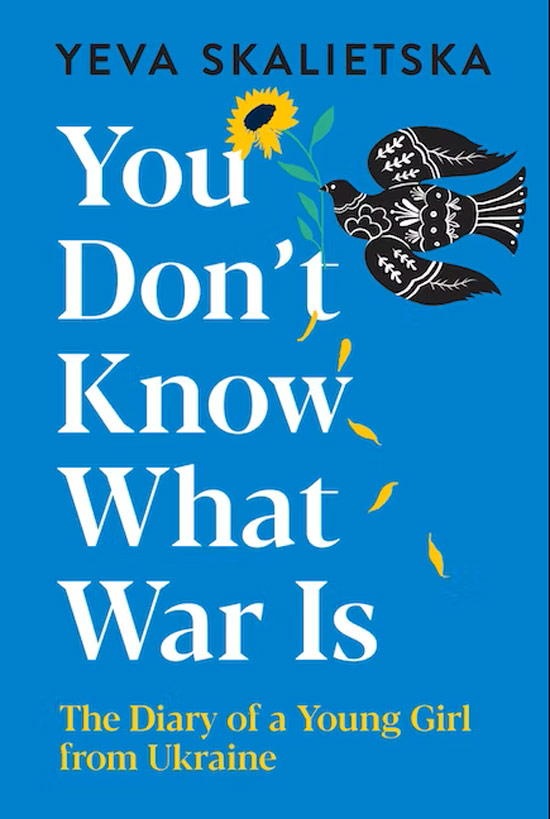
Nine months have passed since Russia commenced its illegal invasion of Ukraine. Despite the brutality of the aggressors, Ukrainian defenders have steadfastly resisted Russian attempts to deprive them of their sovereignty. And while many of us empathise with the struggle of the Ukrainian people, few can truly understand the horrors they confront daily.
Stories and books, such as You Don’t Know What War Is (published by Bloomsbury), written by twelve year old Ukrainian girl Yeva Skalietska, are vital when it comes to appreciating what is happening, even if they can only impart some of the experience, some of the constant, around the clock, fear:
Everyone knows the word ‘war’. But very few understand what it truly means. When you find you have to face it, you feel totally lost, walled in by fright and despair. Until you’ve been there, you don’t know what war is.
This is the gripping and moving diary of young Ukrainian refugee Yeva Skalietska. It follows twelve days in Ukraine that changed 12-year-old Yeva’s life forever. She was woken in the early hours to the terrifying sounds of shelling. Russia had invaded Ukraine, and her beloved Kharkiv home was no longer the safe haven it should have been. It was while she was forced to seek shelter in a damp, cramped basement that Yeva decided to write down her story. And it is a story the world needs to hear.
RELATED CONTENT
books, Ukraine, Yeva Skalietska
Those Dashing McDonagh Sisters by Mandy Sayer
22 November 2022
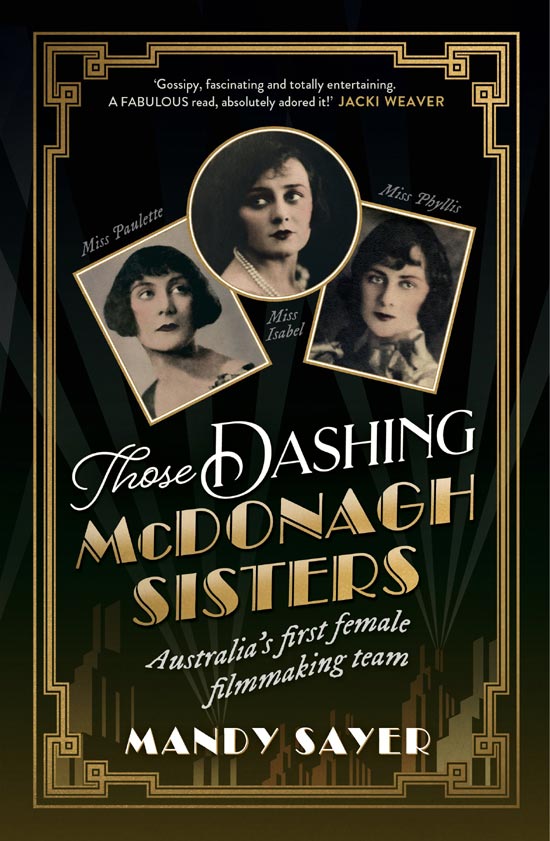
The McDonagh Sisters, Isabel, Phyllis, and Paulette, were Australian film producers active almost one hundred years ago. Based in Sydney, the trio made six films, including two documentaries, in an age of filmmaking that saw the transition from silent features to sound, or talkies.
The youngest, Paulette, was one of only five women film directors in the world. Phyllis produced, art directed, and conducted publicity. And the eldest, Isabel, under her stage name Marie Lorraine, acted superbly in all the female leads. Together, the sisters transformed Australian cinema’s preoccupations with the outback and the bush — and what they mocked as ‘haystack movies’ — into a thrilling, urban modernity.
Their work and lives are the subject of a new book, Those Dashing McDonagh Sisters: Australia’s First Female Filmmaking Team, published by UNSW Press, by Sydney based Australian writer and novelist Mandy Sayer.
The sister’s stories are a fascinating chapter in the history of both Australian film production, and Australia itself. Sayer’s book will help introduce their now often overlooked work to a new generation of people with an interest in Australian filmmaking and its past. For a glimpse of the McDonagh’s work, have a look at this trailer for their 1930 film The Cheaters.
RELATED CONTENT
Australian film, Australian literature, history, Mandy Sayer
Blurb Your Enthusiasm by Louise Willder book blurbs uncovered
21 November 2022
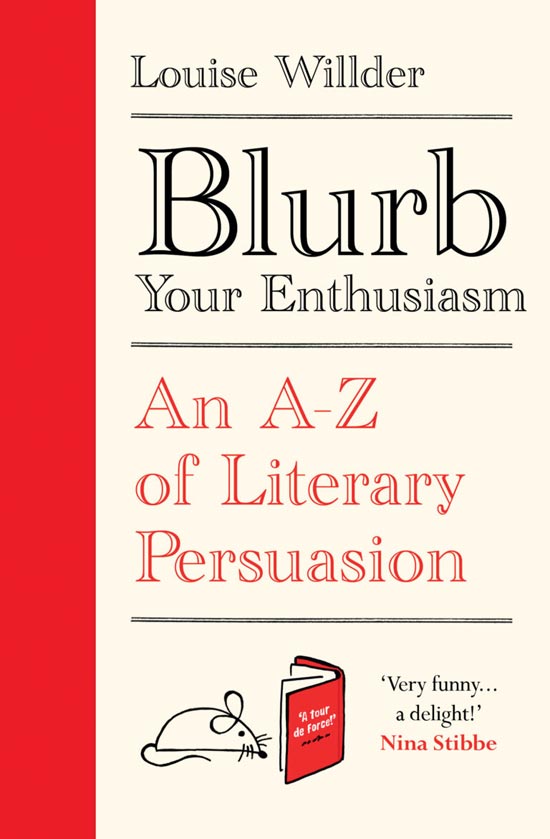
You’ve probably read more of the work of London based copywriter Louise Willder than you realise. Although her writings can be found in bookshops across the world, Willder has only ever written one book, which was published in October 2022.
Certainly Willder may not be in the same league as Elena Ferrante, Sally Rooney, or Kazuo Ishiguro, but her work may well have adorned one of their novels. Willder is a book blurb writer, and in a twenty-five year career at Penguin Books, estimates she has penned some five-thousand of these attention grabbing pitches, intended to entice someone to buy the book in their hands, having read the blurb printed on the dust jacket.
And in Blurb Your Enthusiasm (published by Simon & Schuster), Willder shares all she has learned about the craft of blurb writing:
We love the words in books — but what about the words on them? How do they work their magic? Here is a book about the ways books entice us to read them: their titles, quotes, covers and, above all, blurbs — via authors from Jane Austen to Zadie Smith, writing tricks, classic literature, bonkbusters, plot spoilers and publishing secrets. It’s nothing less than the inside story of the outside of books.
For my part, blurbs are something I take or leave. If a novel has a good enough recommendation — for instance it has been shortlisted for a literary prize — I’ll probably only settle for reading a mere outline of the story. And if I notice an endorsing blurb written by another (high profile) author, I’ll just about always ignore it. While I can’t be sure, I often get the feeling such “endorsements” have been given over sight unseen so to speak.
RELATED CONTENT
books, Louise Willder, novels, publishing
Dinner by Nagi Maehashi a cookbook selling like hot cakes
20 November 2022
Sydney based Australian chef Nagi Maehashi’s cookbook, Dinner, is quite literally selling like hot cakes. Published only six weeks ago, on 11 October 2022, the recipe collection has already outsold works by the likes of Jamie Oliver, and Yotam Ottolenghi:
Dinner is now leading the cookbook charts for 2022, with more than 74,500 copies sold. That’s three times as many sales as the second most-popular book, Jamie Oliver’s One, at 23,000 copies, according to Nielsen BookData. Even at the end of August, Maehashi had pre-orders that were more than double the first week sales of Yotam Ottolenghi’s Flavour.
RELATED CONTENT
Australia, books, Nagi Maehashi
The antilibrary of Umberto Eco a collection of unread books
18 November 2022
Late Italian medievalist, philosopher, and novelist Umberto Eco amassed a collection of some thirty-thousand books during his life, and can be seen here taking viewers on a short tour of his acquisitions.
But who has time to read that many books? Probably not even the most ardent of readers. But that’s not the reason Eco accumulated so many tomes: he wanted to create an antilibrary. And an antilibrary, as Anne-Laure Le Cunff, writing for Ness Labs explains, is not for the vain — those wanting to show off a vast book collection — but rather, for the curious:
The goal of an antilibrary is not to collect books you have read so you can proudly display them on your shelf; instead, it is to curate a highly personal collection of resources around themes you are curious about. Instead of a celebration of everything you know, an antilibrary is an ode to everything you want to explore.
For sure, the curator of any antilibrary, especially one the size of Eco’s, will not have read every title in the collection, but the books are instead present for reference, a constantly available, off-line, trove of information.
RELATED CONTENT
Digital e-books may have a shorter shelf life than paper books
18 November 2022
This might come as a surprise to anyone building an electronic collections of books. As technologies, and even computer operating systems evolve, older versions of e-books may become unreadable, possibly after only a decade or two. A certain amount of on-going reprocessing and reformatting is required to keep them up to date, and readable on newer devices:
For those of us tending libraries of digitized and born-digital books, we know that they need constant maintenance — reprocessing, reformatting, re-invigorating or they will not be readable or read. Fortunately this is what libraries do (if they are not sued to stop it). Publishers try to introduce new ideas into the public sphere. Libraries acquire these and keep them alive for generations to come.
I won’t go saying paper editions win out though. The world’s print books — even if they have a long shelf life, possibly spanning centuries — will eventually decay. Digital titles that are updated as time goes by will potentially be with us in many centuries time. There may be not too many paper books — aside from those in museum display cases — that will go that sort of distance.
RELATED CONTENT
Currowan by Bronwyn Adcock wins 2022 Walkley Book Award
17 November 2022
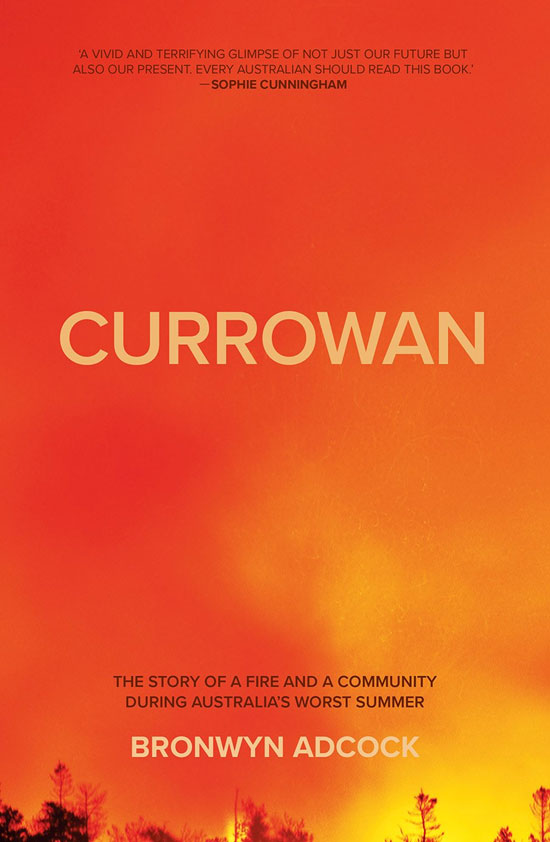
Currowan, by NSW based Australian journalist and writer Bronwyn Adcock, has been named winner of the 2022 Walkley Book Award. Published by Black Inc., Currowan is a harrowing personal account of a bush fire that burnt for seventy-four days on the NSW south coast in 2019.
The Currowan fire — ignited by a lightning strike in a remote forest and growing to engulf the New South Wales South Coast — was one of the most terrifying episodes of Australia’s Black Summer. It burnt for seventy-four days, consuming nearly 5000 square kilometres of land, destroying well over 500 homes and leaving many people shattered.
Bronwyn Adcock fled the inferno with her children. Her husband, fighting at the front, rang with a plea for help before his phone went dead, leaving her to fear — will he make it out alive?
In Currowan, Bronwyn tells her story and those of many others — what they saw, thought and felt as they battled a blaze of never-before-seen intensity. In the aftermath, there were questions — why were resources so few that many faced the flames alone? Why was there back-burning on a day of extreme fire danger? Why weren’t we better prepared?
Currowan is a portrait of tragedy, survival and the power of community. Set against the backdrop of a nation in the grip of an intensifying crisis, this immersive account of a region facing disaster is a powerful glimpse into a new, more dangerous world — and how we build resilience.
The Walkley Awards, which are presented annually, recognise excellence in Australian journalism.
RELATED CONTENT
Australian literature, books, Bronwyn Adcock, literary awards
Signs and Wonders by Delia Falconer wins 2022 Nib Literary award
16 November 2022
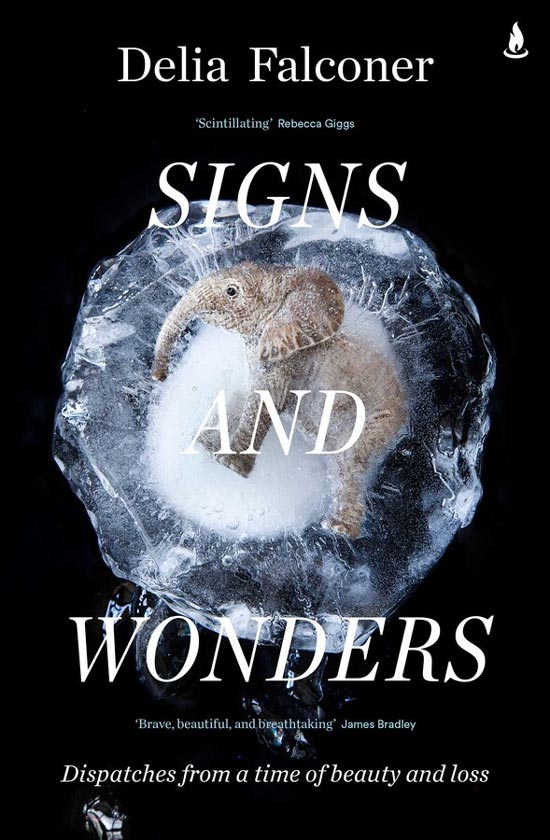
Signs and Wonders, by Delia Falconer has been named winner of the 2022 Mark and Evette Moran Nib Literary Award.
Building on Falconer’s two acclaimed essays, ‘Signs and Wonders’ and the Walkley Award-winning ‘The Opposite of Glamour’, Signs and Wonders is a pioneering examination of how we are changing our culture, language and imaginations along with our climate. Is a mammoth emerging from the permafrost beautiful or terrifying? How is our imagination affected when something that used to be ordinary — like a car windscreen smeared with insects — becomes unimaginable? What can the disappearance of the paragraph from much contemporary writing tell us about what’s happening in the modern mind?
Scientists write about a ‘great acceleration’ in human impact on the natural world. Signs and Wonders shows that we are also in a period of profound cultural acceleration, which is just as dynamic, strange, extreme and, sometimes, beautiful. Ranging from an ‘unnatural’ history of coal to the effect of a large fur seal turning up in the park below her apartment, this book is a searching and poetic examination of the ways we are thinking about how, and why, to live now.
In addition, Mortals, by Rachel E. Menzies and Ross G. Menzies, won this year’s people choice award.
The literary prize, often referred to as the Nib Award, was established in 2002, and principal sponsors are presently Mark and Evette Moran. The award recognises excellence in literary research, and is open to Australian works of any genre, fiction or non-fiction.
RELATED CONTENT
Australian literature, books, Delia Falconer, literary awards
The Best Books of 2022 from The New Yorker
12 November 2022
Twenty-twenty-two must be winding down if “best books of the year” lists are beginning to appear.
The Best Books of 2022, from the New Yorker, is the first summary I’ve seen so far, though they add the crucial “for now” provision. After all, anything could happen in the next month and a half. It’s a pretty extensive list, and includes the fiction work of two Australian authors I could see, Cold Enough for Snow by Jessica Au, and The White Girl by Tony Birch.
RELATED CONTENT
Australian literature, books, Jessica Au, literature, Tony Birch
Stage and TV for Pip Williams The Dictionary of Lost Words
12 November 2022
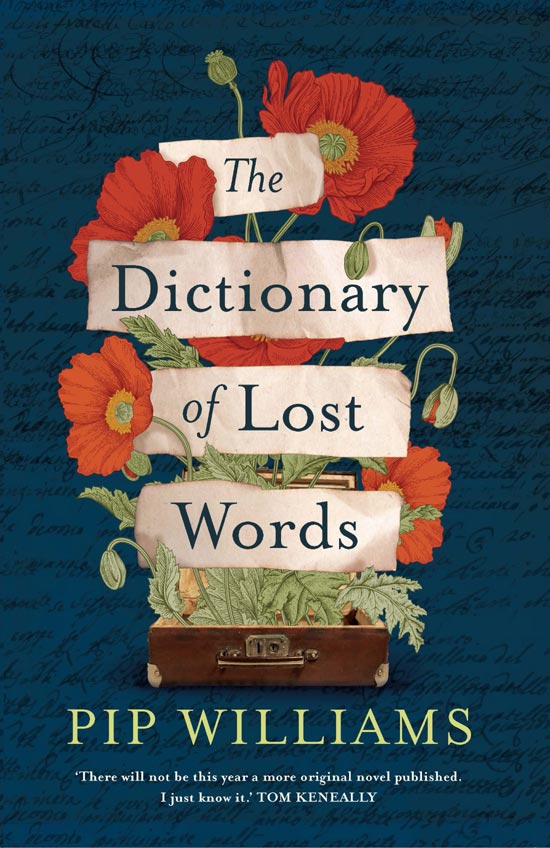
The Dictionary of Lost Words, the debut novel of Adelaide Hills, South Australia, based author Pip Williams, which I happen to be reading at the moment, is to be the subject of not one, but two separate adaptations.
A stage production, directed by Jessica Arthur, a collaboration between the State Theatre Company of South Australia and the Sydney Theatre Company, is set to open in September 2023, in Adelaide. The show then moves to Sydney, where it opens in late October 2023.
And then this week Australian television producers Lisa Scott and Rebecca Summerton announced they had acquired the TV rights to the book, and were planning a six to eight part series. At this stage it remains unknown when the show will go to air.
Set with the publishing of the first Oxford Dictionary as a backdrop, The Dictionary of Lost Words, published in March 2020 by Affirm Press, recounts the story of Esme, the daughter of one of the lexicographers working on production of the dictionary:
Esme’s place is beneath the sorting table, unseen and unheard. One day, she sees a slip containing the word bondmaid flutter to the floor unclaimed. Esme seizes the word and hides it in an old wooden trunk that belongs to her friend, Lizzie, a young servant in the big house. Esme begins to collect other words from the Scriptorium that are misplaced, discarded or have been neglected by the dictionary men. They help her make sense of the world.
Over time, Esme realises that some words are considered more important than others, and that words and meanings relating to women’s experiences often go unrecorded. She begins to collect words for another dictionary: The Dictionary of Lost Words.
RELATED CONTENT
Australian literature, books, entertainment, Pip Williams, television