
Showing all posts about film
Brooklyn, a film by John Crowley starring Saoirse Ronan
8 February 2016
Eilis Lacey (Saoirse Ronan), a young Irish woman, seems set to live an ordinary life in Enniscorthy, on the south east coast of Ireland. Aware of Eilis’ potential, and the lack of opportunities in the country in the 1950’s, older sister Rose (Fiona Glascott), arranges for her to emigrate to New York, in Brooklyn, trailer, the latest feature of John Crowley (Boy A, Closed Circuit).
Eilis is all too happy to farewell her routine job, and spiteful boss, Miss Kelly (Brid Brennan), at a local bakery, and leap into the unknown. What she doesn’t initially count on though is debilitating home sickness, and a way of life not much different to the one she left behind. Even the support of kindly Irish priest, Father Flood (Jim Broadbent), seems to be of little consolation.
Things change when Eilis falls in love with young Italian-American plumber, Tony (Emory Cohen), and finally she begins to feel that she belongs in New York. A family tragedy however sees her return to Ireland, where her mother, and friends, pressure her to remain, forcing Eilis to make a difficult choice between her old life, or a future with Tony, in her adopted homeland.
Based on the 2009 book of the same name, by Colm Tóibín, Brooklyn is an engaging, albeit mildly predictable, tale of the struggles of an immigrant making a new life for themselves, far from home. This might have been a lesser story, if it were not for Ronan’s convincing portrayal of a person who has to decide which side of the fence the grass is greener on.
Originally published Monday 8 February 2016.
RELATED CONTENT
Emory Cohen, film, Jim Broadbent, John Crowley, legacy, Saoirse Ronan
Wuher: A Star Wars Story, and other films you may not live to see
18 November 2015
If a single movie, Rogue One, a Star Wars “spin off” story, slated for release in late 2016, can be spawned by way of a few words taken from the opening crawl of A New Hope, then imagine what else seen in the six films released to date, has the potential to inspire? A point that’s not lost on current series producers, the Walt Disney Company:
And if the people at the Walt Disney Company, which bought Lucasfilm for $4 billion in 2012, have anything to say about it, the past four decades of Star Wars were merely prologue. They are making more. A lot more. The company intends to put out a new Star Wars movie every year for as long as people will buy tickets. Let me put it another way: If everything works out for Disney, and if you are (like me) old enough to have been conscious for the first Star Wars film, you will probably not live to see the last one. It’s the forever franchise.
I think Wuher, the gruff bartender in the canteen at Mos Eisley, is worthy of a film. In fact, I’m of the opinion that the significance of his role in the saga has been greatly understated so far. Read his profile. I think you’ll agree there’s far more to him than meets the eye.
Originally published Wednesday 18 November 2015.
RELATED CONTENT
film, legacy, science fiction, Star Wars
Only the Dead, a documentary by Michael Ware, Bill Guttentag
16 October 2015
“Only the dead have seen the end of war” is a phrase Greek philosopher Plato is said to have uttered the better part of two and a half thousand years ago. They are words bluntly contending, that for some, combat is an experience they will always live with, no matter how much time, or distance, they place between themselves and the battlefield.
War does not only scar the belligerents, and the hapless civilians caught up in the middle of it, but also those whose part is considered ancillary, including medics and journalists. Only the Dead tells one such story, of Australian reporter Michael Ware, and is based on video footage he recorded while working for Time Magazine in Iraq, between 2003 and 2007.
Although American lead coalition forces quickly took control of Iraq, and ousted long-time leader Saddam Hussein, when they invaded in 2003, the real struggle commenced afterwards. Groups of insurgents, some backed by al Qaeda, began engaging in guerrilla warfare, using terrifying tactics that included suicide bombings, kidnappings, and beheadings, against the occupying army.
Gradually Ware was able to make contact with members of some insurgent groups. This eventually resulted in Abu Musab al Zarqawi, who was considered one of al Qaeda’s most vicious leaders, handing him video footage of their attacks against the occupying forces. It soon became apparent to Ware that the insurgents were far more organised than was first realised.
Co-directed by American documentary maker Bill Guttentag (Death on the Job, Nanking), Only the Dead is a harrowing, first-hand, account of the war in Iraq. It is also very much a personal story, and audiences are not only witness to some of the conflict’s most disturbing, horrific moments, but also Ware’s own dark, inner, turmoil.
Originally published Friday 16 October 2015.
RELATED CONTENT
Bill Guttentag, documentary, film, legacy, Michael Ware
Captain America: The Winter Soldier, a film by Anthony and Joe Russo, with Chris Evans
9 April 2014
Steve Rogers (Chris Evans), the diminutive man who was transformed into the far sturdier Captain America as part of a World War II experiment, probably wouldn’t have had the chance read George Orwell’s dystopian novel 1984. Even if he had, it couldn’t possibly have prepared him for the state of surveillance some latter day leaders had in mind.
Corrupt government official Alexander Pierce (Robert Redford) is determined to implement a security program that will endanger more people than it claims to protect. Working with Nick Fury (Samuel L. Jackson), Black Widow (Scarlett Johansson), and Falcon (Anthony Mackie), Captain America sets about trying to thwart Pierce’s plan.
Captain America: The Winter Soldier, trailer, co-directed by Anthony and Joe Russo, ticks over at breathless pace, yet still takes the time to flesh out a little of Steve Rogers’ character, while the story’s parallels with the world we live in today are blunt. Despite the sometimes heavy overtones, as escapist fare there isn’t too much to fault here.
Originally published Wednesday 9 April 2014.
RELATED CONTENT
Anthony Russo, Chris Evans, film, Joe Russo, legacy, Samuel L. Jackson, Scarlett Johansson
Alone Time, a short film by Rod Blackhurst, with Rose Hemingway
27 September 2013
It looked like the perfect weekend away, camping in the wilderness, far from the stresses of the city and career. Until the twist at the end. That’s Alone Time, a short film by American filmmaker Rod Blackhurst, starring Rose Hemingway as Ann.
Based on actual such events by the way, but don’t read about it until you’ve watched the video.
(Thanks Sarah)
Originally published Friday 27 September 2013, with subsequent revisions, updates to lapsed URLs, etc.
RELATED CONTENT
film, legacy, Rod Blackhurst, Rose Hemingway
Trailer for Before Midnight, by Richard Linklater, with Julie Delpy, Ethan Hawke
9 April 2013
Richard Linklater, director of Dazed and Confused, A Scanner Darkly, and Bernie, collaborates once more with Julie Delpy and Ethan Hawke to make Before Midnight, the third title in the Before Sunrise and Before Sunset, series of films.
No word of an Australian release as yet (I heard 13 June whispered as a suggestion), but in the meantime check out the trailer. I can’t say what piqued my interest in these films since first seeing them on DVD eight or nine years ago. Eurorail maybe? Peneda-Gerês? County Bondi?
It looks like he missed the flight…
Originally published Tuesday 9 April 2013.
RELATED CONTENT
Ethan Hawke, film, Julie Delpy, legacy, Richard Linklater, video
Liberal Arts, a film by Josh Radnor, with Elizabeth Olsen, Richard Jenkins
10 December 2012
Say what you will about Liberal Arts degrees, ridiculed by some as glorified courses in general knowledge that effectively leave students without a real education, but like it or not, life, or the university of hard knocks, eventually makes degree holders out of us all. Even if our alma mater is one we never really graduate from.
This is something Jesse (Josh Radnor), discovers in Liberal Arts, trailer, also Radnor’s second directing effort following 2010’s Happythankyoumoreplease, when he returns to his former college for the retirement dinner of Peter Hoberg (Richard Jenkins), a professor he greatly respected during his days as an under-graduate.
Now 35, trapped in a job in New York that offers no fulfilment, and single again after another woman walked out on him, Jesse is delighted to be back on his leafy old stomping ground, at Ohio’s Kenyon College, once more. While dining later with friends of Peter’s, Jesse meets Zibby (Elizabeth Olsen), a 19 year old sophomore at the university.
In the days and weeks that follow, Jesse and Zibby discover, despite their age difference, that they have numerous shared interests through the hand written letters they exchange after Jesse returns to New York. And while both realise that a romantic attraction is forming, Jesse is reluctant to be any more than a friend to Zibby.
It is the reticence to see Jesse and Zibby, who, when in her element, appears to be wiser to the world than her older would-be beau, form a serious relationship, that takes away much of the substance Liberal Arts could have had. The question is though, was this out of a fear of offending certain viewer sensibilities, or not?
Otherwise Radnor’s second feature, even if it gets a little muddled along the way, bestows something of a general knowledge education in itself, and of course more, even if it regards so-called May to December romances as unheard of. But you haven’t lived, or languished, unless you’ve studied the Liberal Arts, and dated beyond your years, and that much it gets right.
Originally published Monday 10 December 2012, with subsequent revisions, updates to lapsed URLs, etc.
RELATED CONTENT
Allison Janney, Elizabeth Olsen, film, Josh Radnor, legacy, Richard Jenkins
Face to Face, a film by Michael Rymer, with Matthew Newton and Luke Ford
12 September 2012
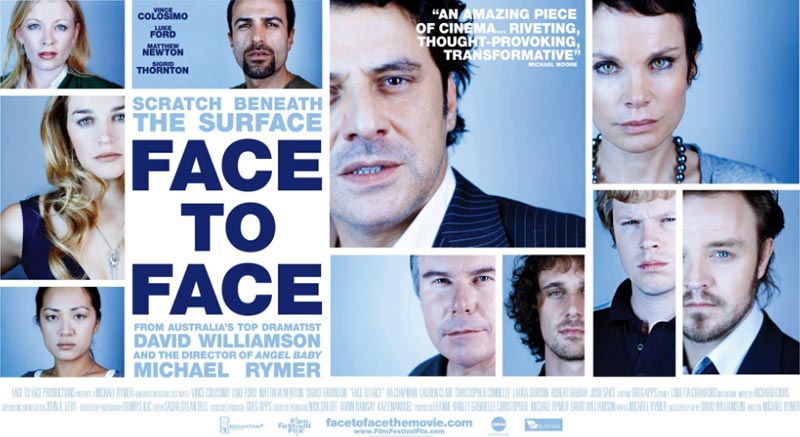
Face to Face (trailer), a drama, is the latest feature of Australian film director Michael Rymer (Perfume, Queen of the Damned), who also produced the Battlestar Galactica TV shows from 2003 to 2009. Face to Face is Rymer’s film adaptation of the play of the same name, written by Queensland based playwright David Williamson, in 2000.
Face to Face traces the proceedings of a community conference, a trial scheme that takes minor matters out of the court system, and brings together all who are party to a dispute. The process allows everyone to tell their side of the story, under the auspices of a moderator, who later drafts a resolution that binds on all involved.
Wayne (Luke Ford), a former employee of a Melbourne scaffolding company, is a hot headed young man who lost his job as result of violent outbursts and inappropriate conduct in the workplace. Luke finds himself before a community conference after ramming his ute into the car of ex-boss, Greg Baldoni (Vince Colosimo).
Wayne is supported by his mother Maureen (Lauren Clair), and best friend Barry (Josh Saks). Meanwhile Greg’s wife Claire (Sigrid Thornton), Julie (Laura Gordon) his secretary, Therese (Ra Chapman) the accountant, Richard (Chris Connelly) the foreman, and Hakim (Robert Rabiah) a worker, turn out for the company.
As the conference progresses though, Jack (Matthew Newton) who is moderating, often struggles to control tensions in the room. As the complicated series of events that led to Wayne’s outbursts work their way to the surface, tempers fray and emotions erupt, but it becomes clear there is far more to his actions than meet the eye.
For a drama that for the most part features ten people sitting in just one room for almost ninety minutes, Face to Face is utterly compelling. The key to this intrigue lies in both its strong characters, the ceaseless allure of gossip, together with the voyeuristic pleasure of witnessing people’s dirty laundry being aired in public.
In opening a can of worms that leaves just about everyone present embarrassed to a greater or lesser degree, Face to Face is a reminder that there are always two sides, maybe more, to every story. Robust performances, solid scripting, together with a deprecating humour, combine to create intense, gripping, fly on the wall style drama.
Originally published Wednesday 12 September 2012.
RELATED CONTENT
film, legacy, Luke Ford, Matthew Newton, Michael Rymer
The Way, a film by Emilio Estevez, with Martin Sheen, James Nesbitt
23 April 2012
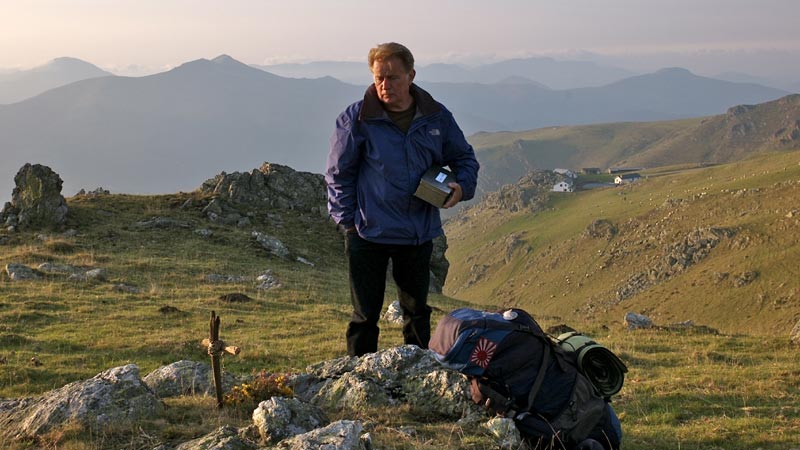
Still from The Way, directed by Emilio Estevez.
People have been walking the Camino de Santiago, or Camino, an 800 kilometre long track from the Pyrenees in France, to the Cathedral of Santiago de Compostela, in the Spanish town Galicia, for over a thousand years. Many are Christian pilgrims on spiritual retreats, while others walk the scenic pathway purely for leisure.
American eye doctor Tom Avery (Martin Sheen) finds himself on the historic trail for other reasons however, in The Way (trailer), the latest feature of American filmmaker Emilio Estevez (The War at Home, Bobby). Estevez also plays Tom’s adult son, the free-spirited Daniel, who dies during a storm soon after embarking on the long trek.
Intent on walking the path alone in remembrance of Daniel, Tom isn’t exactly overjoyed to run into the same people repeatedly. They include Joost (Yorick van Wageningen), a Dutchman trying to lose weight, Sarah (Deborah Kara Unger), a Canadian escaping from an abusive marriage, and Jack (James Nesbitt), a struggling Irish writer.
The four eventually end up walking as a group, and in their own ways are able to be of help to each other. Tom however remains the most aloof of the quartet, and the most prone to bad tempered outbursts, as he struggles to come to terms with his grief, while harbouring a lingering ambivalence towards his trekking companions.
On one hand The Way is a warming portrayal the ancient Camino, and the people who travel along it, and their quest for whatever it is that they are seeking. Many of the situations that Tom and his co-walkers find themselves in will doubtless be familiar to anyone who has spent time backpacking, regardless of where they’ve been.
Yet it’s as if the grimness of Tom’s trudge, and the varying despair of those accompanying him, wasn’t quite enough for the screenwriters, who seemed to decide the story was want of a little more tension. The solution however, mainly in the form of Tom’s frequent meltdowns, comes across as contrived, and at odds with the consoling calm of the Camino.
Originally posted Monday 23 April 2012.
RELATED CONTENT
Deborah Kara Unger, Emilio Estevez, film, James Nesbitt, legacy, Martin Sheen, Yorick van Wageningen
Burning Man, a film by Jonathan Teplitzky, with Matthew Goode, Bojana Novakovic
21 November 2011
Burning Man, trailer, a comedy drama, is the third feature of Sydney based Australian film director Jonathan Teplitzky (Better Than Sex, Gettin’ Square). Set in present day Sydney, Burning Man is partly autobiographical, based on Teplitzky’s own experiences, and explores personal loss and grief.
Tom (Matthew Goode) is a man who seems to have it all. He is a successful chef who owns a highly regarded restaurant at the iconic Bondi Beach. He is married to the beautiful Sarah (Bojana Novakovic), and lives in a cottage in a leafy city fringe suburb, which the couple share with their eight year old son, Oscar (Jack Heanly).
Tom leads a leads a tightly scheduled, chaotic, life. He’s impatient, impulsive, hot-headed, and often obnoxious. But after tragedy strikes, Tom’s life veers off the rails spectacularly, leaving him trying to put the pieces back together, and come to terms with what has happened.
In his heartbreak he seeks solace through a succession of liaisons with sex workers, women he meets randomly, and even mothers of Oscar’s friends, if he can manage it. And while friends and family including Karen (Essie Davis), and Brian (Anthony Hayes), try to help, Tom remains inconsolable.
Tom becomes ever more self-absorbed as he recalls earlier and happier days. His puzzled son, meanwhile, wonders why they live in motels instead of at home, which Tom quite abruptly sold. Not helping are unsettling illusions of fire and flame that Tom sees with disturbing regularity.
Burning Man throws audiences in the deep end with a racing opening sequence that stitches together various of the film’s key scenes. While I have no problem with non-linear narratives, L’appartement and Mulholland Drive, for instance, are great instances of the form, here the result is confusing and disorientating.
While Burning Man disparate threads eventually find a place, and even if there is a certain intrigue in trying to work out their significance, it’s at the cost of what could have been an effecting exposé into an almost destructive trauma. Solid performances, and striking camera work, especially a time-lapse like car crash scene, are however pluses.
Originally published on Monday 21 November 2011.
RELATED CONTENT
Bojana Novakovic, film, Jonathan Teplitzky, legacy, Matthew Goode, Rachel Griffiths