
Showing all posts about film
Jaloux, a film by Patrick Demers with Sophie Cadieux, Maxime Denommee
11 August 2011
Jaloux, trailer (French language), a drama thriller, is the debut feature of Montreal director Patrick Demers, who wrote the screenplay, which was largely improvised during filming, in conjunction with its three stars, Sophie Cadieux who plays Marianne, Maxime Denommée as Thomas, and Benoît Gouin as the neighbour of Thomas’ uncle.
Marianne and Thomas have been together eight years but boredom has begun to stifle their relationship. Thomas believes a weekend away at his uncle’s remote forest cabin, near Mandeville, in Quebec, will help them rediscover each other. Jaloux premiered in Australia at the 6th Canadian Film Festival in Sydney on Tuesday, 9 August, 2011.
To say Marianne and Thomas’ relationship is in strife would be an understatement. A fierce argument, which turns into a tussle, as they approach his uncle Michel’s (Daniel Gadouas) cabin, results in their car running off the gravel road into a ditch. Neither is hurt however, and they complete the trip to the nearby cabin on foot.
On reaching the cabin they are surprised to find Michel’s neighbour, Ben, has prepared a meal for them. Ben had however been expecting Michel and his girlfriend Helene (Marie-France Lambert), but after learning that Thomas is his nephew, and having taken a shine to Marianne, instead invites the couple to share the meal with him.
After a night’s heavy drinking Marianne and Thomas wake the next morning, having slept in separate parts of the house, with little memory of the evening before. Deciding a swim will help clear their heads, they wander down to the nearby lake, only to meet Ben again, much to Thomas’ annoyance, who happens to be out rowing his boat.
Not happy with the way Marianne is taking to Ben, Thomas instead decides to find a mechanic to repair their car. On his way into the local town though he, by chance, meets a cousin who he hasn’t seen in years. It is only then that Thomas comes to realise that the man claiming to be his uncle’s neighbour is in fact someone else altogether…
Jaloux is a slow burning thriller that is underscored by a simmering unease that threatens to boil over at any minute. This tension is accentuated by flashbacks and memories that may be from the night before, the week before, or possibly even months or years earlier.
But what here is real, imagined, or fantasy? While the storyline is relatively simple, what Jaloux lacks in narrative it makes up for in drama and suspense, as jealousy, lies, deceit, and guilt compound. Clichés bountiful in a story of this nature are refreshingly absent, leaving the viewer uncertain as to what exactly will happen next.
Originally published Thursday 11 August 2011.
RELATED CONTENT
Benoit Gouin, film, legacy, Maxime Denommee, Patrick Demers, Sophie Cadieux
Oranges and Sunshine, a film by Jim Loach, with Emily Watson, David Wenham
10 June 2011
Oranges and Sunshine, trailer, a drama set in 1986, is the debut feature of British TV producer Jim Loach, and is based on the book Empty Cradles by British social worker Margaret Humphreys. Her book chronicles efforts to expose the British government’s child migrants program of the 1950’s and 60’s, where over 130,000 children were forcibly sent overseas.
Many of these children — who came from struggling, or single-parent families, and sent to Australia, and other former British colonies — were under the impression their parents were dead, and that a happier life awaited them elsewhere. The reality was anything but; many were abused by their new carers, or became child labourers.
Humphreys (Emily Watson) is a Nottingham social worker caring for orphaned children. She first becomes aware British children were sent overseas when a woman from Australia asks for help tracing her mother. While searching for the woman’s mother, Humphreys uncovers numerous instances of children being sent overseas.
After learning that Nicky (Lorraine Ashbourne), a woman in a support group she convenes, has a brother Jack (Hugo Weaving), who was sent overseas as a child, Humphreys travels to Australia. There she soon meets many hundreds of others who were taken from their families, including Len (David Wenham), who is trying to find his mother.
It soon becomes apparent that it wasn’t just the children who were lied to. As Humphreys continues to reunite now adult children with their families, she learns the parents, whose children were often forcibly removed from their custody, were also lied to. They were often being told their children had been adopted locally, not sent overseas.
Humphreys’ work however is an uphill battle that takes a physical and emotional toll on her. The British and Australian governments are unhelpful. Meanwhile, the charity and church groups who took the children in are angered by the allegations of abuse levelled at them, which results in Humphreys being threatened by their supporters.
Oranges and Sunshine is an intimate and personal portrayal of a dark chapter in our history. In 2009 then Australian Prime Minister Kevin Rudd apologised to the British child migrants, or Forgotten Australians as they are also known. His British counterpart, Gordon Brown, did likewise in 2010.
A compassionately made film that is neither sentimental or sensationalistic, Oranges and Sunshine is a moving, harrowing, and emotional drama. The lid is lifted on a government policy that aimed simply to save money — care for children was cheaper in Australia than Britain — and one that had no regard at all for those the would-be program purported to be helping.
Originally published Friday 10 June 2011, with subsequent revisions, updates to lapsed URLs, etc.
RELATED CONTENT
David Wenham, Emily Watson, film, history, Hugo Weaving, Jim Loach, legacy, Lorraine Ashbourne
Get Low, a film by Aaron Schneider, with Robert Duvall, Sissy Spacek
3 June 2011
Get Low, trailer, a comedy drama, is the debut feature of American cinematographer turned film director Aaron Schneider. Collaborating with Chris Provenzano and C. Gaby Mitchell, who wrote the screenplay, Get Low explores the intriguing notion of attending your own funeral, as a living, rather than dead, participant.
Set in the late 1930’s, Get Low is based in part on the life of Felix Breazeale, or Uncle Bush as some called him, a man living in Tennessee. In 1938 Breazeale arranged a funeral party for himself — while still alive — to which eight to twelve thousand people attended.
Felix Bush (Robert Duvall) has lived alone in a cabin he built deep in the woods of Tennessee for most of his adult life. His self-imposed exile is the result of an unfortunate incident some forty years earlier. He is also the subject of all sorts of gossip, and his few visits to a nearby town, by horse drawn cart no less, attract plenty of, usually unwelcome, attention.
He never married, and has no family, but after hearing that an old acquaintance died, begins to reassess his guilt ridden past. He realises the only way to obtain redemption for his part in a long past transgression is to seek forgiveness before he eventually dies. Forgiveness of the divine kind however won’t cut it, he needs it from elsewhere.
He soon decides a funeral party, with him in attendance while still alive, is the best way to make this happen, and enlists the services of local undertaker, shifty Frank Quinn (Bill Murray), and his assistant Buddy (Lucas Black). While an unusual request, Frank is happy to accommodate Felix, given business has been on the quiet side recently.
In the course of preparations for the party, which include a radio interview, Felix is reunited with Mattie Darrow (Sissy Spacek), an old flame, who has returned to the area following the death of her husband. As Mattie learns more about Felix, and his bizarre funeral party, she realises she is linked to the event from which Felix desperately seeks absolution.
Get Low has the feel of a whodunit, as the story of what has been bothering Felix for so long slowly unfurls. It also features top notch portrayals by a host of veteran actors, especially Duval and Spacek. Murray meanwhile puts in his best performance in a long time, one with a little life, rather than his more usual dead-pan style.
A few people have been critical of the film’s ending. They feel it lacks punch or resolution. While the conclusion may be a touch otherworldly, perhaps they are not happy with the way the story unfolds gradually, reserving Felix’s confession until the finale, and the big reveal. What’s wrong with that?
Originally published Friday 3 June 2011.
RELATED CONTENT
Aaron Schneider, Bill Murray, film, legacy, Robert Duvall, Sissy Spacek
Jucy, a film by Louise Alston, with Francesca Gasteen and Cindy Nelson
14 March 2011
Jucy, trailer, a comedy/drama, is the second feature of Queensland filmmaker Louise Alston (All My Friends Are Leaving Brisbane). Alston teams up again with Leaving Brisbane writer Stephen Vagg to tell a story that is — coincidentally — inspired by the actual lives of its two stars, Francesca Gasteen who plays Lucy, and Cindy Nelson as Jackie.
Collectively they are Jucy, their variation possibly of the media penchant of naming celebrity couples by one-word nicknames, such as TomKat, in the case of Tom Cruise and wife Katie Holmes. Jucy screened at the Ritz Cinema, in Sydney, on Thursday 10 March 2011, as part of this year’s Australian Film Festival.
Jackie and Lucy have been best friends forever (BFF) since they met at school as teenagers. Now in their mid-twenties, they have — on an emotional level at least — changed little since those days. Although they don’t live together, they otherwise live out of each other’s pockets, and work together at Trash Videos, which Jackie manages.
Lucy lives in the family’s opulent harbourside apartment. Her mother has taken off to Tuscany indefinitely with a new boyfriend, leaving Lucy with younger sister Fleur (Nelle Lee). Fluer is somewhat of a control freak, who appears to have her life in order, and has taken it upon herself to sort out Lucy. This by way of ultimatum: “get a real job, or finish your degree, or move out of home!”
Tired also of the taunts served up by the people they socialise with, where they are variously referred to as “straight lesbians” or “friends with emotional benefits”, Jackie and Lucy decide things need to change. Each sets a goal in order to prove themselves to their peers. Jackie will find a boyfriend, while Lucy will seek out the job of her dreams.
And the stage production of Charlotte Bronte’s novel Jane Eyre, being planned by the amateur theatre group they belong to, looks like the way both can realise their goals. Should the show succeed, Lucy believes an acting career awaits, while Jackie has a soft spot for the play’s star, Alex (Ryan Johnson), and thinks the feeling is mutual.
Jucy lifts the lid on co-dependent relationships, platonic or otherwise, and peers inside. Here are often murky situations — to say the least — where reality is distorted — to say the least — to the point that nothing else matters. Career ambitions, relationships with other people, and any semblance of a normal life, go out the window in the name of remaining faithful to the “other half”.
Jucy ventures into some heady territory, yet keeps the tone light, and for the most part upbeat. This through the on, and off, stage antics of the Jane Eyre production, and Lee’s comedic carry on as Lucy’s domineering sister. Here’s a story that demonstrates even super close BFF’s can — sometimes — remain best friends without appearing “creepy” to the outside world.
Originally published Monday 14 March 2011, with subsequent revisions, updates to lapsed URLs, etc.
RELATED CONTENT
Australian film, Cindy Nelson, film, Francesca Gasteen, legacy, Louise Alston, Nelle Lee, Ryan Johnson
The Social Network film and what it says to bloggers, online publishers
28 December 2010
The Social Network was one of my favourite movies of 2010, needless to say it was something I looked at a couple of times. The story speaks volumes to entrepreneurs and geeks, and anyone who has an idea, or knows of one that could be improved, that others might find cool.
It was also a film, that through many of its lines, also spoke I thought, to bloggers and online publishers. While a lot of lines could be quoted in a variety of contexts, here are a few that I thought were especially relevant to writers working online.
I need to do something substantial in order to get the attention of the clubs.
The blogosphere has its own variation of the final clubs — the undergraduate social clubs of Harvard University — though such things don’t appeal to everyone… I don’t care to belong to a club that accepts people like me as members. In other words always do your own thing.
I shouldn’t have written that thing about the farm animals. That was stupid. But I was kidding for gods sakes. Doesn’t anybody have a sense of humor?
Humour is subjective… anyone who has been writing online for even a short period of time will appreciate this comment.
The internet’s not written in pencil. It’s written in ink.
Ain’t that the truth? Need I say more.
It won’t be finished. That’s the point. The way fashion’s never finished.
If you’re onto a good thing you’ll be doing far more than merely writing and posting articles.
We don’t even know what it is yet. We don’t know what it is. We don’t know what it can be. We don’t what it will be. We know that it is cool. That is a priceless asset I’m not giving up.
Never underestimate the value of cool in the rush to monetise, or turn a profit.
He was right. California’s the place we’ve gotta be.
You might already live in California, but that’s not the point, your blog could seriously take you places and you need to be ready to move with it.
We lived in farms, then we lived in cities, and now we’re gonna live on the internet!
I suspect bloggers and online publishers realised this well before Facebook came along.
Originally published Tuesday 28 December 2010, with subsequent revisions, updates to lapsed URLs, etc.
RELATED CONTENT
blogs, film, legacy, self publishing, social networks
The Social Network, a film dramatisation of the founding of Facebook, by David Fincher
29 October 2010
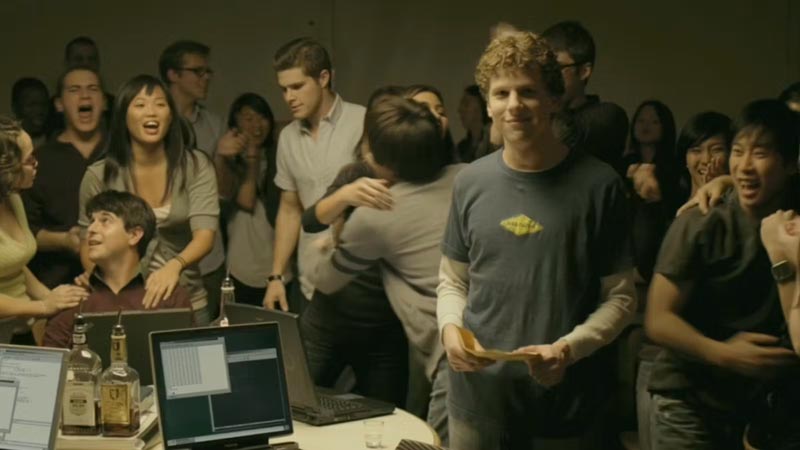
A scene from The Social Network, a film by David Fincher.
The Social Network (trailer), directed by David Fincher, is based on Ben Mezrich’s book The Accidental Billionaires, which he penned with the help of Eduardo Saverin (Andrew Garfield), one of the co-founders of social network Facebook, who later fell out with CEO Mark Zuckerberg (Jesse Eisenberg).
Bookended between numerous litigation sessions in lawyers’ offices, The Social Network pieces together the early days of Facebook through a series of flashbacks. The story focuses mainly on the roles of Zuckerberg and Saverin in creating the network, and how they dealt with raising money and profile, while fending off people claiming they had stolen the Facebook idea from them.
After his girlfriend, Erica Albright (Rooney Mara), ends their relationship, Zuckerberg, a technically brilliant but emotionally cold Harvard University computer science student, hastily builds Facemash. It’s a hot-or-not style website that compares female Harvard students with each other. Zuckerberg sources the photos Facemash needs by effortlessly hacking the databases of Harvard’s colleges.
Although Facemash is quickly shut down, word of Zuckerberg’s programming and hacking skills spread, and he’s soon approached by twins, and fellow students, Cameron and Tyler Winklevoss (both played by Armie Hammer). They have an idea for an exclusive Friendster/MySpace clone, but want to restrict membership to only those with Harvard email addresses.
They ask Zuckerberg to help, but after agreeing he instead creates the first version of Facebook, then called The Facebook. His friend and roommate, Saverin, puts up one thousand dollars to cover web hosting in return for a thirty percent share in the venture, and role of CFO.
The Facebook proves a hit with Harvard students, and other universities in the US and Britain are soon admitted to the fold. Meanwhile Napster founder Sean Parker (Justin Timberlake) hears about The Facebook and arranges hefty financial funding for Zuckerberg. Saverin however sees Parker as a threat to his influence, which quickly becomes a source of tension between him and Zuckerberg.
Any dramatisation about an organisation as ubiquitous as Facebook is certain to be of interest to a large number of people. Unlike many highly anticipated films that might play on the hype surrounding their subject matter though, The Social Network does not create false expectations.
Facebook made clear before the film’s release that neither they, nor Zuckerberg, had any involvement in the production of The Social Network. And while Zuckerberg does not present as a villain per se, his portrayal by Eisenberg is far from flattering.
Facebook has certainly had a controversial history (are stories of the early days of Friendster and MySpace anywhere near as colourful?) and it seems every other week brings news of another alleged privacy breach, or a new court action of some sort. Is it therefore a portent of things to come that the final scene plays out in a lawyer’s office?
Originally published Friday 29 October 2010.
RELATED CONTENT
Andrew Garfield, Armie Hammer, David Fincher, film, Jesse Eisenberg, legacy
Back to the future, I met my parents before they met each other
29 October 2010
Twenty-five years on and people are still asking questions about 1985’s Back To The Future. One that consistently crops up regards the apparent inability of George and Lorraine, Marty McFly’s parents, to remember him, and the part he had in bringing them together, many years earlier.
And to a degree the question makes sense. It would certainly be easy to forget a person you knew only briefly — like for a week — from thirty years earlier. But surely you’d remember anyone who played a big, and very active, part in bringing you together with your future spouse.
The conundrum is this: you tend to remember the people who brought you together in life. You’d certainly remember the person who played Johnny B Goode in such dramatic fashion at the Enchantment Under The Sea dance. And, given that Lorraine had such a crush on Marty in 1955, she’s unlikely to have forgotten him altogether.
What can change over time though are individual perceptions and memories of a person. While I doubt George and Lorraine had forgotten Marty (aka Calvin Klein) all together, they would have forgotten exactly what he looked like after a while. Twenty to thirty years is a long time to remember something like that, more so when you don’t have a photo either.
Even so though, who in their right mind is going think their child, born years after the event, could possibly have had anything to do with their meeting? Can we get back now to simply enjoying repeat screenings of this classic, without the excess analysis?
Originally published Friday 29 October 2010, with subsequent revisions, updates to lapsed URLs, etc.
RELATED CONTENT
film, legacy, physics, science, science fiction
Made in Dagenham, a film by Nigel Cole with Sally Hawkins, Rosamund Pike
25 October 2010
Made in Dagenham, trailer, is British filmmaker Nigel Cole’s dramatisation of events surrounding the 1968 strike by sewing machinists, all of who were women, at Ford Motor Company’s Dagenham assembly plant, in the east of London.
Angered after the motor vehicle manufacturer regraded their jobs as unskilled so they could be paid at the lowest possible rate, the women decided to strike for 24 hours. Their actions set in motion events that went on to pave the way for gender pay equity not only in Britain, but across much of the industrialised world.
Rita O’Grady (Sally Hawkins) a car seat upholstery machinist, lives quietly with her husband Eddie (Daniel Mays), also a Ford factory worker, and their two school-age children, in a modest apartment block near the assembly plant. Rita seems an unlikely leader or negotiator at first, after coming off second best in a confrontation with her son’s bullying teacher.
When her co-workers decide to contest the downgrading of their jobs skill classification, and demand pay equal to that of the male workers, and need a leader, Rita steps up to the plate. A meeting with the company’s management reveals the enormity of the task ahead of them though, everyone regards the concept of gender pay equity as completely alien.
While the women initially have the support of their male colleagues on the factory floor, loyalties fray as the machinists’ on-going industrial action starts to bite. This eventually results in the factory completely ceasing production, and all workers being locked out, which angers many of them.
Meanwhile Rita goes on the road drumming up support for their cause, and soon comes to the notice of the government’s straight-speaking employment minister Barbara Castle (Miranda Richardson), who intervenes in an effort to get the woman back to work. Rita also forms an unlikely friendship with Lisa Hopkins (Rosamund Pike), the wife of a Ford executive, who encourages her efforts.
Made in Dagenham is not a battle of the sexes story, but there is no missing the then male dominated senior ranks of both company and union management. While the prospect of equal pay for women seemed to be of alarm in terms of its cost for the company, union bosses appeared to be fearful of losing influence should the women succeed.
There are insights aplenty into the industrial bargaining process, the politics at play across the workshop floor, company management, and unions, not to mention private sector pressure on government ministers to achieve particular outcomes. But Made in Dagenham also explores the real meaning of gender equality, which is far more than equal pay only for men and women.
Although the portrayals of a number of the key characters here are fictitious, footage of the machinists actually involved in the 1968 strike, who speak about what happened during and after the strike, forms part of the closing credit roll. Needless to say the striking women had no idea just how far reaching the consequences of their actions would be.
Originally published Monday 25 October 2010, with subsequent revisions, updates to lapsed URLs, etc.
RELATED CONTENT
Daniel Mays, film, legacy, Miranda Richardson, Nigel Cole, Rosamund Pike, Sally Hawkins
Summer Coda, a film by Richard Gray, with Rachael Taylor, Alex Dimitriades
19 October 2010
Summer Coda, trailer, is the debut feature of Melbourne born filmmaker Richard Gray, and something he’s been working on since 2004. Gray lives and breathes film, working part time in cinemas while at school, and later studying the medium at the Victorian College of The Arts.
Set predominantly in the Mildura fruit growing region of the Australian state of Victoria, Summer Coda is the story of two people, Heidi (Rachael Taylor), and Michael (Alex Dimitriades). The two become drawn to each other, but are initially reluctant to reveal too much of themselves.
The Sydney premiere of Summer Coda took place on Monday, 18 October, 2010 at the Dendy Opera Quays, Circular Quay. This followed its Australian, and International, premiere at the Melbourne International Film Festival on 4 August 2010.
Although born in Mildura, Heidi’s lived in the American state of Nevada with her mother since age seven, after her father moved in with another woman. Now in her late twenties, news about him — the first she’s heard of her father in many years — prompts her return to Australia.
Travelling on a budget, Heidi takes to hitch-hiking to reach Mildura after flying into Melbourne, and eventually thumbs a ride with Michael, an apparently easy-going and happy orange grower. Their first exchanges are tense and guarded, but after a somewhat eventful evening in a pub, they begin opening up to each other.
Heidi soon reaches her father’s home and meets Angela (Susie Porter), the woman he abandoned her mother for. Angela, meanwhile, is wary of Heidi, believing she’s only after money. Heidi also learns she has a half-brother, Lachlan (Reef Ireland), who’s ten years younger than her.
Feeling less than welcome at her father’s home, Heidi goes to Michael’s orange orchid, and takes a job helping with the summer harvest. After bonding with the regular, and sometimes rumbustious, gang of fruit pickers who help out on the orchard each year, she learns of a tragic event in Michael’s past that he’s kept from her.
Summer Coda is a drama that may burn a little too slowly for some viewers. An action film this is not. Instead the storytelling is meticulous and deliberate, preferring to leave engaged watchers to piece together what is happening. There is little to fault in the performances, especially of the leads, Taylor, and Dimitriades, who here is worlds removed from the hotheaded Nick Poulos of Heartbreak High.
It was Gray’s intention to focus on the cinematography and soundtrack, something the beautifully filmed sequences from across the film’s settings in Melbourne, Mildura, and Reno, Nevada, attest to. But this might frustrate some viewers, who could perhaps walk away from Summer Coda believing it sacrifices substance for style.
Originally published Tuesday 19 October 2010, with subsequent revisions, updates to lapsed URLs, etc.
RELATED CONTENT
Alex Dimitriades, Australian film, film, Jacki Weaver, legacy, Rachael Taylor, Richard Gray, Susie Porter
Let Me In, a film by Matt Reeves, with Chloe Moretz, Kodi Smit-McPhee
15 October 2010
Let Me In, trailer, is American director Matt Reeves’ take of the 2008 Swedish film Let the Right One In (Låt den rätte komma in), about a lonely twelve year old boy who befriends a vampire girl of apparently the same age, after she moves in next door.
Let Me In is the latest in a line of Hollywood remakes of European films. It follows on from the likes of this year’s Neil LaBute version of the 2007 British made Death at a Funeral, or David Fincher’s upcoming interpretation of The Millennium Trilogy book series. This includes a re-rendering of The Girl with the Dragon Tattoo, which is slated for release in late 2011.
Twelve year old Owen (Kodi Smit-McPhee) lives with his separated mother (Cara Buono) in the New Mexico town of Los Alamos, but has few friends. Life at school isn’t much fun either, he is often the target of taunts and assaults from a group of older bullies. But Owen finds some solace playing puzzle games, or drifting in and out of an imaginary world in his mind.
He is intrigued by the arrival of a girl, Abby (Chloe Moretz), who seems to be his age, and a man who appears to be her father (Richard Jenkins), in the apartment next door. But Abby has a few quirks Owen can’t make sense of, such as walking around barefoot in the snow. Or the ability to quietly appear, without warning, where ever he is.
While Abby tells Owen on their first meeting they cannot be friends, they nonetheless become close. Meanwhile the town is the grip of a macabre series of murders, which has local police detective (Elias Koteas) thinking a satanic ritual killer is on the loose.
As the murders become more frequent, and begin occurring ever closer to his home though, Owen begins to realise Abby is no normal twelve year old girl. In fact he begins to suspect she might be involved. But does he report her, the only friend he has ever had, or does he instead help her?
The prospect of a remake of any reasonably highly regarded film is enough to strike dread into the minds of many film-goers, something Reeves was acutely aware of, but here, in the director of Cloverfield, is a safe pair of hands. While I haven’t seen the Swedish original, there’s little to fault.
Perhaps there have been a few teen vampire romance films too many recently, but Reeves strikes the right balance between suspense and action, horror and romance/friendship. There are plenty of moments that make Let Me In feel like another sort of story all together.
Originally published Friday 15 October 2010.
RELATED CONTENT
Cara Buono, Chloe Moretz, film, Kodi Smit-McPhee, legacy, Matt Reeves, Richard Jenkins