
Showing all posts about writing
The subtle art of asking a friend to critique your manuscript
22 September 2021
The subtle (and not so subtle) art of giving feedback to a writer, by London based Scottish cartoonist and illustrator Tom Gauld.
Writers know one of the scenarios Gauld envisages is going to play out. But it started me thinking; what if you’re an aspiring author, in other words, unpublished. How do you go about seeking feedback for the manuscript you’ve possibly spent years toiling over, when you don’t have the luxury of being able to call on an editor?
Should you ask friends? It’s probably what most people would think of. But if what a bunch of people agree to take a look, and you end up hearing nothing back? How do you interpret that? To mean your writing is subpar? That’s what I might think. On the other hand, it could be your friends are time-poor, like everyone else.
Expecting someone to read and digest one hundred thousand words and supply commentary, especially in the space of say a week, is a big ask by any standard. Perhaps a more graduated approach is a better idea, something Chicago based writer and filmmaker Jennifer Peepas suggests:
If someone volunteers to read your novel, send them the first chapter or so. If they write back to you wanting more, you have good feedback from that act alone: You wrote a good first chapter, you hooked them, they do actually want to read it, and they will likely give you notes.
That’s not a bad idea. But let’s get to the nitty-gritty. A friend has sent you their writing for critique, and it… it’s terrible. How do you respond? Without causing offence, and destroying the friendship? Freelance editor and writer Meg Dowell thinks the prospective author should put themselves in their friend’s position before sending anything. Long story short, maybe it’s best you don’t ask in the first place:
As humans often do, I turned this question back on myself and tried to imagine myself as the bad writer friend dreaming big. Would I want someone to tell me my writing kind of sucked? Or would I have a better experience continuing to write to my heart’s content and chase my dreams even if it wasn’t likely they’d come true? I’m not sure I would want to know if my writing was terrible. At least, I’m not sure I’d want to hear it from someone close to me. If I were passionate enough about writing to work hard in an attempt to make it, having my dreams crushed before my eyes … I don’t know how I would handle that.
I’m not sure anyone could tell a friend their would-be novel sucked though. More likely they’d say they really liked it, and they’re looking forward to the book launch. After all, that’s what friends are for. This is a matter requiring of further research, and follow-up. In the meantime, go and look at more of Tom Gauld’s work. It’s stellar, unlike asking friends to critique your writing.
RELATED CONTENT
No One Is Talking About This, by Patricia Lockwood
22 September 2021
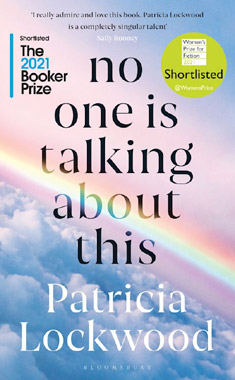
Quite possibly you’re connected to, on, or in the portal, as you read these words. The simplest definition of the portal would be the internet, though most likely there’s a world of difference between the two. The portal could perhaps be regarded as a hard core social media experience, one that all but consumes those who enter its purview. Does this somehow sound familiar?
No One Is Talking About This (published by Bloomsbury Circus, 16 February 2021), is the debut novel of American poet and author Patricia Lockwood. It tells the story of an unnamed social media influencer who is so caught up in the seemingly inescapable domain of the portal, she appears to have lost sight of what is meant to be the real world. This abruptly changes though when she receives word of a family emergency, and is forced to bring herself back to the here and now.
No One Is Talking About This, which has been named on the shortlist of the 2021 Booker Prize, places the protagonist in two starkly different realms, to the point the novel feels like two novels. In doing so, might the suggestion be the portal and real life can, in some way, co-exist? I don’t know; does a choice even exist?
RELATED CONTENT
Booker Prize, fiction, Patricia Lockwood, TBR list, writing
A review of Anuk Arudpragasam’s novel A Passage North
21 September 2021
Isn’t Bookstagram awesome? Soon after writing about Anuk Arudpragasam’s novel A Passage North, I found this eloquent review of his work written by Aloka.
While sitting in my living room I was transported to a train anywhere in the subcontinent looking out into grassy fields for miles spotted with cattle and small mud huts with thatched roofs paddy fields and streams and stations with hot chai in tiny plastic cups and samosas. Berths with thin white sheets and packed dinners leaking with yellow oil. A recent cross country train ride I did just my older son and I where we spent sometime just staring out of the window each with our own thoughts.
While I’m yet to read A Passage North, it seems to me these words capture something of the novel’s essence.
RELATED CONTENT
Anuk Arudpragasam, fiction, reviews, writing
A Passage North, by Anuk Arudpragasam
21 September 2021
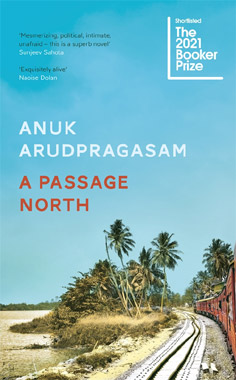
A Passage North, (published by Granta Books, 15 July 2021), is the second novel of Colombo, Sri Lanka, born novelist Anuk Arudpragasam, and was included on the Booker Prize shortlist last week. Set in the wake of the thirty year long civil war that devastated much of northern and eastern Sri Lanka, the story follows Krishan, a young Tamil man, as he makes his way from Colombo to the war ravaged north.
The death of Rana, his late grandmother’s former carer precipitates the long train journey. While travelling to Kilinochchi, Krishan contemplates an email from Anjum, his ex-girlfriend whom he met while living in Delhi, India. This message is the first contact with her in four years, after she ended the relationship to prioritise her activist interests.
Arudpragasam’s work is influenced by late Austrian writer Thomas Bernhard, and this manifests itself in the long sentences and paragraphs that are replete throughout the novel. Dialogue is non-existent, as is a focus on story and setting, and it is this less than standard approach to writing that sets A Passage North apart from other works of literature.
RELATED CONTENT
Anuk Arudpragasam, Booker Prize, fiction, TBR list, writing
The 100 Most Influential People of 2021, but where are the writers?
20 September 2021
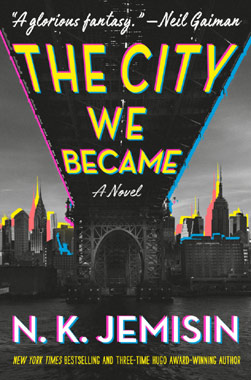
Time Magazine’s list of the Most Influential People of 2021, contains the names of icons, pioneers, titans, leaders, and innovators, but it’s only in drilling down into the artist category, that a single writer comes to light; American author N. K. Jemisin. First and foremost congratulations to Jemisin for being included, but it seems unfortunate more writers aren’t recognised here. How do we remedy this situation?
RELATED CONTENT
The Promise, by Damon Galgut
20 September 2021
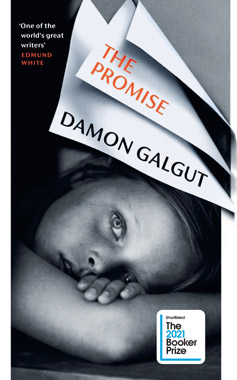
An unfulfilled, decades old promise divides an already dysfunctional South African family of five, in The Promise (published by Chatto & Windus/Penguin Random House, 17 June 2021), the ninth book by Cape Town based playwright and novelist Damon Galgut.
In her final days, family matriarch Rachel extracts an undertaking from her husband, Manie, to provide Salome, the well-off family’s long serving housekeeper, her own house on a block of land. Amor, a daughter of the Pretoria based farming family, overhears the conversation, and is determined the commitment be honoured. Her frustration grows though as the years pass, and the family fails to deliver.
The Promise, the third of Galgut’s books to be shortlisted for the Booker Prize, switches its storytelling perspective between the troubled family members. The pledge to take care of Salome is an analogy of sorts for a hopeful South Africa emerging from the apartheid years, and the challenges confronting the country in moving away from its past.
RELATED CONTENT
Booker Prize, Damon Galgut, fiction, TBR list, writing
The Fortune Men, by Nadifa Mohamed
17 September 2021
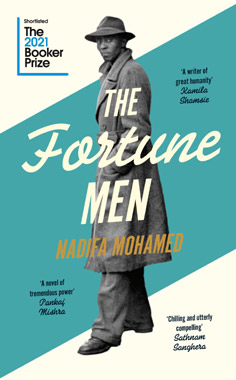
The Fortune Men (published by Viking/Penguin Random House, May 2021) is the third novel by London based author Nadifa Mohamed. The year is 1952, and Mahmood Mattan is a Somali sailor living in Tiger Bay, the docklands area of Cardiff, Wales. Married to Laura, with three children, he is something of a larrikin character and a small time criminal.
When a local shop owner is murdered one evening, and Mattan is named as a suspect, he isn’t too worried at first. He had no part in the atrocity, and is certain he would be cleared by the justice system should charges ever be laid. But when a customer present at the store at the time of the murder changes their statement, Mattan is convicted of the crime.
While later found to be a gross miscarriage of justice, from which he was posthumously exonerated, The Fortune Men is a fictionalised account of Matten’s trial and conviction. In being included in the short list of this year’s Booker Prize, Nadifa Mohamed becomes the first British Somali novelist to achieve the distinction.
RELATED CONTENT
Booker Prize, fiction, Nadifa Mohamed, TBR list, writing
This rabbit hole leads to a library of short stories
13 September 2021
Rabbit Hole, who are compiling a library of short stories, popped up on my Instagram feed the other day. Cool idea, especially when it’s difficult to access public libraries and bookshops in some places at the moment. If you’re a writer, you’re welcome to submit some work.
RELATED CONTENT
Twitter novels: when will they be the next big thing?
9 February 2009
Would you read a novel that was served in 140-character instalments? Text message novels are already proving popular, especially in Japan, and with the ever increasing reach of Twitter, it’s only a matter of time before the 140-character novelists put aside their phones and try the idea online.
In fact, there are already several people tapping together Twitter novels, though at the moment their efforts are generally being greeted with the response: “what’s the point in that?”
Then again, there are still plenty of people questioning the point of Twitter itself, so while Twitter novelist superstars are yet to emerge, writing-off the potential of the idea is definitely premature.
After all, people have built celebrity around themselves in the past by way of all sorts of seemingly unfathomable means, including webcams, YouTube, and even blogging, so it’s only a matter of time before someone comes along with an idea for a Twitter novel that has mass appeal.
“The confessions of a lovelorn sex kitten” anyone?
Among some of the 140-character novelists currently exploring Twitter as a literary medium though, thoughts of fame — or notoriety — seem to be far from their minds.
For example Nick Belardes who writes “Small Places”, which he describes as “a very compartmentalized love story”, thinks Twitter is a great environment for developing a novel, but little else:
Don’t write a novel using Twitter, but mold a novel, transform a novel using Twitter. In my opinion, Twitter isn’t a scratch pad. Any good writer should have a plan, and so should either use a completed manuscript, or a portion, as is my case. The line-by-line rebuilding of the manuscript should be challenge enough. There should be lots of note-taking, forethought, and not just random phrases thrown at readers.
Mike Diccicco, author of The Secret Life of Hamel, sees composing a novel using Twitter as a way of improving his writing skills more than anything:
No — this is about the creative challenge of trying to be interesting and engaging and telling a story under a significant constraint. Plus, after years of preaching “compression” to copywriters in my ad agency, it’s time to see if I can practice what I preach.
For many Twitter novelists the challenge lies in building up a following, and maintaining an on-going interest in the story, something however that is all too familiar to many people already pedalling their wares online.
It’s just a matter of finding the right mix of the usual ingredients, a sticky idea, some deft execution, and a little bit of the WOW factor.
Originally published Monday 9 February 2009.
RELATED CONTENT
legacy, novels, Twitter, writing
The page 69 rule for determining a book’s quality
19 September 2008
That’s right. If you’re trying to read a lot of books, how can you decide what’s worth the time investment, and what’s not? The idea is as follows: flip open a novel at page 69. If you like what you read, chances are the rest of the book should be ok.
A lot of things happen at the point of 69. (Some of them aren’t suitable for inclusion in this blog). Man walked on the moon. Bryan Adams had a summer. Evel Knievel died at the age of 69. And so, ironically enough, did Marshall McLuhan, the Canadian academic to whom we owe a (strictly innocent) relationship to the number 69. His theory of how to choose a book goes like this: first of all, read page 69. If you like it, then chances are you’ll like the rest of it too.
And therein lies a tip to authors. Make page 69 awesome, and you’ll be home free.
Originally published Friday 19 September 2008.
RELATED CONTENT