
Showing all posts about writing
The Fortune Men, by Nadifa Mohamed
17 September 2021
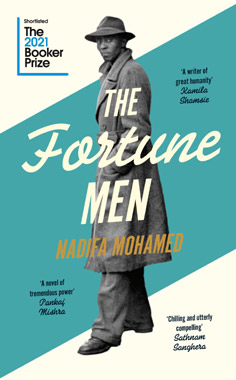
The Fortune Men (published by Viking/Penguin Random House, May 2021) is the third novel by London based author Nadifa Mohamed. The year is 1952, and Mahmood Mattan is a Somali sailor living in Tiger Bay, the docklands area of Cardiff, Wales. Married to Laura, with three children, he is something of a larrikin character and a small time criminal.
When a local shop owner is murdered one evening, and Mattan is named as a suspect, he isn’t too worried at first. He had no part in the atrocity, and is certain he would be cleared by the justice system should charges ever be laid. But when a customer present at the store at the time of the murder changes their statement, Mattan is convicted of the crime.
While later found to be a gross miscarriage of justice, from which he was posthumously exonerated, The Fortune Men is a fictionalised account of Matten’s trial and conviction. In being included in the short list of this year’s Booker Prize, Nadifa Mohamed becomes the first British Somali novelist to achieve the distinction.
RELATED CONTENT
Booker Prize, fiction, Nadifa Mohamed, TBR list, writing
This rabbit hole leads to a library of short stories
13 September 2021
Rabbit Hole, who are compiling a library of short stories, popped up on my Instagram feed the other day. Cool idea, especially when it’s difficult to access public libraries and bookshops in some places at the moment. If you’re a writer, you’re welcome to submit some work.
RELATED CONTENT
Homer frustrated writers by using the best Homeric Epithets three-thousand years ago
8 August 2011
John Barth, writing for The Atlantic:
When the eminent Italian critic and novelist Umberto Eco visited Johns Hopkins some decades ago, he spoke of the problem, for contemporary writers, of the “already said”: the circumstance that because Homer, for example, spoke so memorably in The Odyssey of the “wine-dark sea” and of “rosy-fingered Dawn,” nearly 3,000 years’ worth of poets and storytellers have had to find other images for sea and sunrise — a task that must become increasingly difficult as the repertory of possibilities is exhausted.
It’s not what you say, it’s the way you say it… writers have been struggling for three thousand years to write prose and poetry that is original.
Originally published Monday 8 August 2011, with subsequent revisions, updates to lapsed URLs, etc.
RELATED CONTENT
authors, Homer, legacy, literature, Umberto Eco, writing
Twitter novels: when will they be the next big thing?
9 February 2009
Would you read a novel that was served in 140-character instalments? Text message novels are already proving popular, especially in Japan, and with the ever increasing reach of Twitter, it’s only a matter of time before the 140-character novelists put aside their phones and try the idea online.
In fact, there are already several people tapping together Twitter novels, though at the moment their efforts are generally being greeted with the response: “what’s the point in that?”
Then again, there are still plenty of people questioning the point of Twitter itself, so while Twitter novelist superstars are yet to emerge, writing-off the potential of the idea is definitely premature.
After all, people have built celebrity around themselves in the past by way of all sorts of seemingly unfathomable means, including webcams, YouTube, and even blogging, so it’s only a matter of time before someone comes along with an idea for a Twitter novel that has mass appeal.
“The confessions of a lovelorn sex kitten” anyone?
Among some of the 140-character novelists currently exploring Twitter as a literary medium though, thoughts of fame — or notoriety — seem to be far from their minds.
For example Nick Belardes who writes “Small Places”, which he describes as “a very compartmentalized love story”, thinks Twitter is a great environment for developing a novel, but little else:
Don’t write a novel using Twitter, but mold a novel, transform a novel using Twitter. In my opinion, Twitter isn’t a scratch pad. Any good writer should have a plan, and so should either use a completed manuscript, or a portion, as is my case. The line-by-line rebuilding of the manuscript should be challenge enough. There should be lots of note-taking, forethought, and not just random phrases thrown at readers.
Mike Diccicco, author of The Secret Life of Hamel, sees composing a novel using Twitter as a way of improving his writing skills more than anything:
No — this is about the creative challenge of trying to be interesting and engaging and telling a story under a significant constraint. Plus, after years of preaching “compression” to copywriters in my ad agency, it’s time to see if I can practice what I preach.
For many Twitter novelists the challenge lies in building up a following, and maintaining an on-going interest in the story, something however that is all too familiar to many people already pedalling their wares online.
It’s just a matter of finding the right mix of the usual ingredients, a sticky idea, some deft execution, and a little bit of the WOW factor.
Originally published Monday 9 February 2009.
RELATED CONTENT
legacy, novels, Twitter, writing
The page 69 rule for determining a book’s quality
19 September 2008
That’s right. If you’re trying to read a lot of books, how can you decide what’s worth the time investment, and what’s not? The idea is as follows: flip open a novel at page 69. If you like what you read, chances are the rest of the book should be ok.
A lot of things happen at the point of 69. (Some of them aren’t suitable for inclusion in this blog). Man walked on the moon. Bryan Adams had a summer. Evel Knievel died at the age of 69. And so, ironically enough, did Marshall McLuhan, the Canadian academic to whom we owe a (strictly innocent) relationship to the number 69. His theory of how to choose a book goes like this: first of all, read page 69. If you like it, then chances are you’ll like the rest of it too.
And therein lies a tip to authors. Make page 69 awesome, and you’ll be home free.
Originally published Friday 19 September 2008.
RELATED CONTENT