
Keep Stepping, a documentary by Luke Cornish
19 April 2022
Keep Stepping, trailer, by Sydney based documentary maker Luke Cornish, which has its world premiere at the 2022 Sydney Film Festival, explores the world of competitive street dancing in Australia.
On Sydney’s urban fringe, two young women battle for a better life in the underground world of competitive street dance. Patricia, Romanian-born and hanging out for a visa, is a breakdancer. Gabi, of Chilean-Samoan heritage, pops with power. Both dream of escaping the rough hand they’ve been dealt. Will a win at Australia’s biggest dance competition Destructive Steps – in which 60 contestants compete in the preliminary rounds – be their golden ticket? Or will the external pressures of financial hardship and volatile relationships stop them from even reaching the dancefloor?
RELATED CONTENT
film, film festivals, Luke Cornish, Sydney Film Festival, trailer
Nicholas Wasiliev speaks to Stella Prize shortlist writers
19 April 2022
Sydney based author and podcaster Nicholas Wasiliev, and host of Booktopia’s podcast, Tell Me What To Read, speaks to Evelyn Araluen, Lee Lai, Eunice Andrada, Jennifer Down, and Anwen Crawford, who are five of the six authors to have work shortlisted for the 2022 Stella Prize.
RELATED CONTENT
Australian literature, literary awards, Stella Prize
Time’s absence may make the universe easier to understand
19 April 2022
Writer’s on a tight deadline might disagree, but some physicists are beginning to believe that time may not exist. It’s a heady concept that there’s no such thing as lunch at one o’clock, because there’s no such thing as time, but when scientists talk about time, it’s on a cosmic scale, not a human one, says Dr Sam Baron of the Australian Catholic University, writing for The Conversation.
In the 1980s and 1990s, many physicists became dissatisfied with string theory and came up with a range of new mathematical approaches to quantum gravity. One of the most prominent of these is loop quantum gravity, which proposes that the fabric of space and time is made of a network of extremely small discrete chunks, or “loops”. One of the remarkable aspects of loop quantum gravity is that it appears to eliminate time entirely. Loop quantum gravity is not alone in abolishing time: a number of other approaches also seem to remove time as a fundamental aspect of reality.
The absence of time in this context though may account for discrepancies in some of the theories that scientists use to understand the universe, such as general relativity, quantum mechanics, and string theory.
RELATED CONTENT
Koenji’s Manuscript Writing Cafe, for writers on deadlines
19 April 2022
If you’re a writer with a deadline you simply cannot afford to miss, then the Manuscript Writing Cafe, in Koenji, a district in the Japanese capital Tokyo, is the place for you. Upon arrival writers inform management of their writing goal for the day, be it a five-thousand word article, a couple of chapters of a novel, or a few blog posts.
Everyone in the cafe is working on a manuscript with an imminent deadline. This unique sense of tension like studying for an exam in a library will really stimulate your creative work!
Every hour a staff member will come along and check on your progress, and gently prod you if necessary. But here’s the thing, you will not be allowed to leave the cafe until you’ve finished what you set out to do. I’m not sure exactly how strictly that dictate is enforced, but not being able to go home might be pretty good motivation to meet your deadline.
RELATED CONTENT
2022 Australian Book Design Awards shortlist
19 April 2022
The 2022 Australian Book Design Awards shortlist, which can be viewed here (PDF), was announced last week. The awards celebrate the best of Australian book design, and the winners will be named at a ceremony taking place at The Craft & Co in Melbourne, on Friday 3 June 2022.
RELATED CONTENT
Australian literature, awards, design
All Twitter hashtags for Australian democracy sausage emoji
16 April 2022
The Australian federal election has been called for Saturday 21 May 2022. But election day isn’t entirely about having a say in who gets to govern Australia for the next three years, it’s also synonymous with the sausage sizzle.
While not a feature at every polling booth in Australia — they were only present at about one-third of booths in the 2013 election — partaking of a barbequed sausage after voting seems to be all that voters can talk about.
To get in the spirit though, Twitter has bought back the democracy sausage emoji, and members using any of seven election related hashtags in tweets will see the emoji appended to them. And here, listed below, are all the Twitter hashtags for the Australian democracy sausage:
- #Auspol
- #AusVotes
- #AusVotes2022
- #AusVotes22
- #DemocracySausage
- #MyFirstDemocracySausage
- #SausageSizzle
And if you’re searching for polling booths selling fund-raising democracy sausages on election day, bookmark the Democracy Sausage website.
RELATED CONTENT
Elon Musk offers to buy all Twitter shares
16 April 2022
Not content with a nine-percent stockholding in Twitter, Tesla CEO Elon Musk has made an offer to buy all shares in the social networking service. His intention is to take the company private so he can enact many of the changes he says are necessary for Twitter’s future.
His offer of US$54.20 per share values Twitter at some US$43 billion, meaning Musk would either need to borrow the money, or sell some of his Tesla shares, to complete the purchase. Musk is the largest shareholder in Tesla, owning about seventeen percent of the stock.
But CEOs selling down shares in their own company can make other investors nervous, as it sometimes signals difficult times ahead. Watch this space. I’m waiting to see what happens.
RELATED CONTENT
Elon Musk, social media, Twitter
The Opera House, a book by Peter Fitzsimons
16 April 2022
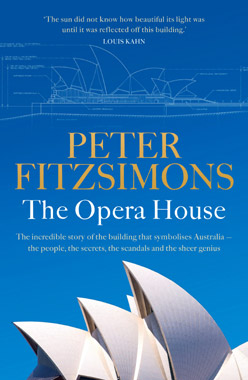
The Opera House, written by Sydney based author and journalist Peter Fitzsimons, and published by Hachette Australia, takes a behind the scenes look at the design and construction of the Sydney Opera House, one of the most recognisable buildings in the world.
On a sacred site on the land of the Gadigal people, Tubowgule, a place of gathering and storytelling for over 60,000 years, now sits the Sydney Opera House. It is a breathtaking building recognised around the world as a symbol of modern Australia. Along with the Taj Mahal and other World Heritage sites, it is celebrated for its architectural grandeur and the daring and innovation of its design. But this stunning house on what is now called Bennelong Point also holds many sorrows, secrets and scandals.
Fitzsimons also asks a question that’s perhaps overshadowed by statue of the building itself, and the dispute between Jørn Utzon, the Danish architect who drew up the original building plans, and the NSW state government:
How the hell did 1950s Sydney, surrounded by a white picket fence, eating meat and three veg, first sign off on, and then BUILD the exquisite Jewel for the Ages that is the Sydney Opera House?
Yes, now that you put it that way…
RELATED CONTENT
Publishing trends emerging from the 2022 London Bookfair
16 April 2022
Sarah Shaffi, writing for The Guardian, identifies five publishing trends to emerge from the 2022 London Bookfair, which ran from 5 to 7 April 2022.
- More books written by celebrities can be expected
- There will be increased interest in books relating to Ukraine
- Books based on Greek Myths, with a modern re-telling, will remain popular
- More novels will feature women who are threatened or in peril
- A more topical range of self-help books, for a troubled world, will be published
RELATED CONTENT
A History of the World (in Dingbats), by David Byrne
16 April 2022
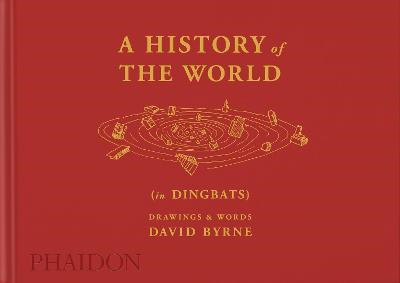
David Byrne, the Scottish-American musician, and co-founder of defunct American band Talking Heads, recently published a hardcover book, A History of the World (in Dingbats), a meditation of life during the recent pandemic imposed lockdowns.
Through striking and humorous figurative drawings, the iconic artist and musician David Byrne depicts daily life in intriguing ways. His illustrations, created while under quarantine, expand on the dingbat, a typographic ornament used to illuminate or break up blocks of text, to explore the nuances of life under lockdown and evoke the complex, global systems the pandemic cast in bright light.
RELATED CONTENT