
I Am Belmaya, the story of Belmaya Nepali
27 October 2021
Growing up in Nepal, Belmaya Nepali found little support – to put it mildly – for her ambition to become a filmmaker. Her inspiring story of overcoming all manner of obstacles and setbacks, is told in I Am Belmaya (trailer), a feature she co-directed with London based documentary maker Sue Carpenter.
RELATED CONTENT
Belmaya Nepali, film, Sue Carpenter, trailer
In the Time of Foxes, by Jo Lennan
27 October 2021
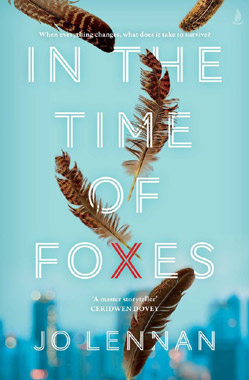
I can’t say I’m thankful for everything the Australian Prime Minister may do, but the Prime Minister’s Literary Awards I can place in the positive category. Not only do the awards send some much needed recognition the way of Australian writers, they’ve also put some titles I was previously unaware of before my eyes.
In the Time of Foxes (published by Simon & Schuster, May 2020), by Sydney based Australian writer Jo Lennan is one such example. Somehow I seemed to miss seeing this title on the bustling Bookstagram, but it has been shortlisted for this year’s Prime Minister’s Literary Awards. Foxes are perceived to be devious yet shrewd, traits the characters featured in this thirteen short story collection share. But each of them needs more than street-smarts as they attempt to navigate the places and circumstances they find themselves in.
Places ranging from Hackney, in London’s East, Tokyo, and a cafe in Sydney. In nearly every story foxes make an appearance in some way, though perhaps they are absent in the tale set on Mars, as in the red planet. Here a journalist seems to be in trouble of some sort, and in the absence of a nearby fox, possibly needs to think like one, if he is to survive.
RELATED CONTENT
fiction, Jo Lennan, TBR list, writing
Last Night in Soho movie poster
26 October 2021
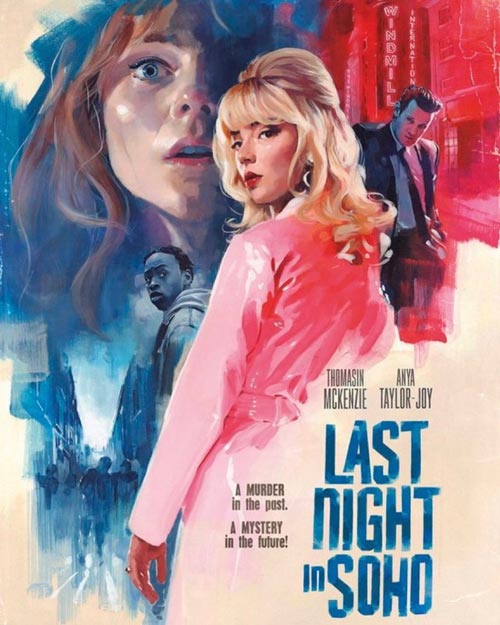
I don’t know what the film itself is like, but Last Night in Soho (trailer) by English actor and filmmaker Edgar Wright (think Shawn of the Dead) brings the London of the swinging sixties in all its west-end nightclub glory to the big screen. But isn’t the vintage style movie poster, designed by British artist and portrait painter James Paterson, stunning?
Also: a selection of Edgar Wright’s favourite fan artworks based on his films.
RELATED CONTENT
Edgar Wright, film, James Paterson, movie posters, posters
Marilou Is Everywhere, by Sarah Elaine Smith
26 October 2021
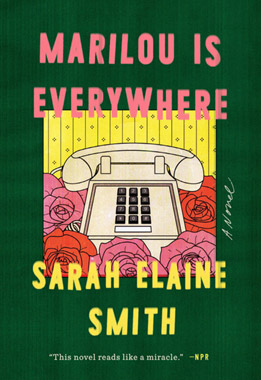
Fourteen year old Cindy leads a brutally unhappy life. Her parents are elsewhere, leaving Cindy in the care of her older brothers, who have little interest – to say the least – in looking after her. But when another local teenager, Jude, goes missing, Cindy perversely sees an opportunity to improve her lot, in Marilou Is Everywhere (published by Penguin Books Australia, 28 September 2021), the debut novel of American author Sarah Elaine Smith.
Jude’s mother Bernadette, afflicted by alcoholism and mental illness, seems unaware her daughter vanished on a camping trip with friends, and unwittingly accepts Cindy as a surrogate. While Cindy is fully aware her charade is all shades of wrong, her longing for the presence of a loving parent, and a happy, stable, family life, is far more compelling.
Michael Schaub, writing for NPR, describes Marilou Is Everywhere as “a novel of stunning emotional intelligence, and Cindy an unforgettable character, but it’s Smith’s writing that’s the real star of the book. Her language is hypnotic and enchanting, with lines that read like poetry.” Sometimes it’s not so much the story, as the way it’s written, that draws me to a book, so this is a title I look forward to reading.
RELATED CONTENT
fiction, Sarah Elaine Smith, TBR list, writing
The Prime Minister’s Literary Awards 2021 shortlist
25 October 2021
The shortlist for the (Australian) Prime Minister’s Literary Awards was unveiled last week. The awards recognise a broad spectrum of Australian writing, including fiction, non-fiction, poetry, Australian history, young adult, and children’s literature. A generous A$80,000 prize (tax free) is on offer to the overall winner, a nice shot in the arm for someone’s future writing endeavours, while all shortlisted authors receive $5,000 each.
Andrew Pippos, Evie Wyld, and Amanda Lohrey, are among contenders in the fiction category. The winner will be announced in early December, 2021.
RELATED CONTENT
Australian writing, literature
A Hero, a new film by Asghar Farhadi
25 October 2021
A Hero (teaser) is the latest feature from Iranian film director Asghar Farhadi. Variety describes the new film thusly:
[A Hero] is the story of Rahim (Amir Jadidi), who is in prison for a debt that he was unable to pay. During a two-day leave, an act of kindness provides him with an opportunity to convince his creditor to withdraw the complaint so he can go free, but not everything goes as planned.
But not everything goes as planned… this is the hallmark of Farhadi’s work. A relatively minor incident occurs. Those in the vicinity scramble to cover their tracks because they have something to hide. But it’s too late, and from there things quickly spiral out of control. If you’re new to Farhadi’s films I suggest you look at About Elly, A Separation, and The Past to get started.
RELATED CONTENT
No. 91/92: A Parisian Bus Diary, by Lauren Elkin
25 October 2021
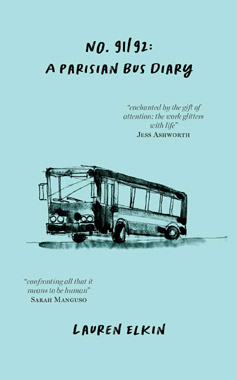
It’s not exactly fiction, but I couldn’t go passed the concept behind No. 91/92: A Parisian Bus Diary (published by Tablo Tales, 2021), written by London based American-French author Lauren Elkin. Partly because it’s sometimes the way I use my phone – though not so much for keeping a dairy of what I see and hear on my travels on public transport – and partly because I think it’s such great idea.
For seven months, between September 2014 and May 2015, using the notes app on her iPhone, while commuting on the number ninety-one and ninety-two buses, to a teaching job, Elkin tapped in observations she made along the way. Perhaps not the way most people might use their smartphones, but Elkin’s aim was “to observe the world through the screen of my phone, rather than to use my phone to distract myself from the world.”
It makes me think, what if a copy of this book were given to every commuter? Might it prompt one or two people to think about how they spend their travel time, and who knows, consider using it differently, more – dare I say it – productively? And potentially end up a published author as a result: how does that sound for an enticement? It’s surprising how much is going on in the world, when we tune into it.
RELATED CONTENT
Lauren Elkin, TBR list, writing
Malignant trailer
23 October 2021
It’s been a long week. I think this calls for a quiet night in, watching a nice movie. Do you think Malignant (trailer), the latest feature from James Wan, starring Annabelle Wallis, is a good choice?
RELATED CONTENT
film, James Wan, trailer, video
Silverchair will not be reforming: Daniel Johns
23 October 2021
Daniel Johns, lead singer of the defunct NSW Central Coast based indie rock act Silverchair, speaking on Channel Ten’s The Project, said the band will not be reforming, and he has no intention of performing live again. For anyone not around at the time, Silverchair was a defining act in Australian music.
He said he had struggled to shut down the persistent rumours that Silverchair, who split in 2011, would one day reform. “I was like, ‘This is really starting to effect my mental health’. Because I am saying ‘that’s it’, and every time I try to tell the truth, someone told a lie,” he told The Project. “So I was like, ‘I wouldn’t get Silverchair back together with a gun to my head for $1 million’. Maybe that was too harsh in hindsight.”
Hope springs eternal I think. In a note posted to Silverchair’s Facebook page in May 2011, the band said they were going into “indefinite hibernation.” It might have suggested to some fans a return was on the cards at some point. John’s conversation with The Project can be streamed here until about 20 January 2022.
RELATED CONTENT
Boundless Indigenous Writer’s Mentorship 2022
22 October 2021
Applications are open for the 2022 Boundless Indigenous Writer’s Mentorship, a partnership between Writing NSW and Text Publishing. Submissions close on Monday 22 November 2021.
The mentorship is awarded annually to an unpublished Indigenous writer who has made substantial progress on a work of fiction or non-fiction. The intention of the program is to support the writer to develop their manuscript and to facilitate a pathway to publication.
RELATED CONTENT