
Everyone in This Room Will Someday Be Dead, by Emily Austin
14 September 2021
Gilda, a woman in her late twenties, is a person with a few problems. She has a dread of death. She’s depressed. So much so she can’t deal with washing the dishes, showering, or even turning up for work. Unsurprisingly then she finds herself seeking another job, and is inadvertently hired as a receptionist at a Catholic church.
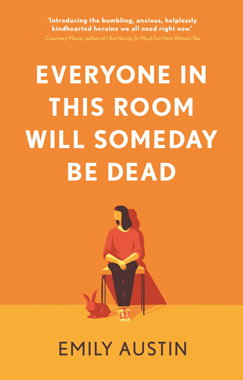
But Gilda is not Catholic, nor is she even religious. She is also gay. In addition though to lying about who she is, and pretending to be familiar with the workings of the Church, she also becomes obsessed with her late predecessor, Grace. Certain her passing was no accident, Gilda commences her own investigation into Grace’s death.
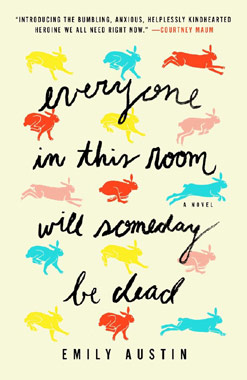
Could then Everyone in This Room Will Someday Be Dead, (published by Allen & Unwin, August 2021) possibly have a more apt title? Early reviews for the debut novel of Canadian author Emily Austin look promising. Buzzfeed described it as “the perfect blend of macabre and funny“, while The Skinny found it “funny, dark and harrowing.”
RELATED CONTENT
books, Emily Austin, fiction, literature, novels, TBR list
Redhead by the Side of the Road, by Anne Tyler
13 September 2021
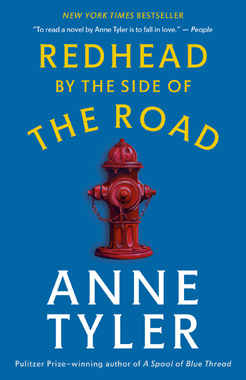
Now I’m judging books by their titles, but as a redhead, how could I go passed the latest novel by American author Anne Tyler: Redhead by the Side of the Road (published by Penguin Books Australia, 2021). The protagonist, forty-something Micah, is a creature of habit; you could set your watch by his routines.
By day he works as a freelance computer technician, and come evening looks after the apartment block he lives in. He has a woman friend, and turns in each night at ten o’clock. But when his better half tells him she’s about to be evicted from her place, and a teenage boy arrives at the door, saying he’s his son, Micah’s ordered life is plunged into turmoil.
From the little I’ve read about the book so far, it seems there’s no actual redhead character in the story, but best I say no more on the count. Coming in at about one hundred and seventy eight pages, Redhead by the Side of the Road is a shorter read though, which sometimes is exactly what you want.
RELATED CONTENT
Anne Tyler, books, fiction, literature, novels, TBR list
This rabbit hole leads to a library of short stories
13 September 2021
Rabbit Hole, who are compiling a library of short stories, popped up on my Instagram feed the other day. Cool idea, especially when it’s difficult to access public libraries and bookshops in some places at the moment. If you’re a writer, you’re welcome to submit some work.
RELATED CONTENT
Common People, by Tony Birch
13 September 2021
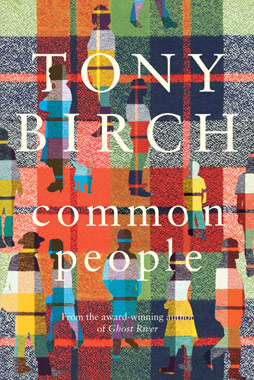
Common People (published by University of Queensland Press, July 2017), is a collection of short stories by award winning Australian author Tony Birch. Other of his works, including Blood was shortlisted for the Miles Franklin Literary Award in 2012, while The White Girl, was named winner of the 2020 NSW Premier’s Award for Indigenous Writing.
Through this collection of short stories, Birch casts a light on facets of day to day life most of us don’t see, or prefer to ignore. Birch’s characters are mainly Indigenous Australians who may find themselves on society’s fringes because of health, race, unemployment, or addition issues. But their lot is not hopeless, as they strive to persevere and overcome.
RELATED CONTENT
Australian writing, fiction, short stories, TBR list, Tony Birch
Film of the last Tasmanian tiger colourised
10 September 2021
The last thylacine, a carnivorous marsupial, usually known as the Tasmanian tiger, died in captivity in 1936 in Hobart’s zoo. Here’s footage filmed of Benjamin, as he was named, originally recorded in 1933, and recently colourised to mark National Threatened Species Day, earlier this week on Tuesday.
It’s horrifying to think Benjamin died as a result of neglect, locked out of a shelter overnight that would have offered him protection from the Apple Isle’s extremes of weather. The video pretty much says it all, in regards to his living conditions though.
RELATED CONTENT
Tasmania, Tasmanian tiger, video
Spencer, starring Kristen Stewart
9 September 2021
I’m loving Kristen Stewart’s work post The Twilight Saga. Clouds of Sils Maria, and Personal Shopper, are two stand-outs for me, but if the trailer/teaser for Spencer is any indication, it looks like she well and truly out does herself.
Set over three days at Sandringham, the Norfolk estate of the British royal family in 1991, Princess Diana makes the decision to end her marriage to Prince Charles, as she spends Christmas with her in-laws.
But Xan Brooks, writing for The Guardian, suggests Spencer may not be a film for monarchists:
No doubt it took an outsider to make a film that’s as un-reverential as Spencer, which dares to examine the royals as if they were specimens under glass. At heart, of course, Larraín and Knight’s tale is utterly preposterous. It’s a tragedy about a spoiled princess who lashes out at the servants; a thriller about a woman who has only 10 minutes to get into her dress before Christmas dinner is served. But how else do you play it? The monarchy itself is preposterous.
RELATED CONTENT
Some suggested reading for September
9 September 2021
A new-ish month, a new selection of suggested reading from the ABC Arts’ monthly book column. I’m liking the sounds of Things We See in the Light, by Sydney based Australian writer Amal Awad. Set in Sydney’s inner west, and loosely related to two of Awad’s earlier books, it tells the story of Sahar, who returns to Sydney after leaving her husband of eight years in Jordan. But it is an experience Sahar is reluctant to discuss with her friends, even as she becomes ever more settled in Sydney.
RELATED CONTENT
Amal Awad, books, literature, novels
Beautiful World, Where Are You, by Sally Rooney
9 September 2021
Beautiful World, Where Are You (published by Faber/Allen & Unwin) is the third novel by Irish author Sally Rooney. Alice and Eileen are old friends who are young, but not that young. They often exchange long emails as they attempt to put the world to rights, and make sense of their love lives. Alice, a famous novelist, asks Felix, a warehouse worker, to accompany her on a holiday to Rome.
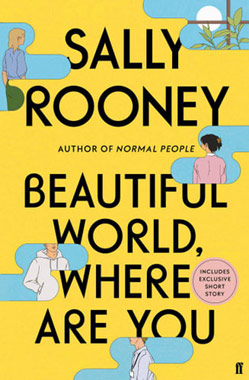
Eileen, a literary assistant, who lives in Dublin, has recently ended a relationship and has begun flirting with Simon, an old childhood friend. The two women haven’t seen each other in many years, so when they eventually meet face to face, they find their perceptions of each other – impressions generated by way of their email correspondences – are in sharp contrast to reality.
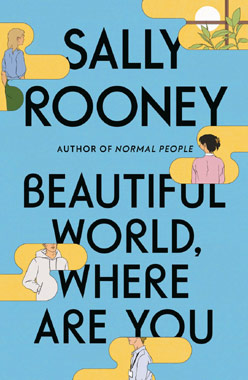
Oh to be a fly on the wall witnessing that meeting. Beautiful World, Where Are You has been published in two editions. The regular edition sports a blur cover, while the yellow cover book is a special edition hardback with a bonus short story. Another addition to the to-be-read list I think.
RELATED CONTENT
books, fiction, literature, novels, Sally Rooney, TBR list
The Man From Snowy River was Aboriginal: Anthony Sharwood
8 September 2021
In his new book, The Brumby Wars, Australian journalist and radio and TV presenter Anthony Sharwood contends there is “overwhelming evidence” the subject of Banjo Patterson’s 1890 poem The Man from Snowy River, was Aboriginal.
Patterson’s iconic verse recounts the story of a lone rancher who succeeds in capturing a racehorse who had absconded with a herd of brumbies, or wild horses. Sharwood says only indigenous ranchers worked in the area where the poem is set.
He has studied the topography of the poem: “the pine-covered ridges,” the flint stones, the “ragged and craggy battlements” of Kosciuszko, and says they all point to the location of the poem around Byadbo in the New South. The Welsh side, not the Victorian. Byadbo is the only part of the mountains with “anything remotely resembling pine-covered ridges,” he writes, and the only place with flint rocks and jagged peaks, rather than smooth ones. If the trip happened there, it is an area where all the ranchers were indigenous, he says.
Sharwood believes Patterson presented the rancher as being of European descent to appease the literary tastes of the late nineteenth century.
RELATED CONTENT
Anthony Sharwood, Australian writing, books, literature
After Story, by Larissa Behrendt
8 September 2021
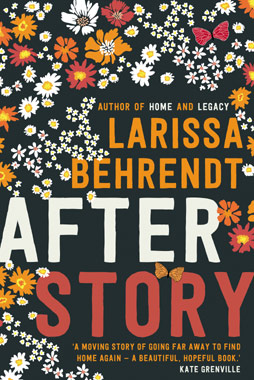
In After Story (published by University of Queensland Press, July 2021), the latest novel by Sydney based Australian author Larissa Behrendt, Jasmine, an Indigenous lawyer, is feeling rundown after an intense case. Della, her mother, meanwhile is struggling following the death of her aunt, and a former partner.
Jasmine believes it would do Della – who’s barely ventured beyond the small rural town where she lives – the world of good to go on an overseas holiday. An avid reader, Jasmine has always wanted to see the places where writers such as Jane Austen, and Virginia Woolf lived and worked, so they set off for England.
Jasmine has hopes the holiday will restore the somewhat neglected mother-daughter relationship. However the disappearance of a child in London’s Hampstead Heath, forces Jasmine and Della to relive the trauma the family suffered when Jasmine’s older sister vanished twenty-five years earlier.
RELATED CONTENT
Australian writing, books, fiction, Larissa Behrendt, literature, novels, TBR list