
Showing all posts about artificial intelligence
AI Pin by Humane pricked by poor user reviews
15 April 2024
Fans of Star Trek series The Next Generation will be familiar with the communication devices crew members used. Or should I say: wore. The small, yet high powered, long range devices, were typically attached to the shirt of a crew person’s uniform.
With a mere tap, those on the surface of a planet could contact their vessel, which was usually somewhere in orbit, and speak to whomever they desired. Instantly, and with perfect clarity. What Star Trek fan didn’t want to own such a gizmo? A wearable that actually, really, worked?
For a time, it looked like Star Trek fans might see science fiction become fact. In March 2023 word seeped out that Imran Chaudhri and Bethany Bongiorno, both former Apple employees, were developing, through new venture, Humane, a device reminiscent of the venerable communicator.
Chaudhri and Bongiorno intended their device, powered by AI, and aptly named AI Pin, to be far more than a simple means of two-way communication though. In addition to making phone calls, the AI Pin can send messages, make appointments, take notes, answer questions, take photos, and record video, among other things. In fact, I’m surprised Star Trek creators never beefed up their wearable communicators, considering the devices would have had several hundred years of technological development behind them, by the time of the twenty-fourth century.
But weeks ago, after a year of hype and anticipation, tech journalists were given AI Pins test units to try out. Their experiences, however, have not been much to write home about. Humane claimed the AI Pin will replace the smartphone, but as David Pierce, consumer tech writer for The Verge found, the device is presently in no danger of replacing any phone, let alone a smartphone:
I’d estimate that half the time I tried to call someone, it simply didn’t call. Half the time someone called me, the AI Pin would kick it straight to voicemail without even ringing. After many days of testing, the one and only thing I can truly rely on the AI Pin to do is tell me the time.
Making phone calls (perhaps) isn’t the AI Pin’s only capability. It is, as noted above, meant to do all sorts of other things. Answering questions, that might otherwise be asked of a search engine, is one of them. But Cherlynn Low, writing for Engadget, struggled even with this:
When the AI Pin did understand me and answer correctly, it usually took a few seconds to reply, in which time I could have already gotten the same results on my phone. For a few things, like adding items to my shopping list or converting Canadian dollars to USD, it performed adequately. But “adequate” seems to be the best case scenario.
The AI Pin does not have a screen. Instead it projects information onto your hand. Your hand also doubles as a keyboard, which is needed to enter a passcode to unlock the device. This sounds well and good in theory, but practice is another matter, as Julian Chokkattu, Wired’s review editor, notes:
I’m going to say it now: Humane’s laser projector display is never going to take off as a viable method of interacting with a gadget. It’s overly sensitive and slow to navigate. When the projection lands on your palm, you have to tilt your hand around in a circular motion to scroll through the icons until you land on the one you want to select. But tilt too much, and it moves past the icon you want, landing on the thing next to it. It’s just plain annoying. Using the projected interface to run through old text messages is also a chore — and yes, you can ask the Ai Pin to read your messages, but that’s just not going to work all the time.
It’s fair to say early reviews are not encouraging. Which is disappointing, as I had high hopes for the concept. I’d watched Chaudhri and Bongiorno’s various presentations, and was impressed by the potential of the device. But I noted many of the trials we saw were conducted indoors, in relatively quiet environments. Which made me wonder; how might the device perform outside, in stormy conditions? Could you hear what a caller was saying? Could they hear you? Of this I am not sure.
It seems to me AI Pin shipped too soon. The device just seems to have too many problems for one deemed market ready. But these are early days, for both AI Pin, and the AI technologies that underpin it, so perhaps a device that performs to expectations, will eventually come forth.
RELATED CONTENT
artificial intelligence, smartphones, technology
Independent publishers jeopardised by Google search changes
8 April 2024
Google seems to have it in for small, and or independent publications and blogs… Google: whatever did we do to you?
Changes last month — known as core updates, which occur regularly — to the way the search giant indexes and ranks websites on search results, have seen scads of sites excluded from the listings. Google claimed one goal of recent core updates was to remove “low quality websites” from the rankings. This may have happened, but they’ve also taken out numerous sites publishing high quality content, in the process.
But some publishers found themselves out in the cold about six months ago, following the September 2023 core update. Retro Dodo, a UK based website that tests and reviews retro gaming products, has seen a sharp decline in traffic since then, something that threatens to wipe out the publication, according to Retro Dodo founder, Brandon Saltalamacchia:
Since September 2023, Google has hidden our site from millions of retro gamers, reducing our organic traffic and revenue by 85% and causing our business to be on the edge of going under.
Retro Dodo is not alone. HouseFresh, also based in Britain, is a publication assessing and writing about in-home air purifying products, has had the same experience. But that’s not all. HouseFresh has discovered that search results for the products they write about have been supplanted by lists compiled by other publishers, apparently based on recommendations supplied by people who have purchased the products in question.
There’s nothing wrong with user recommendations — many of us rely on them when considering a purchase — but the recommendations appearing in the search results suggest these products have been individually tested and reviewed by the publisher, when in fact they have not:
Savvy SEOs at big media publishers (or third-party vendors hired by them) realized that they could create pages for ‘best of’ product recommendations without the need to invest any time or effort in actually testing and reviewing the products first. So, they peppered their pages with references to a ‘rigorous testing process,’ their ‘lab team,’ subject matter experts ‘they collaborated with,’ and complicated methodologies that seem impressive at a cursory look.
This doesn’t look to me like low quality content has been removed from search results. And it’s only going to get worse. News broke recently of a deal between Google and news aggregation social network, Reddit, which will see Google granted access to Reddit’s content. This, we are told, will assist the search engine in the “training” of its AI models.
As if there’s not enough fluff in search results, it’s now going to be polluted with AI produced copy. Reddit is great when it comes to seeking out anecdotal information, or the opinions of others in regards to particular goods or services. Or to find out why the sirens of emergency service vehicles might be blaring in the neighbourhood. But as the basis of solid information for potential search query results? I’m not so sure.
There’s also the point that the Reddit members who wrote much of the content that’s being handed over to Google, will not see any recompense for their efforts. Unless perhaps they are, or will soon be, Reddit shareholders.
So what’s the way forward then for people simply seeking accurate information in response to a search engine query? There are of course alternatives, subscription search service Kagi being among them, but it seems to me many will stay with what they know.
And what’s the way forward for the small independent publishers, whose livelihoods have been impacted, by these recent changes? That’s not so clear at the moment. They might see some traffic from other search engines, and other channels, but hardly enough to keep their operations viable. One can only hope the big search players come to their senses, but that sadly seems like a big ask.
RELATED CONTENT
artificial intelligence, publishing, technology, trends
An app that points to centre of the Milky Way galaxy
26 March 2024

Image courtesy of Pexels.
Tangentially related to my previous post… product designer and technologist Matt Webb has created an app, named Galactic Compass (link to Apple app store), that points to the centre of the galaxy.
When on the (far less light polluted) NSW Central Coast, I can kind of look down from the tail of the constellation Scorpius (the scorpion), and be observing the right patch of the night sky.
When back amongst the super bright lights of Sydney though, that can be a little trickier. Like, find a star, any star, let alone the Scorpius constellation.
Read also Galactic Compass’ origin/development story, the app was built with help from ChatGPT.
RELATED CONTENT
artificial intelligence, astronomy, Milky Way, science, technology
Apple cans electric car project, steps up focus on AI
29 February 2024
Mark Gurman, writing for Bloomberg:
Apple Inc. is canceling a decadelong effort to build an electric car, according to people with knowledge of the matter, abandoning one of the most ambitious projects in the history of the company.
Apple workers involved in the EV project will move to the artificial intelligence division (AI). I’m no expert in matters Apple, but the electric car project never seemed to feel quite right for the company.
RELATED CONTENT
artificial intelligence, technology, trends
Screenwriters strike win seen as victory over generative AI
28 September 2023
The recent long running strike by members of the Writers Guild of America (WGA) in the United States, has ended. But the settlement secured by the WGA not only means fairer pay and conditions for screenwriters, it is also seen as a victory over Generative AI technologies, which were being used as a form of leverage against the striking writers.
At a moment when the prospect of executives and managers using software automation to undermine work in professions everywhere loomed large, the strike became something of a proxy battle of humans vs. AI. It was a battle that most of the public was eager to see the writers win.
RELATED CONTENT
artificial intelligence, current affairs, writers
Publishing contracts that allow AI chatbots to learn from books
29 July 2023
A few weeks ago, I wrote about two authors, Mona Awad and Paul Tremblay, who had filed a law suit against OpenAI, the developer of ChatGPT. Awad and Tremblay were claiming books they had written were being used to help “train” the AI powered chatbot. They say this had happened without their prior knowledge or permission.
It now looks like there may be a solution to this problem, but not perhaps the one writers have been seeking. According to a tweet by the Australian Society of Authors (ASA), some book publishers in the United States are adding clauses to their publishing contracts, allowing the works of authors to be used to train generative chatbots:
We know that some terms of service in publishing have already included clauses allowing the use of authors’ work to train AI and we are now hearing that authors in the US are being asked by publishers to agree to clauses which allow their work to be used to train generative AI.
That’s sure as hell one way to “solve” the problem. But I wonder if authors agreeing to their works being used in this fashion are being offered additional remuneration? And what of writers who disagree with such a proviso? Do their works go unpublished?
RELATED CONTENT
artificial intelligence, books, publishing, technology
Can AI avatars of dead loved ones ease the grief of death?
24 July 2023
Special relatively and cosmic consciousnesses may one day possibly, maybe, precipitate interactions (of who knows what sort) with deceased family and friends. But that day, if it ever arrives, will be in the far, far, distant future. The idea though of making contact with the dead is fantastical, but nonetheless one which has probably preoccupied people since the dawn of time.
And seeking comfort, following the death of someone close, may be why some people give the idea thought. Perhaps a deceased near and dear could somehow alleviate the grief of those left behind, if only there were a way to reach them. And possibly some people have found a way to make this happen, by way of LLM chat bots such as ChatGPT, says Aimee Pearcy, writing for The Guardian:
At the peak of the early buzz surrounding ChatGPT in March, [Sunshine] Henle, who works in the artificial intelligence industry, made a spur-of-the-moment decision to feed some of the last phone text messages and Facebook chat messages she had exchanged with her mother into the platform. She asked it to reply in Linda’s voice. It had been a few months since her mother had died, and while Henle had previously connected with a local therapist to help her cope with her grief, she found it disappointing. “It felt very cold and there was no empathy,” she says.
Indeed some people have found solace in their AI interactions with deceased family members, but for others the experience has been anything but comforting. It’s a concept though that gives rise to numerous ethical and legal problems. Can we go ahead and create AI avatars of the dead without the permission of the person in question? But what of the potential for misuse of the technology, and possible misrepresentation of the thoughts of the deceased?
Last year, the Israeli AI company AI21 Labs created a model of the late Ruth Bader Ginsburg, a former associate justice of the supreme court. The Washington Post reported that her clerk, Paul Schiff Berman, said that the chatbot had misrepresented her views on a legal issue when he tried asking it a question and that it did a poor job of replicating her unique speaking and writing style.
RELATED CONTENT
artificial intelligence, technology
Center for AI Safety warns of risk of extinction from AI
8 July 2023
The California based Center for AI Safety recently issued a short but stark warning about the dangers of artificial intelligence (AI), suggesting the risk of extinction — presumably ours, along with other species — is a distinct possibility:
Mitigating the risk of extinction from AI should be a global priority alongside other societal-scale risks such as pandemics and nuclear war.
Sam Altman, CEO of OpenAI, creator of ChatGPT, is among those who have put their signature to the statement. Despite the risk the Center for AI Safety believes is posed by AI, they did not however suggest any specific course of action to counter the danger.
RELATED CONTENT
artificial intelligence, technology
Mona Awad, Paul Tremblay claim ChatGPT learned from their books without permission
7 July 2023
Canadian novelist Mona Awad, and American author Paul Tremblay, have filed a lawsuit against OpenAI, developer of ChatGPT, alleging breach of copyright. Both writers believe their works were used to assist “train” the artificial intelligence chatbot, after discovering ChatGPT is capable of crafting intricately detailed summaries of their books.
RELATED CONTENT
artificial intelligence, books, Mona Awad, Paul Tremblay, technology
Debbie Disrupt, AI newsreader, broadcasting on Disrupt Radio
19 June 2023
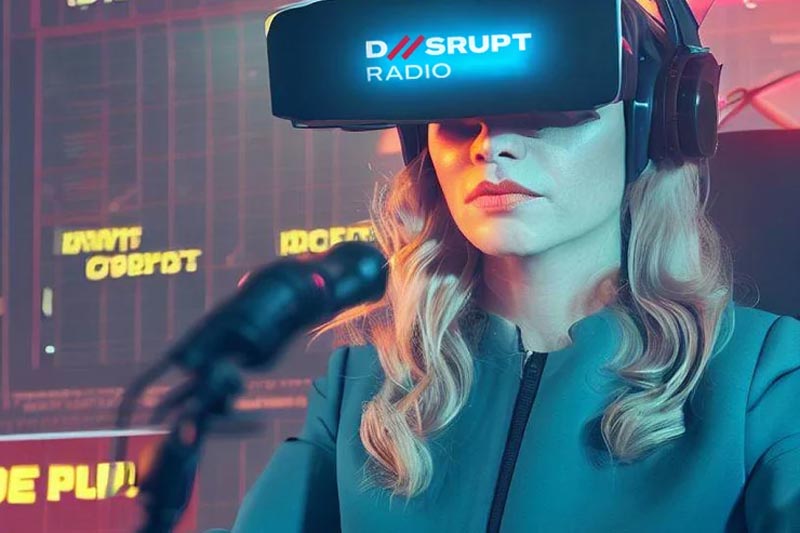
Debbie Disrupt, AI newsreader, image via Disrupt Radio.
Entrepreneurial thinkers and business mavericks are in the sights of Disrupt Radio, Australia’s newest national radio network, which goes to air, or a streaming device near you, on Monday 26 June 2023. Australian comedian and broadcaster Libbi Gorr, also known as Elle McFeast and Irish rocker and activist Bob Geldof, will be kick starting proceedings during the station’s first week, with both set to feature on the breakfast show.
Veteran radio and television presenter, George Donikian has been brought on-board to read morning news bulletins, while Debbie Disrupt, an AI radio presenter will take the afternoon news shift. I don’t know if Debbie Disrupt is the first AI newsreader to ever present on a radio show, but her presence has media pundits talking. At the moment they remain unsure whether her participation is a cost consideration, or a publicity stunt.
I’m leaning more to the latter. Any suitably experienced radio presenter could read the news, but having an AI robot that can do the job instead? That’ll bring in the listeners, at least to begin with. I also see an element of expectation here. Something would be wrong if a start-up digital radio station called Disrupt didn’t have at least one AI presenter on the crew.
RELATED CONTENT