
Showing all posts about legacy
The Social Network film and what it says to bloggers, online publishers
28 December 2010
The Social Network was one of my favourite movies of 2010, needless to say it was something I looked at a couple of times. The story speaks volumes to entrepreneurs and geeks, and anyone who has an idea, or knows of one that could be improved, that others might find cool.
It was also a film, that through many of its lines, also spoke I thought, to bloggers and online publishers. While a lot of lines could be quoted in a variety of contexts, here are a few that I thought were especially relevant to writers working online.
I need to do something substantial in order to get the attention of the clubs.
The blogosphere has its own variation of the final clubs — the undergraduate social clubs of Harvard University — though such things don’t appeal to everyone… I don’t care to belong to a club that accepts people like me as members. In other words always do your own thing.
I shouldn’t have written that thing about the farm animals. That was stupid. But I was kidding for gods sakes. Doesn’t anybody have a sense of humor?
Humour is subjective… anyone who has been writing online for even a short period of time will appreciate this comment.
The internet’s not written in pencil. It’s written in ink.
Ain’t that the truth? Need I say more.
It won’t be finished. That’s the point. The way fashion’s never finished.
If you’re onto a good thing you’ll be doing far more than merely writing and posting articles.
We don’t even know what it is yet. We don’t know what it is. We don’t know what it can be. We don’t what it will be. We know that it is cool. That is a priceless asset I’m not giving up.
Never underestimate the value of cool in the rush to monetise, or turn a profit.
He was right. California’s the place we’ve gotta be.
You might already live in California, but that’s not the point, your blog could seriously take you places and you need to be ready to move with it.
We lived in farms, then we lived in cities, and now we’re gonna live on the internet!
I suspect bloggers and online publishers realised this well before Facebook came along.
Originally published Tuesday 28 December 2010, with subsequent revisions, updates to lapsed URLs, etc.
RELATED CONTENT
blogs, film, legacy, self publishing, social networks
A certain type of screw head in time saves almost 29
15 December 2010

The more common, well-known, Flat and Phillips screw heads are just two of some 28 varieties of screw drive type… you may therefore need to expand the range of screwdrivers you own in case you encounter any of the not so common sorts. Image via Apartment Therapy.
Originally published Wednesday 15 December 2010.
RELATED CONTENT
Ladies of the Letterform, an art show by Sofles, Lo-Fi Collective, Sydney
10 December 2010
Here’s your chance to see the work of Australian graffiti and street artist Sofles.
Sofles has burst from the anonymity of the graffiti world onto a public stage in a manner comparable to the explosive impact of his images rendered on canvas, brick, paper and human bodies. Witness blank space being filled with imagery from the over-running cup of his enigmatic mind.
Ladies of the Letterform is quite possibly Lo-Fi Collective’s last ever exhibition so make sure you don’t miss it. The show takes place at Lo-Fi Collective, Floor 3, 383 Bourke Street, Surry Hills, Sydney, on Thursday, 16 December, 2010 at 6pm.
Update: I posted some photos from the show on my Flickr page.
Originally published Friday 10 December 2010, with subsequent revisions, updates to lapsed URLs, etc.
RELATED CONTENT
art, Australian art, legacy, Sofles
Illustration by Eric Slager, the muppets go minimal
6 December 2010
Since I can’t get enough of minimal design and illustration… graphic designer Eric Slager’s Minimalist Muppets illustration series.
No Cookie Monster then?
(Thanks Jessica)
Originally published Monday 6 December 2010.
RELATED CONTENT
design, illustration, legacy, minimalism, muppets
The ghost stations of East Berlin by video train
6 December 2010
After the German cities of West Berlin and East Berlin were completely partitioned following the construction of the Berlin Wall in 1961, accessing one side of the city from the other — was at first — pretty much out of the question for all but a small number of people.
One group unaffected — to a degree — by the separation of the city were West Berlin train commuters who used a small number of underground services whose lines crossed into parts of East Berlin, as they travelled from one area of West Berlin to another.
While trains still ran through East Berlin, they did not stop at stations on the eastern side of the border. Many of these stations closed during the period the city was divided by the wall were dubbed “ghost stations”, and were usually heavily guarded by East German troops.
The YouTube video, above, contains footage filmed from the driver’s compartments of West Berlin trains as they passed through a couple of East Berlin’s ghost stations.
Update: unfortunately the original YouTube video has been taken down as a result of a copyright claim.
Originally published Monday 6 December 2010.
RELATED CONTENT
Sydney Harbour Bridge climb, December 2010
2 December 2010
This article was originally posted in December 2010. As such the climb packages referred to may have changed, or be out of date.
I don’t know how many times I’ve been over Sydney Harbour Bridge, whether by foot, bus, train, or more often while driving to and from the NSW Central Coast. Too many to count. But there’s no escaping the kick that accompanies each crossing of one of the best known bridges in the world.
And in the next few days I’ll be experiencing the bridge in a completely different way when, thanks to the people at BridgeClimb, I go on my first BridgeClimb.
Sydneysiders, and those familiar with the bridge, have doubtless seen the small — almost ant-like — groups of climbers making their way up or down the bridge’s gently curving arches. Or watched climbers pausing to take in the vistas of the city, harbour, and surrounding Sydney Basin, once they reach the summit, one-hundred-and-thirty-four metres above the water.
But a trek to the top of the bridge isn’t the only aspect of the BridgeClimb experience.
Depending on how much time you have, and how bold you’re feeling, you can venture right into the heart of the bridge, traversing catwalks and steel stairways as road, rail, and pedestrian traffic streams below your feet.
Thinking you’d like to try it yourself? I don’t blame you. There are numerous climbs to choose from, which take place during the day and evening, seven days a week. It is also possible to arrange dawn and twilight climbs.
Of course you might like to treat someone else to the experience also, especially given it’s that time of year. And just as there are several climbs to choose from, there are also a number of BridgeClimb Gift Certificates available.
A Blue Gift Certificate for instance permits the holder to take one of the three climbs at night time. For a little more flexibility, a Gold Gift Certificate allows climbs during the day or after dark. If you really want to push the boat out, a Titanium Gift Certificate also includes the option of climbing at either dawn or twilight, in addition to the day and night slots.
Climbs — which take place in all but the most extreme of weather conditions — can range from 2¼ hours in length for The Express Climb, to 3½ hours for both The Bridge Climb and The Discovery Climb. Before setting off you will be outfitted with a BridgeSuit, and other clothing if needed, depending on weather conditions at the time of your climb.
While it’s a good idea to read-up about the climb beforehand, about the only thing you really need to know is that photography is a no-no during the climb. But that doesn’t mean you won’t come away without photographic evidence of your time on the bridge, as the guide, who has a secured camera, will take photos throughout.
Obviously cameras — and any other loose items, including phones — pose a risk to pedestrians and traffic on the bridge, and possibly even vessels on the harbour, should they be dropped or fall. This then is an experience that you will mostly have to file to memory.
That shouldn’t be too difficult though. After all, it’s not everyday you’ll have the opportunity to saunter around one of the world’s most iconic structures.
My thanks again to BridgeClimb for the opportunity to partake of the BridgeClimb experience.
Originally published Thursday 2 December 2010, with subsequent revisions, updates to lapsed URLs, etc.
RELATED CONTENT
The Social Network, a film dramatisation of the founding of Facebook, by David Fincher
29 October 2010
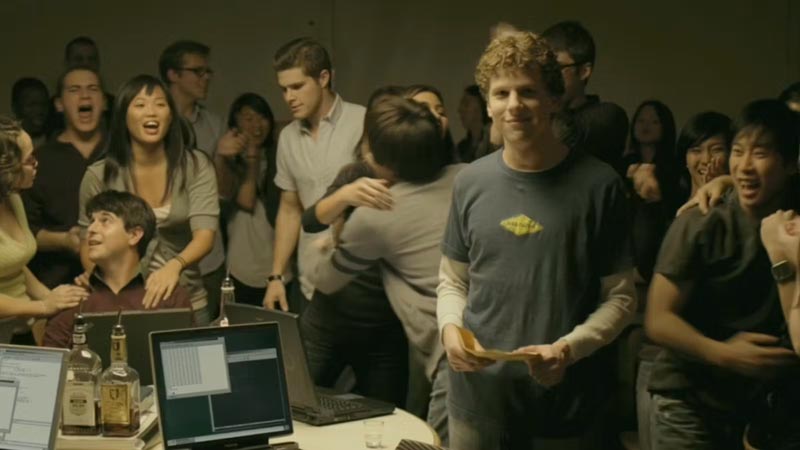
A scene from The Social Network, a film by David Fincher.
The Social Network (trailer), directed by David Fincher, is based on Ben Mezrich’s book The Accidental Billionaires, which he penned with the help of Eduardo Saverin (Andrew Garfield), one of the co-founders of social network Facebook, who later fell out with CEO Mark Zuckerberg (Jesse Eisenberg).
Bookended between numerous litigation sessions in lawyers’ offices, The Social Network pieces together the early days of Facebook through a series of flashbacks. The story focuses mainly on the roles of Zuckerberg and Saverin in creating the network, and how they dealt with raising money and profile, while fending off people claiming they had stolen the Facebook idea from them.
After his girlfriend, Erica Albright (Rooney Mara), ends their relationship, Zuckerberg, a technically brilliant but emotionally cold Harvard University computer science student, hastily builds Facemash. It’s a hot-or-not style website that compares female Harvard students with each other. Zuckerberg sources the photos Facemash needs by effortlessly hacking the databases of Harvard’s colleges.
Although Facemash is quickly shut down, word of Zuckerberg’s programming and hacking skills spread, and he’s soon approached by twins, and fellow students, Cameron and Tyler Winklevoss (both played by Armie Hammer). They have an idea for an exclusive Friendster/MySpace clone, but want to restrict membership to only those with Harvard email addresses.
They ask Zuckerberg to help, but after agreeing he instead creates the first version of Facebook, then called The Facebook. His friend and roommate, Saverin, puts up one thousand dollars to cover web hosting in return for a thirty percent share in the venture, and role of CFO.
The Facebook proves a hit with Harvard students, and other universities in the US and Britain are soon admitted to the fold. Meanwhile Napster founder Sean Parker (Justin Timberlake) hears about The Facebook and arranges hefty financial funding for Zuckerberg. Saverin however sees Parker as a threat to his influence, which quickly becomes a source of tension between him and Zuckerberg.
Any dramatisation about an organisation as ubiquitous as Facebook is certain to be of interest to a large number of people. Unlike many highly anticipated films that might play on the hype surrounding their subject matter though, The Social Network does not create false expectations.
Facebook made clear before the film’s release that neither they, nor Zuckerberg, had any involvement in the production of The Social Network. And while Zuckerberg does not present as a villain per se, his portrayal by Eisenberg is far from flattering.
Facebook has certainly had a controversial history (are stories of the early days of Friendster and MySpace anywhere near as colourful?) and it seems every other week brings news of another alleged privacy breach, or a new court action of some sort. Is it therefore a portent of things to come that the final scene plays out in a lawyer’s office?
Originally published Friday 29 October 2010.
RELATED CONTENT
Andrew Garfield, Armie Hammer, David Fincher, film, Jesse Eisenberg, legacy
Back to the future, I met my parents before they met each other
29 October 2010
Twenty-five years on and people are still asking questions about 1985’s Back To The Future. One that consistently crops up regards the apparent inability of George and Lorraine, Marty McFly’s parents, to remember him, and the part he had in bringing them together, many years earlier.
And to a degree the question makes sense. It would certainly be easy to forget a person you knew only briefly — like for a week — from thirty years earlier. But surely you’d remember anyone who played a big, and very active, part in bringing you together with your future spouse.
The conundrum is this: you tend to remember the people who brought you together in life. You’d certainly remember the person who played Johnny B Goode in such dramatic fashion at the Enchantment Under The Sea dance. And, given that Lorraine had such a crush on Marty in 1955, she’s unlikely to have forgotten him altogether.
What can change over time though are individual perceptions and memories of a person. While I doubt George and Lorraine had forgotten Marty (aka Calvin Klein) all together, they would have forgotten exactly what he looked like after a while. Twenty to thirty years is a long time to remember something like that, more so when you don’t have a photo either.
Even so though, who in their right mind is going think their child, born years after the event, could possibly have had anything to do with their meeting? Can we get back now to simply enjoying repeat screenings of this classic, without the excess analysis?
Originally published Friday 29 October 2010, with subsequent revisions, updates to lapsed URLs, etc.
RELATED CONTENT
film, legacy, physics, science, science fiction
Made in Dagenham, a film by Nigel Cole with Sally Hawkins, Rosamund Pike
25 October 2010
Made in Dagenham, trailer, is British filmmaker Nigel Cole’s dramatisation of events surrounding the 1968 strike by sewing machinists, all of who were women, at Ford Motor Company’s Dagenham assembly plant, in the east of London.
Angered after the motor vehicle manufacturer regraded their jobs as unskilled so they could be paid at the lowest possible rate, the women decided to strike for 24 hours. Their actions set in motion events that went on to pave the way for gender pay equity not only in Britain, but across much of the industrialised world.
Rita O’Grady (Sally Hawkins) a car seat upholstery machinist, lives quietly with her husband Eddie (Daniel Mays), also a Ford factory worker, and their two school-age children, in a modest apartment block near the assembly plant. Rita seems an unlikely leader or negotiator at first, after coming off second best in a confrontation with her son’s bullying teacher.
When her co-workers decide to contest the downgrading of their jobs skill classification, and demand pay equal to that of the male workers, and need a leader, Rita steps up to the plate. A meeting with the company’s management reveals the enormity of the task ahead of them though, everyone regards the concept of gender pay equity as completely alien.
While the women initially have the support of their male colleagues on the factory floor, loyalties fray as the machinists’ on-going industrial action starts to bite. This eventually results in the factory completely ceasing production, and all workers being locked out, which angers many of them.
Meanwhile Rita goes on the road drumming up support for their cause, and soon comes to the notice of the government’s straight-speaking employment minister Barbara Castle (Miranda Richardson), who intervenes in an effort to get the woman back to work. Rita also forms an unlikely friendship with Lisa Hopkins (Rosamund Pike), the wife of a Ford executive, who encourages her efforts.
Made in Dagenham is not a battle of the sexes story, but there is no missing the then male dominated senior ranks of both company and union management. While the prospect of equal pay for women seemed to be of alarm in terms of its cost for the company, union bosses appeared to be fearful of losing influence should the women succeed.
There are insights aplenty into the industrial bargaining process, the politics at play across the workshop floor, company management, and unions, not to mention private sector pressure on government ministers to achieve particular outcomes. But Made in Dagenham also explores the real meaning of gender equality, which is far more than equal pay only for men and women.
Although the portrayals of a number of the key characters here are fictitious, footage of the machinists actually involved in the 1968 strike, who speak about what happened during and after the strike, forms part of the closing credit roll. Needless to say the striking women had no idea just how far reaching the consequences of their actions would be.
Originally published Monday 25 October 2010, with subsequent revisions, updates to lapsed URLs, etc.
RELATED CONTENT
Daniel Mays, film, legacy, Miranda Richardson, Nigel Cole, Rosamund Pike, Sally Hawkins
For the universe is a hologram and I have touched the sky
25 October 2010
All sorts of ideas have been devised in an effort to make sense of the universe, some more… notable than others. For instance, a couple of years ago New Zealand scientist Brian Whitworth speculated that the cosmos was just a giant virtual reality simulation (Internet Archive link).
Meanwhile US astrophysicist Craig Hogan, who in 2008 ventured that the universe is a hologram, is now preparing to test the idea, after spending the last couple of years building the world’s most precise clock.
Black hole physics, in which space and time become compressed, provides a basis for math showing that the third dimension may not exist at all. In this two-dimensional cartoon of a universe, what we perceive as a third dimension would actually be a projection of time intertwined with depth. If this is true, the illusion can only be maintained until equipment becomes sensitive enough to find its limits. “You can’t perceive it because nothing ever travels faster than light,” says Hogan. “This holographic view is how the universe would look if you sat on a photon.”
Originally published Monday 25 October 2010, with subsequent revisions, updates to lapsed URLs, etc.
RELATED CONTENT