
Showing all posts about legacy
The Nothing Men, a film by Mark Fitzpatrick, with Colin Friels, David Field
13 August 2010
The Nothing Men, trailer, (NSFW: profanities) is the first feature of Australian director and screenwriter Mark Fitzpatrick. Set mainly on the floor of a Sydney factory that is about to close, six bored men bide their time, as they are forced to wait two weeks for their redundancy payments.
Despite the fact there is no actual work to do, and the men have started to become a tad irritated with each other, their final weeks of literally sitting around haven’t been too bad. After all, very few companies effectively pay their staff to spend the day drinking and playing cards.
News that a worker, David Field (David Snedden), from head office is to join them for their final fortnight however unsettles the foreman, Jack Simpson (Colin Friels). David spent the week prior at another company site where a dozen workers were abruptly sacked, losing their severance payments in the process. Jack thinks he smells a rat.
David, who on first acquaintance seems normal enough, is though, as a draftsman, an odd placement for a factory workshop. When he starts making what he claims are private phone calls behind closed doors in the office, and seemingly going home during the day for personal reasons, everyone soon becomes unsettled.
The men fear David is a spy sent from head office to find excuses to sack them, so the company won’t have to pay out their redundancy money. Accordingly, they reluctantly agree to dispense with the beer and card games, and sit tight for the duration, while also keeping their distance from him.
David does manage to befriend Wesley Timms (Martin Dingle-Wall), the quieter, more studious, of the six, who is also a fellow chess player, and invites him back to his place for a game one evening. While there, Wesley makes a disturbing discovery, and also learns, unbeknownst to David, that they are linked by a past tragedy.
Anyone who has been in a situation similar to that facing the soon to be retrenched men, will understand how uncertainty, innuendo, and gossip, can combine to create fear and mistrust.
Compound that with the prospect that much anticipated redundancy payments are at risk, and the situation can quickly become insufferable. Are the fears of the factory workers justified though, or are they perhaps over reacting? The Nothing Men shows just how suddenly the seed of an idea — whether based in fact, or not — can get out of hand.
While equal parts drama and thriller, The Nothing Men is let down by several plot inconsistencies. There are also a number of red-herrings, intended to build up mystery around David that are just a tad too contrived, and at odds with the rest of the story. Still, the audience is left guessing as to what will happen, right up to the final frame.
Originally published Friday 13 August 2010.
RELATED CONTENT
Colin Friels, David Field, film, legacy, Mark Fitzpatrick, Martin Dingle-Wall
The Waiting City, a film by Claire McCarthy, with Radha Mitchell, Joel Edgerton
12 July 2010
The Waiting City, trailer, the second full length feature of Sydney and Los Angeles based Australian filmmaker Claire McCarthy, has the distinction of being the first Australian produced movie to be filmed entirely in India. The story recounts the experiences of Fiona Simmons (Radha Mitchell), and husband Ben (Joel Edgerton), who travel to the city of Kolkata to adopt a baby girl.
While outwardly happy, the couple are as different as chalk and cheese. The “always on” Fiona continues working on client cases — through her mobile phone and laptop — as if she never left the office. This is in sharp contrast to the laid back, somewhat aimless Ben, who easily strikes up rapport with the locals through his music.
The adoption process, which the couple expect to be a mere formality — they only booked their Kolkata hotel for two weeks after all — turns out to be far more daunting than anticipated. Instead Fiona and Ben find themselves confronted by a rigid, and manual bureaucratic system, replete with delays and hold-ups, that are unexpected and unexplained.
Despite the reservations of others, particularly Krishna (Samrat Chakrabarti), a hotel worker with a direct manner whom they befriend, there is no doubt Ben and Fiona are eagerly awaiting the finalisation of the adoption process. The want nothing more than to take Lakshmi, their adoptive daughter, home to Australia.
But Ben’s chance meeting with the younger Scarlett (Isabel Lucas), a fellow musician from Australia, brings to light the first hint of trouble in his marriage with Fiona. This leads to a series of rifts between the two, which at one point sees the pair staying in separate hotels.
The growing discord between Ben and Fiona gradually results in the reopening of old wounds, and the uncovering of a long held secret. Their marital woes come to a head during a trip to Bhopal, Lakshmi’s birth place, leaving the couple questioning whether they should even be together, let alone adopting a child.
McCarthy is in no hurry to tell her story allowing us to take in the enthralling destinations that are Kolkata and the other places Ben and Fiona visit. Mitchell, who blends seamlessly into her role as the hopeful mother-to-be, together with the ever versatile Edgerton, put in stand out performances.
Visually, The Waiting City is a delight to watch, thanks to the work of cinematographer Denson Baker, whose soft, hazy camera work beautifully renders the locations. His use of close shots meanwhile, projects the bewilderment and turmoil first time travellers to unfamiliar places experience.
The Waiting City is more than a journey to exotic lands though, it is one of self discovery and coming to understand what you really want from life. To adapt a line from a well known quote, perhaps the best way to find yourself is to lose yourself first.
Update: I recently interviewed director Claire McCarthy about the making of The Waiting City.
Originally published Monday 12 July 2010, with subsequent revisions, updates to lapsed URLs, etc.
RELATED CONTENT
Australian film, Claire McCarthy, film, Isabel Lucas, Joel Edgerton, legacy, Radha Mitchell, Samrat Chakrabarti
We made it back to the future, but in a parallel universe
9 July 2010
If you’re a dyed-in-the-wool Back to the Future fan I hope you weren’t taken in by the claim that last Monday, 5 July, was “Future Day”. That being the day Marty McFly and Doc Brown arrived in the future when they travelled forward in time during 1989’s Back to the Future Part II.
The arrival of the time travellers from 1985 last Monday may not have been all bad though, had it have happened. In the twenty-five years since the release of Back to the Future, and only five years out from 2015 — the setting for much of Back to the Future Part II — we still have ground to make up in terms of matching some of the advances in technology seen in the movie trilogy.
So far we’re still lagging in the development of:
- Flying cars (actually they exist, but are far from in everyday use)
- Hoverboards
- Time travel
We have however made advances in other areas, with the advent of:
- The World Wide Web
- Smart phones
- High Definition TV (if that’s much of innovation really, considering we’ve had low-def TVs for years)
There’s still another five years to go though, perhaps by then we’ll at least have hoverboards that are able to match what we can do with skateboards today.
Originally published Friday 9 July 2010, with subsequent revisions, updates to lapsed URLs, etc.
RELATED CONTENT
film, legacy, physics, science, science fiction
Q&A with Claire McCarthy director of The Waiting City
30 June 2010

Australian director Claire McCarthy’s latest film The Waiting City is a portrayal of an Australian couple Ben (Joel Edgerton), and Fiona (Radha Mitchell), who travel to Kolkata, India, to collect a baby they have adopted. But delays in finalising the process, together with the disorientation of an unknown city and unfamiliar culture, begin to take a strain on their marriage.
The Waiting City has the distinction of being the first Australian made movie to be filmed entirely in India. Recently Claire McCarthy (Instagram page) took some time out to answer a few of my questions about the making of her new film.
Q: To what degree did your experiences of living in India, and working in orphanages there, have in inspiring the film?
A: A great deal of the film is based on real life situations, friends and interview subjects although it is most certainly a work of fiction. The film is an amalgam of many formative experiences in my life.
Beginning with working in the slums of Kolkata with Mother Teresa’s nuns with my amazing sister Helena and at a turning point shooting a music video on the sweltering banks of the Ganges with my husband-to-be Denson Baker ACS as a test run for the real film, The Waiting City in many ways is an expression of many of my loves; of people, music, food, culture and importantly, of the city of Kolkata.
The documentary I made (called Sisters) also undeniably became a jumping off point for research and development of the fiction screenplay of The Waiting City and gave me insight into the people behind adoption as well as the people and city of Calcutta. I have gleaned so much inspiration from so many very remarkable and inspiring people who have allowed me to interview them and have shared their stories with me.
The inspiration for this story is personal, researched, observed and imagined.
Q: The Waiting City was filmed entirely in India, and accordingly we see nothing of the life of Ben and Fiona in Australia. Why was that?
A: My intention was to allow Fiona and Ben’s history to gradually bubble up to the surface through their experiences in India. This felt like a more elegant solution to expose the characters, and us the audience, to the world of India and that in doing so force them to question their lives and choices about themselves and their relationship.
Q: Aside from your past association with Kolkata, why did you choose to make this city the main setting for the story?
A: The personal connection I had with Kolkata was a big factor in setting the film in this city. It was crucial that the film had a unique rhythm, texture, colour palette and sense of exoticism that we as a Western audience had never seen before. Kolkata is a perfect for this as it has such a unique look and feel and so many contrasting locations and settings.
It was important that through the journey into this city that the main characters would be forced out of their comfort zones to be truly present experiencing each other and the city. The film is really inspired by the beauty, textures and unique rhythms of the city of Kolkata.
As another character in the film too Kolkata forces our main characters to really think about their projections and judgements and to look at their own lives back in Australia from a different vantage point. So it was an aesthetic, strategic, emotional and personal reason to shoot in the city of Kolkata.
Q: What for you was the biggest challenge in filming completely on an overseas location?
A: It was crucial to me that the team became like a family in the making of The Waiting City. We never wanted to be considered a ‘foreign’ film as such and were resistant to the idea of just coming into India and taking over the town. We wanted the film to be a collaborative process with a blending of ideas and resources.
This was one of the biggest challenges of the film; finding the time to ensure the creative process was not lost under the freight train of production pressures. The film is a very fine example of high level planning, collaboration and cultural exchange between incredible Australian and Indian creatives and technicians.
Q: Adoption is a key part of the story, were there any thoughts you wished to convey here, especially on the adoption of children from developing nations?
A: As a filmmaker it’s not my intention to be for or against adoption, it’s more to raise questions about what it means to take a child away from their culture and whether or not bringing them to another culture is a good or a bad thing. In the work I did in orphanages and the research I did about adoption, the one consistent factor I found was the protracted waiting period to receive a child.
Over and above the adoption process itself, the possibilities interested me of what might happen to a couple whilst they were waiting to receive their child.
So I began to look at that emotional stranglehold for both the parents and the child, which was of primary interest to me as a filmmaker over and above the adoption process itself. I started to consider that in waiting for a child a couple would inevitably be pulled in so many different directions and vulnerabilities would be exposed within their relationship.
So in the film the adoption process forces the relationship of the couple under a microscope and causes them to address other issues as well: motherhood, fertility, mortality, gender politics, different expressions of families and journeys to parenthood, spirituality and desire.
Thanks Claire.
Update: some behind the scenes video footage of The Waiting City just to hand.
Originally published Wednesday 30 June 2010, with subsequent revisions, updates to lapsed URLs, etc.
RELATED CONTENT
Australian film, Claire McCarthy, film, Joel Edgerton, legacy, Radha Mitchell
Flip from left to right when driving from Hong Kong to China
16 June 2010
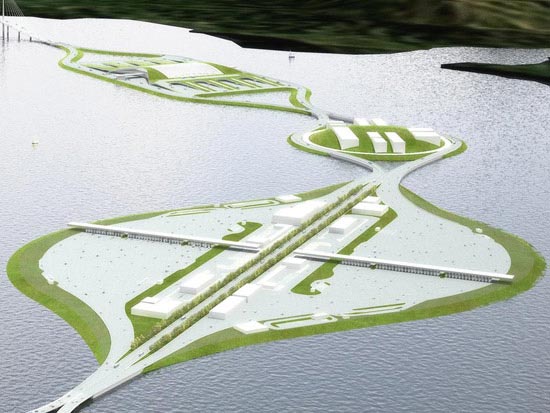
A proposal by Dutch designers, NL architects, could result in the construction of a far from ordinary bridge roadway connecting Hong Kong to the Chinese mainland, which would include artificial islands serving as car parks and bus stations.

Under the proposal, a “flipper” would be incorporated along the connecting roadway, allowing Hong Kong motorists – who drive on the left – to switch safely and effortlessly to the right, the side Chinese drivers use, and vice versa.
Originally published Wednesday 16 June 2010.
RELATED CONTENT
China, design, Hong Kong, legacy, travel
An online revenue model for independent content producers
12 April 2010
Independent online publishers, content producers, and bloggers, who are looking for a way to earn an income, or make money online, could do worse than take a few cues from Daring Fireball, the website of John Gruber, who lives and breathes all things Apple.
Daring Fireball serves over two million page views, and generates an estimated revenue of US$15-20,000 each month, making Gruber’s methods well worth scrutinising. Let’s find out how we, as independent content producers, can do likewise.
Become a member of a private advertising network
Daring Fireball is part of The Deck, a private ad network created by Jim Coudal. Collectively, member websites have a very large audience made up mainly of creative, web and design professionals.
Members, who are admitted by invitation only, are required to display an image 120 by 90 pixels in size, and cannot carry any other forms of advertising on their website.
When you consider that 26 advertisers pay US$7900 per month, to advertise across 43 member sites though, the return, even allowing for The Deck’s cut, is going be very worthwhile.
Sell weekly sponsorship slots on your RSS feed
Gruber estimates that in excess of 150,000 readers (though the actual number is probably far higher) subscribe to Daring Fireball’s RSS feed, and this level of interest has allowed him to offer exclusive weekly sponsorship at US$3,500 a slot.
Do the maths there, that’s an income of US14,000 every four weeks, not bad at all for a one person operation.
A number of other high profile bloggers have attempted to monetise their RSS feeds, many of whom incidentally are members of “The Deck”, though very few have emulated Daring Fireball’s success.
A recent discussion with Jason Kottke on The Pipeline, Dan Benjamin’s online radio show, both conceded that Gruber is one the few people to make RSS feed sponsorship work.
Sell merchandise and website memberships
Daring Fireball offers readers the chance to become members for a cost of US$19 annually.
While membership isn’t worth much in itself though, aside from gaining access to a separate RSS feed which apparently includes a few extra items not published to the main feed, it is really a way for supporters of the site to make a contribution should they wish to.
T-shirts are also sold, they are usually made available once a year, and with a purchase comes an automatic one year membership.
The income from t-shirt sales and memberships, while handy, would be far less than that generated by “The Deck” membership and RSS sponsorships though.
Leverage your online profile to earn income offline
Someone with the high profile of John Gruber could probably do well on the speaking and appearance circuit, so there are definitely opportunities in that regard.
Don’t charge your readers a cent to access your website
Despite publishing one of the most highly regarded news and information resources of all things Apple and Mac, Daring Fireball does not charge the casual reader anything to visit the site.
Sure, the super-motivated can take out a US$19 annual membership, or buy a t-shirt, but there is no compulsion whatsoever to do so.
I want a piece of the action, what do I do next?
Who wouldn’t want to be an independent online content producer earning in the region of $20,000 a month? I’d happily settle for a quarter of that amount.
Without telling you how to go about it, I can say that there are two important things you need to do, and that both require inordinate amounts of time and effort.
One is always to work on boosting your profile (marketing and promotion), the other is producing quality, useful, content.
While nowhere near the traffic levels of Daring Fireball, it’s my thought that an independent online publisher could make a reasonable, self supporting, income from around 30,000 unique visitors a day.
At least it’s a nice round number to aim for.
Originally published Monday 12 April 2010.
RELATED CONTENT
How to make your own green tea… matcha cappuccinos
23 March 2010
A green tea cappuccino, that’s a new one for me, and I had the chance to try one of these beverages while out road tripping last week. I jotted down a few notes while our host prepared the drinks, so should you wish to indulge, here’s the recipe.
You certainly don’t need a coffee-making machine to whip up a green tea cappuccino. A kettle, tea cups, a mixing jug or cup, and a cordless hand-held milk frother, will do the trick, along with:
- Near boiled water
- Warmed, but not excessively hot, milk
- Matcha green tea powder
And now to brew:
- Place two heaped dessert spoons of green tea powder per tea cup into the mixing jug
- Pour a third of a cup of near, but not fully, boiling water, per tea cup, into the mixing jug
- Blend the tea powder and water for a minute until foam forms on top of the mixture with the milk frother
- Pour an equal measure of the mixture into each tea cup
- Pour the warmed milk to the mixing jug and froth
- Add the frothed milk to the tea cups
- Serve and enjoy
If like me, you’re a big drinker of both green tea and cappuccinos, you may find the green tea cappuccino takes some getting used to. Worth it though.
Update: a video of the brewing process (thanks to the ever vigilant Coffee Girl).
Originally published Tuesday 23 March 2010, with subsequent revisions, updates to lapsed URLs, etc.
RELATED CONTENT
Tips for artists arranging their own art exhibition and opening
8 March 2010
Ask anyone what they like the best about going to an art show and most people will tell you it’s the opening night party.
And who can blame them, after all what better way is there to spend an evening, than enjoying some brand new art while partying?
So while from a show-goer’s point of view the opening night party seems like a straightforward process — placing a collection of artworks in a gallery and then laying on refreshments and live music — there’s a lot more to staging an exhibition, even a smaller show, than meets the eye.
Months, possibly years, of planning and organising go into some shows and their opening night party, so in the interests of imbuing the curious with an appreciation of the process, here it is, a step by step guide to planning and staging an exhibition.
Planning
You might be surprised at the amount of planning an exhibition requires. Factors such as venues, budgets, funding, sponsorship, advertising and promotion, catering, and possibly insurance, all need careful consideration.
Lead times can vary greatly as a result, with some shows taking a year or more to set up, while others can be arranged within a couple of months.
Budgets, sponsorship, and funding
Staging an exhibition can be expensive, and you will need to ensure you have sufficient funding, whether private, or through sponsorships, to cover the cost of things like catering, promotion, printing, and gallery space.
While established artists may be able to find sponsors to cover costs, as their larger following ensures a reasonable degree of exposure for their backers, new or emerging artists may not be so fortunate, and will have to rely on savings, or help from family or friends.
Check around though.It may be possible to obtain funding through arts grants, and sometimes municipal councils or community groups may offer some assistance staging a show, whether it be providing a venue, or publicity.
Artists at some exhibitions I have been to sometimes ask a for small (gold coin) contribution to help cover costs, a portion of which they usually donate to charity.
Finding a gallery
Gallery space is competitive, and can be hard to secure, especially if you want to exhibit at an established, well known, venue.
You will also need to weigh-up the amount, nature, and size, of work to be exhibited, against the availability of suitable galleries.
Other things to consider are whether the gallery operates on a commission basis, taking a percentage on works sold, or charges a fixed fee for holding a show.
Also, depending on your location, since regulations vary from place to place, are insurance matters, both public liability, and cover for items on show.
Look out also for alternative venues, such as cafes or bookshops for instance, which may offer wall space, and would surely be happy to collect a commission on any works sold.
Given the potential for publicity and custom, cafe and bookshop owners may possibly be prepared to provide other forms of support for your show as well.
A theme and a name for the exhibition
Your show will need a name and a theme. It’s worth taking some time to think this over.
Pricing your artworks
This is one of the more difficult steps in the process of planning an art show.
The amount you can ask for an artwork will depend on a number of factors including your reputation or standing as an artist. Obviously the more regarded your work, the more you can ask.
Another is the arrangement you have with the gallery exhibiting your work. Most galleries take a commission on works sold during an exhibition. While this cut varies, sometimes greatly, rates of about twenty-five to up to fifty percent are reasonably common.
Don’t be afraid to negotiate on the commission either. If you believe you will sell a lot of your work, you may be able to haggle a slightly lower rate.
To set a price you will need to work out much you would like to receive, against how much you think someone will pay, less the commission asked for by the exhibiting gallery.
Printing
Once you have funding, a venue, and a theme worked out, you can start arranging the printing of promotional flyers and brochures, title cards, and a list or catalogue of items you’ll be exhibiting.
If money is tight you may be able to reduce some printing costs by doing some of the work yourself.
Great looking catalogues and title cards can be produced with a word-processor, the use of good fonts, some careful page layout, and a reasonable quality printer.
If you know someone with calligraphy skills see if they can make title cards for your works.
Promote and advertise
There’s quite a few options when it comes to promoting shows, many of which are low-cost, or free.
Social networking sites, such as Facebook, make it easy for members to create pages for events, such as an exhibition opening, and issue invitations to their contacts.
There’s also art focused discussion forums, and you could even consider approaching arts bloggers to see if they will help the spread the word. Be careful not to wear out your welcome, or take anything for granted here though.
Setting up a page on a photo-sharing site, such as Flickr, and posting photos of your work is also a good way to generate some ongoing profile.
If your budget permits, consider printing flyers to post on community notice boards. Local shops may also be happy to display these for you. Also think about writing a press release to send to local and community magazines and newspapers.
I’ve received a number of invitations to exhibition openings through (snail) mail, so if time and money allows, have some invitations printed and then gather up a list of people to post them to.
Finally, invite as many people as you can, however you can, to the opening. Not only will they appreciate a drink and snack, they’ll also add some atmosphere, and make your attendance numbers look good. Nothing says success more than a well attended show opening.
Food, beverages, and catering
A big part of the opening night of any exhibition is the food, drink and party atmosphere, but you don’t need to go overboard.
Offering guests a choice between a red and white wine, and water (and juice or soft drinks, if you really want to push the boat out) is quite acceptable.
If you have a generous sponsor, or even just a catering sponsor, you may also be able to lay on beer and some finger food.
Other entertainment
Many of the openings I’ve been to have some sort of live music, and given the atmosphere a DJ, or even a band, can add to proceedings, this is something well worth thinking about.
If money, or floor space dictates otherwise, the only option may be background music. Whatever you do, choose music that is light and upbeat, and generates a good vibe.
Opening times
Most of the shows I go to usually open on Wednesdays, Thursdays, or Fridays. Thursday seems to be the most common day, it’s not too early in the week, and not too close to the weekend.
If possible, avoid weekend openings, or early in the week, times that people usually have other plans.
An early evening opening of around 6pm is probably a good all round time. Most your guests will be on the way home form work by then, yet it is still early enough for them to fit your show in around other plans they have for later in the evening.
Photos
You will definitely want a photographic record of the opening, so try and arrange for someone to take photos through out the evening.
Post the photos to your Flickr or Facebook pages, and also use them when you write about about the opening on your blog later.
And enjoy
The opening night, and exhibition itself, will probably be over in what feels like no time, especially when compared to the months of prior planning and preparation, so be sure to take a little time out to enjoy your own exhibition.
Good luck with it.
Originally published Monday 8 March 2010, with subsequent revisions, updates to lapsed URLs, etc.
RELATED CONTENT
art, art shows, artists, legacy
What might have happened if the internet was not invented?
1 March 2010
The other week, an article written in 1995 by Clifford Stoll who — in short — could see no future for the internet, resurfaced.
While events obviously took a different course, Stoll’s words started me wondering about a world without an internet, and what our lives in 2010 might be like in the absence of this “most trendy and oversold community”, as Stoll put it.
And faster than Marty McFly and Doc Brown can conjure up an alternative timeline, here we are, a day in my life, in an un-wired, web-less, 2010.
The day begins like this, as always…
I go down to my letter box. There are three letters, a bill, two magazines, and the daily newspaper. A prominently placed front-page article boasts of a circulation increase of 0.1%, according to the latest readership audit.
Over breakfast I continue scanning the paper. The music industry is on the war path. Again. They can’t seem to shut down the groups who are bootlegging albums, by burning them onto DVDs and then selling them for — quite literally — a song on the street.
Before settling into the day’s work I quickly reply to the letters I’ve received, this is a breeze since nowadays people mostly only write letters that are a paragraph or two long. And given they now only cost five cents to send, literally millions are exchanged daily in Australia.
Getting down to work, I need to do some research
I work from home as a freelance writer. I work for a number of what are called street magazines, which are independently produced publications.
Sometimes several people operate them, sometimes they are the work of one person, an editor, who also relies on contributions from freelance writers.
But more on street magazines later.
I work using a computerised pad like device about the size of an A4 sheet of paper. The top section has a screen, while the lower part has a keypad.
I can send output to either a printer, via fax (the Victorian age technology has really stood the test of time), or save it as a text file to a floppy disc, which I can courier to whomever I’m writing for.
I have two article deadlines in two days time, and will need to spend a couple of hours at the local library doing some research for them.
Some of those street magazines are quality rags
Some of the more popular publications do really well, and thanks to their numerous sponsors, turn out top-shelf editions each week.
People like Jason Kottke, Karen Cheng, John Gruber, and Duncan Macleod who runs a zine called The Inspiration Room, are considered some of the big names in street magazine publishing.
What makes one street magazine more popular than another? I have no idea really. Quality content for sure, but I think luck has a lot to do with it also. That hasn’t stopped a large number of hopefuls from publishing street magazines on how to publish street magazines though.
Clearly these sorts of publications don’t bother the established newspapers though, who are after all, boasting of increases in their readership.
Producing your own street magazine is also easy
Self publishing really caught on with the advent of photo-copy print machines, and because they are so cheap and easy to operate, they can be found in most corner stores, newsagents, and supermarkets.
The whole process is incredibly simple. You write content using your computer’s word-processor, and then, when finished, export the file to a floppy disc. Then it’s away to the nearest photo-copy print machine.
You simply insert the floppy disc in the yellow slot, select from a number of print-out (or publishing) options, insert some money, and a few minutes later you are a published author, proudly holding your paperback — which is usually A5 size by the way — in your hands.
Sites that offer photo-copy printing services also allow you to place your publications in vending shelves, for a small fee. Your readers can then come along and pick up your latest work.
Cafes, bars, cinemas, and even public transport services, also have distribution facilities, so publishers with good advertising revenue can afford to widely circulate their magazines.
Instead of Facebook and social networks
The way you meet people in this world is truly weird.
Case in point. I was just over at the supermarket when a girl smiled and waved at me. This puzzled me as she didn’t look familiar, so I asked if I knew her from somewhere. She looked perplexed. “I was just wondering if you wanted to be friends,” she said.
Maybe it was the way I was looking at her, as if she had stepped out of a flying saucer or some such.
“Well, what do you expect me to do? Send you a photo, a bio, and a list of my friends to you, or something? Come on, what sort of world do you think we live in? The Star Trek universe?”
We ended up shrugging at each other and went our separate ways.
Coffee meetings and face to face networking
Today is when the weekly writers coffee group meets. We get together every week to chat, network, and compare notes.
One guy there today was in a very excitable mood though, “you know, this is far more than people sitting in a cafe chatting, exchanging information and tips, it’s a… I don’t know, er, community network, a like, social network, you know?”
A social network? That sounds kind of cool. We all nodded meaningfully, and resumed our random chatter.
Instead of Twitter, micro-blogging, and text messaging
On returning home from the coffee group, there are a stack of “slips” in my letter box.
Slips are a micro revolution in what I call — for want of a better term — instant communication. Basically people can send 150 character messages to each other via the postal service.
In Australia for example you pay $100 a month and can send up to 500 slips. To send one you call the Post Office service centre, where a communications consultant transcribes your message, and then faxes it to the post office nearest to where the recipient lives.
Slips are delivered through out the day, though not so often in rural areas, by people who drive around in very distinct red and blue striped vans.
The big advantage of slips is in their brevity. People often can’t be bothered making a phone call or writing a letter, especially if they only want to tell their friends what they had for lunch or where they were at a certain time, so slips really took off.
Designed to be recycled, and printed on fax paper with a special ink that fades after a few days, they have also proved a boon for postal services worldwide as a result of their popularity.
Advertising is also carried on the back of slips, making the concept a veritable gold mine.
The future of the future is still televised
I watch as someone called Steve Jobs walks onto a stage at a trade show with a pad like device very similar to what I use. Except it has what Jobs’ refers to as a dongle attached to it.
The “dongle”, which is about the size of a packet of chewing gum, is a wireless transmitting device that allow computers to talk to each other, and also share information and files. It will change the very essence of our lives, Jobs says.
We’ll be able to buy music and movie files through the dongle somehow, publish street magazines “online”, and even meet people the same way. Yeah, right.
Quite a few people in the audience are clearly excited by what he is saying. But not me. Such a thing will never catch on.
I flick the TV off, and as I take delivery of the day’s last batch of slips, prepare to spend the rest of the evening reading through the growing pile of street magazines that I subscribe to.
An “online” world?
I couldn’t possibly imagine living in such a place. If you disagree though, please send me a slip or letter. Good night.
Originally published Monday 1 March 2010, with subsequent revisions, updates to lapsed URLs, etc.
RELATED CONTENT
blogs, humour, legacy, self publishing, social media, social networks, technology
Webstock 2010 conference bags
22 February 2010
I’ve been looking through some of the photos* from last week’s Webstock conference in Wellington, and of all things a picture of this year’s Webstock computer carry bag, above, caught my eye.
This has to be the best one yet, I already have the 2008 and 2009 bags, so here’s hoping I can get hold of this year’s as well.
* some photos are dated March 2009, I’m not sure why, a camera’s incorrect date setting possibly?
Originally published Monday 22 February 2010, with subsequent revisions, updates to lapsed URLs, etc.
RELATED CONTENT