
Showing all posts about technology
Somerton Man identified as Carl ‘Charles’ Webb
3 August 2022
Derek Abbott, a professor at the University of Adelaide, claimed last week to have identified the so-called Somerton Man, perhaps bringing a close to one of the most intriguing, and lingering, Australian mysteries of the twentieth century.
In December 1948, the body of a man thought to be about forty, was found at Somerton beach in Adelaide, capital of South Australia. His body showed no sign of trauma. He was not carrying any identification, nor were there missing person reports for anyone matching his description.
In the months following his death, a suitcase containing some of his possessions was located, but offered no clues as to who he was. A scrap of paper, bearing the words tamam shud, was found concealed in clothing the man owned. The fragment was later found to have been torn from a page of a book of poems titled Rubaiyat of Omar Khayyám, originally written in the twelfth century.
It was all enough to send the rumour mill into overdrive. People variously believed Somerton Man to be a spy, a displaced war veteran who’d made his way to Australia, or a jilted lover who’d presumably somehow taken his own life at the beach one night.
South Australian police exhumed Somerton Man’s body in May 2021, to further their investigation, but Abbott had been making progress separately. Working with Colleen Fitzpatrick, an American genealogist, he concluded the man to be Carl “Charles” Webb, an electrical engineer from Melbourne.
While mystery still surrounds the circumstances of his death, Abbott believes Webb may have travelled to Adelaide to see his ex-wife, who moved there after the pair separated several years prior.
RELATED CONTENT
Australia, crime, history, technology
Beat writer’s block and meet deadlines with AI writing apps
28 July 2022
Far from usurping writers of fiction, AI writing programs, such as Sudowrite, could aid authors, particularly those bogged down with writer’s block, and facing looming deadlines, says Josh Dzieza, writing for The Verge:
Lepp, who writes under the pen name Leanne Leeds in the “paranormal cozy mystery” subgenre, allots herself precisely 49 days to write and self-edit a book. This pace, she said, is just on the cusp of being unsustainably slow. She once surveyed her mailing list to ask how long readers would wait between books before abandoning her for another writer. The average was four months. Writer’s block is a luxury she can’t afford, which is why as soon as she heard about an artificial intelligence tool designed to break through it, she started beseeching its developers on Twitter for access to the beta test.
In other words, AI writing programs could act as ghostwriters, of a sort, who are paid — in kind at least — but never acknowledged for their contribution.
RELATED CONTENT
For short work breaks fast fun cross platform puzzle games
25 July 2022

Cambridge based British software engineer Simon Tatham, creator of PuTTY, which I once required the services of, has also made available a collection of puzzle-like games, designed to be played for two to three minutes at a time.
I wrote this collection because I thought there should be more small desktop toys available: little games you can pop up in a window and play for two or three minutes while you take a break from whatever else you were doing.
As Tatham notes, few of the games were actually invented by him, but he has made them playable across several computer platforms, notably Windows, Apple Mac, and Unix.
RELATED CONTENT
Drawing program interfaces from the 1980s and 90s
15 July 2022
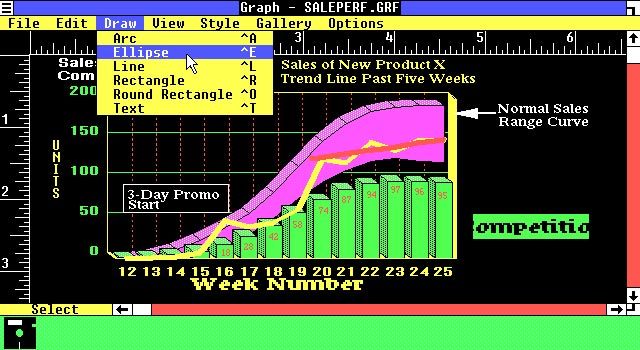
Here’s a truly awesome blast from the past… a Twitter thread, by California based data storyteller RJ Andrews, with images of drawing program software used on computers in the late 1980’s and early 1990’s.
The image above is the Micrografx Windows Graph interface, which was released in 1987, used to create graphs and charts on computers running the Microsoft Windows 1 operating system, which launched in 1985.
While some people might say the bold fluorescent pink, green, and yellow colours against the black background clash, the more you look at them, the better they begin to look.
RELATED CONTENT
The Global Music Vault, saving music for 10000 years
15 July 2022

Image courtesy of the Global Music Vault.
Much like the Svalbard Global Seed Vault which is intended to preserve plant seed specimens in the event of happenings such as natural disasters, wars, sabotage, or disease, the Global Music Vault, an initiative being supported by Microsoft, will safeguard and preserve the sonic arts for up to ten thousand years.
With the abundance of music in a variety of formats, vinyl, digital optical disc data storage (i.e. compact disc), and digital audio for instance, why is there a need take such a step in the first place? The thing is, none of these storage formats last all that long:
By Microsoft’s estimation, hard drives protect data for five years before they can go bad. Tape lasts about a decade, while CDs and DVDs can make it as long as 15 years before their contents are at risk of becoming illegible. While we seem to live in an age of progress — the iPhone can store thousands of songs in your pocket and stream countless more from the cloud — even in the best of cases, those songs will deteriorate millennia earlier than hieroglyphics carved into stone by the ancient Egyptians.
To conserve the music stored in the music vault — which incidentally will be located not far from the Global Seed Vault on the Norwegian island of Spitsbergen — compositions may be etched into quartz glass, using technology developed by Microsoft to store data as 3D patterns in a glass platter:
Microsoft begins with quartz glass, a high-quality glass that features a symmetrical molecular structure, which makes it far more resilient to high temperature and pressure than the glass in your home’s windows (and, like all glass, it’s immune to the electromagnetic scrambling of nuclear weapons). Then, using a femtosecond laser — a laser that can fire for one quadrillionth of a second — Microsoft etches information as 3D patterns into the glass. Once this data is stored, another laser reads the quartz, as machine learning algorithms translate the pattern back into music, movies, or any other digital information.
RELATED CONTENT
Quick and quiet e-bikes assisting Ukrainian defenders
15 July 2022
Ukrainian soldiers have been using e-bikes, specially modified to carry light anti-tank weapons, in the defence of their country from Russian invaders. The e-bikes allow defenders to move both quickly, and crucially, quietly, to positions where they are needed.
Soldiers on electric bikes have been spotted across Ukraine since the early days of the war, mostly on ELEEK brand bikes. e-bikes are fast and, critically, much quieter than a gas powered bike. They allow soldiers to perform quick guard patrols or move swiftly into position.
RELATED CONTENT
Milling wood scraps into bricks compatible with Lego blocks
14 July 2022
How cool is this? A method of turning wood scraps, from say household building projects, into bricks that will fit together with LEGO blocks.
And tangentially related, a method of using LEGO blocks for data storage, in the form of punch cards made up of LEGO bricks in a binary format (should the need arise to do so), by American software developer Mike Kohn.
Both ideas look like fun for a rainy day, of which we’ve a fair few of recently in this part of the world.
Via Hackaday.
RELATED CONTENT
A guide to designing and building websites in 1997
11 July 2022
It’s 1997 and you want to build a website, a history of the early days of website development, by Jay Hoffmann. The first version of disassociated went online in 1997. I even held a small launch party. We went to an internet cafe so I could see disassociated on a third-party device that was not mine, nor anyone I knew.
They were the good old days of web design. Designers would stay up all night working on a new website, only to pull it apart, and start all over again when some new trend came along, which seemed to be all the time. Javascript image rollovers, anyone? TV lines? Some of the best experimental web design was to be found in the late nineties. Partly because there was a new-frontier exuberance, and the rules were few.
Despite this, I worked to the HTML 3.2 standard — a non-proprietary specification for building websites to — published by the W3C. My desire to use standards was two-fold: they promised to make the web a little more accessible, and hardly anyone else was working with them. It made me feel like some sort of counter-culture rebel.
When the HMTL 4 spec came along in April 1998 though I quickly adopted it, because, you know, it was shiny and new. I only talk about standards because they were the only paper resource I referred to when coding — sorry, marking up — a website. I didn’t rely on text books to teach myself web design, but rather the online tutorials of the time. Plus a little, actually considerable, trial and error.
I worked at some big-end-of-town company for a short time in 1998, where I furtively printed out the HTML 4 spec, twenty pages at a time, here and there, throughout the day, for several weeks.
Why I needed to waste all that paper — once printed the spec was almost the size of a telephone directory — when I could’ve referred to the document online (via dialup), eludes me now. I think having the spec, bound in a ring-binder, sitting on my desk at home, validated my then fledgling web design aspirations.
For somebody surfing the web in 1997, a book might feel a bit… 20th century. If you already knew the basics of getting online, why not poke around some sites that might help, right there in your browser.
Hoffmann’s article also mentions a bunch of early-on-the-scene web design agencies, including Razorfish, who were behind the production of This Girl, the monthly serialisation of the life of a fictitious twenty-something living in New York, called Phoebe. The work of Razorfish, and the exploits of Phoebe, were one of thousands of web influences I absorbed.
I wonder what became of Phoebe. And that print out of that HMTL 4 spec.
RELATED CONTENT
SXSW is coming to Sydney Australia in October 2022
1 July 2022
Long running Austin, Texas, based American music, film, and interactive conference and festival South by Southwest, better known as SXSW, is hosting a week-long event in Sydney, from Saturday 15 October 2022 until Saturday 22 October.
While SXSW has held a number of spin-off events in the past, usually in North America, this is the first time the festival is being replicated outside of the United States. While details are yet to be finalised, most events will be taking place at the International Convention Centre (ICC), in Darling Harbour.
RELATED CONTENT
events, film, music, technology
Blockade Australia protestors forced to surrender smartphones, passcodes
29 June 2022
Say what you will about the recent Blockade Australia protests (do we not now have a climate-change friendly government?), but the conduct of police in dealing with the protestors they have been detaining has been causing alarm.
According to Digital Rights Watch, an organisation dedicated to protecting the digital rights of Australians, some arresting officers are demanding alleged offenders hand over devices such as smartphones, and also surrender access passcodes.
Digital Rights Watch has also been made aware of an incident where an individual who was simply near a location thought to be connected with Blockade Australia activities has had their phone seized by police. The police made a number of attempts to guess the passcode before handing the phone back.
Posted at Daring Fireball yesterday, and possibly useful: how to temporarily disable face id or touch id, and require a passcode to unlock your iPhone or iPad.
RELATED CONTENT