
Showing all posts about trends
If Starbucks gives you lemon lattes, go co-work at McDonalds
29 May 2024
Craig Meerkamper, writing at Spacing, laments the apparent demise of the once omnipresent commercial third place, a kind of neutral zone between home and work, such as a cafe, where people gather. Or where remote workers can set up shop for the day.
Coffee houses are one of the earliest examples of ‘Third Places,’ a term popularized by urban sociologist Raymond Oldenberg, who described them as “public places on neutral ground where people can gather and interact. In contrast to first places (home) and second places (work), Third Places allow people to put aside their concerns and simply enjoy the company and conversation around them.” More than that, Third Places are essential to community-building because they bring people together within a shared space who may otherwise remain in more disparate social circles.
Meerkamper cites the recent renovation of a large-chain coffee shop, where he used to work remotely, as an example. The once numerous tables where people could sit are gone, and the shop has been transformed into what he describes as “a one-room mobile pickup lane”.
Yecch. As if there were little enough incentive to visit the large-chain coffee shop in question. From the photos posted by Meerkamper, the renovation — to be blunt — looks hideous. The operators said one goal of the revamp was to improve accessibility for people with mobility constraints, which appears to be the case, but that seems to be the only plus.
But a whole bunch of matters are raised here. Do coffee shop operators have an obligation to provide office space for remote workers? Ditto, other organisations, such as large shopping centres, from where — as chance would have it — I wrote this post. Libraries even.
Further, what does the revamped setting say about us as a society? Meerkamper writes that tables have been replaced by a narrow bench running along a windowless wall. Patrons can choose to sit down. And face a blank wall. But they won’t be doing that. They’ll be looking at their phones. In fact, the new seating arrangement seems perfect for that purpose.
Does this mean people no longer want to gather at coffee shops to socialise? Would they rather sit there and stare at their smartphones instead? Is that what the new look caters for? Is a coffee shop, of all places, encouraging this behaviour? Structures on which people can lean have also appeared. They’re something to rest against, while waiting, presumably, for takeaway orders.
That definitely doesn’t make for a place where you can hang out for any length of time. Is this, I wonder, something the pandemic has occasioned? Now that more people are working from home, and have become accustomed to it, is there a need for somewhere else to go, a third place? We order our coffee online, race out to collect it, then return home.
No sitting down at the cafe to read, or chat with a friend, anymore. Are these the types of changes places like Starbucks are allowing for, when they remodel their shops?
Starbucks operates a store in a shopping centre I regularly visit. The last time I went passed, it seemed to be business as usual. No renovation work appeared to be in progress. I noticed, through the picture windows adorning the front of the shop, that tables along the back wall were occupied, as usual, mostly by people with laptops.
Meerkamper’s article makes me wonder if the same thing will happen in Australia. It might, but there may be a contingency option for people seeking a commercial third place to work from.
We recently had to make an “emergency” food stop at a large-chain hamburger restaurant, in the west of Sydney. A niece desperately needed a chocolate sundae. We decided to go inside and sit down for a while. As we did, I couldn’t help noticing all the tables along the walls had power points, along with USB charger slots.
Looking around the room, just about every wall table sported a laptop. And none of these people appeared to be in any hurry to leave. A group of people at a nearby table had bought in a scanner, which they’d plugged into a power point, together with several photo albums.
It was clear they intended to stay several hours, as they digitised their photos. McDonalds as a co-working space, or what? Could this be a case of a door closing, and a window opening?
RELATED CONTENT
Telstra redundancies, AI robots come in, the future is now
24 May 2024
Australia’s largest telecommunications company, Telstra, announced this week it was making about three thousand employees, or ten percent, of its workforce redundant. About three hundred people were sent home straightaway — hopefully with some sort of pay-out — while the remainder will depart between now and the end of the year.
This is terrible news for those who will now be looking for new work, at a time when the seasonally adjusted Australian unemployment rate has also been rising. Telstra cites the need to cut costs, and claims the mass layoffs will produce savings to them of three-hundred-and-fifty-million dollars.
The thing is, when cuts are made to the workforce — allegedly in the name of saving money — the work once carried out by the three-thousand people who have been let go, does not necessarily evaporate. Accordingly, in the past companies laying off large numbers of staff have out-sourced some of this work to lower-cost providers.
Or, have said advances in technology will make up for the shortfall in staff. In this instance however, advances in technology includes the deployment of Artificial Intelligence (AI) powered software:
“AI and cloud computing and robots, you know they can be far more efficient and effective in the network,” telecommunications consultant Paul Budde said. “So therefore, what you start seeing is absolutely replacing humans [with] this new technology … that is seriously happening.”
Telstra’s move has stoked fears of a wider adoption of AI “solutions”, for companies looking to reduce their headcount. It could be argued the Telstra situation is a one-off. The telco’s customer base has been declining for decades as people make use of internet based call services, and move away from landline phones. Other Australian companies, therefore, especially large enterprises, are likely not quite facing the same challenges as Telstra.
But does that mean they’re not looking at the cost-cutting potential of incorporating more AI technologies into their operations? That, unfortunately, remains to be seen.
RELATED CONTENT
artificial intelligence, technology, trends, work
Running clubs, the IndieWeb of the dating realm?
23 May 2024
Konrad Marshall, writing for the Sydney Morning Herald:
Run South Yarra co-founder Tom Adair is wary of any suggestion that run clubs are the new Tinder, yet relationships are born here, and side-by-side chats while jogging, he notes, are definitely less pressurised than face-to-face interactions. (Plus, you can always pick up the pace and scoot away if a chat isn’t going well.) “It’s almost like a nightclub, but no one’s drunk, and you’re actually making meaningful conversation,” Adair concedes.
If you can stomach the unearthly start times, six o’clock in the morning, maybe earlier, weekends included, it all makes sense. You’re sharing a bonding experience with likeminded people. How could run clubs not be somewhere you’d potentially meet a romantic prospect? Aside from the fact you’re there to run of course, not anything else.
But here’s a thought. Granted, one that could probably only occur to me. If there is a movement online, a turning away from social media, a return to the small web, and personal websites, might the rising popularity of run clubs represent a similar movement away from dating apps?
Imagine meeting, then building rapport with someone — maybe in time, more — in a safe group setting, while partaking of a shared interest, such as running? Though it could be something else. Who needs a meddlesome, intrusive, dating app, for that?
RELATED CONTENT
An indie guide to the IndieWeb, by Wing Pang
22 May 2024
Sydney based product designer Wing Pang, whom I wrote about last week, has published a comprehensive guide to the IndieWeb.
Coming from a design background, joining the IndieWeb was an incredibly exciting and rewarding, yet maze-like journey. To be honest, almost every step of the way was like a leap! But I’ve learnt so much and got a lot of feedback throughout this process from the passionate and friendly community.
RELATED CONTENT
blogs, IndieWeb, social media, trends
Blog of the .Day, bringing back the blogosphere one blog at a time
22 May 2024
Blog of the .Day, yes, styled as Blog of the .Day, a collaboration between James Gallagher of James’ Coffee Blog, and Joe Crawford, will highlight a new blog every day.
Aside from casting the spotlight daily on a blog, another goal of the project is to bring the term blogosphere back into popular usage. For those coming in late, the blogosphere — that great interconnectedness of blogs — preceded the Twitterverse, and now looks to have outlived it as well.
Long live the blogosphere.
RELATED CONTENT
blogs, IndieWeb, social media, trends, Twitter
What has happened to cover versions of popular songs?
20 May 2024
Every week, Australian radio station Triple J, invites a band or musician to record a cover of a song, for their Like A Version show. Anything goes here. About two years ago, Sydney based Australian DJ Dave Winnel performed a cover of Africa, by Toto, not the sort of music you’d usually hear on the jays.
While Like A Version recordings are archived on the Triple J website, I’m not sure many are released as singles, where they may, or may not, chart. The idea here is to have a bit of fun.
Cover songs, where one musician records a usually popular song by another recording artist, are an integral part of music history. Many well-known acts launched their careers by recording a cover of someone else’s song. The Rolling Stones first single, for example, from 1963, was a cover of Come On, by Chuck Berry.
But today though, covers are a lost art. Or, covers of popular songs, at least, according to this chart, compiled by American musician and writer, Chris Dalla Riva. The image makes for grim viewing for fans of cover songs. In the last fifteen to twenty years, barely any cover songs — of the popular variety, that is — have made it onto the Billboard Hot 100 charts.
Surely this is not the end of the road for covers? Read more about Dalla Riva’s findings here.
RELATED CONTENT
RSS is really simple, why do so many find it complicated?
17 May 2024
Chris, writing at uncountable thoughts:
RSS is a pervasive, but little known, web technology that allows you aggregate all your content into one place for easy reading. There are very few websites without an RSS feed, although many don’t advertise the link (or, even realise they have it).
When you put an RSS feed link into your RSS, it is called “subscribing”. But don’t worry — it’s totally free, and you don’t give your email address.
Really Simple Syndication (RSS) is really simple. But a lot of people don’t see it that way, and anyone who has ever syndicated their web content, has always struggled to convince their readers of that. Like, probably since RSS arrived in March 1999. Yet RSS almost had its moment, during the so-called golden age of blogging, circa 2003 to 2010.
Writers took to writing blogs, and readers took to reading blogs. Content Management Systems like WordPress churned out RSS feeds automatically. All a blogger had do was prominently post a link to their RSS feed. Really simple. Writing posts explaining what RSS was, and why it was useful, was also common. Erstwhile (by the looks of it) Australian blogger Meg Tsiamis, of (defunct) Top 100 Australian Blogs Index fame, wrote a post in 2007, outlining RSS to her mother, and other of her readers.
Sadly, the more in-depth resource she linked to, is no longer online. In other words though, we’ve been trying for years, decades, to impress upon others the simplicity and function of RSS, but too little, or no, avail. Unfortunately RSS plain simply baffled just about anyone, and everyone, who didn’t write a blog. RSS was too technical, too geeky, many people complained.
But popular perceptions of RSS were only one problem. Accessing RSS easily was another. Some argued Google closing down their popular RSS reader, er, Google Reader (which I never used), in 2013, sounded the death knell of RSS. But the real problem had always been one of uptake, or rather, lack of uptake. Geekiness aside, some people questioned the purpose of RSS in the first place.
I recall, in 2014, trying to explain the utility of RSS to a co-member of a small business coffee meeting group I was then part of. I pulled out my laptop at the cafe we gathered at one morning, and showed him my RSS reader of the time (NewsGator, I think). “Look, see, you only have to visit one website to read one hundred websites,” I said, as I scrolled through my subscription list.
He marvelled as he looked on, recognising a number of websites he visited regularly. “All you need do is get a RSS reader app, like the one we’re looking at now, subscribe to the RSS feeds you like, and you’re set,” I said. Despite my small presentation though, he still looked confused. He didn’t seem to understand why you’d stop visiting a website, to read its content elsewhere.
Oh, the frustration.
Today RSS is even simpler. No apps are needed, one only has to create an account through a RSS aggregator website, Feedly for example (free for a basic account), and start subscribing. You don’t even need to know the URL of a website’s RSS feed. Type in the regular URL, and Feedly will search for available feeds.
Subscribing to an RSS feed is really the same as following someone on Instagram (IG). And it’s just as simple. Choose an IG page you want to follow, and tap the follow button. With RSS though, instead of following, you’re subscribing, although some RSS aggregators call the process following.
Better still, and as is often reported elsewhere, your subscription is anonymous (you could follow my RSS feed, and I’d have no idea unless you told me), and you only see the content you want to. There are no algorithms, or annoying “suggested for you” content. How good is that?
Well, not good enough, perhaps. Until subscribing to a RSS feed literally becomes as easy as following someone on social media, selling RSS as a really simple way of following a website, will, unfortunately, remain a hard sell.
RELATED CONTENT
blogs, RSS, technology, trends
Like describing a photo to a friend, how to write alt-text
15 May 2024
Web designers and bloggers have been able to use alternative text, often referred to as “alt-text”, to describe images and photos, for decades. Alt-text helps people with little or no vision comprehend a website image, so long as the description is reasonably accurate.
In recent years social media has caught up, and most channels, Instagram, Threads, Mastodon, and Bluesky among them, allow users to add alt-text to images they post.
The facility has left people wondering though about the best way to describe an image. Sadly, writing something like “a photo of my cat” as alt-text for a photo of a pet, doesn’t quite cut it.
A person with low vision knows your photo is of a cat, but is left wondering what sort of cat, what colour is the cat’s hair, and so on. So some degree of detail is useful.
Scott Vandehey, writing at Cloud Four, offers a straightforward suggestion for writing alt-text: imagine yourself describing something you’re looking at, to someone who you’re on the phone to:
I find people often get too wrapped up in what the “rules” are for alternative text. Sure, there are lots of things to be aware of, but almost all of them are covered under this simple guideline. If you were talking to a friend on the phone and wanted to describe a meme you saw, you might say “There was this dog wearing safety glasses, surrounded by chemistry equipment, saying ‘I have no idea what I’m doing.'”
The great thing about writing alt-text is the way you can write it once, say on a Notes file, but publish indefinitely, depending how many channels you end up posting the image to. It’s what I do now. Write a caption and alt-text first, then start posting across my socials.
RELATED CONTENT
social media, technology, trends
Angel Baby, a story of doomed loved, and changing Australian accents
14 May 2024
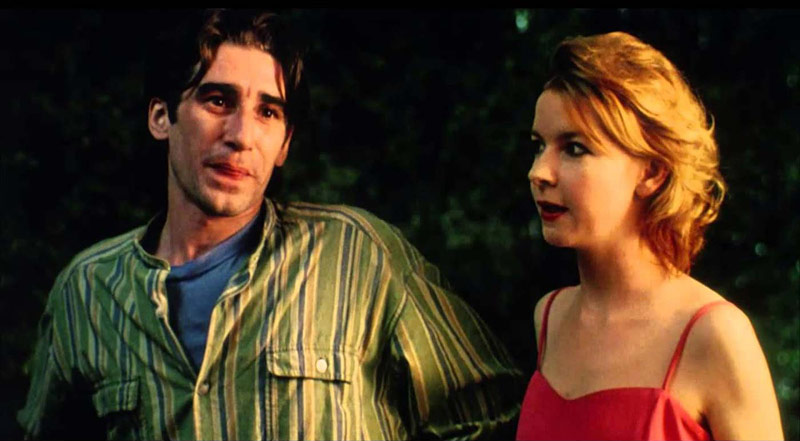
A scene from Angel Baby, a film by Michael Rymer, depicting stars Jacqueline McKenzie and John Lynch.
Angel Baby, trailer, is the 1995 debut feature of Australian filmmaker Michael Rymer. You may have seen some of his other work: Battlestar Galactica, Hannibal, both TV series, and/or his 2012 feature, Face to Face, but likely you’ve not have heard of Angel Baby.
Filmed in Melbourne, Angel Baby tells the story of a doomed love shared by Kate (Jacqueline McKenzie) and Harry (John Lynch), both of whom are battling severe mental illnesses. I won’t say too much more about it, except to note this is an example of under-appreciated Australian cinema.
And, possibly, an exemplification of how Australian accents have changed over thirty years. I say this because I was amazed at how distinct, how strong, some of the actor’s accents were. I live in Australia, and am surrounded by people with Australian accents.
That’s obviously a no-brainer — well, to an extent — but it means generally Australian accents should sound “neutral” to me, because I’m exposed to them daily. Mostly, that is. I spend several days a week in Sydney, a diverse city. Here, Australian accents are only a sample of the many I hear daily.
Perhaps this accounts for why I found some of the accents in Angel Baby so pronounced, so unmissable, because in reality I am not wholly immersed by them. But it seems to me, to detect an accent, local to the region you reside in, which may otherwise seem indiscernible, you need to go outside that area, to begin to perceive it.
I spent several years in London, England not Canada, and after a few months could easily detect Antipodean accents. It was an odd sensation to speak on the phone to lifelong friends living down under, and notice their accents. To notice, effectively, my accent. I wonder if you can pick up my accent on the phone, to lift a line from the Waifs’ 2002 song, London Still.
Australian accents are said to fall into three main categories: broad, general, and cultivated. The Australian accents I detected in Angel Baby had to be in the board category. Of course, there are any number of explanations as to why the accents seemed pronounced.
Could it be I was hearing not wholly familiar Melbourne variations of the Australian accent? Or could it be some of the actors were asked to emphasise their accents, Angel Baby being an Australian production, and all. Perhaps Rymer wanted people, particularly overseas audiences, to make no mistake they were watching an Australian film.
But I also began wondering if the internet was playing some part in my hearing Australian accents on Australian soil? Angel Baby was made in 1995. The year after 1994, which Angela Watercutter, writing recently for Wired, described as the last year before culture began to migrate online.
Could it be imagined Australian accents were among this migration, where they began to blend with every other English language accent, every other accent full stop, and begin altering? Of course, accents from other global regions are still distinct. I have no trouble discerning, for example, Irish, North American, or English accents.
Or those of other cultures, because different accents stand out. But might thirty years of internet culture, monoculture perhaps, be making a difference? Unlike thirty years ago, today we are constantly hearing, constantly absorbing, the voices of speakers from across the globe, on the web, and social media.
Might this be resulting in accents — I don’t know — dissolving into each other a bit? Are we unwitting students of elocution lessons, being served up through the world wide web? Accordingly, a “normal” Australian accent of thirty years ago, may sound quite different today. But who knows? Perhaps I am only imagining this would-be diction.
One thing is certain though. If you have the chance, look at Angel Baby. If you’re a Kanopy member, it may be available in your region.
RELATED CONTENT
film, Jacqueline McKenzie, John Lynch, language, Michael Rymer, trends
Unwanted AI-generated content has a name: slop
14 May 2024
Seen at Simon Willison’s Weblog:
Not all promotional content is spam, and not all AI-generated content is slop. But if it’s mindlessly generated and thrust upon someone who didn’t ask for it, slop is the perfect term for it.
Spam and slop. Now there’s a diet guaranteed to be bad for your health and mental well-being.
RELATED CONTENT