
Showing all posts about trends
Paris bans rental e-scooters after accidents, injuries
6 September 2023
The French capital, Paris, has become the first European city to ban the use of electric share scooters. The move follows a referendum earlier this year, where Parisians were asked to decide whether the e-scooters should remain or be removed.
Paris will this week become one of the only cities in Europe with an outright ban on rented e-scooters — as operators plan to ramp up their e-bike fleets to replace them ahead of the 2024 Olympics. Despite previously expressing hopes for a last-minute reprieve, the three firms with e-scooter operating licenses in the French capital, Lime, Dott and Tier, all confirmed to CNBC that they will have removed their scooters, or trottinettes, by the Sept. 1 deadline.
At first glance, e-scooters seem like a low-cost, convenient, and even environmentally friendly, way to travel short distances. But the sometimes dangerous conduct of some e-scooter users, resulting in injuries, and tragically, a fatality, drew wide condemnation in Paris.
E-scooter users are also causing similar problems in parts of Australia. A number of pedestrians have been hurt in collisions, and often have little legal recourse, or access to compensation.
While the e-scooters hire companies offer insurance to users, the policies are often voided if the e-scooter driver was not wearing a helmet, or breaking the law in some other way, leaving accident victims, who were doing nothing wrong, high and dry.
It seems like a no-brainer that the use of sustainable methods of travel, such as e-scooters, should be encouraged, but laws need to be in place to ensure pedestrians, and others in public spaces, are protected in the event something goes wrong.
RELATED CONTENT
current affairs, technology, trends
Libraries, co-working spaces lending out sewing machines, iPads, and more
1 September 2023
Australian libraries are no longer quiet places to study or borrow books, writes Bec Zhuang for The Guardian. Today they are community hubs offering working spaces, meeting rooms, film screenings, art shows, and study courses, among other things. And in some places, libraries loan out more than books. Musical instruments, gaming consoles, sewing machines, bike repair tool kits, and, in the case of Waverley library, in Sydney’s east, iPads, are now potentially on offer:
In fact, libraries are transforming into “community hubs” to work, play or access outreach services — at no cost to visitors. The Australian Library and Information Association says forthcoming data from Public Libraries Victoria’s annual survey suggests that, with Covid restrictions now over, participation in free library programs increased by 95% this year.
Up until the pandemic I used to work semi-regularly at a nearby library. Looking around, I’d frequently see the same people each time, and it was apparent many were operating small businesses, or working there. Of these regulars, one often conducted meetings with clients in the library’s foyer, as there were, at the time, no dedicated meeting rooms.
RELATED CONTENT
Would watching films be more fun if smartphones were banned?
10 August 2023

Image courtesy of Startup Stock Photos.
Blockbusters such as Barbie and Oppenheimer have been a windfall for cinemas struggling as a consequence of the Covid lockdowns of recent years, and stories of packed auditoriums are surely good news.
But the news hasn’t been all good. In staying home to watch movies over the last few years, some film-goers appear to have forgotten their cinema etiquette. Reports have emerged of people taking phone calls, scrolling social media, and, incredibly, giving their children phones to amuse themselves should the main feature not be of interest.
Cripes.
While there might be a generation of young film-watchers to whom cinema-going is a new experience, that cannot be the case for their parents. And it seems only a couple of short years of viewing movies from home have been enough to make some forget how to behave at the movies.
Perhaps though, as people begin to come re-accustomed to seeing a film in a communal setting, their conduct will improve. But I wonder. For some time, years prior to the pandemic, I’d been noticing a change in the behaviour of cinema audiences.
While it now seems to be a granted people will glaze at their phones during a film, I would have thought they’d draw the line at taking, or making, calls during the screening. Of course there have always been issues with people arriving late, going in and out of the auditorium repeatedly, along with being baffled by allocated seating.
But talking on the phone during a movie? That’s a whole other level of film-watching misery.
I wonder though, how much of the audience behaviour problems we see today can be attributed to smartphones, and our umbilical-like dependency on them? In the past I’ve been to film preview screenings where we’ve had to leave our phones outside the auditorium, in a secure locker. This to prevent a yet to be released feature being recorded, and leaked.
For sure, it seemed strange to be temporarily separated from our phones, but I wasn’t aware of anyone suffering adversely as a result. These screenings were quite the spectacle though. Everyone, for the most part, sitting still for the duration, focussed only on the film. Of course most of those present were film critics or journalists, at what was effectively a work event.
Still, it’s tempting, if futile, to conject here. Imagine if everyone had to leave their phones at the box office, prior to sitting down to watch a movie. Sure, there’d still be people turning up late, sitting in someone else’s seat, and opening bags of food in the noisiest way possible. But if music festivals can operate phone-free, why can’t cinemas?
For the benefits, and audience comfort, of phone-free movie sessions though, sadly I can’t see any cinema even dreaming of imposing such a demand on customers. After the last few difficult years, movie house owners would be reluctant to do anything that might dissuade patrons.
Over the course of the pandemic, and the lockdowns, I became quite the fan of streaming films at home. Doing so certainly has downsides, such as the waiting time for some titles to become available for streaming, but at least we can engage in all those irritating film-goer behaviours I’ve described, without annoying anyone else.
RELATED CONTENT
film, movies, smartphones, trends
Have film influencers killed off insightful film critique?
3 August 2023
London based film writer Manuela Lazić, writing for The Guardian:
If the internet has paved the way for the devaluation of cinema via streaming platforms, it has also done the same for film criticism. The democratising effect is undeniable, but so is the cheapening one, literally and figuratively. With so many more people writing about cinema online, fees for reviews have fallen to shockingly low levels and the expertise supposedly required of film critics has been forgotten – knowledge of the film history and good writing skills are less and less valued.
Once, many years ago, during a regrettable stint working in the corporate sector, I was called into division wide meeting by my boss. The CEO, whom my boss reported to directly, wanted to conduct a staff survey. The CEO was — so he said — keen to learn what people thought about working at the company. My boss was clearly terrified at what might be said, and sought to steer our thinking.
“I think it’s great of the CEO to offer us this opportunity to speak our minds, and accordingly, I think we should be positive,” he said, trying, but failing, to sound as matter-of-fact as possible. Whether he missed my colleagues and I side-eyeing each other, or only pretended to, I don’t know. My frazzled boss though was able to rest easy. A few days later it was announced the survey was being delayed, and that was the last anyone heard of it.
But the takeaway was clear. When asked to offer honest feedback, always be complimentary.
Ten years ago, I was being invited to film preview screenings left, right, and centre. I was, according to a marketer at one of the promotions agencies I was “partnering” with, an influencer. But I wasn’t an influencer, and I certainly wasn’t a film critic, even though I wrote a bit about some of the films I saw. What I did have though was a website, the content of which, at the time, ranked quickly and well, on certain search engines.
There it was: I was an asset. If I were to write about a film, chances were the review would be near the top of the search results. Now if only I could write positively about that film. Perhaps the excitement, the extravaganza, of being at the local premiere, where food was abundant, the alcohol flowed, and the stars were in attendance, would entice me to say something nice. Well, sometimes it worked, sometimes it didn’t. But I can’t say I didn’t enjoy the hoopla of it all.
Generally though, I heard little back from the agencies, regardless of what I wrote. It was apparent, from my web stats reports, that some of them looked, but that was all. A bad write up didn’t see me struck off the invite list. But times have changed it seems. All a would-be influencer cum film critic can expect today when being asked to review a film, is a free ticket to the show. Gone is the red carpet, the bubbly, and the assorted “free” gifts. Gone also are tickets to the next event, if a favourable social media post is not forthcoming.
An incentive, if ever there were one, to be complimentary, and positive.
And that’s it. That’s the way film reviews roll in the third decade of the twenty-first century, particularly where the big budget blockbusters are concerned. Experienced film critics seem to no longer be part of the process, or if they are, their thoughts are relegated to the fringes where few paying cinema-goers venture. Social media, and influencers, and a world where negative reviews never see the light of day: what a boon that’s been for the blockbuster film industry.
RELATED CONTENT
Boost Threads engagement by making the platform more useful
31 July 2023

Image courtesy of Igor Ovsyannykov.
The number of people using Threads, Meta’s micro-blogging app, together with the amount of time they are spending there, has continued to decline, according to Israeli web analytics company, Similarweb. It’s certainly not what a lot of people would have expected, given Threads’ awe inspiring debut in early July. Meta however maintain they are not surprised by the latest numbers, and perhaps for good reason.
While Threads signed on a record one-hundred million members in a matter of days, that could be largely attributed to the ease of joining. If you had an Instagram (IG) account, as do some two billion people, joining Threads was almost as simple as pressing a button. A person’s IG profile information was copied straight over to their Threads page, as were their followers, who had the option to follow back if and when they joined.
Aside from early adopters scrambling to score a low Threads badge number, numerous people already established on IG were keen to carry over their IG username and brand to Threads, lest someone else get in first. Threads also appealed to those disillusioned with the shenanigans of the micro-blogging platform formerly known as Twitter, who further were enticed by Threads’ ease of use, compared to alternatives such as Mastodon.
But once set up and ready to go on Threads, many Threaders were left wondering: what next? On looking more closely at Threads, members found a platform lacking not only in user options, but also a significant proportion of their friends and followers from other social networks. In addition, some users, particularly those with smaller followings, had expressed frustration at the low levels of engagement they were experiencing on Threads.
Many of these new users also had the existing social networks they were part of to consider.
Yet none of these problems are, I think, insurmountable. So long as Meta doesn’t overly Facebook-ernise Threads in the way they have IG, that is. Do we want Facebook and IG like “suggestions”, and other content we didn’t expressly opt-in for, clogging up our timelines and feeds? Not me. I’m not saying Meta shouldn’t be able to generate revenue from Threads through advertising in some form, but surely they can do so in a measured way.
What Meta needs to do is make Threads more useful. They could start by making topics of interest searchable. This was one of the highlights of Twitter/X. Finding out what’s happening elsewhere in my hometown, or why there’s a delay on the train line, was as simple as entering a phrase into the search box. Another urgently needed feature is making hashtags live. Being able to see what others are saying about the same topic was another feature that gave Twitter great value.
A list of trending topics would also be useful. As would desktop/laptop computer access to Threads. The current app-only access means I need to email posts I’ve written for other platforms to my smartphone, just to make the cross-post to Threads. And on the subject of cross-posting, how about the option to post photos and videos from IG — as we can to other Meta properties, such as Facebook — to Threads at the same time.
When it comes to boosting engagement on Threads, perhaps selected posts from users with public profiles, who are not influencers, nor have large following counts, could have more prominence in the “For you” column. At present the “For you” column seems to be the domain of the Threads rock stars, whom maybe I could refer to as the threaderati, were I to riff on that celebrated neologism from the blogosphere, bloggerati.
Threaders with modest profiles though might feel less disinclined to interact with someone closer to their level, rather than respond to an influencer who may not even see their comment. If nothing else, it might garner more interaction at grass roots level. But let’s see what eventuates. Meta have said new features are forthcoming. Now it’s a matter of waiting for them, and seeing what impact they have on the platform.
RELATED CONTENT
social media, social networks, Threads, trends
Threads engagement declines, badges removed from Instagram
17 July 2023
The curious joined, looked around, and then returned to what they were doing before. Daily active users on Threads, Meta’s answer to Twitter’s micro-blogging platform, declined by twenty percent in the days following the app’s red-hot launch, while time spent by users on Threads fell from twenty minutes per day, to ten.
This is probably par for the course though. It’s not as if Twitter, and other social networks vanished, leaving Threads users more time to spend on the app. While not the most active on social networks, I’m on a few, and as much as I like Threads, there’s only so much time in the day that can (or should) be devoted to activity on social networks.
And although there might have been one-hundred million sign-ups for Threads, the people many of these new members follow may not be among that number, necessitating visits to wherever those followers are. And that might remain the case. For instance, Threads does not have the same news and politics focus as Twitter, meaning the platform won’t be for everyone, meaning some people will be spending their time on multiple social networks, not just one.
In other Threads news, member badge numbers, which I wrote about last week, are no longer visible on the Instagram app profile pages of those who are members of both Meta platforms. The badge, indicating what number member someone was on Threads, has been replaced by the Threads logo, linking to that person’s Threads page, and right now is only visible on the Instagram website.
How unfortunate. I had high hopes for those badge numbers, some of which were surely collectable (and subsequently worth paying good money for). It looks like I won’t be buying that villa in the north of Portugal, to summer at, after all…
RELATED CONTENT
social media, social networks, Threads, trends
Australian cafes feel brunt of rising inflation, interest rates
17 July 2023
Australian cafes are among those bearing the brunt of the cost of living crisis. Many are dealing with rising overheads, and reduced revenue, as their customers — who are negotiating increased rent or mortgage payments, among other things — feel compelled to reduce discretionary spending.
As a result, many cafes are going out of business:
About one-sixth of cafes advertised for sale now will close down before finding a buyer. In May, ASIC data showed business insolvencies were at the highest monthly rate in eight years. So far the insolvencies have been dominated by construction firms, but hospitality is expected to overtake it in 2024, credit reporting agency CreditorWatch said.
At a large shopping centre I visit in Sydney’s east, I’ve seen about half a dozen coffee shops close in perhaps the last twelve months. While myriad factors could account for this, including a noticeable decline in foot traffic in the centre, rising interest rates and inflation are surely also to blame.
It’s sad to see. For many people, operating a cafe is one way of realising the dream of owning a small business and being self-employed, together with creating work opportunities, both direct and indirect, for other people.
RELATED CONTENT
Threads revenue tipped to reach $8 billion by 2025
15 July 2023
Threads, Meta’s micro-blogging app, may only be a week old, and boast a relatively small membership of one-hundred million, but some analysts are already predicting, boldly perhaps, the Twitter clone may draw in revenues of eight-billion dollar per annum by 2025:
Evercore ISI analysts reportedly said they expect Threads to add $8 billion to Meta’s annual revenue by 2025. Nevertheless, while marketers and brands are already experimenting with the app, they really want to know when ad formats will be available.
This is the eight-billion dollar question. Part of Threads’ present appeal is the relative absence of advertising. I think most people appreciate ads of some sort will need to make an appearance at some point — this playground Meta has made for us has an overhead after all — but the way they are deployed will be critical.
Any misstep could drive users away, and potentially bring an end to Threads. As a comparison, Twitter, with a membership of some 368 million daily active users, made four and a half billion dollars in 2022, chiefly from advertising. Whether we get to see the 2023 numbers remains to be seen.
Via Matt Fleury.
RELATED CONTENT
social media, social networks, Threads, trends, Twitter
Have Threads badges made my Instagram account valuable?
11 July 2023
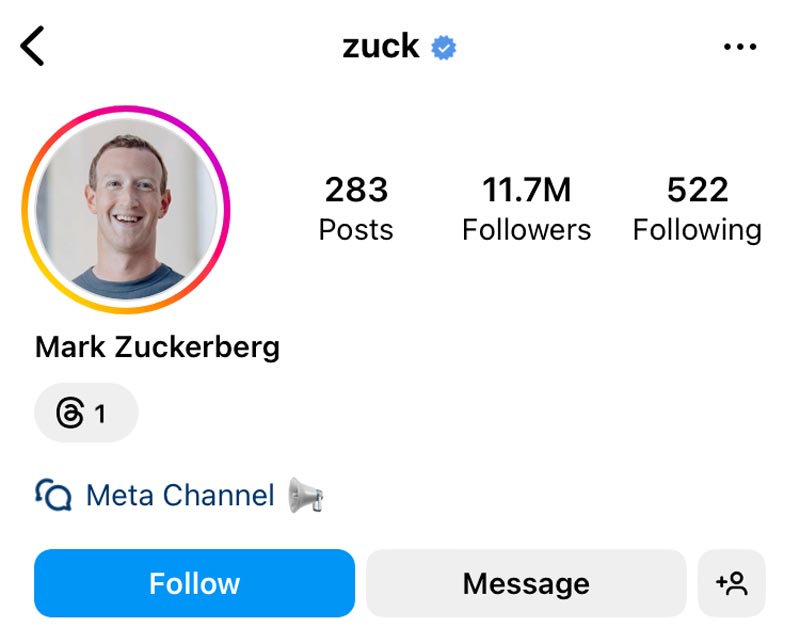
Mark Zuckerberg’s Instagram profile displaying his Threads badge.
The launch last week of Meta’s Twitter-like micro-blogging service Threads has been a riotous success, if the one-hundred million sign-ups in its first five days are any indication. Threads seems to have been the much wanted breath of fresh air micro-bloggers were waiting for. The Meta made app not only offers ease of use, but comes largely unencumbered by the baggage of Twitter, or the confusion some people have experienced with Mastodon, another micro-blogging contender.
Of course it is early days. Threads is not completely without its drawbacks. Privacy advocates have voiced concerns about some of the user data Threads is collecting. And compared to, say, Twitter, many features micro-bloggers are used to — hashtags for example — remain absent, though it sounds like more functionality is on the way.
Introducing the Threads badge
One feature however that may have surprised many Instagram users after signing up for Threads, is the appearance of a number on their Instagram account, situated just below their username. The image above, a screen grab of Facebook co-founder Mark Zuckerberg’s Instagram page, is an example of what I mean. From what I can gather, the symbol that looks a little like @1, is called a badge, or a Threads badge, though, in some cases, it could just as easily be called a badge of honour.
In short the badge, which can only be seen on the Instagram app, but not the website, tells the world what number member you are of Threads. It also links to your Threads page, and anyone tapping on the badge will be taken there, if they are a member themselves. It is of little surprise that Zuckerberg, as CEO of Meta, scored the surely much coveted badge number one. But aside from letting everyone know how quickly, or not, that you became a Threads member, might the badge have other value?
As in financial value? I mean, who wouldn’t want to have Threads badge number one adorning their Instagram page? While it is fair to say the chances of acquiring this particular badge number are pretty much non-existent, might other badge numbers become something people would be prepared to pay top dollar for?
Speculating on Threads badges, really?
Speculating on Threads badge numbers however would be fraught with difficulty. For one, Threads needs to take hold as a serious micro-blogging player, for the badges to accrue any value. As I said earlier, there has been a rush to sign up for Threads, but how many people will remain active on the platform long term? If the initial burst of enthusiasm wanes, Meta might decide to close Threads down, rendering the badges worthless.
But that’s not to say there might still be interest in the badges as a commodity. While the ultra-low badge numbers are probably in the hands of those who will not let them go, come what may, there may be people potentially interested in trying to acquire double, or three figure numbers. Or so-called “golden numbers” that may be higher, but are possessed of some subjective value to a would-be buyer, or even a Threads badge number speculator.
666, anyone? Or perhaps a year of birth? Or possibility any relatively low number that makes the owner look like they are an early adopter. But while someone may be interested in buying a particular Threads badge, that doesn’t mean the sale process would be straightforward. Even if the price was right. And the transfer were to evade Meta’s notice. Anyone selling their in demand Threads badge number would have a few things to think about.
Beware the pitfalls…
They would be giving up both their Instagram and Threads accounts, and may lose their possibly cherished username, and followers, in the process. While an arrangement might be reached with the buyer to give up the username, there’s the risk it might be snatched by someone else, if the seller doesn’t move quickly to re-secure it. The seller would also need to get their original followers on board at their new Instagram and Threads pages, something not necessarily straightforward.
Some sort of legally binding written agreement would also need to be in place to ensure each party to the transaction did what was required of them, at the requisite times. Buyer transfers money, seller surrenders account passwords, things like that. Perhaps a brokering service to cater for such a transaction could be engaged to oversee the sale. Maybe there’s a business opportunity for brokers, if the sale of Threads badge numbers becomes commonplace. Oh, the possibilities…
Or is it all a pipe dream?
But the prospect of a marketplace for badge numbers emerging, is likewise, pie in the sky possibility. That’s too bad, some of us might have been millionaires for a minute there, at least in the recesses of imagination. But also read this Mashable article by Sam Haysom. See that image as you start to scroll down. The image bearing the somewhat ominous notification, stating “this temporary badge lets your followers know that you’re on Threads and sends them to your profile if they have the app.”
What? The Threads badges are only temporary? Where’s the fun (and millions) in that? If then you do wish to cash in on your Threads badge number, move quickly. And whatever you do, don’t tell the buyer the badges are temporary…
RELATED CONTENT
social media, social networks, Threads, trends
The Loneliness Project, stories of loneliness curated by Marissa Korda
11 July 2023
I’m a little late to the party, the Loneliness Project, by Canadian graphic designer and illustrator Marissa Korda, has stopped publishing stories, but previous editions remain online for your reading enjoyment. I have to say I like the way each story is presented as a different apartment building (go to the website and see what I mean).
But the idea people can still be lonely, even though they live among a group of others, albeit separated by the wall of their dwellings, is poignant. Certainly, someone residing alone in an isolated house in a remote region may experience loneliness, but that it may happen in such close proximity to others seems unthinkable, even though of course it happens all the time.
But you don’t need to live alone, and not know your neighbours, to feel lonely. As these anecdotes about loneliness go to show, you can be surrounded by people, and still feel utterly alone.
And perhaps tangentially related, loneliness, particularly among young adults, has seen a rise in the number of friend-finder apps, not dissimilar to the likes of dating apps such as Tinder and Bumble.
RELATED CONTENT