The libraries I grew up with would buy books, preserve them, and lend them for free to their patrons. If my library did not have a particular book, then it would borrow a copy from another library for me. In the shift from print to digital, many commercial publishers are declaring each of these activities illegal: they refuse libraries the right to buy ebooks, preserve ebooks, or lend ebooks. They demand that libraries license ebooks for a limited time or for limited uses at exorbitant prices, and some publishers refuse to license audiobooks or ebooks to libraries at all, making those digital works unavailable to hundreds of millions of library patrons.
In Australia we have the Lending Right Schemes, and I’m sure similar arrangements apply in other countries, whereby an author or publisher receives a royalty when one of their titles is borrowed from a library. While the arrangement doesn’t presently cover electronic books, changes are afoot. But it sounds like these sorts of payments may not be enough for some publishers going forward.
This sounds convenient. Instead of hauling a smartphone around all the time, you could instead have a social media platform injected into the roof of your mouth. The implant would mesh with your brain, eventually taking the place of your phone. Blink twice to take a photo maybe, communicate brain to brain with friends who also have the app implant.
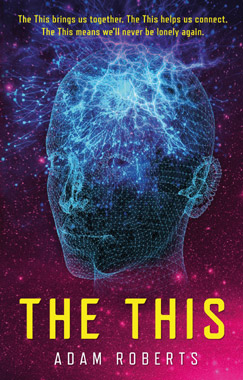
Welcome to The This, the futurist social media app, and novel of the same name, written by British science fiction author Adam Roberts, published by Hachette Australia. The app is popular with many, but there are those who do not like it. They do not want to be part of the so-called hive mind. They’ve seen Twitter, they’ve seen enough. But the storyline has all the hallmarks of a hive mind, a sprawling, surreal, neural network spanning space and time.
Adan is a journalist, sent to profile the CEO of The This. But after Adan’s mother unexpectedly leaves the country, he is forced to join the army as he is left without a home or any money. Adan is battling a robot invasion, in a reality far removed from the one he once knew. In later centuries a diminished humanity is fighting off another hive mind, one intent of the final destruction of humanity. And all because we wanted to try out a new social media app…
From February 14 to March 3, Twitter users will be able to vote up to 20 times a day for their favorite film and favorite film moment of 2021. The winning film and scene will then be featured during this year’s Oscars broadcast.
If you were a writer like British author Francis Spufford is, but didn’t want to call yourself a writer, as was once the case for Spufford, what title would you settle for instead?
It took me a long time to decide I wanted to be a writer. And then I felt that to call myself a writer, let alone a novelist, would be a kind of boast. I accepted it gradually, once I could see the objects I’d made.
If it were me, and we were talking about say works of fiction, I’d probably describe myself as a storyteller.
Related to my earlier post, can it be? George Lucas and Steven Spielberg collaborated on a remake of 2001: A Space Odyssey? How did I miss this? And even though the remake has a release date of 3 December 2022, it has already been appraised by the critics:
The film got mixed reviews from critics. Rotten Tomatoes gave it a 89%, which is very close to the original films rating. People thought that it had good music (while the original barely had any music) since it was performed by John Williams, who makes great music, and they loved HAL 9000’s theme “Bad Programming Day”. Also, a lot of people thought that it was similar to the original film. Harrison Ford even got a reward for his excellent acting in this film, people even say that it was better than his performance as Han Solo.
In this… “remake” Harrison Ford voices HAL, Chris Pratt is David Bowman, Jason Bateman is Frank Poole, and Mark Hamill portrays Heywood Floyd, so it looks like the reboot fails the Bechdel Test. John Williams composed the soundtrack, which is awesome even if it means no Blue Danube this time around.
Your oblong (called a smartphone in the real world) allows you do all sorts of things: work, play, organise your finances, take and share photos, participate in word games, and read books. But this functionality and usefulness may come at a cost, particularly when it comes to reading: reduced comprehension. This according to research lead by Motoyasu Honma of the Showa University School of Medicine, in Japan.
We found that, compared to reading on a paper medium, reading on a smartphone elicits fewer sighs, promotes brain overactivity in the prefrontal cortex, and results in reduced comprehension.
Blue Mountains based Australian writer Victoria Brookman talks to Dani Vee on the Words and Nerds podcast, about her debut novel Burnt Out. It’s always great to hear how a first time author goes about getting their work published.
The study found that YouTube, which is owned by Google, mostly collects your personal data for its own purposes — like tracking your online search history, or even your location, to serve you relevant ads. But TikTok, which is owned by Chinese tech giant ByteDance, mostly allows third-party trackers to collect your data — and from there, it’s hard to say what happens with it.
I couldn’t imagine how I’d feel if I were told I only had a certain amount of time left to live. It’s not the sort of situation most of us are used to dealing with. Our time, energy, and thought-output goes into dealing with all those other everyday predicaments. Paying the mortgage, getting the kids into the best school. Meeting the latest deadline. No pun intended.
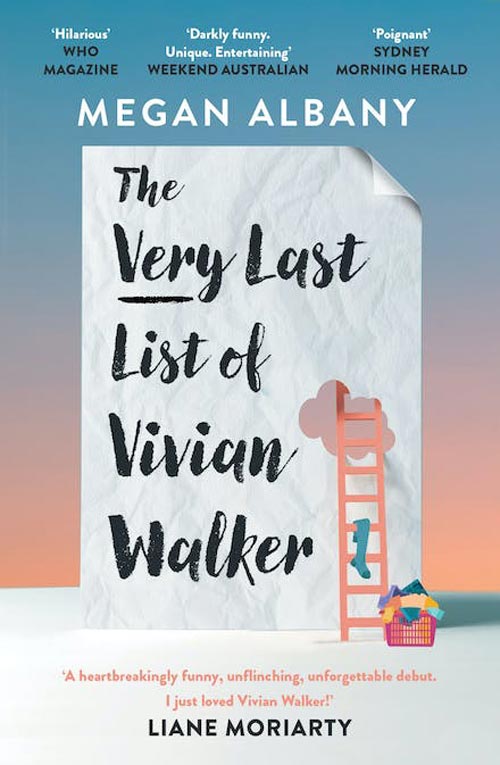
With her mortality hanging by a thread, Vivian does what any self-possessed control freak whose life is regimented by lists would; she decides to face her demise by organising herself. She prepares to-do lists not only for herself, but husband Clint, and son Ethan. These lists, she hopes, will soften the blow of her terminal diagnosis, and prepare the family for a future without her.
Vivian’s final days are punctuated with a certain dark humour, and one hopes not too many of us will ever find ourselves taking a leaf from the book of Vivian Walker.