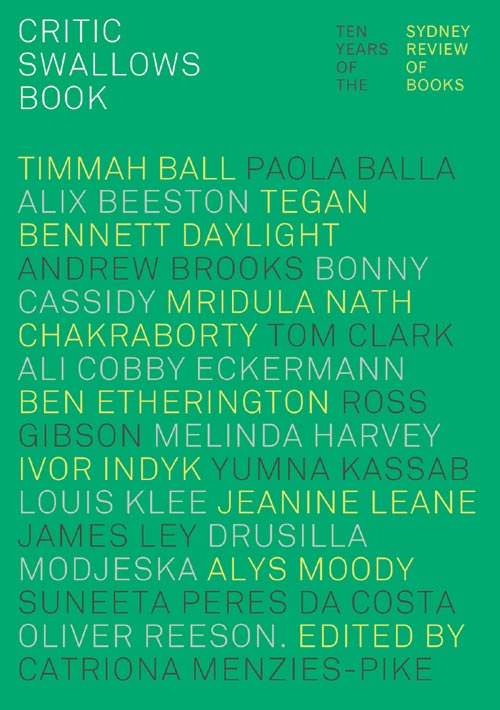
Book cover of Critic Swallows Book, published by the Sydney Review of Books.
Australian literary criticism journal, the Sydney Review of Books (SRB), has been online for ten years. To mark the occasion, SRB has published a book, Critic Swallows Book, containing twenty-two essays, written by contributors over the past decade:
It includes essays on decolonising Australian literature and revisiting the classics, on blockbuster fiction and book-length poems, on modernism in the Antipodes and reading during the pandemic. Essays on Susan Sontag and Rita Felski sit alongside critical considerations of the work of Murray Bail and Joan London, of new books by Evelyn Araluen and Samia Khatun.
Much of the dark humour permeating the novel was voiced through the internal monologue of the characters, something I hope is carried over somehow in the dramatic adaptations.
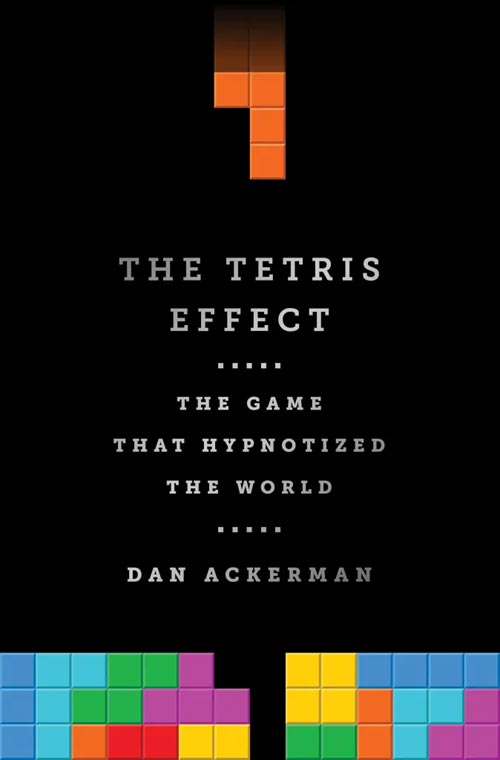
Book cover of The Tetris Effect, written by Dan Ackerman.
Dan Ackerman, editor-in-chief of design and technology publication Gizmodo, claims in a recent court filing that Apple TV+, producers of the 2023 film Tetris, directed by Jon S. Baird, copied the storyline from his 2016 book, The Tetris Effect. Ackerman further alleges he sent a pre-publication edition of the book to Maya Rogers, CEO of the Tetris Company, and soon after received a cease and letter warning him not to adapt the story for film or television:
Ackerman accused Rogers of working with screenwriter Noah Pink to develop a screenplay using content taken from his book without his knowledge or consent. Apparently, numerous producers showed interest in adapting his book, but the Tetris Company refused to license its IP for the project. “This was done at the direction and behest of Ms. Rogers so that she and the Tetris Company could pursue their own project and opportunities based on Mr. Ackerman’s book without compensating him,” the lawsuit reads.
I wrote about the film last March, but still haven’t had a chance to see it. According to the film’s IMDb page, the screenplay was written by Noah Pink. No mention, at least that I can see, is made of Ackerman, nor The Tetris Effect, there.
Jacoténe, the Melbourne based Australian soul and pop singer, whose vocals reminds more than a few people of Amy Winehouse, has released a new single, You Already Know. This a year after she won Triple J’s Unearthed High with her song I Need Therapy.
Blockbusters such as Barbie and Oppenheimer have been a windfall for cinemas struggling as a consequence of the Covid lockdowns of recent years, and stories of packed auditoriums are surely good news.
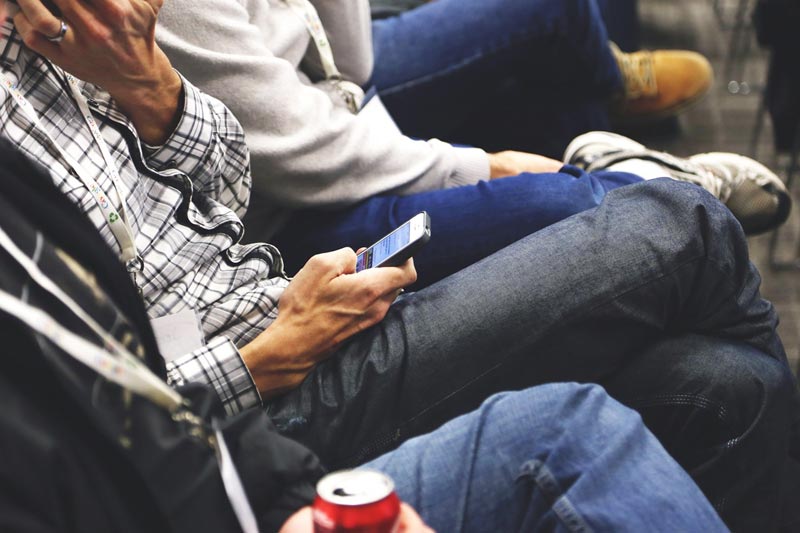
But the news hasn’t been all good. In staying home to watch movies over the last few years, some film-goers appear to have forgotten their cinema etiquette. Reports have emerged of people taking phone calls, scrolling social media, and, incredibly, giving their children phones to amuse themselves should the main feature not be of interest.
Cripes.
While there might be a generation of young film-watchers to whom cinema-going is a new experience, that cannot be the case for their parents. And it seems only a couple of short years of viewing movies from home have been enough to make some forget how to behave at the movies.
Perhaps though, as people begin to come re-accustomed to seeing a film in a communal setting, their conduct will improve. But I wonder. For some time, years prior to the pandemic, I’d been noticing a change in the behaviour of cinema audiences.
While it now seems to be a granted people will glaze at their phones during a film, I would have thought they’d draw the line at taking, or making, calls during the screening. Of course there have always been issues with people arriving late, going in and out of the auditorium repeatedly, along with being baffled by allocated seating.
But talking on the phone during a movie? That’s a whole other level of film-watching misery.
I wonder though, how much of the audience behaviour problems we see today can be attributed to smartphones, and our umbilical-like dependency on them? In the past I’ve been to film preview screenings where we’ve had to leave our phones outside the auditorium, in a secure locker. This to prevent a yet to be released feature being recorded, and leaked.
For sure, it seemed strange to be temporarily separated from our phones, but I wasn’t aware of anyone suffering adversely as a result. These screenings were quite the spectacle though. Everyone, for the most part, sitting still for the duration, focussed only on the film. Of course most of those present were film critics or journalists, at what was effectively a work event.
Still, it’s tempting, if futile, to conject here. Imagine if everyone had to leave their phones at the box office, prior to sitting down to watch a movie. Sure, there’d still be people turning up late, sitting in someone else’s seat, and opening bags of food in the noisiest way possible. But if music festivals can operate phone-free, why can’t cinemas?
For the benefits, and audience comfort, of phone-free movie sessions though, sadly I can’t see any cinema even dreaming of imposing such a demand on customers. After the last few difficult years, movie house owners would be reluctant to do anything that might dissuade patrons.
Over the course of the pandemic, and the lockdowns, I became quite the fan of streaming films at home. Doing so certainly has downsides, such as the waiting time for some titles to become available for streaming, but at least we can engage in all those irritating film-goer behaviours I’ve described, without annoying anyone else.
As well as being one of the world’s great hip hop groups, the Beastie Boys’ evolution also happens to be one of the scene’s most fascinating.
As well as bringing hip hop to a wider mainstream audience, the Beasties can also be credited for opening up the genre’s horizons, fusing in everything from alt-rock and sample-based psychedelics to punk ferocity.
And they did all with a sense of adventure, fun, and camaraderie.
So, how did a bunch of white kids playing ramshackle hardcore find themselves at the forefront of a cultural revolution?
And tomorrow, Friday 11 August, is a red-letter day for fans of the genre, being the fiftieth birthday of hip hop, which emerged at a party in NYC borough, The Bronx, on Saturday 11 August 1973.
Australian authors Jess Scully, Kate Larsen, and Nardi Simpson, are among speakers at VOLUME, a one day symposium, taking place online, on Thursday 21 September 2023. Amidst concerns Australians do not read enough, VOLUME will explore strategies to encourage more people to read.
Despite its ability to enhance health, knowledge, and wellbeing, support for embedding reading in our daily lives is often overlooked. With national literacy and reading rates declining for children and adults alike, it’s time for urgent action. By exploring effective approaches to encouraging reading alongside insights into advocacy from other industries, VOLUME will provide a platform to untangle the issues affecting reading engagement.
Turn off the TV an hour earlier, put down the games console, and leave your phone in the other room (unless you use it to read e-books), a few of my suggestions to make for more reading time.
With Barbie, American filmmaker Greta Gerwig has become the first woman director to make a billion dollar earning movie. In addition, Barbie is, so far, just one of nine films to reach the milestone featuring a woman as the main protagonist:
Nine, that is, if you count female fish. Finding Dory (2016) swims in the billion dollar club, along with the animated princesses of Frozen (2013), Frozen II (2019) and Beauty and the Beast (2017). Two mega-franchises managed to spit out a billion-dollar film with women at the story’s heart: Star Wars: The Last Jedi (2017) and Captain Marvel (2019). Then, two other billion dollar one-offs: Titanic (1997) and a live-action Alice in Wonderland (2010).
Anyone hoping for a reprieve this month will be disappointed though: their latest video explains exactly how nasty the variola virus, better known as smallpox, was, and the suffering and death it unleashed. While smallpox has officially been eradicated, the story of the virus is a potent reminder of how deadly some diseases can be. Let’s be thankful a vaccine was developed.
The book publisher is said to have been bought for US$1.62 billion, reports The Guardian. This in the wake of the failed 2020 takeover attempt by Penguin Random House, which was blocked in late 2022, by a US court.
Late in 2020, Paramount had announced the sale of Simon & Schuster to Penguin Random House for $2.2bn, a deal that would have made the new company by far the biggest in the US. But the Department of Justice, which under the Biden administration has taken a tougher stance on mergers compared to other recent presidencies, sued to block the sale in 2021.
I don’t know a whole lot about the book publishing business, but US$1.62 billion seems like quite a bargain to me.