
Marzahn, Mon Amour by Katja Oskamp wins 2023 Dublin Literary Award
26 May 2023
German author Katja Oskamp has won the 2023 Dublin Literary Award with her 2019 book Marzahn, Mon Amour. The Dublin Literary Award is an international literary award that has been recognising excellence in global literature since 1994. Books written in, or translated into, English are eligible, but must be nominated by one of the award’s participating libraries.
After Story by Larissa Behrendt, Bodies of Light by Jennifer Down, and Cold Enough for Snow by Jessica Au, were some of the Australian authors to be longlisted for this year’s award.
RELATED CONTENT
books, Katja Oskamp, literary awards, literature
2023 Australian Book Industry Awards (ABIAs) winners
25 May 2023
Horse, by United States based Australian author Geraldine Brooks, has been named winner of the 2023 Literary Fiction Book of the Year, at the ABIA awards this evening. Horse is a story that spans centuries, and explores the connection unrelated people share in a race horse:
Kentucky, 1850. An enslaved groom named Jarret and a bay foal forge a bond of understanding that will carry the horse to record-setting victories across the South, even as the nation reels towards war. An itinerant young artist who makes his name from paintings of the horse takes up arms for the Union and reconnects with the stallion and his groom on a perilous night far from the glamour of any racetrack.
New York City, 1954. Martha Jackson, a gallery owner celebrated for taking risks on edgy contemporary painters, becomes obsessed with a nineteenth-century equestrian oil painting of mysterious provenance.
Washington, DC, 2019. Jess, a Smithsonian scientist from Australia, and Theo, a Nigerian-American art historian, find themselves unexpectedly connected through their shared interest in the horse — one studying the stallion’s bones for clues to his power and endurance, the other uncovering the lost history of the unsung Black horsemen who were critical to his racing success.
Dirt Town by Hayley Scrivenor won the General Fiction Book of the Year category, while Wake by Shelley Burr won the Matt Richell Award for New Writer of the Year.
RELATED CONTENT
Australian literature, literary awards
Time Shelter by Georgi Gospodinov wins International Booker Prize
24 May 2023
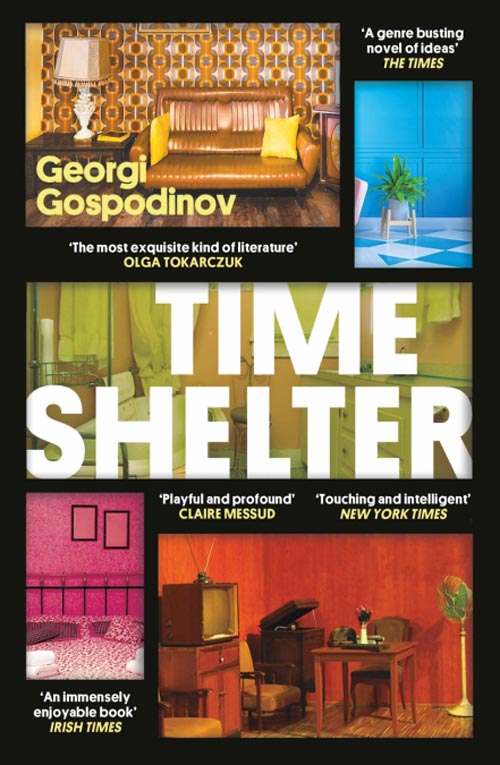
Time Shelter by Georgi Gospodinov, book cover.
Georgi Gospodinov, described as the most translated and internationally awarded Bulgarian writer after 1989, has won the 2023 International Booker Prize, for his 2022 novel Time Shelter.
Translated by American literary translator Angela Rodel, Gospodinov’s fourth book features a curious medical facility that assists Alzheimer’s patients, by masquerading as a time machine:
In Time Shelter, an enigmatic flâneur named Gaustine opens a ‘clinic for the past’ that offers a promising treatment for Alzheimer’s sufferers: each floor reproduces a decade in minute detail, transporting patients back in time.
As Gaustine’s assistant, the unnamed narrator is tasked with collecting the flotsam and jetsam of the past, from 1960s furniture and 1940s shirt buttons to scents and even afternoon light. But as the rooms become more convincing, an increasing number of healthy people seek out the clinic as a ‘time shelter’, hoping to escape from the horrors of our present — a development that results in an unexpected conundrum when the past begins to invade the present.
The winning author and translator each receive half of the £50,000 prize money on offer. If there had been an award for best book cover of the International Booker Prize shortlist, I would have adjudged Time Shelter the winner at the time I wrote about the shortlist.
RELATED CONTENT
Georgi Gospodinov, International Booker Prize, literary awards, literature
Debra Dank wins NSW Premier Literary Award Book of the Year
22 May 2023
We Come With This Place, written by Gudanji and Wakaja woman Debra Dank, was named Book of the Year in the 2023 NSW Premier’s Literary Awards this evening in Sydney.
We Come with This Place is a remarkable book, as rich, varied and surprising as the vast landscape in which it is set. Debra Dank has created an extraordinary mosaic of vivid episodes that move about in time and place to tell an unforgettable story of country and people.
Dank calibrates human emotions with honesty and insight, and there is plenty of dry, down-to-earth humour. You can feel and smell and see the puffs of dust under moving feet, the ever-present burning heat, the bright exuberance of a night-time campfire, the emerald flash of a flock of budgerigars, the journeying wind, the harshness of a station shanty, the welcome scent of fresh water.
We Come with This Place is deeply personal, a profound tribute to family and the Gudanji Country to which Debra Dank belongs, but it is much more than that. Here is Australia as it has been for countless generations, land and people in effortless balance, and Australia as it became, but also Australia as it could and should be.
Dank’s 2022 debut title also won the Indigenous Writers’ Prize, the Douglas Stewart Prize for Non-fiction, and the UTS Glenda Adams Award for New Writing.
RELATED CONTENT
Australian literature, Debra Dank, literary awards
The Book Thief, Australia’s Eurovision book contest 2023 entry
22 May 2023
The Book Thief, the 2005 novel by Sydney based Australian author Markus Zusak, is Australia’s entry in the inaugural Eurovision book contest. Yes, you read that right. The Eurovision book contest, which is an initiative of the annual Hay Festival, a literary festival held in Hay-on-Wye, Wales.
The victor will be decided by way of audience discussion on Friday 2 June 2023. A full list of contenders in the contest can be seen here.
RELATED CONTENT
Tiktok reading community BookTok prompts reading surge
22 May 2023
Short-form video hosting service TikTok certainly has its nay-sayers. Security analysts believe the app may be compromising the privacy of users, while lawmakers in some countries are considering banning it. But the news isn’t all bad: TikTok appears to be behind a recent surge in book readership, thanks to the app’s reading community, BookTok, according to Kristen McLean of NPD Bookscan:
The romance novel It Ends With Us by Colleen Hoover was the second best-selling Adult Fiction book and sixth best-selling book overall in 2021 — selling more than 770,000 copies last year — despite being a backlist title originally published in 2016, and McLean believes that is “almost exclusively there because of BookTok,” where it was championed.
RELATED CONTENT
books, literature, social media, tiktok
Australian authors, illustrators say generative AI is a threat
22 May 2023
A recent poll of just over two hundred Australian Society of Authors (ASA) members reveals local authors and illustrators are concerned generative AI technologies pose a threat to their livelihoods. This despite about twenty percent of poll participants stating they made use of AI tools — if only partially — in their work.
The survey results demonstrate that while a small minority of authors are using AI tools as part of their writing and illustrating process, there is overwhelming concern about the threat generative AI poses to already precarious writing and illustrating professions.
While it seems certain authors will more fully embrace tools such as ChatGPT to help brainstorm, edit, and correct work, most ASA members feel the part AI technologies play in the writing of a book should be publicly divulged.
RELATED CONTENT
artificial intelligence, books, literature, technology, writing
Sydney Morning Herald Best Young Australian Novelists 2023
22 May 2023
Katerina Gibson, George Haddad, and Jay Carmichael, have been named the Sydney Morning Herald Best Young Australian Novelists for 2023. The prize is presented annually for Australian writers under the age of thirty-five, each of whom will receive five thousand dollars.
Melbourne based author Grace Chan was among authors accorded an honourable mention, for her debut novel Every Version of You. Established in 1997, past recipients of the Best Young Australian Novelists prize include Alice Pung, Michael Mohammed Ahmad, Jennifer Down, and Robbie Arnott.
RELATED CONTENT
Australian literature, literary awards
Helen Dale AKA Helen Demidenko speaks on Fakes and Frauds show
21 May 2023
In 1993 Brisbane based Australian author Helen Demidenko wrote her debut novel, The Hand that Signed the Paper. The work, which was labelled faction, being a story that blends fact and fiction, depicted a Ukrainian family who collaborated with the Nazis during the Second World War.
Demidenko, who claimed to be of mixed Ukrainian and Irish ancestry, said much of the novel was based on the experiences of her uncle, and other family members, who lived in Ukraine during the war. The Hand that Signed the Paper won The Australian/Vogel Literary Award in 1993, a prize for unpublished manuscripts written by Australian authors aged thirty-five or under.
While some people criticised the novel for its anti-Semitic content, The Hand that Signed the Paper went on to win the 1995 Miles Franklin Literary Award, making Demidenko the youngest recipient of the prize in the process. Soon afterwards though, it was discovered Demidenko’s name was actually Helen Darville, who was the daughter of British immigrants, and of her supposed Ukrainian and Irish heritage, there was no trace.
Despite the resulting furore, The Hand that Signed the Paper also won the Australian Literary Society Gold Medal in 1995, and remains available as an ebook, published under the name Helen Dale. Dale, who now lives in the United Kingdom, recently spoke to Sarah L’Estrange, host of Radio National’s Fakes and Frauds series, about writing the novel, and what happened when the hoax was revealed.
Although The Hand that Signed the Paper was not considered a work of non-fiction, thus evading potentially closer scrutiny, Dale claims, among other things, to have been surprised at how long it took for the ruse to be uncovered. One has to wonder whether we’ve heard the last of what must be Australia’s most astonishing literary hoax to date.
RELATED CONTENT
Australian literature, Helen Dale, Helen Demidenko
Bath image sees Mem Fox children’s book removed from Florida libraries
18 May 2023
Guess What?, a children’s book written in 1988 by Adelaide, South Australia, based Australian author Mem Fox, has reportedly been removed from school libraries in the US state of Florida. An image of a character — drawn by illustrator Vivienne Goodman — taking a bath, apparently contravenes anti-pornography laws in the state:
In one illustration, Daisy sits across a double bowl sink (that she is comically too big to fit in) wearing a scuba mask. The bowls are filled with water, and she sits sideways in one with her feet splashing in the other. She is nude, but not exposed. Limbs cover her breasts and genitalia. The room is busy and pleasantly chaotic: soap on the floor, a frog on a towel, fish pegged to the clothesline that hangs over the sink. It’s far from a sexual image.
That it’s taken thirty-five years for this… transgression to come to light is mind boggling. The offending illustration — safe for work by the way, at least in Australia — can be seen here.
RELATED CONTENT