
Not once a writer, always a writer, not for Ocean Vuong
7 June 2023
In ten years’ time Vietnamese born American author Ocean Vuong may not be a writer anymore. For all anyone knows, including possibly Vuong himself, he might be a software engineer by then. Speaking to British journalist, and writer for The Guardian, Kadish Morris, Vuong says he might reach a point where he’s happy with what he has written, and decide to stop:
I may be alone in thinking this, but I truly don’t believe that a writer should just keep writing as long as they’re alive. I see my career not by how much I can produce but by how the work can get me to where I can meaningfully stop and be satisfied with what I’ve done. I’m more interested in stopping well rather than endlessly creating.
Vuong’s titles to date are On Earth We’re Briefly Gorgeous, a novel he wrote in 2019, and Time is a Mother, a collection of poetry published in 2022.
Aside from perhaps being intrinsic to their nature, people possibly remain lifelong writers on account of the difficulty in becoming one in the first place.
RELATED CONTENT
literature, Ocean Vuong, writing
The Next Chapter, publishing unpublished Australian stories
7 June 2023
Every year the Next Chapter helps four emerging, unpublished, Australian writers bring their stories to a wider audience, through financial support and mentoring. Writers chosen to participate receive fifteen thousand dollars, and are given assistance to get their work published.
Past Next Chapter writers include Evelyn Araluen, winner of the 2022 Stella Prize with her collection of poetry, Dropbear, and Adam Thompson, who wrote short story collection Born Into This in 2021.
The initiative is organised by the Wheeler Centre, and aided by funding from the Australia Council for the Arts. Applications for the Next Chapter 2024 close on Friday 30 June 2023.
RELATED CONTENT
Australian literature, awards, writing
Gaia, symbol of climate change failure, in Every Version of You, by Grace Chan
5 June 2023
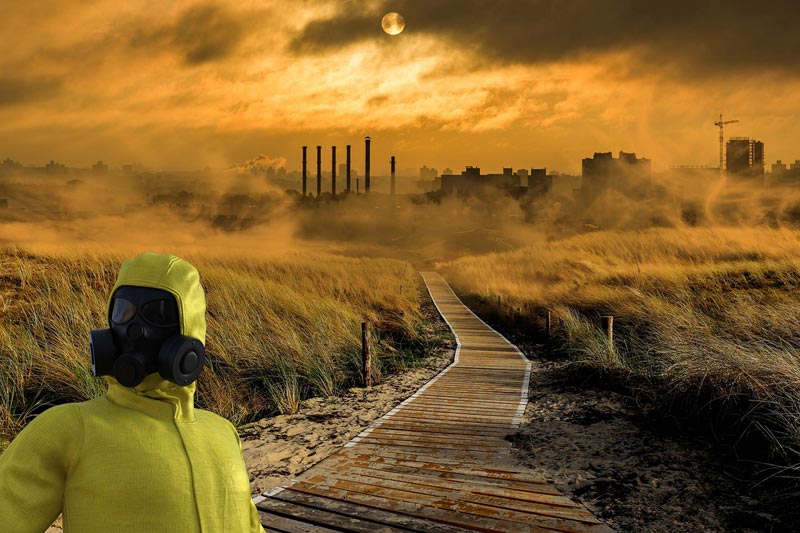
Image courtesy of Pete Linforth.
Warning: spoilers ahead. Return to this article once you’ve finished reading the novel.
Every Version of You, published by Affirm Press in 2022, is the debut novel of Melbourne based Australian author Grace Chan. Set in the late twenty-first century, primarily in Melbourne, Chan’s novel is about a young couple, Tao-Yi and her boyfriend Navin, and a momentous decision they need to make, which has life changing consequences.
Climate change has rendered Earth almost uninhabitable. Outdoor activities have become uncomfortable and dangerous. People need to don protective clothing and equipment before leaving the cocoon-like sanctuary of their dwellings. Body suits to block the Sun’s burning rays. Goggles and facemasks to combat dust, and other airborne irritants.
But the creation of a would-be new world, a “hyper-immersive, hyper-consumerist virtual reality” named Gaia, offers humanity an alternative to the world outside. And while this digital, artificial, macrocosm, mimics the old world in virtually every way, it also offers inhabitants a whole lot more.
Accessing Gaia, called logging in, is facilitated by climbing into a small, diving bell like chamber, filled with a gel-like liquid, called a neupod. While people’s bodies lie immersed in the pod’s gel, their minds roam free in Gaia, and they go about their lives, as normal. Except here, their presence takes the form of a digital avatar, one they are able to continually customise.
They go to work and school. They see friends and family. They engage in sporting and recreational activities. People “live” in Gaia just as they do in the real, outside, world. But within its realm, people can do more than live their old lives. They can venture to places they once only dreamed of, and become someone they could never have been otherwise.
Gaia, a promise of eternal life, but at a cost
Like everyone else, Tao-Yi and Navin switch back and forth between Gaia and the outside world, although Navin spends more time in Gaia than Tao-Yi. But one day a technology emerges allowing people to permanently meld with Gaia, through a process called “Uploading”.
In essence, Uploading, also known as mind uploading, allows a person to live forever within Gaia’s seemingly boundless domain. But there is a crucial caveat. Once uploaded, a person cannot return to the old world. Not, at least, as a corporeal entity. Uploading transforms a person into a conscious digital entity, through a procedure that extracts their every thought, memory, and personality.
A person’s no longer needed body is disposed of in manner they choose beforehand, once Uploading is completed. Despite Tao-Yi’s misgivings, Navin was a keen proponent. And not just because he saw himself as an early adaptor. Navin was also afflicted with a chronic illness, one that medicine could not alleviate. Uploading would allow Navin to live disease free.
And there were doubtless others in Navin’s position. Medical science could offer these people no hope, but Uploading, and becoming a digital version of themselves, would completely eliminate their ailments. For some, the decision to Upload was easy to make. They could enjoy full “health”, and also be free of the ravages of climate change. To say nothing of “living” forever.
Although in a minority, there were people — called holdouts — who refused to Upload. They wished to remain in the “meatspace”, a derogatory term given to the old world. Xin-Yi, Tao-Yi’s mother, was among them. And even Tao-Yi — for the benefits Uploading bestowed upon Navin — was far from convinced that permanently merging with Gaia was the right thing to do. And for good reason.
Gaia, a symbol of climate change denial
Tao-Yi knew Gaia was not a solution to climate change, only a means by which to escape it. To her, and other holdouts, Gaia was humanity’s way of signalling defeat in the battle to restore Earth’s environment to the way it once was. But not only that. Gaia, while being heralded as a new beginning for humanity, also potentially spelt the end of the line for humans.
Aside from a small number of holdouts braving life in the near inhospitable real world, all of humanity’s eggs were in the single basket that was Gaia. Its digital inhabitants had condemned themselves to eternal imprisonment on Earth. Gaia also left humanity all the more vulnerable to some sort of planet-wide calamity, such as the asteroid impact that brought about the end of the dinosaurs.
It was be hoped the tech savvy denizens of Gaia would eventually figure out a way to leave Earth, and at least put down roots elsewhere in the solar system. If not beyond. But a global catastrophe was not the only danger facing Gaia. The digital realm also depended on an army of (presumably self-replicating) robots to maintain its infrastructure.
There would be the hope the robots continued to serve, and replace themselves. But what if these maintenance droids infused themselves with an intelligence of their own? And what if they one day turned against their digital masters, and pulled the plug on them?
Some of these concerns — and could they be the basis for a sequel, or even an Every Version of You expanded universe? — are alluded to in the novel, even if they are beside the point. Gaia is a potent symbol of climate change denial, and the unwillingness, by some people, to do anything about it. Gaia might promise eternal life, but that could be an eternity spent regretting sacrificing Earth to climate change.
Gaia, why does the name sound familiar?
In Greek mythology Gaia is the goddess of Earth, and the mother of all life. She is one of the “primordial deities”, the first generation of Greek gods, and the grandmother of Zeus, god of sky and thunder, and later king of the cosmos, and the other Greek gods.
As a name for the digital realm humanity withdraws to, Gaia may also derive from the Gaia hypothesis, which was formulated by late British scientist and futurist James Lovelock in the 1970s. His theory proposes “living organisms interact with their inorganic surroundings on Earth to form a synergistic and self-regulating, complex system that helps to maintain and perpetuate the conditions for life on the planet.”
In Every Version of You, humanity has well and truly failed to “maintain and perpetuate the conditions for life on the planet.” But by creating a new, artificial, domain named Gaia, perhaps the people of the late twenty-first century — up to their eyes in denial — could claim to have succeeded in achieving this goal.
RELATED CONTENT
books, climate change, climate fiction, Grace Chan, science fiction
36 Streets by T R Napper wins 2022 Aurealis best sci-fi novel
4 June 2023
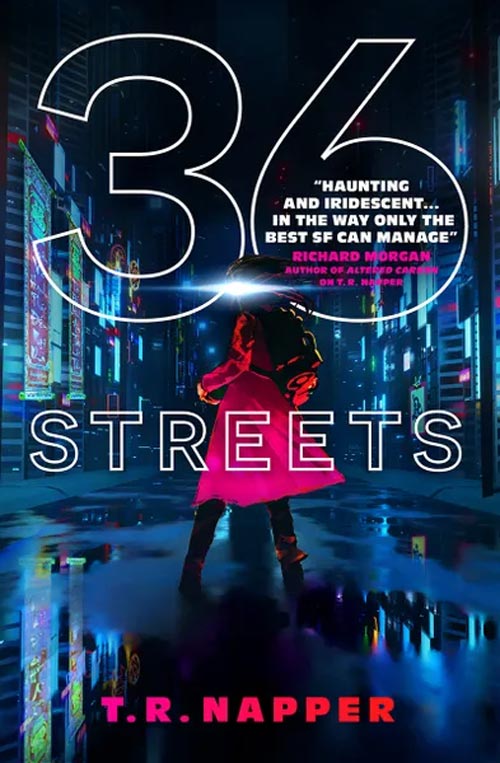
Book cover of 36 Streets, written by T R Napper.
Australian science fiction writer T. R. Napper was named winner of the Best Science Fiction Novel award, with 36 Streets, in the 2022 Aurealis Awards, at a ceremony in Canberra, last night.
The novel, Napper’s debut, is set in a futuristic version of Hanoi, the capital of Vietnam. In 36 Streets, the city is occupied by China, but residents seem to be preoccupied by a highly addictive stimulation of the American-Vietnamese war of the mid-twentieth century:
Lin ‘The Silent One’ Vu is a gangster in Chinese-occupied Hanoi, living in the steaming, paranoid alleyways of the 36 Streets. Born in Vietnam, raised in Australia, everywhere she is an outsider. Through grit and courage, Lin has carved a place for herself in the Hanoi underworld under the tutelage of Bao Nguyen, who is training her to fight and survive. Because on the streets there are no second chances.
Meanwhile the people of Hanoi are succumbing to Fat Victory, an addictive immersive simulation of the US-Vietnam war. When an Englishman — one of the game’s developers — comes to Hanoi on the trail of his friend’s murderer, Lin is drawn into the grand conspiracies of the neon gods: the mega-corporations backed by powerful regimes that seek to control her city.
Lin must confront the immutable moral calculus of unjust wars. She must choose: family, country, or gang. Blood, truth, or redemption. No choice is easy on the 36 Streets.
Established in 1995, the Aurealis Awards honour works of original speculative fiction written by Australian authors, which are published in the preceding calendar year. A full list of winners in the 2022 awards can be seen here.
RELATED CONTENT
Aurealis Awards, literary awards, science fiction, T. R. Napper
Letterboxd scavenger hunt for Wes Anderson’s Asteroid City
2 June 2023
The Australian premiere of the latest Wes Anderson feature, Asteroid City, takes place in less than a week on Thursday 8 June 2023, at the 2023 Sydney Film Festival.
If you need a little something to keep you occupied between now and then though, help contain the excitement and all, film social network Letterboxd is running the Asteroid City Scavenger Hunt for the next two weeks:
Every day for the next fourteen days, a new item will be hidden on Letterboxd somewhere in the extended Wes Anderson universe of films and their creators. We’ll drop daily clues on our social media, and once you have collected all fourteen items, you’re automatically in the draw to win the grand prize: a private screening of Asteroid City for you and your friends at your nearest cinema.
Letterboxd, in case you’ve not heard of it, was established in New Zealand in 2011, by Matthew Buchanan, and Karl von Randow, and I’ve been a member since 2012. If you’re looking for a place to discuss film, and film only, Letterboxd is where you need to be.
And here’s something, the screenplay for Asteroid City is available to buy in hardback book, or Kindle format, from Amazon on Tuesday 22 August 2023. I didn’t know that was a thing.
RELATED CONTENT
film, Sydney Film Festival, Wes Anderson
The 2023 Australian Book Design Awards (ABDA) winners
31 May 2023
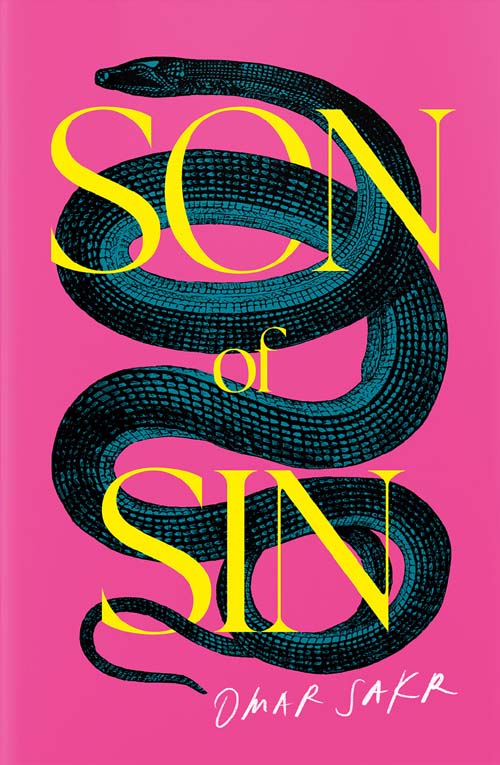
Book cover of Son of Sin, written by Omar Sakr, designed by Amy Daoud.
The Australian Book Design Awards (ABDA) not only judge books by their covers, they celebrate them, and last week the winners of the 2023 awards were announced. Son of Sin written by Omar Sakr, pictured above, won the Best Designed Literary Fiction/Poetry Cover award, with a cover created by Sydney based book designer Amy Daoud.
In other categories, Zeno Sworder, who both wrote, and designed the cover for My Strange Shrinking Parents, won the ABDA Cover of the Year prize, while ABDA’s Book of the Year award went to QUEER: Stories from the NGV Collection, with a cover by Dirk Hiscock and Karina Soraya, who both work at the National Gallery of Victoria.
All of the winning covers can be seen on ABDA’s Instagram page.
RELATED CONTENT
Australian literature, books, design, Omar Sakr, Zeno Sworder
ooh.directory a blogroll and web directory in the TikTok age
31 May 2023
My thanks to Phil Gyford for listing disassociated in his web directory ooh.directory. In the early days of the web, before search engines were a thing, website owners often sought to be added to web directories, as promotional opportunities were otherwise limited.
These website lists, or catalogues, were usually broken down by category or subject, so if, say, you were seeking websites focussed on literature, the books or literature page was the place to go. I used to while away many an hour perusing web directories. Site descriptions were often concise, to say the least, and on occasion there was no telling where a link might lead. There was a certain spontaneity that came with directories and blogrolls, something perhaps lacking in today’s web.
ooh.directory is also a blogroll. Once upon a time bloggers used to list their favourite websites and blogs, usually in a sidebar of their blog. Blogrolls were preceded by link pages, which served a similar purpose. They’re not seen so often today, as their use became frowned upon by the search engines. There was a concern some websites included on blogrolls and link pages might have been paid placements, potentially giving the listed blog an unsanctioned leg up in search rankings.
Web directories and blogrolls have been making something of a comeback recently. And in a world chock full of distractions, their return couldn’t be more timely. Elegant tools for a more civilised web. In addition to ooh.directory, there’s also the excellent feedle, the actual Blogroll, and FeedLand.
RELATED CONTENT
Blog publishing application WordPress has turned twenty
29 May 2023
When I re-launched disassociated as a blog in 2007, being one of many reboots this website has been subject to since 1997, I migrated to blog publishing application WordPress (WP). Prior to that, all pages here were laboriously hand coded. Hand coding was a hangover from my web design days, and my distaste for WYSIWYG website editors. My beef, at the time, with many of these webpage builders was the way they worked. Best practice, and standards, were an alien concept to them, to say nothing of the extraneous code they generated.
One, that shall remain nameless, created rollover code for text hyperlinks using JavaScript. JavaScript. This despite the web being well into the age of CSS generated rollover code by that stage. Come 2007 though, apps like WP were the way to go. Other bloggers I was speaking to then told me WP, or similar such CMSs, would save a bundle of time, and allow me to go about my disassociated way. I’m sure glad I listened to them. “WP is working for me, even while I sleep,” one counterpart said.
I was sold. By that stage WP had been around for about four years, but was still regarded as being relatively new. It was enough to make me feel as if I were some sort of (sort of) pioneer. But WP frustrated the hell out of some people. Many felt WP’s core capabilities were lacking, necessitating an over dependence on plugins — small apps that add, or extend to, WP’s functionality — to bring about the website, or blog, they desired. Ben Barden, a developer and blogger, once created his own CMS, back in the day, named Injader, for this reason.
But I’ve always strived to keep the backend as simple as the front. My use of plugins is as minimal as the interface design. All I want to do is write and post content. But here we are in 2023. disassociated, still styled (mostly) with a lowercase d, which first came into being in 1997 (not as a blog, the term was yet to be coined), is, despite stops and starts, still publishing. And this week WP is twenty years old. So, happy birthday WordPress, and thanks for being here. I’m looking forward to your thirtieth, which will really be something if disassociated is still doing its thing.
RELATED CONTENT
blogs, design, history, technology
The rise of experimental, strange Australian literature and fiction
29 May 2023
There’s a lot to like about smaller, independent, book publishers. The first has to be the quality of the stories they’ve been bringing to bookshelves in recent years. This is borne out by the increasing presence of indie published titles in the long and short lists of Australian literary awards such as the Stella, and the Miles Franklin.
The second is the “risk” smaller publishers — many of whom are members of the Small Network Press — will take on a book with a storyline that might be regarded as fringe, something perhaps their mainstream counterparts are reluctant to do.
Nina Culley, writing for Kill Your Darlings, says the publication of titles including Grimmish by Michael Winkler, Every Version of You by Grace Chan, and Dropbear, a collection of poetry by Evelyn Araluen, is signalling a move away from “realist” stories, towards writing more on the experimental and strange side.
Small presses, literary magazines, anthologies and poetry collections have long since encouraged outlandish stories, experimentation and play, and we are now seeing more smaller publishing houses doing the same. Publishers like Spineless Wonders, SubbedIn, UQP, Transit Lounge and Giramondo are revolutionising Australia’s literary output by responding to an expanding readership that craves literary disobedience.
I’m intrigued by what is regarded as “literary disobedience” though (much as I like the term). For instance I finished reading Every Version of You last week, and despite the novel being described as a work of speculative literary fiction, the entire premise really seemed all too plausible. But maybe I need to stop consuming as much science fiction and fantasy as I do.
RELATED CONTENT
Australian literature, books, Evelyn Araluen, Grace Chan, Michael Winkler
Influencer, a film by Kurtis David Harder with Cassandra Naud
27 May 2023
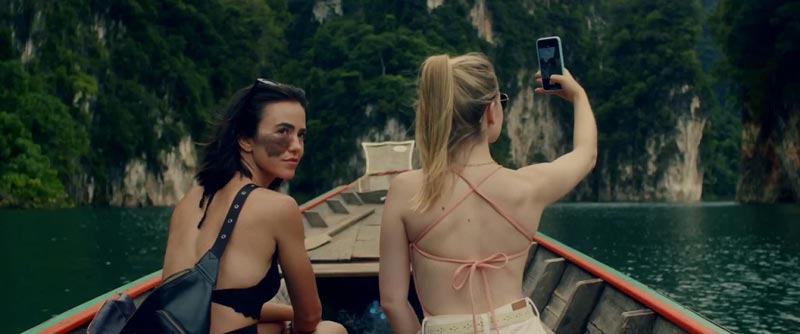
Still from Influencer, a film by Kurtis David Harder.
Being a social media influencer isn’t all sunshine and double shot half decaf blonde espresso cappuccinos with caramel drizzle. There’s a dark, and dangerous, side to this occupation. That you should have learned after seeing Sissy, a horror/thriller made in early 2022 by Australian filmmakers Hannah Barlow and Kane Senes.
Influencer, trailer, by Canadian filmmaker Kurtis David Harder, also a horror/thriller, set in Thailand, sees a young, worldly, traveller CW (Cassandra Naud) prey on social media influencers who venture into the region. One of her targets is Madison (Emily Tennant), who spruiks skincare products. Although her socials suggest otherwise, Madison isn’t quite enjoying Thailand as much as she hoped.
Madison’s vulnerability makes her the perfect target for CW, and before long the new friends are taking a boat trip to the obligatory secluded island. One can only imagine what happens next. I can’t find any information about a cinematic release in Australia for Influencer, but you may be able to stream the film on Shudder.
RELATED CONTENT
Cassandra Naud, Emily Tennant, film, Kurtis David Harder, trailer