
Showing all posts about artificial intelligence
AI companies using rare books to train agents, while destroying them
19 August 2026
Emanuel Maiberg, writing for 404 Media:
A 404 Media investigation was able to reveal Amazon’s book buying operation, which hasn’t been previously reported, by placing a tracking device in a rare book we suspected would be acquired by an AI company for training data, and following it around the country to its final destination.
It’s one thing to use books to train AI without seeking the author’s permission, nor paying a royalty, but is there any need to destroy them as part of the process?
There is the point that being rare books, they may be older publications, and copyright has lapsed, but that still seems to be beside the point. I was about to suggest these titles be donated to schools or libraries, once no longer needed, but they’ve likely no longer in one piece.
Going further, the process strikes me as being a form of book burning. The AI companies are taking all sorts of liberties with copyrighted material, but destroying books takes bad form to new lows.
RELATED CONTENT
artificial intelligence, books, technology
AI slop exposes fraudulent publishing offer to Australian author Mary Colussi
18 August 2026
Touch Grass, the debut novel of Sydney based Australian author Mary Colussi, was published in June this year. And a fraudulent publishing deal was not too far behind. In this instance though AI slop played a part in giving the scam away.
An email sent to Colussi, apparently from a representative of a well-known publishing house in the UK, was full of praise for Touch Grass. Curiously though comments about the novel’s plot were limited only to what had been published online in its synopsis.
This despite claims by the publishing house rep that they’d read the book. Their AOL (once America Online) email address was also something of a give away, to say nothing of the request for money in exchange for a publishing deal.
While this wasn’t the best executed fraud attempt, as AI agents evolve their efforts will no doubt become more convincing. But asking an author to pay to be published would still arouse suspicion.
Traditional publishing houses do not ask writers for money, rather they pay out in the form of an advance. The objective of these scams though is catch people — particularly newcomers to the industry — off guard, and this is where they might succeed.
RELATED CONTENT
artificial intelligence, Australian literature, books, novels, trends
AI scrapers use bogus URL tracking tags to make website visits seem legit
17 August 2026
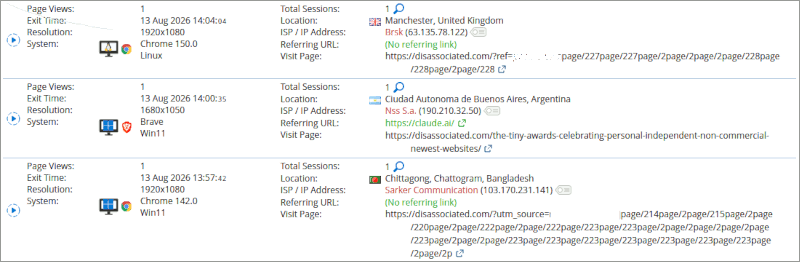
It looks like AI scrapers have been using a surreptitious method of making their marauding presence appear legitimate, this time by appending a bogus query parameter, or tracking tag, to the URL of the webpage they are targeting.
In the last month or so, I have seen a stack of page visit items looking something like this:
https://disassociated.com/?ref=yourwebsitepage/213page/page/page/ 14page/16page/page/2page…
I’ve replaced the actual website name with the generic yourwebsite marker in the above example.
What is particularly insidious though, is the way the crawlers are using the names of reputable websites and blogs that have linked to disassociated in the past.
Initially I thought some of these blogs had mentioned my website again, but after having a closer look at them, this is not the case. There’s also the detail that my web analytics app does not identify a referring page from the website supposedly sending visitors my way.
The frequency of visits doesn’t stack up either. I’m sure the blogs cited in the /?ref= parameter, that are supposed to be linking here, have many (human) readers, but I can’t imagine every last person, sometimes thousands of them, have been clicking through to my website.
Another possibility was my website had been shared in a newsletter. Usually though the URL query, or UTM parameter, I see in newsletters are along the lines of say ?utm_content, or ?utm_source.
One of the query parameters seen in the screenshot from my web analytics app does is ?utm_source though. However, with one exception I think, none the cited websites publish newsletters.
Also, if any of the cited websites were legitimately sending traffic here using a tracking tag, I doubt they’d use such a nonsensical URL path… page/14page/16page/page/2page… what?
It does puzzles me why these scrapers only seem to be targeting the front page of my website. Only a small amount of the total content posted here is visible there. But they’re AI bots, no doubt they know what they’re doing.
In the meantime, I’ll have to get used to seeing these analytics entries until I can figure out a way to block or mask them. That might be easier to say than do though.
But kudos (ironically) to Claude for acknowledging disassociated in response to a query about the Tiny Awards, in the above image. It’s much appreciated, truly, but doesn’t happen often enough.
RELATED CONTENT
artificial intelligence, technology, trends
Humanity is not a monoculture, and nor is Australia
14 August 2026
I’m still reading through Meta CEO Mark Zuckerberg’s recently published vision of an AI future, but this paragraph jumped out at me:
Humanity is not a monoculture. People’s diverse values represent different tradeoffs they would make on important issues. There is no technological solution that can align with everyone’s opposing interests and values at once. Any singular superintelligence would have to prioritize some values over others and in the process would be incapable of being benevolent to everyone.
In this context, I think Zuckerberg is discussing the challenges of developing a so-called superintelligence that could comprehend the values of the world’s many varied, disparate, cultures.
Superintelligence, sometimes referred to as Artificial Superintelligence (ASI), sits above Artificial General Intelligence (AGI), which in turn sits above AI. A go to example (for me) of AGI is the HAL 9000 computer, AKA Hal, from Stanley Kubrick’s movie 2001: A Space Odyssey.
Hal appears to be conscious, and is capable of thinking and reasoning as a human would.
It seems to me ASI, which is (theoretically) vastly superior to AGI, should be able to extend its “benevolence” to all the people of the Earth, because understanding each of their cultures would surely be something that level of technology is easily capable of. Meta however is developing what they describe as superintelligence, which may vary from ASI.
But I digress.
I doubt Australian politician, and leader of a far-right party called One Nation, Pauline Hanson, would agree with Zuckerberg’s view that humanity is not a monoculture. Because during her recent appearance at the National Press Club, she declared Australia must exist as a “monocultural society”.
Yes, Australia, the place where people from just about every culture in the world, reside.
Surprisingly, Hanson views AI favourably, although she did call for stronger government regulation of the technologies. But technologies that may recognise humanity, and by extension, the people of Australia, are not monocultural? Can that be tolerated?
No doubt Hanson will be calling for the very strict regulation of that sort of technology.
RELATED CONTENT
artificial intelligence, Australia, current affairs, politics
LinkedIn CringeBot 3000, generating AI slop of the best quality
13 August 2026
Since the volume of slop-in-general is of epidemic proportions on the platform, it makes perfect sense an AI agent write actual AI slop for consumption there.
RELATED CONTENT
artificial intelligence, humour, social networks, technology, trends
Zuckerberg says AI will improve your relationships. Did an AI scam bot tell him that?
12 August 2026
Tangentially related to the previous post. A few days ago Meta CEO Mark Zuckerberg published the company’s latest AI vision. Or the one for this week at least. And the future is rosy, incredibly rosy.
If Meta has it their way, everyone will have access to their own “exceptionally capable” agent — must Meta use URLs that look like someone typed out a random string of keyboard characters? — (edit: URL amended) that seemingly will be able to help with anything at all:
Everyone will have an exceptionally capable personal agent that understands you, your goals, and everything you care about. Your agent will work 24/7 on your behalf to improve your relationships, health, career, finances, home management, hobbies, and more.
But I’d be concerned about the relationship advice this agent intends to dispense.
As we learned from my post yesterday, some AI agents, particularly those attempting to scam people, specialise in faking relationships. One can only hope Meta’s relationship guidance agent is not taking cues from such scam agents.
RELATED CONTENT
artificial intelligence, technology
AI scam bots better at faking relationships than human scammers
11 August 2026
There’s good news and there’s bad news, but in reality not much is really good. The good, such that it is; AI bots could well put scammers out of work.
The bad; the AI scammers are far more effective at deceiving people.
Disturbingly though, these are scams that involve entering into a fake relationship with the intended victim. In other words, AI bots appear to be better at faking human relationships than people.
Take a minute to think about that.
The human scammers, meanwhile, having been put out work, might instead look for an honest way to make a living. That would be a plus.
But here’s the problem. If AI scammer bots are so adept at tricking people, what else might they be capable of? Putting yet more people out of work? Or is there nothing whatsoever to worry about?
RELATED CONTENT
artificial intelligence, security, technology
Deserts, sea water, the AI data centre problem solved. Seriously
10 August 2026
Tech bros across the world have been giving everyone a right ear-bashing in the last few years about their AI agents, and the need for data centres to power them. And they’ve been crying foul in response to the environmental concerns many have expressed.
Tech bros worldwide are annoyed we don’t want to share our power and water supplies with them.
They’re unhappy we don’t want their data centres near the places we live, work, and send our kids to school. The tech bros are furious that we cannot seem to grasp the big picture. A prosperous and happy future of one-hundred percent dependence on their AI technologies is worth a few sacrifices.
Is it not?
Can’t we, the little people, cut back on our water and power consumption? Can’t we accept a little bit more climate change precipitated by water and power hungry data centres, is a small price to pay?
Wait up. Did I just say climate chnage? The phenomenon wreaking all sorts of havoc across the world, the driver of rising sea levels, temperatures, and unpredictable weather? Is not that sort of stuff the answer here? Not wild storms, and destructive bush fires.
No, I mean rising sea levels and warmer temperatures. Warmer temperatures must be the result of more sunlight getting through, right? That’s logical, isn’t it? Can you see what I’m getting at? You can’t be a much smart tech bro, if you don’t. That extra sunlight can be put to good use.
So people don’t want data centres near where they live. Fair enough. Who wants their golf club to make way for one? Not the tech bros. The solution is obvious. Build the data centres where no one lives. Like a desert. Ok, sure. But what about power? There’s no power infrastructure in the desert.
No problem. Build large solar panel arrays. No one lives in the desert, so no one will be around to complain about the solar panels. Ditto the data centres. But wouldn’t the cost of solar panel arrays be prohibitive? Sure, but again, no problem. Simply increase the price of AI tokens. Just slightly.
That solves the power problem. What about water? There’s gnenerally not much water in a desert. And, depending who you listen to, AI data centres either use enormous quantities of water, or hardly any at all. Either way, people don’t want thirsty data centres guzzling any amount of water.
What to do? The solution is obvious.
Pipe it in. End of story. That’s not really the end of the story, but anyone, even the little people, can surely see the logic. Sea levels are rising. That means there’s plenty of water at hand. But AI data centres in the desert may be hundreds, if not thousands of kilometres, from the ocean.
No problem, pipelines are still the answer. If something like the Guildford West pipehead and water supply canal, in the west of Sydney, Australia, can be brought into being, the tech bros can do something similar out in the desert. Bonus points if gravity feeds alone can somehow be used.
Sure, the Guildford West system is only about sixteen kilometres total length. But if pipes can span sixteen kilometres, simple logic says they can go further. And don’t forget about the East–West Pipeline in Saudi Arabia, which is about twelve-hundred kilometres long.
But wouldn’t the cost of building massive pipe systems be prohibitive? Sure, but again, no problem. Simply increase the price of AI tokens. Just slightly.
I think we’ve covered off everything.
The tech bros can have their data centres, and the rest of us won’t even know they exist. Plus one or two problems occasioned by global warming will be resolved. Well, maybe one. If you believe the ocean can be drained with a tea cup.
Of course, I expect no one to take any of what I said the least bit seriously. Really I don’t. Particularly the tech bros who want to solve this very problem. Besides, they don’t read my website.
But perhaps I speak too soon. They might ask one of their AI agents about the feasibility of building data centres in the desert, in the manner I’ve prescribed. Then they might learn about this suggestion, since my website’s content is scraped all too often by their AI bots.
Can I then expect the tech bros offer me any recompense? Anything at all. A single lousy AI token even? Yes, I’m quite certain that will happen. When hell freezes over.
RELATED CONTENT
artificial intelligence, climate change, technology
LinkedIn users can report AI slop, but what about the rest of it?
1 August 2026
Members of the professional network will be able to flag posts they think are AI generated. I haven’t been a LinkedIn participant in years — I have a personal website, why would I? — but it seems to me slop has been a problem on the platform since before AI was what it is.
RELATED CONTENT
artificial intelligence, social networks, technology, trends
AI does not compose my pickup lines, I do, have the t-shirt to prove it
29 July 2026
Natalie Kaufman, writing for the Wall Street Journal, about an apparent trend in early twenty-somethings, to rely on AI agents to supply them with conversation starters, and pickup lines.
The article is paywalled, but would you really want to read about this?
I think these things are best learned through experience, and watching other people, rather than turning to AI for pointers. It gives me an idea for a t-shirt though.
Some websites and blogs sport not by AI buttons, as a way of reassuring readers their content was written by a person, and not an AI agent.
People who want others to know their conversation starters, and, where applicable, pickup lines, are their own effort, could wear a not by AI-style t-shirt, perhaps bearing the slogan “AI does not compose my pickup lines, I do”.
It might help eliminate the confusion as to what banter is AI-generated, and what is not.
For the record, my pickup lines are reserved for the only person who reads this website…
Update: Simon at Firesphere has created a mockup of my no-AI t-shirt idea. Green is an ideal colour choice to, it’s affirming, and noticeable. Awesome, thanks Simon.
RELATED CONTENT