
Showing all posts about blogs
Clive Thompson: how blogging changes the way you think
5 January 2023
American journalist, author, and blogger, Clive Thompson, writing about the benefits of blogging. The audience effect is one of the positives, and will go a long way to sharpening your writing:
But blogging has another benefit, which is that it triggers the “audience effect”. The audience effect is precisely what it sounds like: When we’re working on something that will soon go before an audience, we work far harder than if we’re doing work that’s for our eyes only. For decades, psychologists have documented the audience effect in studies: If you have experimental subjects write out an explanation for other people, for example, it’ll be far longer and clearer and more comprehensive than if you ask them to write it merely for themselves.
RELATED CONTENT
Monique Judge: bring back personal blogging in 2023
5 January 2023
Monique Judge, writing for The Verge:
Buy that domain name. Carve your space out on the web. Tell your stories, build your community, and talk to your people. It doesn’t have to be big. It doesn’t have to be fancy. You don’t have to reinvent the wheel. It doesn’t need to duplicate any space that already exists on the web — in fact, it shouldn’t. This is your creation. It’s your expression. It should reflect you.
I’m all for this, obviously. But as I wrote last month, social media apps have made it so easy to create a web presence (should I even use that term in 2023?), that buying a domain name, and installing a blogging application, seems like a lot of work.
Still to those willing to put in the hard yards, more power to you. And, for a more… succinct call to action, read Start a Fucking Blog, by Kev Quirk.
RELATED CONTENT
Independent self-publishing, or blogging, here to stay I’m afraid
16 February 2015
A prominent blogger, or independent self-publisher, if you will, decides to stop writing online, and next thing we’re hearing about the imminent demise of the medium.
Sure, Twitter, Instagram, YouTube, Medium, and the like, have all come along and splinted the domain of the blog/personal website. But, as a media property, or communications tool, a writer’s own website has one distinct advantage over many social media channels. It belongs to the writer, and not some other autarchic entity.
And so, to be clear, when I speak of the “blog” I am referring to a regularly-updated site that is owned-and-operated by an individual (there is, of course, the “group blog,” but it too has a clearly-defined set of authors). And there, in that definition, is the reason why, despite the great unbundling, the blog has not and will not die: it is the only communications tool, in contrast to every other social service, that is owned by the author; to say someone follows a blog is to say someone follows a person.
Originally published Monday 16 February 2015.
RELATED CONTENT
blogs, legacy, social media, social networks, trends
The Social Network film and what it says to bloggers, online publishers
28 December 2010
The Social Network was one of my favourite movies of 2010, needless to say it was something I looked at a couple of times. The story speaks volumes to entrepreneurs and geeks, and anyone who has an idea, or knows of one that could be improved, that others might find cool.
It was also a film, that through many of its lines, also spoke I thought, to bloggers and online publishers. While a lot of lines could be quoted in a variety of contexts, here are a few that I thought were especially relevant to writers working online.
I need to do something substantial in order to get the attention of the clubs.
The blogosphere has its own variation of the final clubs — the undergraduate social clubs of Harvard University — though such things don’t appeal to everyone… I don’t care to belong to a club that accepts people like me as members. In other words always do your own thing.
I shouldn’t have written that thing about the farm animals. That was stupid. But I was kidding for gods sakes. Doesn’t anybody have a sense of humor?
Humour is subjective… anyone who has been writing online for even a short period of time will appreciate this comment.
The internet’s not written in pencil. It’s written in ink.
Ain’t that the truth? Need I say more.
It won’t be finished. That’s the point. The way fashion’s never finished.
If you’re onto a good thing you’ll be doing far more than merely writing and posting articles.
We don’t even know what it is yet. We don’t know what it is. We don’t know what it can be. We don’t what it will be. We know that it is cool. That is a priceless asset I’m not giving up.
Never underestimate the value of cool in the rush to monetise, or turn a profit.
He was right. California’s the place we’ve gotta be.
You might already live in California, but that’s not the point, your blog could seriously take you places and you need to be ready to move with it.
We lived in farms, then we lived in cities, and now we’re gonna live on the internet!
I suspect bloggers and online publishers realised this well before Facebook came along.
Originally published Tuesday 28 December 2010, with subsequent revisions, updates to lapsed URLs, etc.
RELATED CONTENT
blogs, film, legacy, self publishing, social networks
What might have happened if the internet was not invented?
1 March 2010
The other week, an article written in 1995 by Clifford Stoll who — in short — could see no future for the internet, resurfaced.
While events obviously took a different course, Stoll’s words started me wondering about a world without an internet, and what our lives in 2010 might be like in the absence of this “most trendy and oversold community”, as Stoll put it.
And faster than Marty McFly and Doc Brown can conjure up an alternative timeline, here we are, a day in my life, in an un-wired, web-less, 2010.
The day begins like this, as always…
I go down to my letter box. There are three letters, a bill, two magazines, and the daily newspaper. A prominently placed front-page article boasts of a circulation increase of 0.1%, according to the latest readership audit.
Over breakfast I continue scanning the paper. The music industry is on the war path. Again. They can’t seem to shut down the groups who are bootlegging albums, by burning them onto DVDs and then selling them for — quite literally — a song on the street.
Before settling into the day’s work I quickly reply to the letters I’ve received, this is a breeze since nowadays people mostly only write letters that are a paragraph or two long. And given they now only cost five cents to send, literally millions are exchanged daily in Australia.
Getting down to work, I need to do some research
I work from home as a freelance writer. I work for a number of what are called street magazines, which are independently produced publications.
Sometimes several people operate them, sometimes they are the work of one person, an editor, who also relies on contributions from freelance writers.
But more on street magazines later.
I work using a computerised pad like device about the size of an A4 sheet of paper. The top section has a screen, while the lower part has a keypad.
I can send output to either a printer, via fax (the Victorian age technology has really stood the test of time), or save it as a text file to a floppy disc, which I can courier to whomever I’m writing for.
I have two article deadlines in two days time, and will need to spend a couple of hours at the local library doing some research for them.
Some of those street magazines are quality rags
Some of the more popular publications do really well, and thanks to their numerous sponsors, turn out top-shelf editions each week.
People like Jason Kottke, Karen Cheng, John Gruber, and Duncan Macleod who runs a zine called The Inspiration Room, are considered some of the big names in street magazine publishing.
What makes one street magazine more popular than another? I have no idea really. Quality content for sure, but I think luck has a lot to do with it also. That hasn’t stopped a large number of hopefuls from publishing street magazines on how to publish street magazines though.
Clearly these sorts of publications don’t bother the established newspapers though, who are after all, boasting of increases in their readership.
Producing your own street magazine is also easy
Self publishing really caught on with the advent of photo-copy print machines, and because they are so cheap and easy to operate, they can be found in most corner stores, newsagents, and supermarkets.
The whole process is incredibly simple. You write content using your computer’s word-processor, and then, when finished, export the file to a floppy disc. Then it’s away to the nearest photo-copy print machine.
You simply insert the floppy disc in the yellow slot, select from a number of print-out (or publishing) options, insert some money, and a few minutes later you are a published author, proudly holding your paperback — which is usually A5 size by the way — in your hands.
Sites that offer photo-copy printing services also allow you to place your publications in vending shelves, for a small fee. Your readers can then come along and pick up your latest work.
Cafes, bars, cinemas, and even public transport services, also have distribution facilities, so publishers with good advertising revenue can afford to widely circulate their magazines.
Instead of Facebook and social networks
The way you meet people in this world is truly weird.
Case in point. I was just over at the supermarket when a girl smiled and waved at me. This puzzled me as she didn’t look familiar, so I asked if I knew her from somewhere. She looked perplexed. “I was just wondering if you wanted to be friends,” she said.
Maybe it was the way I was looking at her, as if she had stepped out of a flying saucer or some such.
“Well, what do you expect me to do? Send you a photo, a bio, and a list of my friends to you, or something? Come on, what sort of world do you think we live in? The Star Trek universe?”
We ended up shrugging at each other and went our separate ways.
Coffee meetings and face to face networking
Today is when the weekly writers coffee group meets. We get together every week to chat, network, and compare notes.
One guy there today was in a very excitable mood though, “you know, this is far more than people sitting in a cafe chatting, exchanging information and tips, it’s a… I don’t know, er, community network, a like, social network, you know?”
A social network? That sounds kind of cool. We all nodded meaningfully, and resumed our random chatter.
Instead of Twitter, micro-blogging, and text messaging
On returning home from the coffee group, there are a stack of “slips” in my letter box.
Slips are a micro revolution in what I call — for want of a better term — instant communication. Basically people can send 150 character messages to each other via the postal service.
In Australia for example you pay $100 a month and can send up to 500 slips. To send one you call the Post Office service centre, where a communications consultant transcribes your message, and then faxes it to the post office nearest to where the recipient lives.
Slips are delivered through out the day, though not so often in rural areas, by people who drive around in very distinct red and blue striped vans.
The big advantage of slips is in their brevity. People often can’t be bothered making a phone call or writing a letter, especially if they only want to tell their friends what they had for lunch or where they were at a certain time, so slips really took off.
Designed to be recycled, and printed on fax paper with a special ink that fades after a few days, they have also proved a boon for postal services worldwide as a result of their popularity.
Advertising is also carried on the back of slips, making the concept a veritable gold mine.
The future of the future is still televised
I watch as someone called Steve Jobs walks onto a stage at a trade show with a pad like device very similar to what I use. Except it has what Jobs’ refers to as a dongle attached to it.
The “dongle”, which is about the size of a packet of chewing gum, is a wireless transmitting device that allow computers to talk to each other, and also share information and files. It will change the very essence of our lives, Jobs says.
We’ll be able to buy music and movie files through the dongle somehow, publish street magazines “online”, and even meet people the same way. Yeah, right.
Quite a few people in the audience are clearly excited by what he is saying. But not me. Such a thing will never catch on.
I flick the TV off, and as I take delivery of the day’s last batch of slips, prepare to spend the rest of the evening reading through the growing pile of street magazines that I subscribe to.
An “online” world?
I couldn’t possibly imagine living in such a place. If you disagree though, please send me a slip or letter. Good night.
Originally published Monday 1 March 2010, with subsequent revisions, updates to lapsed URLs, etc.
RELATED CONTENT
blogs, humour, legacy, self publishing, social media, social networks, technology
Presenting Injader: content management for everyone
29 September 2008
Sydney IT manager and software developer Ben Barden is the creator of Injader, an open source content management system (CMS) for websites and blogs, and an Australian made alternative for the likes of WordPress or Movable Type.
Update: Injader is no longer available.
Originally published Monday 29 September 2008.
RELATED CONTENT
blogs, design, legacy, technology
SPAMVENTDOCUMENT the blog, again, by Justin Fox
11 August 2008
I’ve mentioned Australian Infront founder, and web designer about Sydney, Justin Fox’s latest personal blog before, but in a blogosphere choke full of make-money-online and blogs-about-blogging… blogs, it is refreshing to read something again that is the no-strings-attached real deal.
I feel like I’ve been sitting here all these years watching the world go by, in my “only dead fish go with the flow” sort of way, while Justin is out there doing all sorts of different stuff with hotted-up bikes, hotted-up cars, hotted-up web design, and all sorts of other stuff.
Here’s an example of what I mean:
The Met helmet was awesome, so cool. Nice to see a couple of other riders out there with them on too. The TLD XC gloves, whilst suuper comfy for the first hour, are a bit thin. Might look into thicker gloves. The Joplin seatpost is a miracle which I called on a billion times today on the fly. It gives you power when you need it for the climbs and gives you bucket loads of confidence for the tech downhill stuff.
I don’t what half of that means, but it’s fun to read.
Update: Justin’s blog can now be found here.
Originally published Monday 11 August 2008, with subsequent revisions, updates to lapsed URLs, etc.
RELATED CONTENT
Australia, blogs, legacy, self publishing, Sydney
The Aussie Bloggers Forum launches
1 January 2008
A brand new discussion forum for Australian bloggers — which I was invited to help setup — goes into soft launch (I hope: this is the timestamp speaking again…) today: Aussie Bloggers Forum (update: no longer online).
Of course it’s not just for Australians, and everyone, where ever you are, is welcome.
So whether blogging is your major or minor, head along and say hello, network, and strut your stuff.
How’s that for an easy, not too demanding way, to spend New Year’s Day?
Originally published Tuesday 1 January 2008.
RELATED CONTENT
How to blog for media snackers: serve bite-sized bits of information
31 October 2007
Chris Wilson, writing at Fresh Peel:
My generation is historically known for being addicted to bite-sized bits of information. The Internet hit schools right at the time we were enveloped in the core of our developmental learning. We quickly adapted and changed how we digested information, and schools in turn changed the way they taught. This was the beginning of the Media Snackers.
Wilson has some great tips for blogging with the attention-span-deprived generation in mind, in particular:
I try to keep my posts short.
… and something I’ve been dabbling with at disassociated recently, bite size blogging:
I break my posts up into little lists and bites so that they are easier to skim so readers can indulge themselves where they were interested.
Originally published Wednesday 31 October 2007, with subsequent revisions, updates to lapsed URLs, etc.
RELATED CONTENT
blogs, legacy, self publishing
Going offline: a guerrilla marketing campaign for my website
16 August 2007
A few days ago I wrote about how I had been trying out a little bit of guerrilla marketing, as mentioned at ProBlogger.
As Darren says, guerrilla marketing campaigns may not result in great floods of traffic, but it can be fun having a bit of a dabble nonetheless.
For my part mounting such a “campaign” required very little “real” work, just a redeployment of some existing resources, and taking advantage of my close proximity to UNSW, one of Australia’s largest universities.
Here’s what I did.
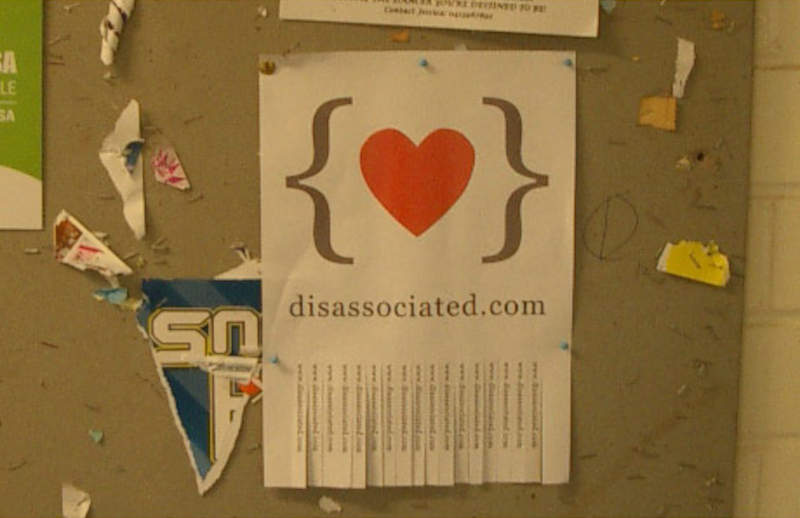
First up I created some A4 flyers. The “hardest” part was preparing the flyer to print specifications… that is using CMYK colours (instead of RGB colours), and a resolution of 300 dpi instead of 72 dpi, the usual resolution of images served to the web.
This meant I had to draw a new heart shape from scratch, since nothing else I had would scale properly. While the bigger version turned out just a slight tad wonky, I was otherwise very happy with the flyer.

As you can see the flyers have convenient “tear off” tabs, so the thousands of interested flyer viewers can look up disassociated.com as soon as they reach a computer.
The next step was to arrange some business cards. I needed these anyway, but realised they could also play a part in my guerrilla marketing.
There are a few shops that allow you to design your own cards and then send them the artwork as a “pre press” file in PDF format, all for a relatively modest outlay.
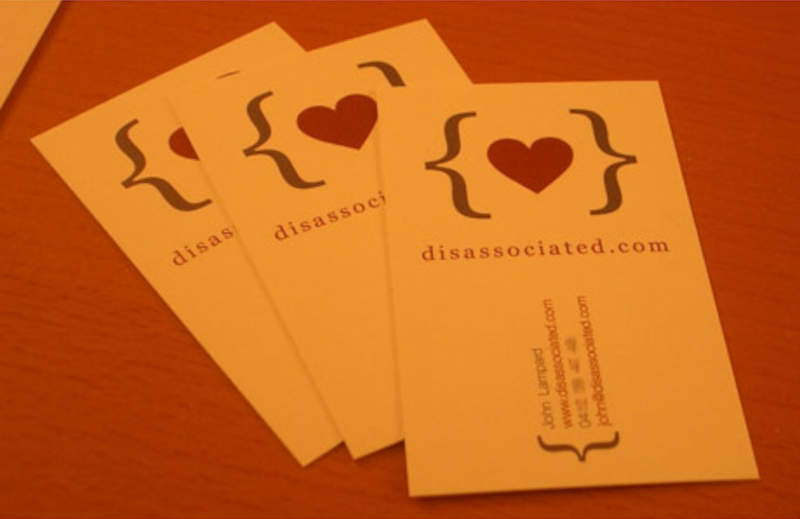
The shrewd (ha, if I say so myself) design of these cards allows me to cut off my contact details while leaving the logo and truncated URL intact, which then forms a handy calling card.
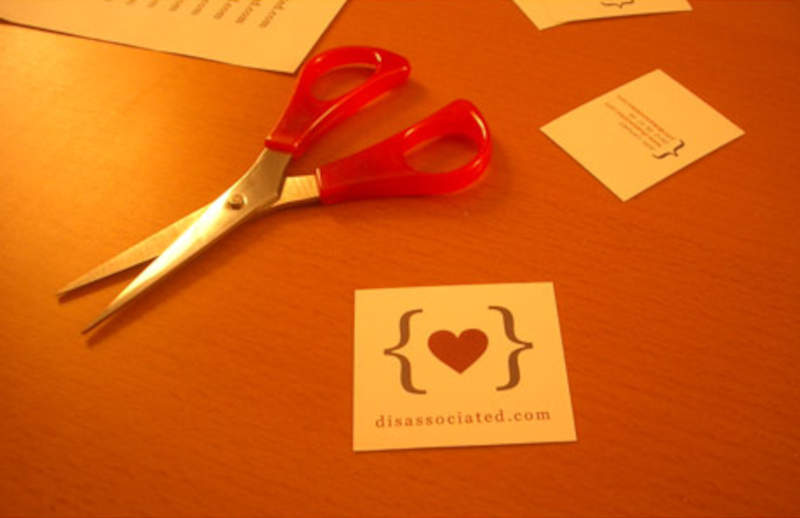
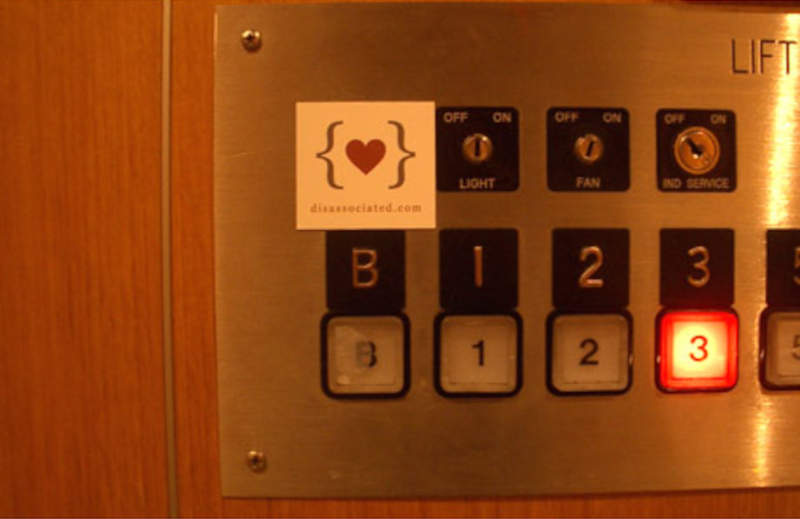
If you happen to visit UNSW you may have already noticed some of these babies around the place…
As well as of course the flyer, which I placed on a couple of boards around the campus. When I checked back a day later, a number of the tear tabs had been torn off, so there had been some interest.
While it is difficult to gauge exactly what sort of response, in terms of traffic, this campaign had (I was checking my web stats for visitors from Sydney and/or UNSW servers arriving via “no referring link”), it was by no means overwhelming.
Still it was relatively simple to pull off, didn’t require huge resources of time or money, got me out of the house and away from the blog for awhile, plus gave me the chance to get back to UNSW and check out the campus again.
For some edgier examples of guerrilla marketing check out Web Urbanist, and if you’ve tried out any guerrilla, or off-line, marketing yourself please leave a comment and tell me what you did, and how it went.
Originally published Thursday 16 August 2007, with subsequent revisions, updates to lapsed URLs, etc.
RELATED CONTENT