
Showing all posts about social media
X marks the spot, new Twitter logo soon, following name change
24 July 2023
Twitter owner, Elon Musk, says the present blue bird logo of the micro-blogging service will be changed to an X styled emblem, and that an interim logo could be unveiled sometime today. The new branding follows the recent name change, from Twitter to X Corp last April.
The changes are part of a bigger plan that will see Twitter/X transform into something similar to WeChat, an instant messaging, social media, and mobile payment app, that is popular in China.
Exciting times, no?
RELATED CONTENT
design, social media, social networks, technology, Twitter
Threads engagement declines, badges removed from Instagram
17 July 2023
The curious joined, looked around, and then returned to what they were doing before. Daily active users on Threads, Meta’s answer to Twitter’s micro-blogging platform, declined by twenty percent in the days following the app’s red-hot launch, while time spent by users on Threads fell from twenty minutes per day, to ten.
This is probably par for the course though. It’s not as if Twitter, and other social networks vanished, leaving Threads users more time to spend on the app. While not the most active on social networks, I’m on a few, and as much as I like Threads, there’s only so much time in the day that can (or should) be devoted to activity on social networks.
And although there might have been one-hundred million sign-ups for Threads, the people many of these new members follow may not be among that number, necessitating visits to wherever those followers are. And that might remain the case. For instance, Threads does not have the same news and politics focus as Twitter, meaning the platform won’t be for everyone, meaning some people will be spending their time on multiple social networks, not just one.
In other Threads news, member badge numbers, which I wrote about last week, are no longer visible on the Instagram app profile pages of those who are members of both Meta platforms. The badge, indicating what number member someone was on Threads, has been replaced by the Threads logo, linking to that person’s Threads page, and right now is only visible on the Instagram website.
How unfortunate. I had high hopes for those badge numbers, some of which were surely collectable (and subsequently worth paying good money for). It looks like I won’t be buying that villa in the north of Portugal, to summer at, after all…
RELATED CONTENT
social media, social networks, Threads, trends
#BookThreads, a name for the book community on Threads?
15 July 2023
Threads banner image, by Meta.
If Threads, Meta’s recently launched micro-blogging app, takes off and becomes as popular as the likes of Twitter and Instagram, a community of book readers and fans is bound to form. As was the case on Instagram, Threads’ Meta owned stablemate, where a thriving and lively book community interacts under the #Bookstagram hashtag.
But where there’s a social network, there’ll be an active community of book lovers. On rival micro-blogging network, Twitter, the bookish use the #BookTwitter hashtag to label their tweets, making them visible and searchable for fellow literary mavens, while on while on TikTok, BookTokers share book content using the #BookTok tag.
Presently hashtags are not functional on Threads, but they, along with a bevy of other features, are on the way. It’s therefore only a matter of time before book readers will be able to connect with bookworms on Threads. That’s good though, it gives the bookish time to devise a community name and hashtag to use on Threads. But that’s hardly going to be difficult.
The hashtags used by the book reading communities on Twitter, Instagram, and BookTok, are simple and to the point, and the same will doubtless apply on Threads. Which makes BookThreads the logical choice. I first saw the term used by Australian book publisher Pan Macmillan Australia on their Instagram page, though someone else may well have used the moniker before.
So #BookThreads it is, at least if you ask me. And just because hashtags still aren’t functional on Threads doesn’t mean you can’t use them. I’ve sporadically been including them on posts, probably through habit, as I imagine others have to, and I’ve used #BookThreads on at least one of my Threads posts. But by adding #BookThreads to your bookish Threads posts now, means you’ll be immediately be visible to the Threads book community, when hashtags become operational.
But what are your thoughts on a hashtag and title for a potential Threads book community? Does BookThreads make sense, or is it a terrible idea? Do you have alternative suggestion? Let me know in the comments below, which will be open for a week or so after this article is posted.
RELATED CONTENT
books, social media, social networks, Threads
Threads revenue tipped to reach $8 billion by 2025
15 July 2023
Threads, Meta’s micro-blogging app, may only be a week old, and boast a relatively small membership of one-hundred million, but some analysts are already predicting, boldly perhaps, the Twitter clone may draw in revenues of eight-billion dollar per annum by 2025:
Evercore ISI analysts reportedly said they expect Threads to add $8 billion to Meta’s annual revenue by 2025. Nevertheless, while marketers and brands are already experimenting with the app, they really want to know when ad formats will be available.
This is the eight-billion dollar question. Part of Threads’ present appeal is the relative absence of advertising. I think most people appreciate ads of some sort will need to make an appearance at some point — this playground Meta has made for us has an overhead after all — but the way they are deployed will be critical.
Any misstep could drive users away, and potentially bring an end to Threads. As a comparison, Twitter, with a membership of some 368 million daily active users, made four and a half billion dollars in 2022, chiefly from advertising. Whether we get to see the 2023 numbers remains to be seen.
Via Matt Fleury.
RELATED CONTENT
social media, social networks, Threads, trends, Twitter
Have Threads badges made my Instagram account valuable?
11 July 2023
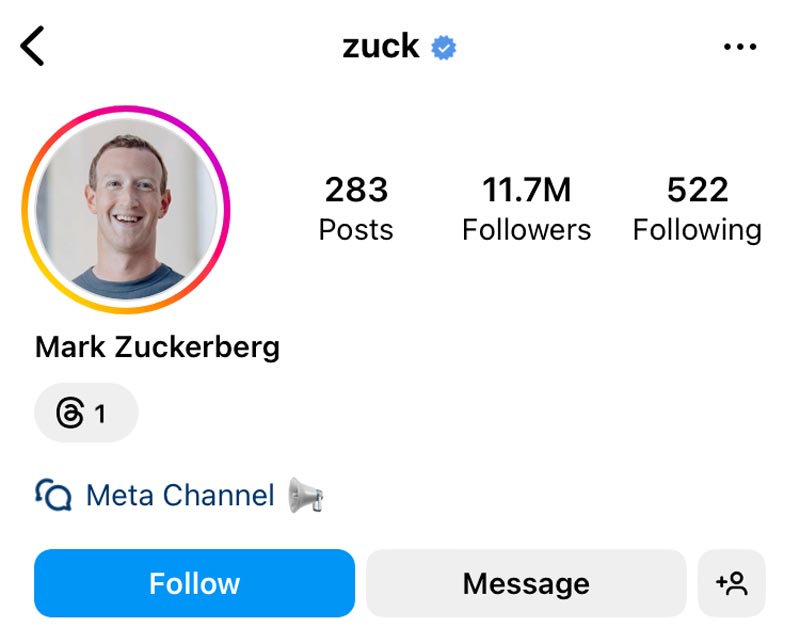
Mark Zuckerberg’s Instagram profile displaying his Threads badge.
The launch last week of Meta’s Twitter-like micro-blogging service Threads has been a riotous success, if the one-hundred million sign-ups in its first five days are any indication. Threads seems to have been the much wanted breath of fresh air micro-bloggers were waiting for. The Meta made app not only offers ease of use, but comes largely unencumbered by the baggage of Twitter, or the confusion some people have experienced with Mastodon, another micro-blogging contender.
Of course it is early days. Threads is not completely without its drawbacks. Privacy advocates have voiced concerns about some of the user data Threads is collecting. And compared to, say, Twitter, many features micro-bloggers are used to — hashtags for example — remain absent, though it sounds like more functionality is on the way.
Introducing the Threads badge
One feature however that may have surprised many Instagram users after signing up for Threads, is the appearance of a number on their Instagram account, situated just below their username. The image above, a screen grab of Facebook co-founder Mark Zuckerberg’s Instagram page, is an example of what I mean. From what I can gather, the symbol that looks a little like @1, is called a badge, or a Threads badge, though, in some cases, it could just as easily be called a badge of honour.
In short the badge, which can only be seen on the Instagram app, but not the website, tells the world what number member you are of Threads. It also links to your Threads page, and anyone tapping on the badge will be taken there, if they are a member themselves. It is of little surprise that Zuckerberg, as CEO of Meta, scored the surely much coveted badge number one. But aside from letting everyone know how quickly, or not, that you became a Threads member, might the badge have other value?
As in financial value? I mean, who wouldn’t want to have Threads badge number one adorning their Instagram page? While it is fair to say the chances of acquiring this particular badge number are pretty much non-existent, might other badge numbers become something people would be prepared to pay top dollar for?
Speculating on Threads badges, really?
Speculating on Threads badge numbers however would be fraught with difficulty. For one, Threads needs to take hold as a serious micro-blogging player, for the badges to accrue any value. As I said earlier, there has been a rush to sign up for Threads, but how many people will remain active on the platform long term? If the initial burst of enthusiasm wanes, Meta might decide to close Threads down, rendering the badges worthless.
But that’s not to say there might still be interest in the badges as a commodity. While the ultra-low badge numbers are probably in the hands of those who will not let them go, come what may, there may be people potentially interested in trying to acquire double, or three figure numbers. Or so-called “golden numbers” that may be higher, but are possessed of some subjective value to a would-be buyer, or even a Threads badge number speculator.
666, anyone? Or perhaps a year of birth? Or possibility any relatively low number that makes the owner look like they are an early adopter. But while someone may be interested in buying a particular Threads badge, that doesn’t mean the sale process would be straightforward. Even if the price was right. And the transfer were to evade Meta’s notice. Anyone selling their in demand Threads badge number would have a few things to think about.
Beware the pitfalls…
They would be giving up both their Instagram and Threads accounts, and may lose their possibly cherished username, and followers, in the process. While an arrangement might be reached with the buyer to give up the username, there’s the risk it might be snatched by someone else, if the seller doesn’t move quickly to re-secure it. The seller would also need to get their original followers on board at their new Instagram and Threads pages, something not necessarily straightforward.
Some sort of legally binding written agreement would also need to be in place to ensure each party to the transaction did what was required of them, at the requisite times. Buyer transfers money, seller surrenders account passwords, things like that. Perhaps a brokering service to cater for such a transaction could be engaged to oversee the sale. Maybe there’s a business opportunity for brokers, if the sale of Threads badge numbers becomes commonplace. Oh, the possibilities…
Or is it all a pipe dream?
But the prospect of a marketplace for badge numbers emerging, is likewise, pie in the sky possibility. That’s too bad, some of us might have been millionaires for a minute there, at least in the recesses of imagination. But also read this Mashable article by Sam Haysom. See that image as you start to scroll down. The image bearing the somewhat ominous notification, stating “this temporary badge lets your followers know that you’re on Threads and sends them to your profile if they have the app.”
What? The Threads badges are only temporary? Where’s the fun (and millions) in that? If then you do wish to cash in on your Threads badge number, move quickly. And whatever you do, don’t tell the buyer the badges are temporary…
RELATED CONTENT
social media, social networks, Threads, trends
Twitter claims Meta Threads is theft of their trade secrets
8 July 2023
Meta is possibly facing a lawsuit from Twitter, hours after the much hyped launch of Threads, its micro-blogging service, according to Semafor.
In a letter sent to Mark Zuckerberg, Twitter accuses Meta of poaching certain of its employees (presumably those who weren’t laid off), together with “systematic, willful, and unlawful misappropriation of Twitter’s trade secrets and other intellectual property.”
But haven’t we been here before, and isn’t there an answer to this? Anyone who saw American film director David Fincher’s 2010 movie The Social Network, will know what I mean. After all, a guy who builds a nice chair doesn’t owe money to everyone who ever has built a chair.
Is that right, or is that right? Time will tell I expect.
RELATED CONTENT
social media, social networks, Threads, trends, Twitter
Threads by Meta/Facebook has started rolling out
6 July 2023
Threads, the Meta/Facebook micro-blogging/discussion alternative to Twitter was ready to go when I came into the studio this morning. You can find me here.
Threads is pretty simple to set up, especially if you’re already on Instagram (IG), and there’s the option to import your IG profile data, if you don’t want to fill out the same information on your Threads page. You can also auto-follow everyone on your IG following list with a single click, or make individual selections.
From there, you’re pretty much ready to go. Instead of posting a tweet, as you do on Twitter, or a toot if on Mastodon, you post a thread every time you say something. It’s all very new, and early days, and I’m checking in on Threads as I do other things, but it looks like you’ll see a lot of threads from people you don’t directly follow, particularly influencers.
I’m interested to see what other Twitter-like features are, or will be, available, such as lists, and scheduling threads. Isn’t it fun though, something new, and perhaps not so encumbered with baggage, and general bad vibes. And another big one, fingers crossed Meta/Facebook don’t impose too much Meta/Facebook-ness upon us in Threads.
RELATED CONTENT
social media, social networks, Threads, trends, Twitter
Meta’s Twitter clone, Threads, said to be launching this week
4 July 2023
The much talked about Meta/Facebook Twitter-like micro-blogging application, reportedly called Threads, will be launched later this week, according to Bloomberg.
With well over one billion Instagram users, and approaching three billion Facebook members, Meta’s Twitter clone has tremendous potential traction.
RELATED CONTENT
social media, social networks, Threads, trends, Twitter
Lee Tilghman, giving up influencing for nine to five work
27 June 2023

Image courtesy of Veeka Skaya/Vancity Digital.
What do social media influencers, through with influencing, wanting to try something new, do? They find a nine-to-five corporate job, and act as a consultant for other influencers likewise wishing to exit the industry, of course. That’s the story of former — sort of — American wellness influencer Lee Tilghman. But in 2019, with the role no longer fun, Tilghman decided she wanted out. And what’s the point in staying in something you don’t like, especially when there are other options?
But Tilghman’s story is an intriguing one, given the number of people who would give their right arm, to be in her former position. Who wouldn’t want to be self-employed, on a high income, in return for making a few (sponsored) Instagram posts a day? But that’s simplifying matters somewhat. The posts appearing on an influencer’s social media feed or blog, are the tip of the iceberg. Most the work of an online content producer, even those with assistants, takes place behind the scenes.
In a profile written for the New York Times by Mattie Khan, Tilghman speaks of the delight nine-to-five work is presently bringing her. But is the grass really greener on the other side? One of Tilghman’s new corporate colleagues was mortified when he learned she had given up her role as an influencer. How could she possibly want to be “shackled” by a nine-to-five job? But Tilghman replied by saying “when you’re an influencer, then you have chains on.”
The chains binding influencers are numerous. There’s the need to toe the line — or at least convey that impression — of the brands you represent. While you might be happy to take a brand’s money, for a time anyway, your values may not always align with theirs. There’s also pressure to post frequently to keep followers engaged, lest they drift away. Being in the spotlight constantly can also take a toll over time, to say nothing of the criticism some influencers are subject to.
Today Tilghman counts the relatively low profile nature of nine-to-five work as a bonus, citing the absence of a “comments section at an office job.” That may be so, but how about things like office politics, and KPIs, at a corporate job? There’s a comment section surely as fearsome as any other. But I wonder, once an influencer, always an influencer? Despite having turned her back on the profession, Tilghman still has a profile that would make many a newbie green with envy.
At last count, Tilghman had some two-hundred and forty thousand Instagram followers, a following she’s partly leveraging for her side-hustle, online workshops assisting retiring influencers transition to a new career. And despite the desire for a “boring job”, Tilghman admits to occasionally missing her old work. But is influencing really work? It’s hardly what I am, I call it being a self-publisher, or blogger. But it’s not a job, it’s more of a way of life, and one that’s hard to turn away from.
RELATED CONTENT
social media, technology, trends
Tiktok reading community BookTok prompts reading surge
22 May 2023
Short-form video hosting service TikTok certainly has its nay-sayers. Security analysts believe the app may be compromising the privacy of users, while lawmakers in some countries are considering banning it. But the news isn’t all bad: TikTok appears to be behind a recent surge in book readership, thanks to the app’s reading community, BookTok, according to Kristen McLean of NPD Bookscan:
The romance novel It Ends With Us by Colleen Hoover was the second best-selling Adult Fiction book and sixth best-selling book overall in 2021 — selling more than 770,000 copies last year — despite being a backlist title originally published in 2016, and McLean believes that is “almost exclusively there because of BookTok,” where it was championed.
RELATED CONTENT