
Showing all posts about trends
Instagram creators launch news reading app called Artifact
3 February 2023
Kevin Systrom and Mike Krieger, creators of the original Instagram, who sold the photo-sharing to Facebook for one billion dollars in 2018, have launched a new app called Artifact. Rather than curating photos though, Artifact serves up popular news articles and blog posts:
The simplest way to understand Artifact is as a kind of TikTok for text, though you might also call it Google Reader reborn as a mobile app or maybe even a surprise attack on Twitter. The app opens to a feed of popular articles chosen from a curated list of publishers ranging from leading news organizations like The New York Times to small-scale blogs about niche topics.
Artifact sounds like the sort app I could make use of, but ads appearing on the news pages the app displays, don’t make for a smooth reading experience, according to John Gruber, writing at Daring Fireball, who has been trialling Artifact:
I’ll give it some time, but at the moment, it’s a disappointment. The articles they show come directly from publishers’ websites, but because Artifact isn’t a web browser, per se, there’s no ad filtering. It’s just ads ads ads, interrupting seemingly every single article, every couple of paragraphs. This same “man, I miss ad blockers” feeling strikes me when I use Apple News too, but Apple News articles have way fewer ads, and better ads, than what I’m seeing so far in articles I read in Artifact.
RELATED CONTENT
current affairs, technology, trends
ChatGPT may take your job but ChatGPT may make your next job
30 January 2023
Jobs in education, finance, software engineering, journalism, and graphic design, are among some of the occupations under threat from OpenAI chatbot ChatGPT, writes Alex Mitchell for the New York Post. That’s a wide gamut of work. But ChatGPT will also play a part in creating new work opportunities:
From the financial sector to health care to publishing, a number of industries are vulnerable, [Pengcheng] Shi said. But as AI continues its mind-blowing advancements, he maintains that humans will learn how to harness the technology.
RELATED CONTENT
artificial intelligence, technology, trends
ChatGPT cannot take author credit for academic papers published by Springer Nature
28 January 2023
The United States Copyright Office (USCO) recently declared it only wants to grant copyright protection to artworks created by people, not AI technologies.
Now Springer Nature, one of the world’s largest publisher of scientific journals, says hot AI technology of the moment, ChatGPT, along with other large language models (LLM) tools, cannot be credited as the author of any academic papers they publish. The OpenAI engineered chatbot can however assist with research writing, but their use must be disclosed:
First, no LLM tool will be accepted as a credited author on a research paper. That is because any attribution of authorship carries with it accountability for the work, and AI tools cannot take such responsibility. Second, researchers using LLM tools should document this use in the methods or acknowledgements sections. If a paper does not include these sections, the introduction or another appropriate section can be used to document the use of the LLM.
RELATED CONTENT
artificial intelligence, science, technology, trends, writing
Australians prefer physical books says Amazon Kindle research
25 January 2023
Amazon Kindle recently quizzed just over one thousand Australians about their reading habits. Here are some of the findings that caught my eye:
- Almost half those surveyed read fewer than five books in the past twelve months
- Meanwhile just over five percent said they’d read fifty or more books in the same time frame. That’s almost a book a week, maybe more, for some in that five percent band
- Sixty-eight percent of respondents read physical books, compared to twenty-two percent who favoured electronic formats
- Mystery, true crime, and romance, where among the most popular fiction genres. Sadly, poetry barely rated a mention. Literary fiction, apparently, was not assessed
- About twenty-five percent of people said they read to experience escapism and alternate realities, while not quite forty percent read for relaxation
- On the other hand, about one percent of respondents said they did not enjoy reading at all. Hmm, ok, I see.
RELATED CONTENT
Are the current tech layoffs a result of over recruitment?
23 January 2023
The layoffs in the tech sector continue, with Microsoft and Google among companies announcing mass redundancies across their operations last week. Ten thousand people are impacted at Microsoft, and twelve thousand workers at Google have been sacked. Although both company CEOs struck a contrite tone in breaking the news, that will be cold comfort to workers who have lost jobs when higher inflation, and rising interest rates, are already posing challenges for many people.
But why are so many employers in the tech sector announcing layoffs, almost one after the other? A few weeks ago I read an article by Professor Jeffrey Pfeffer, of the Stanford Graduate School of Businese, who suggested the redundancies were a form of social contagion. One company sacks some workers, other feel they have to do the same.
John Gruber, meanwhile, writing at Daring Fireball, sees another possible reason for the job losses. He thinks many of the companies announcing layoffs had spent the last few years over recruiting:
There are numerous reasons the tech industry wound up at this layoffpalooza, but I think the main reason is that the biggest companies got caught up in a game where they tried to hire everyone, whether they needed them or not, to keep talent away from competitors and keep talent away from small upstarts (or from founding their own small upstarts). These big companies were just hiring to hire, and now the jig is up.
RELATED CONTENT
Taylor Swift, Harry Styles, part of cassette tape revival, but why?
14 January 2023
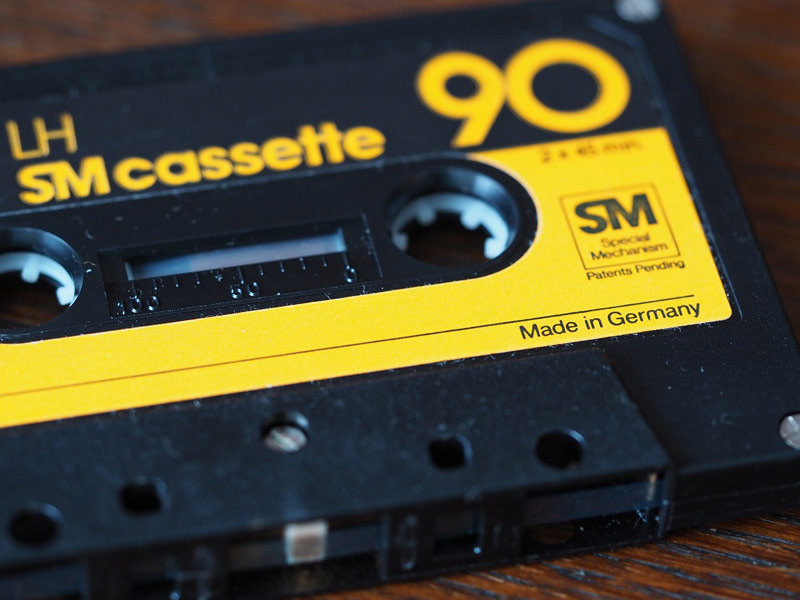
Image courtesy of Ratfink1973.
Taylor Swift and Harry Styles are among musicians to recently release material on… cassette. As in cassette tape, or compact cassette. But at least eighty percent of both performers’ target audience must be under the age of thirty-five. How many of these people would have even heard of cassettes, let alone have access to a cassette player?
Australian writer and radio presenter Richard Glover is on the money in saying cassettes, along with rotary dial telephones, VHS tapes, camera film, and typewriters, having had their day, belong in the past:
But not every piece of old technology was a boon. The typewriter, for instance, was a menace. The sliding carriage seemed designed to knock over any coffee cup momentarily perched on your desk, while vigorous typing would produce tiny portholes on the page every time you hit the “o” or the “p”.
Music in digital formats might have its naysayers — high compression, reduced quality — but it has eliminated the need to haul cumbersome players, speakers, and storage cabinets for all those cassettes, around with us. Call me a philistine, but I’ll take the convenience of carrying my music collection, and my books come to that, in my pocket, any day of the week.
RELATED CONTENT
The American Dialect Society word of the year 2022 is –ussy
13 January 2023
Are you ready for some word play?
-ussy, which, in this context, is actually considered a suffix — but, in this case, is still a word — has been chosen as the American Dialect Society’s (ADS) word of the year for 2022:
“The selection of the suffix -ussy highlights how creativity in new word formation has been embraced online in venues like TikTok,” Zimmer said. “The playful suffix builds off the word pussy to generate new slang terms. The process has been so productive lately on social media sites and elsewhere that it has been dubbed -ussification.”
Remember the word e-mail, before it simply became email? The e- suffix was selected as the ADS word of the year in 1998. Somehow e- felt more like a word of the year than -ussy, but then I guess that’s what someone who doesn’t use TikTok would say.
RELATED CONTENT
The exorbitant cost of luxury goods is why people queue up to buy
12 January 2023
Despite their cost, the goods sold by some luxury retailers are not always quality buys, though such matters seldom deter customers. It’s the price tag they’re interested in. And the higher the price, the better, writes American author and entrepreneur, Seth Godin:
Luxury goods are items that are worth more (to some) because they cost more. The cost itself is the benefit that is being sold.
But the exorbitant cost isn’t the only… benefit. The roped-off queuing areas outside the store, where customers must wait for a sales agent to become available, are another. There’s a luxury in lining up to enter a luxury retailer, it’s the hope of being seen waiting for admission. The picture windows adorning many of these stores, and their relatively confined floor space, are another benefit. They combine to create an additional opportunity to be seen shopping.
A large shopping centre I visit has a dedicated “luxury precinct”, an area set aside solely for luxury stores. I’m not sure all the people I see queuing up outside these stores are exactly in the luxury store demographic, but maybe that’s another benefit of the luxury shopping experience.
RELATED CONTENT
The wave of tech company layoffs and social contagion
12 January 2023
I’ve worked in a number of organisations in the past that have been subject to rounds of staff layoffs or redundancies. In most cases the prime motivation was cost cutting, and the decision to proceed was usually made by a senior executive who would not have to deal directly with the subsequent fallout. For anyone not familiar with the process, it was not pleasant. Stress, anxiety, baseless rumours, and misinformation, were all in abundance.
Despite noises made to the contrary by management, the negative impact on workers — both those departing, and those staying behind — was seldom given thought. In one situation, a former colleague made what is probably a common observation: there’ll still be the same amount of work to do. New work processes and technologies might reduce some of the load, but likely not markedly.
Like many people, the recent wave of layoffs in the tech sector has puzzled me. One company announced a round of redundancies, and the next thing other tech companies are following suit. But why? Surely all these companies, Meta (the Facebook owner), Linkedin, Twitter, Tesla, Netflix, and Salesforce — who are but a handful of organisations to send employees home in recent months — cannot all be struggling financially.
This make the staff cuts all the more baffling. But as Jeffrey Pfeffer, a professor at the Stanford Graduate School of Business explains, the layoffs are a case of social contagion. In other words, because one or two tech companies have been shedding staff, everyone else feels they must do the same. Long story short, there is no real reason for the redundancies, and the turmoil they create for workers, and the organisations themselves:
The tech industry layoffs are basically an instance of social contagion, in which companies imitate what others are doing. If you look for reasons for why companies do layoffs, the reason is that everybody else is doing it. Layoffs are the result of imitative behavior and are not particularly evidence-based.
RELATED CONTENT
Apple Books puts AI narrators to work voicing select audiobooks
8 January 2023
Text-to-speech AIs have begun narrating select romance and fiction audiobooks available from Apple Books. Audiobook listeners electing an AI… entity (is that how I should refer to them?) to recite their title can choose between two digital voices, named Madison and Jackson. An additional two AI narrators, Helena and Mitchell, will soon be reading out non-fiction titles. Apple says the move will reduce costs, making it easier for independent authors and publishers to produce audiobooks:
The feature represents a big shift from the current audiobook model, which often involves authors narrating their own books in a process that can take weeks and cost thousands for a publisher. Digital narration has the potential to allow smaller publishers and authors to put out an audiobook at a much lower cost.
I don’t know what professional book narrators will think — though I can guess — but the move also makes sense for those authors who currently chose to narrate their own work. They can save several weeks of recording time, leaving them to focus on what they do best: write. While it could be said AI narrators were inevitable, that will be cold comfort for their human counterparts.
RELATED CONTENT