
Showing all posts about writing
Storywizard an AI for creating instant kids bedtime stories
6 December 2022
Somewhat related to my last post… Storywizard is a generative AI story creation app, that composes bedtime stories for children, complete with images, in real time.
We all have vivid imaginations and great ideas, but it’s not easy to express them and put them into writing. We built Storywizard to help parents and kids bring their ideas to life.
RELATED CONTENT
artificial intelligence, technology, writing
Could AI technologies be the end of writers and bloggers?
5 December 2022
For a long time it was believed the inevitable rise of automation technologies would bring about the end of repetitive and labour intensive jobs. Warehouse workers, drivers, and filing clerks would need to re-skill if they weren’t to be left unemployed.
But as digital and AI technologies evolved, the threat of being usurped by a computer moved up the ranks. An article published in The Economist in January 2014 (I couldn’t find an author credit, surely a machine didn’t write it?), warned that white collar professions such as accountants and doctors were also at risk:
Computers can already detect intruders in a closed-circuit camera picture more reliably than a human can. By comparing reams of financial or biometric data, they can often diagnose fraud or illness more accurately than any number of accountants or doctors.
Creatives meanwhile, writers and artists among them, always felt immune from these technologies. After all, how could a computer possibly produce an artwork, or write a book? Well, thanks to the likes of DALL·E and Jasper, we now know it’s possible. But creative output is not the limit of these technologies. They’re also capable of creative and problem solving… thought.
For instance, an application called Consensus, promises to seek answers, or consensus, to deceptively simple questions such as “is drinking coffee good or bad for my health?”, and potentially save hundreds, maybe more, of research hours. The app, once fully developed will be able to accurately scan multitudes of research papers on a particular topic, and deliver a pithy yet informative, summary in response to the query, says Derek Thompson, writing for The Atlantic:
Consensus is part of a constellation of generative AI start-ups that promise to automate an array of tasks we’ve historically considered for humans only: reading, writing, summarizing, drawing, painting, image editing, audio editing, music writing, video-game designing, blueprinting, and more. Following my conversation with the Consensus founders, I felt thrilled by the technology’s potential, fascinated by the possibility that we could train computers to be extensions of our own mind, and a bit overcome by the scale of the implications.
I expect in time AI technologies will be able to research and write the papers apps like Consensus will scan. But while AI apps can create artworks and perhaps write novels, will they really be any better at being creative? Let’s take blog writing as an example. A lot of people blog, but how popular are all these bloggers? We know some are more widely read than others. Their writing might be seen by hundreds of thousands of people, while other bloggers struggle to attract a handful of readers.
Just because, then, a machine writes something, does that mean the work will automatically have a larger audience? Will they cause every last writer on Earth to throw in the towel, and give up? I’m not so sure. Certainly the AI writers will improve, learn as they go, hone their craft, but will that result in more readers than an article written by a person? Maybe. Maybe not. Human and AI bloggers could be evenly matched. Of course, AI blogging apps will be able to research and write articles a lot faster, and that will be an advantage.
They’ll be able to publish an article on a given topic far more quickly than I can, and that work may rank on the search engines and elsewhere before mine. And that will suit some readers, but not all. And then we come to the human side of the process. Will readers be able to interact with the AI blogging app, as they can with human bloggers, through say email or social media? More crucially though, depending on the topic at hand, will an AI blogging or writing app, have the same authority to write as a person?
Could, for instance, an AI app write about raising a family? This is something most people learn about the hard way, by living through it. How could an AI blogging app possibly claim to be better qualified than a person, through “personal experience”, in this regard? How could the app ever gain the crucial trust to write on some subjects? This I suspect remains to be seen. At their core, AI apps are capable of thinking like people. For better or worse. I dare say, unfortunately, they will find a way.
RELATED CONTENT
artificial intelligence, creativity, psychology, technology, writing
Penguin Random House calls off Simon & Schuster merger
23 November 2022
Penguin Random House, one of the world’s largest book publishers, has called off a proposed merger with Simon & Schuster. Last month, a United States court blocked the proposal, on the grounds competition, and remuneration to authors, stood to be adversely effected. Initially Penguin had indicated they would appeal the ruling, in the hope the deal could still go ahead. The merger, had it proceeded, would have reduced the world’s major publishers from five to four.
The U.S. Justice Department filed a lawsuit aimed at stopping the deal in November 2021. In hearings held in August, the government argued that the largest five publishers control 90% of the market, and a combined Penguin and Simon & Schuster would control nearly half of the market for publishing rights to blockbuster books, while its nearest competitors would be less than half its size.
Hopefully this is a good outcome for authors and book readers. However, Paramount Global, who own Simon & Schuster, have expressed a desire to divest itself of the book publisher, as the film production company sees ownership of a publisher as a non-core asset. This probably means we’ll see Simon & Schuster being brought to the market again, at some point in the future.
RELATED CONTENT
The Fanzine Scan Hosting Project preserving fanzines fanfiction
18 November 2022
For every well-known work of fiction, there’s an extended universe behind it, called fanfiction. Look at the likes of Star Trek, The Twilight Saga, Star Wars, Harry Potter, and a whole lot more, it’s all there. Stories written by adoring fans of the original books, films, and TV shows, expanding on the creator’s canon, and exploring other weird and wonderful story arcs.
At times not all of these works are sanctioned by the series creator, but that won’t always stop the most die-hard of adherents. If they think there’s a story to tell, they’ll write it. But while works residing online, in electronic format, are likely to be preserved — at least for now — publications such as zines, or fanzines, which usually exist solely in paper format, are another matter.
The Fanzine Scan Hosting Project, an initiative of An Archive of Our Own, or A03, one of the most extensive online repositories of fanfiction, along with a number of collaborators, aims to preserve physical fanzines, and eventually make as many as possible available in electronic format online. Needless to say it’s a big job, but progress is being made:
Over the last year or so, however, Open Doors’ Fan Culture Preservation Project has expanded, finally giving them room to launch the Fanzine Scan Hosting Project. So far, they’re making their way through the backlog of scans that Zinedom has already accumulated, which Dawn estimates is “a couple thousand.”
RELATED CONTENT
books, history, technology, writing
November is NaNoWriMo bad writing and vomit texts incoming
7 November 2022
It’s November and that means it is NaNoWriMo (National Novel Writing Month) time. Writers, whether new or established, have thirty days to pen a fifty-thousand word manuscript. That works out to about seventeen hundred words a day. A daunting task for sure, but it wouldn’t be much of a challenge if it were easy.
NaNoWriMo doubtless makes for an enjoyable way to while away cool autumn days for northern hemisphere participants. A Camp NaNoWriMo event is also held in April and July, and might suit writers based south of the equator, who’d rather be away from their laptops, enjoying the spring weather in November.
And while the vast majority of works produced during NaNoWriMo seldom sees the light of day, the event has launched the careers of several authors. But it’s not for everyone, and some writers are critical of NaNoWriMo. They say the tight deadline encourages bad writing, as people scramble to reach the fifty-thousand word target.
It’s one reason science fiction author and game developer, and past participant, Dale Thomas gave up on NaNoWriMo. But Thomas goes further than describing some NaNoWriMo output as “bad writing”. To his mind, vomit texts make for a more apt metaphor:
You see, the big problem I have with the challenge is that it forces me to write fast. Too fast for my liking. I end up vomiting all over my writing application. And because only wordcount matters and the clock is ticking, there is no time to wipe the drool from my mouth, no time to find a damp cloth to clean up the mess. The vomit just sits there, drying out, and day after day I vomit afresh. Layer upon layer of disgusting, half-digested ideas, dripping all over the once pristine white page.
RELATED CONTENT
Penguin Random House, Simon & Schuster merger blocked
3 November 2022
The proposed merger of book publishers Penguin Random House and Simon & Schuster has been blocked — at least for now — by the U.S. District Court. The idea, first mooted in late 2020, has drawn the ire of many in the publishing industry, who fear the combined entity, and the influence it could wield, would be detrimental to authors and readers alike.
But it was still a dramatic departure from recent history in the book world and beyond. The publishing industry has been consolidating for years with little interference from the government, even when Random House and Penguin merged in 2013 and formed what was then the biggest publishing house in memory. The joining of Penguin Random House and Simon & Schuster would have created a company far exceeding any rival and those opposing the merger included one of Simon & Schuster’s signature writers, Stephen King, who testified last summer on behalf of the government.
RELATED CONTENT
Novelist as a Vocation by Haruki Murakami
1 November 2022
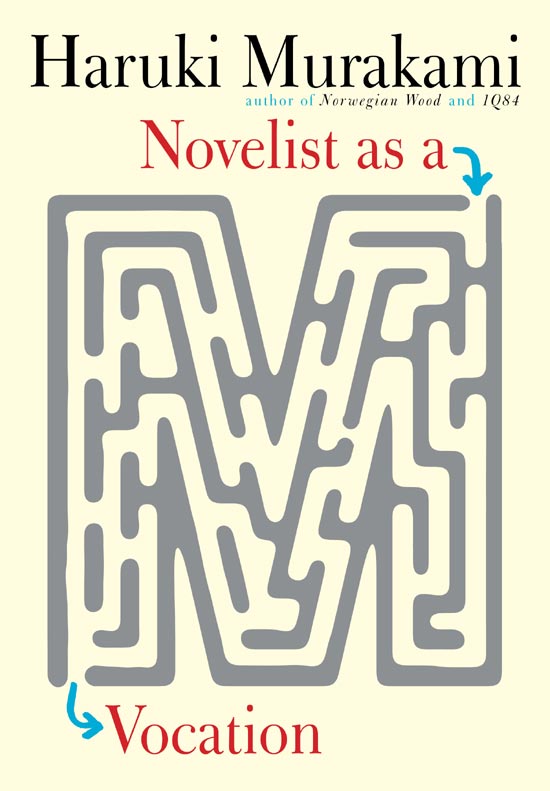
Despite what you might see on bookstagram, the stages of many a literary festival, and many other places, writers are not, and cannot be, friends with each other.
They “are are basically an egoistic breed, proud and highly competitive“, contends Japanese author Haruki Murakami. We’re not here to make friends, we’re here to write books. And if anyone would know, Murakami would. With fourteen novels to his name, no one can say he wouldn’t know.
This is but one nugget of wisdom Murakami shares in his latest title, Novelist as a Vocation, published by Penguin Books, where he writes about being a novelist:
Haruki Murakami’s myriad fans will be delighted by this unique look into the mind of a master storyteller. In this engaging book, the internationally best-selling author and famously reclusive writer shares with readers what he thinks about being a novelist; his thoughts on the role of the novel in our society; his own origins as a writer; and his musings on the sparks of creativity that inspire other writers, artists, and musicians. Readers who have long wondered where the mysterious novelist gets his ideas and what inspires his strangely surreal worlds will be fascinated by this highly personal look at the craft of writing.
RELATED CONTENT
books, Haruki Murakami, writing
Bramble a literary journal for and by disabled creatives
31 October 2022
Bramble is a newly launched quarterly literary journal for, and by, disabled creatives. Founded by Spencer Barberis, and Scout Lee Robinson, past University of Wollongong arts students, Bramble only publishes creative work by disabled writers and artists based in Australia.
RELATED CONTENT
Australian literature, writing
Australian author Bri Lee on earning income from Substack
24 October 2022
On the subject of Substack, Sydney based Australian writer Bri Lee is another author who has turned to Substack. Asking subscribers for money can be a thorny matter, especially as readers have no compulsion to pay: Substack remains free for anyone to access.
But it comes down to the individual reader. They like a writer’s work, and wish to support them. As simple as that. No one is being forced to do anything.
People who do pay will often be paying to ‘support you and your work’ rather than necessarily paying because they perceive the value of what they get in their inbox is equal to the dollar figure you charge. When I launched the paid section in January 2021 I explicitly told people that I wanted to keep the vast majority of the content freely available, and that anyone who did pay was essentially subsidising the access of the non-paying subscribers.
RELATED CONTENT
Authors with profile can earn money publishing on Substack
24 October 2022
British author Tim Lott writes about starting a Substack page, and how the publishing platform can help writers generate income from their work. In Lott’s case it’s so far, so good:
What do my subscribers get in return for signing up? Anything I want to give them. I have total freedom. There are no editors or advertisers telling me what to do. Independence isn’t without its downsides. You have to learn to sell yourself, you have to understand how online media works and you have to be self-disciplined and dedicated. No editors, no agents, no marketing department. You’re on your own. But we novelists know how to be on our own. Now we have the chance to be multi-media publishers as well.
Profile is key here. Anyone with sufficient followers on the platform of their choosing can make money. While there are plenty of people doing well on Instagram or TikTok, they are what I call visual mediums. But they’re not the best for writing, especially long form writing, as they do not function so well as blogging platforms. Substack then may be the solution writers are looking for.
RELATED CONTENT