Waves of Change takes inspiration from the story of the Bangladesh Girls Surf Club, a group started years ago in the Cox Bazaar region of Bangladesh. In a place where girls are forbidden from even entering the water, kept from an education and typically married away at 11-12 years of age, a group of young girls learned to surf and imagined a world for themselves full of freedom and choices.
Golf buggy driver. Call centre operator. Editor of porn videos. These were some of the jobs Australian thriller writer Christian White worked on the way to becoming a published author. If you want to succeed, and have the requisite determination to succeed, you will succeed, says White, in an interview with Melbourne based journalist Kylie Northover.
White, 40, has wanted to be a writer since he was a teenager, having an “iron-clad plan” to be a best-selling author by 25. “That shifted because 25 came and went, so I changed it to 30, which also came and went,” he says. “When I went past 30 and there was still no career in sight, I made the decision to just focus on writing for the love it – I really do just love the craft.”
And then there’s this nugget of wisdom:
He also realised he’d be better off writing the kinds of books he’d like to read. “Early on I was going to write deep, thoughtful novels – it wasn’t until I started writing thrillers I went oh! Because I love reading thrillers,” he says.
Write what you like reading. I think it’s something many aspiring authors overlook in the burning desire to become a published author. White’s third novel Wild Place was published last month.
Run by Stella’s Virtual Writer in Residence, afshan d’souza-lodhi, the mentorship is open to an emerging woman or non-binary poet based in Melbourne, and seeks to support them in developing an unpublished collection of poetry.
How good’s this? American filmmaker Joel Coen, he of Coen brothers fame, has made an adaptation of the old Shakespeare play The Tragedy of Macbeth. See the trailer here. And what’s become of brother Ethan, the other half of the renowned film production duo? It seems he’s had enough of making films, according to Indiewire.
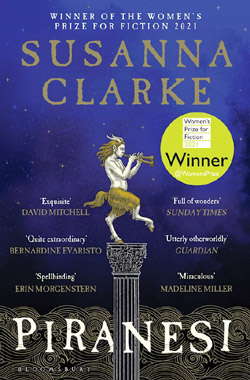
Not that it’s my intention to traumatise you with the workings of my subconscious, but the premise to Piranesi (published by Bloomsbury Publishing, August 2021), by British author Susanna Clarke sounds like the sort of dream I might have. The setting is an old, dilapidated multi-level building, and is home to the titular protagonist known as Piranesi, who refers to the enigmatic structure as the “House.”
And dream-like is the best way to describe the dwelling. An ocean floods the lower levels of this labyrinth, providing food and fuel – in the form of seaweed – for Piranesi. The sprawling hallways of the house’s mid-section stories are lined with statues, while the upper floors are shrouded in clouds. Save for an old scholar, whom Piranesi calls the “Other”, who makes brief appearances a few times a week, the building is otherwise deserted.
But one day Piranesi begins to notice messages chalked onto walkways around the House. Do they point to the presence of a third person within the building? The Other sees them a portent of bad things to come. In order to discover the identity of this mysterious third person, and what they want, Piranesi will need to learn more about the House and its history.
Although René Goscinny and Albert Uderzo, the original creators of the popular Asterix comic book series are no longer with us, their work continues. Jean-Yves Ferri and Didier Conrad, who have been writing and illustrating the stories since 2013, have recently published Asterix and the Griffin, book thirty-nine in the series.
We’re living in a time of unprecedented and rapid change. An age of chaos. Democracies are in decline worldwide. Dictators are ascendant. Civic organizations are crumbling. People feel lonelier and more rudderless than in any other time in recent history. We’ve tried to slow down, and in some cases we, like Anakin, have tried stop the change, but failed at every turn. The fears that come with living in an age of disruption have produced public anger, and that anger has swelled movements of hate.
WARNING: while there are no explicit spoilers here (for instance I don’t describe how Klara and the Sun ends) this article does give away some story points…
Klara, the titular character of Kazuo Ishiguro’s 2021 novel Klara and the Sun, is an AF. She is an artificial friend. AFs are robots that are able to walk, talk, think, and perceive the world around them. In the near-future universe Ishiguro has crafted in his eighth novel, AFs, who appear to be similar in appearance to humans, are highly intelligent companions for teenagers. Despite their human-like qualities though, AFs are easily distinguishable from people. But Klara is said to differ from her AF contemporaries by way of her keen perception and curiosity.
As narrator of the story, Klara often describes in great detail what she sees, or hears, even if she doesn’t always fully comprehend what she has witnessed. Early in the story, as she sits in the display window of a store selling AFs, she watches two older people – a man and a woman – run into each other on the outside street. Their joy at meeting for what may be the first time in decades, is palpable, but Klara is confused by the obvious pain the two people also appear to experience.
While then we may be walking into a future where children will one day have keenly smart and perceptive android-like friends, the question remains as to why there is a need for AFs in the first place. In an introduction to the story’s plot on the Klara and the Sun Wikipedia page, we are told children are schooled at home by tutors through tablet devices (objects Klara refers to as oblongs). For this reason, families who can afford it, buy an AF for their housebound children, as opportunities to socialise with people the same age are said to be limited. But is that really the case?
Soon after coming into the service of a teenage girl called Josie, Klara meets many of her (human) friends at a gathering called an interaction party, hosted by Josie’s mother. The name alone suggests such gatherings are standard, but not necessarily. The dynamic among Josie’s guests implies most the teenagers know each other well. While interaction parties, by virtue of their name, sound like regular affairs, that the event takes place at Josie’s house is notable. For one thing, she lives in a remote region, restricting opportunities to interact with people her age.
But what of her friends? Do they also live in similar circumstances? It seems unlikely every last one does, meaning many would be able to see other teenagers living nearby, outside of schooling hours, thus negating the need (and cost) of an AF. It is also obvious Klara is something of a novelty to some of Josie’s friends. While they’re familiar with AFs, and the attributes of models like Klara, few have actually seen one before. This suggests AF ownership is an exception, most people don’t need them, as they probably live relatively close to others.
For instance, at one point Klara travels with Josie and her mother, Chrissie, to the city where they stay at the apartment of a family friend. While there are vaguely alluded to significant problems in the world Klara and Josie inhabit, they have not resulted in a mass exodus from large urban centres, nor their abandonment. People continue to live and work in cities as usual. Those residing in remote areas then do so by choice. And while we know Josie is ill, and may not get out as much as other teenagers, the need for a carer for her alone would not be reason enough to fill the world with AFs.
It is through this illness – the unfortunate side effect of what seems to be a common genetic modification procedure some teenagers go through – we come to realise Chrissie, Josie’s mother, has another possible purpose in mind for Klara. But again this idea is not the usual intended function of an AF. We’re still left wondering why there is an apparent wide need for AFs such as Klara. Might they then be there to undertake tasks or parental obligations that some parents are unable, or unwilling, to fulfil themselves? For example we know Klara acted as a chaperone at times.
When Rick visited the bedbound Josie in her room, Klara was told to always be present. While she sat with her back to Josie and Rick, Klara could still hear what they were saying and doing. When once asked to leave Josie’s room during one of Rick’s visits, Klara initially resisted, saying she’d been “instructed to ensure against hanky-panky.” But that directive had been issued by the ever-present, live-in, housekeeper, Melania. If she, and by extension Chrissie, was so concerned about “hanky-panky”, surely Melania could’ve been present during Rick’s relatively short visits.
So far there’s little an AF can do that another person – be it a friend, or family member – couldn’t. Josie certainly had plenty of both in her life. Perhaps then AFs were a vanity item. Something you had to have, so you stood apart from other people. A must have, though ultimately dispensable, gimmick. Or was an AF’s unswerving loyalty and devotion the reason they came into being? Like an artificial intelligence chatbot, “someone” who’s always there, who’s always ready to listen, and someone who is never offended no matter how badly they are treated?
The Colour Room (trailer), by Australian filmmaker Claire McCarthy (The Waiting City) re-tells the story of British ceramic artist Clarice Cliff, portrayed by Phoebe Dynevor, who was intent on becoming a designer, something unheard of for a woman living one hundred years ago. “The modern woman is forward thinking, not backward thinking.”