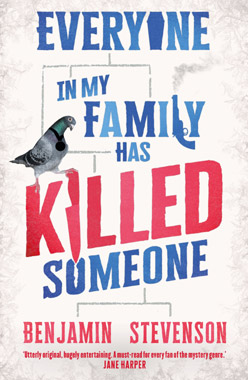
I was dreading the Cunningham family reunion even before the first murder. Before the storm stranded us at the mountain resort, snow and bodies piling up. The thing is, us Cunninghams don’t really get along. We’ve only got one thing in common — we’ve all killed someone. My brother. My step-sister. My wife. My father. My mother. My sister-in-law. My uncle. My stepfather. My aunt. Me.
The quirkiness doesn’t end with the premise and name though, even Stevenson’s way of story-telling deviates slightly from the norm, he tells us how the novel ends on the first page, as he explains to Australian critic Beejay Silcox, writing for The Guardian:
Benjamin Stevenson has a cinephile buddy who seeks out spoilers. Once an ending is good and ruined, he can focus on the film. Stevenson’s new novel was inspired by this back-to-front tactic. “I thought: ‘what if I spoiled the entire book on the first page,” the author explained in a recent interview, “can I build a crime novel out of it?”‘.
An excerpt from The Ukraine, written by Ukrainian author Artem Chapeye, published in The New Yorker. Chapeye is currently serving in the Ukrainian army, fighting the Russian invasion. He also spoke with Deborah Treisman, fiction editor for The New Yorker, about defending Ukraine, and expresses a sentiment that may resonate with some:
What’s most amazing, I think, is that most of us didn’t even expect so much resistance and solidarity from ourselves.
[The Mystery of Marilyn Monroe: The Unheard Tapes] explores the mystery surrounding the death of movie icon Marilyn Monroe through previously unheard interviews with her inner circle.
While Monroe’s death was ruled suicide through a barbiturate overdose, some people believe Monroe was murdered, despite a police investigation finding no evidence of foul play.
The Mystery of Marilyn Monroe: The Unheard Tapes goes to air on Wednesday 27 April 2022.
The Banjo Prize gives Australian writers the opportunity to have their manuscript published, and entries for the 2022 Banjo Prize are open until Friday 27 May 2022.
Past recipients include journalist Tim Slee, winner of the inaugural prize in 2018 with Taking Tom Murray Home, and Sydney based Dinuka McKenzie in 2020 with The Torrent. The shortlist will be announced on Tuesday 6 September 2022.
The shortlist for the 2022 Stella Prize was announced on Thursday 31 March 2022. The six titles, the work of Australian women and non-binary writers, along with an excerpt of the judges’ comments for each book are as follows:
This is an ambitious novel, spanning decades and locales, that sees Down demonstrate her imaginative range and take risks following the success of her previous two books. The result is a daring and compelling work, suffused with pathos and an impressive degree of empathic vulnerability.
Dropbear is a breathtaking collection of poetry and short prose which arrests key icons of mainstream Australian culture and turns them inside out, with malice aforethought. Araluen’s brilliance sizzles when she goes on the attack against the kitsch and the cuddly: against Australia’s fantasy of its own racial and environmental innocence.
Homecoming is both a genre-defying book, and a deeply respectful ode to the persistence of Noongar people in the face of colonisation and its afterlives… Shiosaki has delivered a work of poetic and narrative genius and can be read either as an ensemble of poems or as a single piece that moves seamlessly between the elegiac and the joyful.
No Document is a longform poetic essay that considers the ways we might use an experience of grief to continue living, creating, and reimagining the world we live in with greater compassion and honour… This work is a complex, deeply thought, and deeply felt ode to friendship and collaboration.
Lee Lai’s Stone Fruit is a moving graphic novel in which queer couple, Bron and Ray, find themselves at a tense crossroads in their relationship. Throughout scenes rendered in Lai’s signature art style – simple lines and a muted blue and grey colour palette – and featuring spare, perfectly articulated dialogue… Stone Fruit beautifully reflects a tender domesticity that is affecting and atmospheric.
Andrada’s collection adroitly combines the personal, the political, and the geopolitical, narrated by a voice that is at once hip, witty, and deeply serious. Andrada has the imaginative ability to move between the memories of poet-narrators, historical asides, reflections on the nature of race and feminism in Australia, and questions of colonisation both locally and in the Philippines. Formally remarkable, stylistically impressive, and often surprising, TAKE CARE is a collection that understands the ways in which ‘There are things we must kill / so we can live to celebrate.’
If the Stellas are about finding writing that mixes it up and shakes it around a bit, then the contest for this year’s Prize is going to be fascinating.
In the past novels, non-fiction, biographies, and memoirs have won, but in 2022 works of poetry have a better than average chance of prevailing, with the work of three poets in the shortlist.
Then of course there is Stone Fruit, Lee Lai’s graphic novel. Bring on Thursday 28 April, the day the winner is announced I say.
Ferrante has been acclaimed for her “singular”, “uncompromising” voice, and her “ruthless” honesty. But what emerges from the first lecture, Pain and Pen, is just how cramped and conflicted she felt trying to develop this voice. It was an agonising negotiation between a “compliant” style of writing that stayed “diligently within the margins” and a more “impetuous” approach, which allows “unexpected truth” to spill out on to the page.
Running every March, the Tournament of Books is like an elimination contest, and starts with a longlist of fiction titles considered to be “worthy tournament competitors” that is formed in December. From there a shortlist of sixteen, sometimes more, books is produced, before they go head to head against each other, but that’s only a brief outline of how the tournament works.