
Seth Godin: Mastodon is a federation not a corporation
21 November 2022
Inconvenient. Difficult. Different. Resilient. Social network Mastodon — viewed by some as a Twitter alternative — as seen by American author, entrepreneur, and master of short-form blogging, Seth Godin:
It’s a network in the real internet sense of the word. It’s not just a network of users, it’s a network of servers as well. No one owns it. Like email, it’s a set of principles and rules, not a place. A federation is different than a corporation. It might not be as shiny, but it’s far more resilient. It’s inconvenient. You can’t get started in ten seconds. This leads to less initial stickiness. It means that the people who get through the learning curve are more likely to be committed and perhaps generous.
RELATED CONTENT
Mastodon, social media, social networks
Tune into the aftermath of the Big Bang on television
21 November 2022
If you’re still using an aerial (is that still a thing?) instead of cable (is that still a thing?) or internet, to watch TV, and — presumably — still possess an old school (think rabbit ears) TV, you may be able to pickup remnants of the Big Bang, the force of cosmic nature, that brought the universe into being.
Like COBE, WMAP scans the sky over and over again, soaking up the ancient light from the Big Bang known as the cosmic microwave background. Microwaves are a low-energy form of radiation but higher in energy than radio waves. The cosmic microwave background blankets the universe and is responsible for a sizeable amount of static on your television set–well, before the days of cable. Turn your television to an “in between” channel, and part of the static you’ll see is the afterglow of the big bang.
All you’d see is static, some of which may be post Big Bang microwaves bouncing around the cosmos, but it might be more interesting than some of what is broadcast on the terrestrial channels.
RELATED CONTENT
astronomy, history, science, technology
Blurb Your Enthusiasm by Louise Willder book blurbs uncovered
21 November 2022
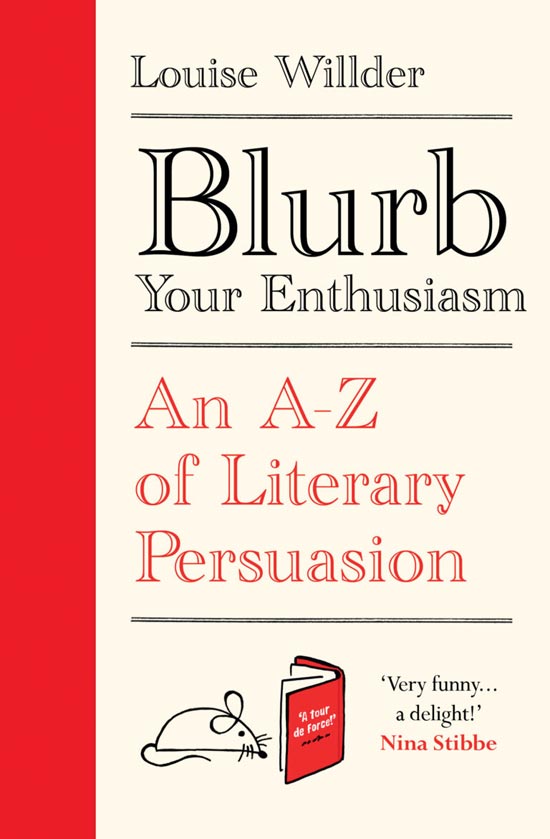
You’ve probably read more of the work of London based copywriter Louise Willder than you realise. Although her writings can be found in bookshops across the world, Willder has only ever written one book, which was published in October 2022.
Certainly Willder may not be in the same league as Elena Ferrante, Sally Rooney, or Kazuo Ishiguro, but her work may well have adorned one of their novels. Willder is a book blurb writer, and in a twenty-five year career at Penguin Books, estimates she has penned some five-thousand of these attention grabbing pitches, intended to entice someone to buy the book in their hands, having read the blurb printed on the dust jacket.
And in Blurb Your Enthusiasm (published by Simon & Schuster), Willder shares all she has learned about the craft of blurb writing:
We love the words in books — but what about the words on them? How do they work their magic? Here is a book about the ways books entice us to read them: their titles, quotes, covers and, above all, blurbs — via authors from Jane Austen to Zadie Smith, writing tricks, classic literature, bonkbusters, plot spoilers and publishing secrets. It’s nothing less than the inside story of the outside of books.
For my part, blurbs are something I take or leave. If a novel has a good enough recommendation — for instance it has been shortlisted for a literary prize — I’ll probably only settle for reading a mere outline of the story. And if I notice an endorsing blurb written by another (high profile) author, I’ll just about always ignore it. While I can’t be sure, I often get the feeling such “endorsements” have been given over sight unseen so to speak.
RELATED CONTENT
books, Louise Willder, novels, publishing
Dinner by Nagi Maehashi a cookbook selling like hot cakes
20 November 2022
Sydney based Australian chef Nagi Maehashi’s cookbook, Dinner, is quite literally selling like hot cakes. Published only six weeks ago, on 11 October 2022, the recipe collection has already outsold works by the likes of Jamie Oliver, and Yotam Ottolenghi:
Dinner is now leading the cookbook charts for 2022, with more than 74,500 copies sold. That’s three times as many sales as the second most-popular book, Jamie Oliver’s One, at 23,000 copies, according to Nielsen BookData. Even at the end of August, Maehashi had pre-orders that were more than double the first week sales of Yotam Ottolenghi’s Flavour.
RELATED CONTENT
Australia, books, Nagi Maehashi
Elon Musk shares whiteboard outline of Twitter 2.0
20 November 2022
Jason Cartwright, writing for TechAU, analyses a whiteboard image posted by Elon Musk following the recent contentious Twitter HQ code review. Long story short, coders who failed to attend would no longer be regarded as Twitter employees. Following the meeting though, Musk shared outlines of plans to rebuild the social media service’s platform, which is being dubbed Twitter 2.0:
It’s rare to see content from inside the company, especially anything to do with current and future development items. While Musk has hinted at potential improvements to the platform, the whiteboard photo does reveal some more information.
RELATED CONTENT
Elon Musk, social media, technology, Twitter
Jack Dorsey regrets role via Twitter in centralising internet
19 November 2022
As Twitter teeters on the brink of collapse (I think there’s a lot of us hoping it pulls through though) founder Jack Dorsey, in a tweet from April this year (preserved here for posterity should the worst happen), says he feels partly to blame for the present centralised state of the internet:

the days of usenet, irc, the web…even email (w PGP)…were amazing. centralizing discovery and identity into corporations really damaged the internet. I realize I’m partially to blame, and regret it.
Twitter’s only part of this centralised “problem” though. Other giant tech companies, Google, Amazon, among many others, have also played a role. Nonetheless, I imagine some of us see an upside. As for Twitter’s woes? Maybe owner/operator Elon Musk ought to consider stepping aside from day to day management of the company, and leave it to better qualified people?
Yep, I can see that happening.
RELATED CONTENT
Elon Musk, Jack Dorsey, social media, Twitter
The Fanzine Scan Hosting Project preserving fanzines fanfiction
18 November 2022
For every well-known work of fiction, there’s an extended universe behind it, called fanfiction. Look at the likes of Star Trek, The Twilight Saga, Star Wars, Harry Potter, and a whole lot more, it’s all there. Stories written by adoring fans of the original books, films, and TV shows, expanding on the creator’s canon, and exploring other weird and wonderful story arcs.
At times not all of these works are sanctioned by the series creator, but that won’t always stop the most die-hard of adherents. If they think there’s a story to tell, they’ll write it. But while works residing online, in electronic format, are likely to be preserved — at least for now — publications such as zines, or fanzines, which usually exist solely in paper format, are another matter.
The Fanzine Scan Hosting Project, an initiative of An Archive of Our Own, or A03, one of the most extensive online repositories of fanfiction, along with a number of collaborators, aims to preserve physical fanzines, and eventually make as many as possible available in electronic format online. Needless to say it’s a big job, but progress is being made:
Over the last year or so, however, Open Doors’ Fan Culture Preservation Project has expanded, finally giving them room to launch the Fanzine Scan Hosting Project. So far, they’re making their way through the backlog of scans that Zinedom has already accumulated, which Dawn estimates is “a couple thousand.”
RELATED CONTENT
books, history, technology, writing
The antilibrary of Umberto Eco a collection of unread books
18 November 2022
Late Italian medievalist, philosopher, and novelist Umberto Eco amassed a collection of some thirty-thousand books during his life, and can be seen here taking viewers on a short tour of his acquisitions.
But who has time to read that many books? Probably not even the most ardent of readers. But that’s not the reason Eco accumulated so many tomes: he wanted to create an antilibrary. And an antilibrary, as Anne-Laure Le Cunff, writing for Ness Labs explains, is not for the vain — those wanting to show off a vast book collection — but rather, for the curious:
The goal of an antilibrary is not to collect books you have read so you can proudly display them on your shelf; instead, it is to curate a highly personal collection of resources around themes you are curious about. Instead of a celebration of everything you know, an antilibrary is an ode to everything you want to explore.
For sure, the curator of any antilibrary, especially one the size of Eco’s, will not have read every title in the collection, but the books are instead present for reference, a constantly available, off-line, trove of information.
RELATED CONTENT
Digital e-books may have a shorter shelf life than paper books
18 November 2022
This might come as a surprise to anyone building an electronic collections of books. As technologies, and even computer operating systems evolve, older versions of e-books may become unreadable, possibly after only a decade or two. A certain amount of on-going reprocessing and reformatting is required to keep them up to date, and readable on newer devices:
For those of us tending libraries of digitized and born-digital books, we know that they need constant maintenance — reprocessing, reformatting, re-invigorating or they will not be readable or read. Fortunately this is what libraries do (if they are not sued to stop it). Publishers try to introduce new ideas into the public sphere. Libraries acquire these and keep them alive for generations to come.
I won’t go saying paper editions win out though. The world’s print books — even if they have a long shelf life, possibly spanning centuries — will eventually decay. Digital titles that are updated as time goes by will potentially be with us in many centuries time. There may be not too many paper books — aside from those in museum display cases — that will go that sort of distance.
RELATED CONTENT
Currowan by Bronwyn Adcock wins 2022 Walkley Book Award
17 November 2022
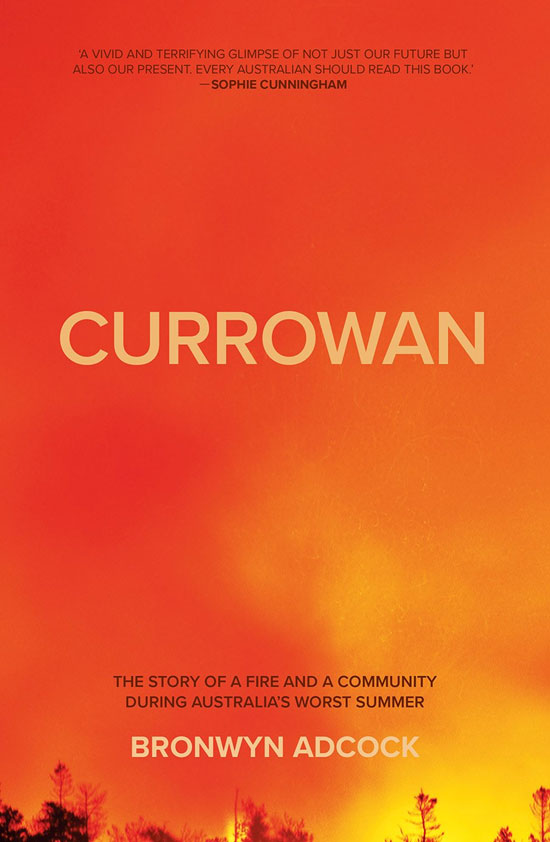
Currowan, by NSW based Australian journalist and writer Bronwyn Adcock, has been named winner of the 2022 Walkley Book Award. Published by Black Inc., Currowan is a harrowing personal account of a bush fire that burnt for seventy-four days on the NSW south coast in 2019.
The Currowan fire — ignited by a lightning strike in a remote forest and growing to engulf the New South Wales South Coast — was one of the most terrifying episodes of Australia’s Black Summer. It burnt for seventy-four days, consuming nearly 5000 square kilometres of land, destroying well over 500 homes and leaving many people shattered.
Bronwyn Adcock fled the inferno with her children. Her husband, fighting at the front, rang with a plea for help before his phone went dead, leaving her to fear — will he make it out alive?
In Currowan, Bronwyn tells her story and those of many others — what they saw, thought and felt as they battled a blaze of never-before-seen intensity. In the aftermath, there were questions — why were resources so few that many faced the flames alone? Why was there back-burning on a day of extreme fire danger? Why weren’t we better prepared?
Currowan is a portrait of tragedy, survival and the power of community. Set against the backdrop of a nation in the grip of an intensifying crisis, this immersive account of a region facing disaster is a powerful glimpse into a new, more dangerous world — and how we build resilience.
The Walkley Awards, which are presented annually, recognise excellence in Australian journalism.
RELATED CONTENT
Australian literature, books, Bronwyn Adcock, literary awards