
Twitter novels, written in 140 character tweets
17 March 2022
Here’s a blast from the past, from back in the days when tweets were limited to 140 characters: “novels” restricted to said limit, written by best-selling authors including Jilly Cooper, Ian Rankin, Jeffrey Archer, and Anne Enright, in October 2012.
If there were an award for the best Twitter fiction “novel”, and I were the judge, I’d name British novelist Helen Fielding, she who gave the world Bridget Jones’s Diary in 1999, the winner:
OK. Should not have logged on to your email but suggest if going on marriedaffair.com don’t use our children’s names as password.
This may, or may not be, Fielding’s Twitter page.
RELATED CONTENT
Helen Fielding, novels, writing
The 2022 Elizabeth Jolley Short Story Prize
16 March 2022
Entries are open in the 2022 Elizabeth Jolley Short Story Prize. Works of fiction, written in English, consisting of two thousand to five thousand words, are eligible, with a prize money pool totalling A$12,000 on offer. Entries close on Monday 2 May 2022. While an Australian based prize, submissions will be accepted from anyone regardless of their location.
Established in 2010, the prize was renamed the following year in honour of late British born Australian writer Elizabeth Jolley. Although she had been writing for decades, Jolley’s first book was not published until she was fifty-three. She also taught writing at what is now Curtin University, in Perth, Western Australia, and renowned Australian author Tim Winton was among her students.
RELATED CONTENT
Elizabeth Jolley, literature, writing
How I was conned by a manuscript thief
16 March 2022
American writer Peter C. Baker on being fooled into handing over a draft of his novel to a manuscript thief. The culprit, known as the Spine Collector, who was finally arrested earlier this year, had tricked numerous other authors, including many who were still unpublished, into sending him copies of their work.
It was the first book I’d ever tried writing, and, during the previous near-decade, it had become an overburdened locus of my ambitions, hopes, doubts, and fears. Many times, I’d looked at the manuscript and wondered if I was fooling myself. Getting fooled into handing it over made me feel sick.
RELATED CONTENT
Indulge your oblong obsession at the Selfie Museum
15 March 2022
If the Selfie Museum, in Canberra, the capital city of Australia, isn’t a sign of the times, and indicative of our collective oblong obsession, I don’t know what is. But if you’re looking to change up the backdrops for your self-portraits, the Selfie Museum — which presently boasts thirty-five photo sets — is the place to go.
RELATED CONTENT
Twenty books to rebuild civilisation curated by Brian Eno
15 March 2022
British musician and producer Brian Enohas put together a list of twenty books that could help in the rebuilding of our civilisation… should the need somehow arise.
It so happens that Eno now sits on the Long Now Foundation’s board and has had a hand in some of its projects. Naturally, he contributed suggested reading material to the foundation’s Manual of Civilization, a collection of books humanity could use to rebuild civilization, should it need rebuilding.
RELATED CONTENT
My Salinger Year: did Joanna Rakoff talk to J.D. Salinger?
14 March 2022
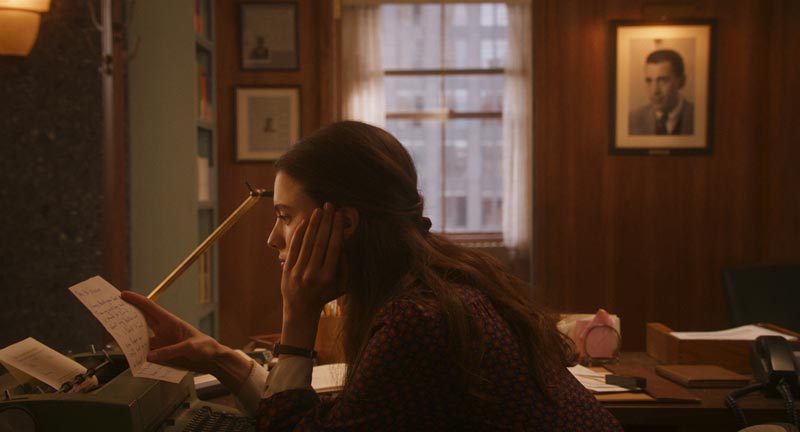
Still from My Salinger Year, courtesy of Mongrel Media.
In late 1995 twenty-three year old Joanna Rakoff abruptly leaves her degree course, and boyfriend Karl, at Berkeley, California, and returns to her native New York. She’s had enough of studying the work of other writers, she wants to write for herself. And what better place to do so than New York City. But she still needs to pay the bills.
Initially hoping to find work with a book publisher — and the industry contacts that would come with the role — Rakoff instead takes a job as an admin assistant at one of New York City’s oldest literary agencies. Little has changed in the agency’s office, she later quips to friends, since 1927, a place where the office photocopier is considered high-tech.
Computers are forbidden. Agency boss Margaret believes they create work, rather than reduce it. The literary agency appears to be as old-school as they come. But there is one consolation for Rakoff. The agency represents none other than reclusive author J.D. Salinger, he of The Catcher in the Rye fame, a book, ironically she has not read.
Released on 1 January 2021 in Australia, My Salinger Year is Canadian filmmaker Philippe Falardeau’s screen adaptation of the 2014 memoir of the same name, written by literary journalist and author Joanna Rakoff, played by Margaret Qualley. But while Rakoff’s book was well received, Falardeau’s adaptation of her memoir did not meet with the same acclaim.
Salinger’s Miranda Priestly problem
Despite being a nostalgic stroll through a New York City that no longer exists, and a visual treat, with its warm, saturated hues, and lovingly rendered frames, My Salinger Year rates a paltry fifty percent among critics, according to film review aggregator Metacritic. Critics had a number of issues with the production.
Peter Bradshaw, writing for The Guardian thought My Salinger Year tried too hard to be another The Devil Wears Prada, and failed abysmally:
The provincial-making-it-in-the-big-city genre is well established, but the influence of The Devil Wears Prada is so clear it almost begins to feel like a upscale homage. It suffers in comparison because The Devil Wears Prada is forthright and funny with Anne Hathaway and Meryl Streep delivering fireworks. Perhaps Qualley and Weaver could have done the same with a sparkier script. But the all-important master-servant hero-worship dynamic is always stymied: diverted on to the semi-unseen and necessarily unresponsive Salinger.
When I saw Margaret coldly ignoring Rakoff on her first day of work at the agency, I too thought of Miranda Priestly. But I’m not sure making Margaret out to be a Priestly clone was the filmmaker’s intention. Meanwhile Peter Debruge, writing for Variety, didn’t think Qualley’s portrayal of Rakoff as an aspiring writer was convincing:
Director Philippe Falardeau (who made one very good movie in the form of “Monsieur Lazhar”) has written Joanna Rakoff as well-read and intelligent, but Qualley has a dopey, nobody-home quality: The actor looks eager and ready to please, standing politely with her shoulders back and hands clasped like an obedient schoolgirl, but there’s nothing happening behind the eyes. Portrayed thus, Joanna comes across as childlike, naive and shockingly shallow. Though she’s no doubt plenty bright in person, close-ups in which she’s shown thinking are eerily unconvincing.
It’s true Qualley portrayed Rakoff with wide-eyed enthusiasm, and a breathy exuberance, but I wouldn’t say the lights were on but no one was home. Let’s not forget Rakoff aspired to other things, and working at the agency wasn’t exactly what she wanted in the first place. She didn’t see the role as a stepping stone, but rather a means to keep a roof over her head.
My friend Salinger
While My Salinger Year may not rate as award winning drama, the question remains. Were the interactions viewers of the film witnessed between Rakoff and Salinger the real deal, or were the producers’ taking some cheeky poetic licence? And while we may never know exactly what did transpire, Rakoff and Salinger indeed spoke to each other.
Given the nature of Rakoff’s work at the agency, corresponding — by way of standard, clipped, responses — to the volumes of Salinger fan mail the agency received, regular communication between the pair might go without saying. But the hermit-like Salinger had no interest in what his readers had to say.
But on learning Rakoff wrote poetry, Salinger warmed to her. He even encouraged her writing, almost chastising her for doing humdrum office work. “Don’t get stuck answering the phone Joanna, you’re a poet,” he said to her on one occasion. He cared, even if the then partly deaf author did get her name wrong, when they first spoke:
Salinger, when Rakoff finally plucks up the courage to converse with him, is indeed kind to her. He is extremely deaf, and gets her name wrong. But he also encourages her to keep writing her poetry (he reveres poets).
While Salinger didn’t ask to see her work, it’s hard to imagine Rakoff being disappointed. When a literary giant is in your corner, rooting for your writing ambitions, what more do you need? Who wouldn’t give up the dead-end day job, and follow their dreams. And this is who My Salinger Year — for all its apparent faults — really speaks to: the dreamers with the big ideas.
RELATED CONTENT
film, J.D. Salinger, Joanna Rakoff
A trailer for the Obi-Wan Kenobi TV mini-series
12 March 2022
A teaser/trailer for the upcoming Disney+ Obi-Wan Kenobi six-part TV mini-series, that delves further into the Star Wars saga. Both Ewan McGregor and Hayden Christensen reprise their roles as Obi-Wan and Darth Vader, respectively.
The story begins 10 years after the dramatic events of “Star Wars: Revenge of the Sith” where Obi-Wan Kenobi faced his greatest defeat — the downfall and corruption of his best friend and Jedi apprentice, Anakin Skywalker, who turned to the dark side as evil Sith Lord Darth Vader.
From this snippet, Obi-Wan Kenobi looks promising. Though some have been better than others, I’m wary of some efforts to “fill in” gaps in the original Star Wars saga, or more the point, the first six films, as, to me, episodes seven through nine didn’t feel the least bit like Star Wars.
While I thought Rogue One, depicting events immediately prior to A New Hope, wasn’t too bad — terrible CGI representation of some characters aside — Solo, the Han Solo “origin story”, was unnecessary to say the least.
Given almost twenty-years separate events of Revenge of the Sith, and A New Hope, there’s probably enough room to insert a story half-way between episodes three and four, without compromising the integrity of the saga. Time will tell. Obi-Wan Kenobi debuts on Wednesday 25 May 2022.
RELATED CONTENT
film, science fiction, trailer
The Passenger, Stella Maris, new novels by Cormac McCarthy
12 March 2022
After a sixteen year hiatus, American author Cormac McCarthy, whose last book, The Road, was written in 2006, will publish two new novels later this year. Both stories are connected, and will be released a month apart. The first title, The Passenger, arrives in bookshops on 25 October 2022:
1980, Pass Christian, Mississippi: It is three in the morning when Bobby Western zips the jacket of his wetsuit and plunges from the boat deck into darkness. His divelight illuminates the sunken jet, nine bodies still buckled in their seats, hair floating, eyes devoid of speculation. Missing from the crash site are the pilot’s flightbag, the plane’s black box, and the tenth passenger. But how? A collateral witness to machinations that can only bring him harm, Western is shadowed in body and spirit – by men with badges; by the ghost of his father, inventor of the bomb that melted glass and flesh in Hiroshima; and by his sister, the love and ruin of his soul.
The second book, Stella Maris, set eight years earlier, is based on the treatment transcripts of Bobby’s sister Alicia, who is a patient at a psychiatric hospital, and will be released on 22 November 2022:
1972, Black River Falls, Wisconsin: Alicia Western, twenty years old, with forty thousand dollars in a plastic bag, admits herself to the hospital. A doctoral candidate in mathematics at the University of Chicago, Alicia has been diagnosed with paranoid schizophrenia, and she does not want to talk about her brother, Bobby. Instead, she contemplates the nature of madness, the human insistence on one common experience of the world; she recalls a childhood where, by the age of seven, her own grandmother feared for her; she surveys the intersection of physics and philosophy; and she introduces her cohorts, her chimeras, the hallucinations that only she can see. All the while, she grieves for Bobby, not quite dead, not quite hers.
While I haven’t yet read The Road, I did see John Hillcoat’s harrowing 2009 film adaptation, starring Viggo Mortensen, Charlize Theron, and a then young Kodi Smit-McPhee.
RELATED CONTENT
2022 International Booker Prize longlist
11 March 2022
Thirteen titles have been named on the 2022 International Booker Prize longlist. Awarded in its present format since 2016, the International Booker celebrates works translated into English, with the £50,000 prize split equally between the author and translator.
Among the titles translated from eleven languages into English, is Tomb of Sand, by New Delhi based Indian author Geetanjali Shree, and translated by American writer and painter Daisy Rockwell. Shree’s work is the first book written in Hindi to be included on the International Booker Prize longlist.
Just about all of these titles are new to me — the books I read, when time permits, tend to be contemporary Australian, but not always — so it’s good to see something new and not so familiar, that I can add to my to-be-read list.
RELATED CONTENT
Booker Prize, literature, writing
Adaptable 2021/22 text to screen longlist announced
11 March 2022
Adaptable is an initiative of the Queensland Writers Centre that connects aspiring screen writers, working across all genres, with film and television producers.
Adaptable seeks material for film or television adaptation. Open to writers across Australia and New Zealand, the contest accepts any genre, fiction or non-fiction, published or unpublished. Queensland Writers Centre also identifes several early career unpublished/emerging writers to pitch their work to screen creatives, with these writers receiving mentorship and advice prior to the pitching sessions.
A longlist of contenders was unveiled this week, with the shortlist to follow shortly.
RELATED CONTENT