
Showing all posts about history
The Man Who Invented Vegemite, a book by Jamie Callister
21 June 2023
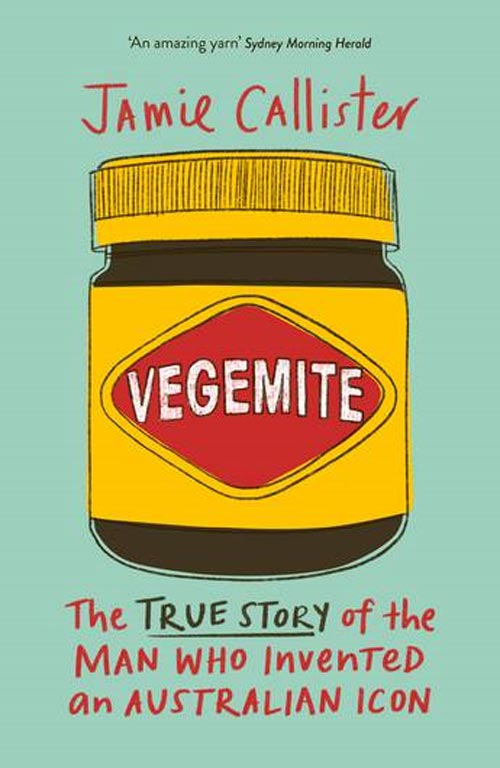
Book cover of The Man Who Invented Vegemite, written by >Jamie Callister.
Strewth, it’s been one hundred years since Australia’s favourite yeast extract, Vegemite, hit the shelves of grocery shops. Although similar (sort of…) to Marmite, which came along in 1902, Vegemite was developed by Cyril Callister, a Melbourne chemist and food technologist in 1922.
In 2012, Jamie Callister, the grandson of Cyril wrote a book, The Man Who Invented Vegemite, to mark what would have been the ninetieth anniversary of Vegemite. And now, ten years later, it looks like the book has been republished to commemorate a century of the viscous, dark brown — and might I add — delicious, spread’s presence in the world.
RELATED CONTENT
Australia, books, food, history, Jamie Callister
The Last Daughter a film by Nathaniel Schmidt, Brenda Matthews
21 June 2023
For decades until the 1970’s, some Aboriginal and Torres Strait Islander children were forcibly removed from their families by successive Australian governments. These children became known as the Stolen Generations. Indigenous woman Brenda Matthews was taken from her family aged two, and placed in the care of a white family.
Matthews was later returned to her birth family after her biological mother regained custody of her. The The Last Daughter, trailer, a documentary which Matthews co-directs with Nathaniel Schmidt, recounts her story as she attempts to trace her adoptive, loving, white foster family, while learning more about her Indigenous family.
The Last Daughter is presently screening in selected Australian cinemas.
RELATED CONTENT
Australia, documentary, film, history, Indigenous culture
The Beatles get by with a little help from AI with new song
14 June 2023

Image courtesy of Firmbee.
With emphasis on the word little. Recent comments made by Sir Paul McCartney, bass player and co-songwriter of defunct 1960s British music act the Beatles, that AI has brought about a “new” song by the band, are perhaps a tad misconstrued. AI technology has indeed assisted in the production of a previously unreleased Beatles song, but application of the technology was somewhat limited.
In 1978 John Lennon, late Beatles guitarist and co-songwriter, recorded a number of demo songs in his New York home, using a portable audio cassette player, variously called a boombox or ghettoblaster. In 1995, when the remaining members of the Beatles were preparing to release the Beatles Anthology, they considered using Lennon’s demo songs as a basis for some new Beatles tracks. This resulted in the inclusion of two songs, Real Love, and Free as a Bird, in the Anthology set.
Starr, Harrison, and McCartney also wanted to include a third track from Lennon’s demo tape, called Now And Then, but there was a problem: the quality of Lennon’s vocals on the recording wasn’t the greatest. Despite their best efforts to tidy up the singing, the group — George Harrison in particular — wasn’t happy with the result. So the idea was shelved.
AI technology however has recently been able to extract Lennon’s vocals from his forty-five year old demo recording, and elevate the quality to a level McCartney and Starr, the surviving band members, are satisfied with. But that was the limit of AI’s part in bringing about this new — and according to McCartney — final Beatles song. The song, and it’s still not certain that it is Now And Then — though Beatles pundits believe it is — is expected to be released later in 2023.
Unless there are other forgotten, or lost, demo tapes made by Beatles members, lying undiscovered somewhere, it is to be hoped whatever track is eventually released, is indeed the last “new” material we hear from the old Liverpool musicians. I say that as I have the concern AI will surely manufacture additional, unauthorised, tracks that mimic the sound and style of the Fab Four, and be passed off as “newly discovered” lost recordings made by the band, by unscrupulous parties.
RELATED CONTENT
artificial intelligence, Beatles, history, music, technology
ooh.directory a blogroll and web directory in the TikTok age
31 May 2023
My thanks to Phil Gyford for listing disassociated in his web directory ooh.directory. In the early days of the web, before search engines were a thing, website owners often sought to be added to web directories, as promotional opportunities were otherwise limited.
These website lists, or catalogues, were usually broken down by category or subject, so if, say, you were seeking websites focussed on literature, the books or literature page was the place to go. I used to while away many an hour perusing web directories. Site descriptions were often concise, to say the least, and on occasion there was no telling where a link might lead. There was a certain spontaneity that came with directories and blogrolls, something perhaps lacking in today’s web.
ooh.directory is also a blogroll. Once upon a time bloggers used to list their favourite websites and blogs, usually in a sidebar of their blog. Blogrolls were preceded by link pages, which served a similar purpose. They’re not seen so often today, as their use became frowned upon by the search engines. There was a concern some websites included on blogrolls and link pages might have been paid placements, potentially giving the listed blog an unsanctioned leg up in search rankings.
Web directories and blogrolls have been making something of a comeback recently. And in a world chock full of distractions, their return couldn’t be more timely. Elegant tools for a more civilised web. In addition to ooh.directory, there’s also the excellent feedle, the actual Blogroll, and FeedLand.
RELATED CONTENT
Blog publishing application WordPress has turned twenty
29 May 2023
When I re-launched disassociated as a blog in 2007, being one of many reboots this website has been subject to since 1997, I migrated to blog publishing application WordPress (WP). Prior to that, all pages here were laboriously hand coded. Hand coding was a hangover from my web design days, and my distaste for WYSIWYG website editors. My beef, at the time, with many of these webpage builders was the way they worked. Best practice, and standards, were an alien concept to them, to say nothing of the extraneous code they generated.
One, that shall remain nameless, created rollover code for text hyperlinks using JavaScript. JavaScript. This despite the web being well into the age of CSS generated rollover code by that stage. Come 2007 though, apps like WP were the way to go. Other bloggers I was speaking to then told me WP, or similar such CMSs, would save a bundle of time, and allow me to go about my disassociated way. I’m sure glad I listened to them. “WP is working for me, even while I sleep,” one counterpart said.
I was sold. By that stage WP had been around for about four years, but was still regarded as being relatively new. It was enough to make me feel as if I were some sort of (sort of) pioneer. But WP frustrated the hell out of some people. Many felt WP’s core capabilities were lacking, necessitating an over dependence on plugins — small apps that add, or extend to, WP’s functionality — to bring about the website, or blog, they desired. Ben Barden, a developer and blogger, once created his own CMS, back in the day, named Injader, for this reason.
But I’ve always strived to keep the backend as simple as the front. My use of plugins is as minimal as the interface design. All I want to do is write and post content. But here we are in 2023. disassociated, still styled (mostly) with a lowercase d, which first came into being in 1997 (not as a blog, the term was yet to be coined), is, despite stops and starts, still publishing. And this week WP is twenty years old. So, happy birthday WordPress, and thanks for being here. I’m looking forward to your thirtieth, which will really be something if disassociated is still doing its thing.
RELATED CONTENT
blogs, design, history, technology
Trove receives funding to continue ongoing operation
4 April 2023
Trove, Australia’s online library database of historical and cultural documents, which is operated by the National Library of Australia, has received a new round of funding from the Australian federal government. The move ends months of uncertainty that had been shrouding Trove’s future:
The National Library of Australia welcomes the commitment made by the Albanese Government to provide $33m over the next 4 years to maintain Trove, with $9.2m ongoing and indexed funding from July 2027. We are delighted that Trove’s future has been secured.
RELATED CONTENT
art, Australia, culture, history, politics
How to design 1999-like websites in 2023
23 January 2023

Websites designed in the late 1990’s, especially personal sites, like the in-your-face Geocities pages, might have been inaccessible, difficult to navigate, devoid of standards, and completely lacking in latter day best practice methodology, but they were fun. Bold. Colourful. Non-generic.
Professional web designers of the time may have hated them, but I dare say they loved to hate them. And they might be about to again. British web engineer Sophie Koonin — who built her first Geocities page at age ten — is on a mission to bring the flamboyant and weird back to the web.
This time though without the HTML markup hacks, and proprietary code, of twenty-five years ago:
I’d love to see this spirit return today – the experimental and fun side of the web. My goal is to show you how we can be just as creative today but using modern and accessible methods. Because, as fun as they were, old websites were a nightmare for accessibility. We didn’t really use semantic HTML, we used tables for layouts (instead of, y’know, tabular data), everything was constantly flashing and moving. Luckily for us, the modern web allows us to be just as creative while still considering the user at the other end of the browser.
Talking of websites built during the nineties, I found out the other day that entropy8 (screenshot above), an example of beautiful website design from the era, built by Rome, Italy, based American digital artist and sculptor, Auriea Harvey, is still online. I used to visit entropy8 a bit, back in the day. Websites designed by artists are also what the web needs more of.
RELATED CONTENT
Funding uncertainty may see online database Trove close down
10 January 2023
Trove, an online library database containing digital copies of significant historical and cultural Australian documents, maintained by the National Library of Australia, may be forced to cease operating at the end of June 2023, unless it is allocated more funding, according to its recently published strategy document:
The Library has sufficient resources to maintain Trove until June 2023. The future of Trove beyond July 2023 will be dependent upon available funds. To achieve the full strategic vision will require substantial investment. More modest investment sustained over a longer term would enable achievement of the strategy at a measured pace. In a limited funding environment, Trove may reduce to a service focused on the National Library of Australia’s collections. Without any additional funds, the Library will need to cease offering the Trove service entirely.
While funding for Trove, and other collecting institutions, including the National Gallery of Australia, and the National Museum of Australia, was not part of the recently unveiled National Cultural Policy, Australian federal arts minister Tony Burke suggested the matter would be looked at as part of this year’s federal budget, which is traditionally handed down in May.
RELATED CONTENT
art, Australia, culture, history, politics
A return to blogging RSS and blogrolls for content discovery
6 December 2022
While I’m not one hundred percent sure we’re entering the end-days of social media, some recent talk of a resurgence in blogging, and a return to using RSS for content discovery, is encouraging. It’s kind of the web I know the best. But like anyone else, I can be found on the socials, Twitter and Mastodon, among them. I should add I’m an introvert, so my socials are relatively quiet. And no, the irony of that last sentence is not lost on me.
I first acquired the disassociated domain name, disassociated.com.au, in 1997. disassociated.com, meanwhile, came along in early 2003. But not before someone else, who’d bought the name, tried to sell it to me in the early 2000’s. But way back in the day, a person’s own website was always regarded the central pivot of their online presence. Pages on the early socials, Friendster, MySpace, and later Twitter, Facebook, and Instagram, were always seen as “outposts”.
As a web person you had presences there, because everyone else did, but they were not core to your overall online presence. And for good reason. The socials might have been public web-spaces, but they were privately owned. Fall foul of their terms of service, and you stood have your account suspended, or worse, permanently shut down. Sometimes without recourse, because you were in the realm of someone else who was setting the rules.
But no problem, you still had your largely untouchable core online presence, your website, at your own domain, which was self-hosted somewhere. Until we didn’t. The socials became too easy to use. They were free, and no hosting charges needed to be paid. Having a self-hosted website required some degree — no matter how little — of technical competence. Twitter and Instagram offered unlimited server capacity, ease of use, and, through their sprawling memberships, a multitude of potential followers. No more drawn out wrangling with SEO to find eyes to see your stuff, an audience was already present. You simply (sort of) had to make yourself known to them.
But before SEO and the socials came along, audience building was a little trickier. Website owners and bloggers were required to put in a lot more groundwork. In the late 1990’s I was writing blog posts before blogging was a thing. Back then we called these blogs online journals. To make ourselves known to other people then, we might write an online journal post about them, while linking to their website at the same time. Another option was through guestbook comments.
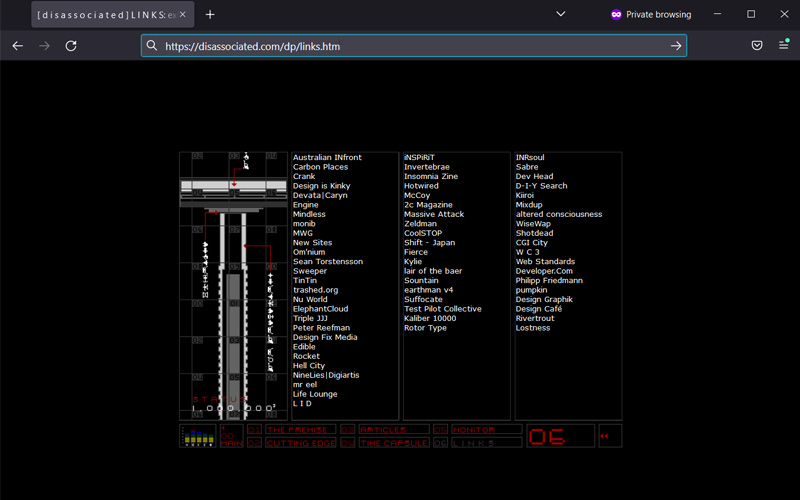
Guestbooks were one of the earliest methods of interacting with a website owner, and were hugely popular in the late 1990’s. There were akin to the comments section of a blog post, although the discussion was confined to a single page on a website, where the guestbook was situated. Another tried and true way of making yourself known to other website owners was by way of a links page. Above is the links page that featured on disassociated in late 1999. I know a lot of those links are gone now, but later on I might click links and see who is still around.
I guess you could say website link pages evolved into the blogrolls that once adorned the main pages, usually a side bar (which I stopped using about ten years ago) of a blog, when blogs per se arrived. The search engines however bought about the demise of the old school blogroll, from around 2007 or 2008. They were concerned many of the inclusions to what were the favourite websites of the blogger, were paid placements. In those earlier days, the search engines were also opposed to the practice of linking to so-called “bad neighbourhoods.”
Bad neighbourhoods were seen as websites having little, or no relevance, to the subject matter of the blog that linked out to them. For instance, it was seen as bad practice for a blog focussed on film production to link to a blog focussed on baking cupcakes. That could only be downright suspicious, couldn’t it? Too bad if the cupcake blogger was the significant other of the film production blogger, interlinking was simply unacceptable, and might earn you a slap down from a search engine.
Hopefully those days are behind us. The web is too vast and diverse a place for anyone to stay in their own lane. But blogrolls have been making a comeback. Not so much on individual blogs, but in the form of a number of aggregator websites, which are focused on content discovery, and the work of outstanding writers and bloggers. Chief among them are feedle, Blogroll, ooh.directory, and FeedLand, which is a feeds repository.
As I wrote on Twitter recently, “search engines are great for finding resources on topics of interest but scrolling through lists of blogs and randomly spotting something compelling is plain fun”. I for one am hopeful of a blogging renaissance, and other ways of discovering content, far from the shadows of the social media giants.
RELATED CONTENT
design, history, RSS, technology
Those Dashing McDonagh Sisters by Mandy Sayer
22 November 2022
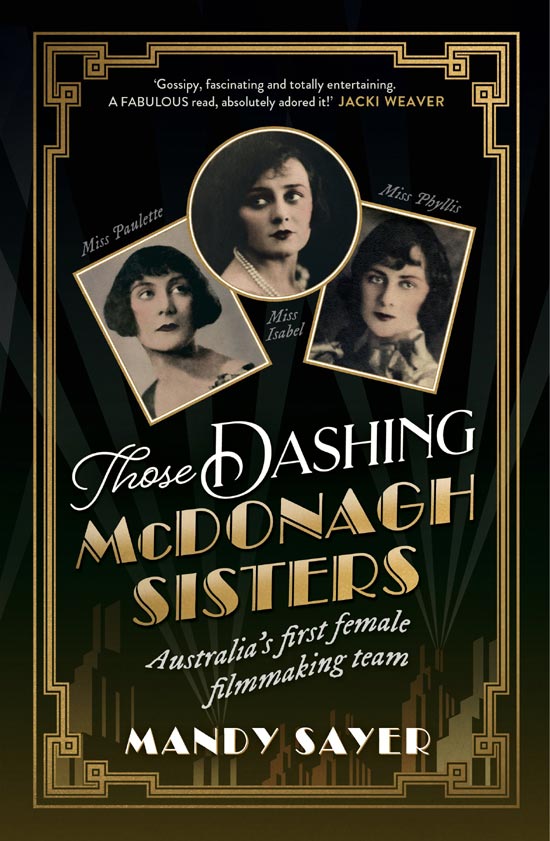
The McDonagh Sisters, Isabel, Phyllis, and Paulette, were Australian film producers active almost one hundred years ago. Based in Sydney, the trio made six films, including two documentaries, in an age of filmmaking that saw the transition from silent features to sound, or talkies.
The youngest, Paulette, was one of only five women film directors in the world. Phyllis produced, art directed, and conducted publicity. And the eldest, Isabel, under her stage name Marie Lorraine, acted superbly in all the female leads. Together, the sisters transformed Australian cinema’s preoccupations with the outback and the bush — and what they mocked as ‘haystack movies’ — into a thrilling, urban modernity.
Their work and lives are the subject of a new book, Those Dashing McDonagh Sisters: Australia’s First Female Filmmaking Team, published by UNSW Press, by Sydney based Australian writer and novelist Mandy Sayer.
The sister’s stories are a fascinating chapter in the history of both Australian film production, and Australia itself. Sayer’s book will help introduce their now often overlooked work to a new generation of people with an interest in Australian filmmaking and its past. For a glimpse of the McDonagh’s work, have a look at this trailer for their 1930 film The Cheaters.
RELATED CONTENT
Australian film, Australian literature, history, Mandy Sayer