The things you find while trawling through the The Public Domain Review… Agnes Giberne was a British novelist and science writer, who died aged 93 in 1939. As a writer her output was prolific.
Wikipedia lists one hundred and thirty books published under her name during her lifetime. On top of her writing though, Giberne was also an accomplished artist and illustrator.
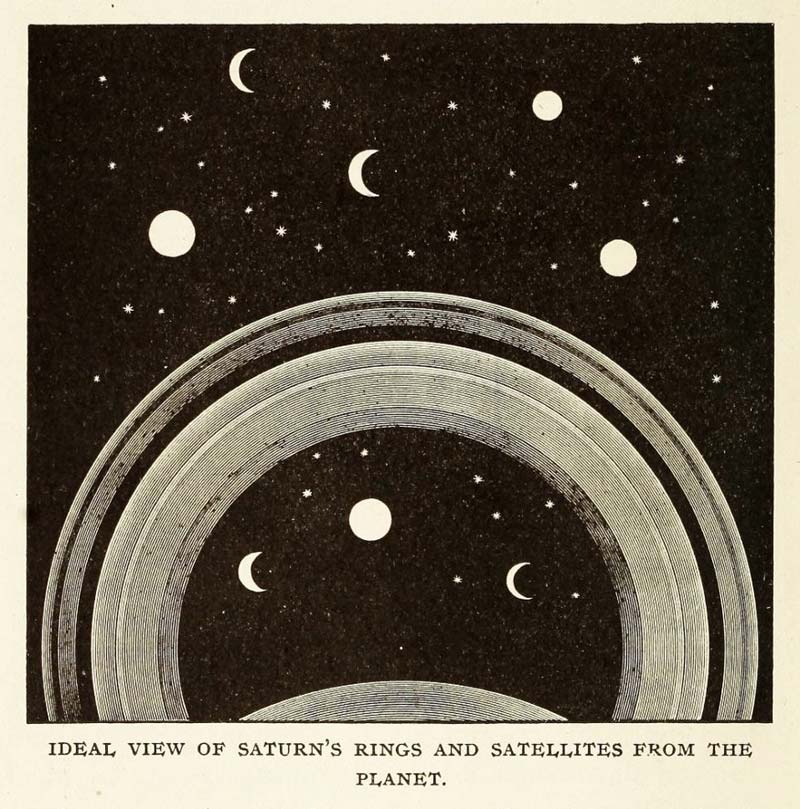
The above illustration, titled “Ideal view of Saturn’s rings and satellites from the planet” is a silhouette woodcut from her book, Sun, Moon, and Stars: A Book for Beginners, which was published in 1898.
Released in quick succession between 1993 and 1994, and starring Juliette Binoche, Julie Delpy, and Irène Jacob, the trilogy became an arthouse sensation, with Red, the third and final film in the series, collecting a coveted Metascore of one hundred.
Our insatiable appetite for coffee leaves a few superfluous by-products in its wake. Disposable coffee cups are one. Coffee grounds, being what remains of the beans used to brew the cup of coffee you bought, are another. And, as with the disposable cups, coffee grounds tend to build up. It’s estimated two billion cups of coffee are made daily globally, which adds up to a lot of coffee grounds.
And given just about all these dregs end up in the waste bin, our caffeine addiction is hardly environmentally friendly, nor particularly sustainable. While some people make an effort to recycle discarded grounds, they can be repurposed as household deodorisers, compost, and even insect repellent in the garden, among other things, most end up in landfills.
The people at Coffee Kreis are hoping to change that though. They’d like to see coffee grounds come full circle, as it were, by turning them into reusable coffee cups, which is quite apt as kreis is the German word for circle, or circuit.
Kreis means circle, resembling our circular economy model based on the regeneration of natural materials into a sustainable product. The Kreis Cup is an alternative to disposable paper cups and aims to replace the end-of-life concept of used coffee grounds.
Few would have been surprised by Elon Musk’s decision to withdraw his takeover for Twitter, it seemed the writing had been on the wall for some time. But now the recriminations begin. Twitter directors have said they’ll commence legal action against the Tesla CEO to enforce the deal. At the least Musk may be slugged with a billion dollar fine. A billion dollars is probably coffee money for someone like Musk, but a slew of additional lawsuits may end up costing Musk far more than that.
In addition to the fine for the failed deal, Musk could face serious consequences from the SEC for his antics, which have had major impacts on the several public companies he manages as well as Twitter itself. Musk is an executive at the artificial intelligence firm Neuralink, the electric car company Tesla, the space travel company SpaceX, and the tunnel construction firm the Boring Company. He has in the past faced lawsuits from investors over his erratic behavior and its effects on the companies’ stocks.
It’s 1997 and you want to build a website, a history of the early days of website development, by Jay Hoffmann. The first version of disassociated went online in 1997. I even held a small launch party. We went to an internet cafe so I could see disassociated on a third-party device that was not mine, nor anyone I knew.
They were the good old days of web design. Designers would stay up all night working on a new website, only to pull it apart, and start all over again when some new trend came along, which seemed to be all the time. Javascript image rollovers, anyone? TV lines? Some of the best experimental web design was to be found in the late nineties. Partly because there was a new-frontier exuberance, and the rules were few.
Despite this, I worked to the HTML 3.2 standard — a non-proprietary specification for building websites to — published by the W3C. My desire to use standards was two-fold: they promised to make the web a little more accessible, and hardly anyone else was working with them. It made me feel like some sort of counter-culture rebel.
When the HMTL 4 spec came along in April 1998 though I quickly adopted it, because, you know, it was shiny and new. I only talk about standards because they were the only paper resource I referred to when coding — sorry, marking up — a website. I didn’t rely on text books to teach myself web design, but rather the online tutorials of the time. Plus a little, actually considerable, trial and error.
I worked at some big-end-of-town company for a short time in 1998, where I furtively printed out the HTML 4 spec, twenty pages at a time, here and there, throughout the day, for several weeks.
Why I needed to waste all that paper — once printed the spec was almost the size of a telephone directory — when I could’ve referred to the document online (via dialup), eludes me now. I think having the spec, bound in a ring-binder, sitting on my desk at home, validated my then fledgling web design aspirations.
For somebody surfing the web in 1997, a book might feel a bit… 20th century. If you already knew the basics of getting online, why not poke around some sites that might help, right there in your browser.
Hoffmann’s article also mentions a bunch of early-on-the-scene web design agencies, including Razorfish, who were behind the production of This Girl, the monthly serialisation of the life of a fictitious twenty-something living in New York, called Phoebe. The work of Razorfish, and the exploits of Phoebe, were one of thousands of web influences I absorbed.
I wonder what became of Phoebe. And that print out of that HMTL 4 spec.
The Handmaid’s Tale, speculative fiction novel written in 1985 by Margaret Atwood, is set in the fictitious Republic of Gilead — usually referred to as Gilead — a totalitarian patriarchal theocracy, occupying much of what is the continental United States. Gilead is a place where even the most basic rights and liberties of many, particularly women, have been curtailed.
But the recent decision by the Supreme Court of the United States to overturn the 1973 Roe v. Wade ruling giving women the constitutional right to terminate a pregnancy, has stoked fears of a Gilead-like regime becoming reality.
Talk of other long standing rights — including access to contraception, and same sex marriage — possibly being rescinded, is doing little to quell such concerns.
I first read The Handmaid’s Tale in 2019, weeks before Atwood announced she was publishing a follow-up, The Testaments. If you haven’t already read her 1985 novel, I recommend it to you, and a TEDEd video presentation Naomi R. Mercer made in 2018, is an excellent introduction.
Paused for weekend viewing… produced by Zaya and Maurizio Benazzo, The Art of Life is a documentary about mathematician Michael Behrens who walked away from academia, and made a life for himself living in a home he built in the midst of a dense Hawaiian jungle.
As a rising star in the field of abstract mathematics, Michael discovered that he could see beauty and pattern where others could not. But his path was not to be inside academia, or even inside society. He went on a grand adventure to unify his Buddhism with his ability to see an expanded view of reality. He created beauty in a place where nobody else would, and made his friends amongst dolphins.
With the way things are in the world at the moment, who can help but think the last human might be born sooner rather than later. But in taking on the question, Kurzgesagt argues we may be among the first humans born, especially if our species goes on to survive and flourish over the next billion years. A whole lot depends on that eventuality, but what’s wrong with some optimism?
The future of humanity seems insecure. Rapid climate change, political division, our greed and failings make it hard to look at our species with a lot of optimism and so many people think our end is in sight. But humans always thought they lived in the end times. Every generation assumes they’re important enough to witness the apocalypse and then life just goes on. This is a problem because it leads to short term thinking and prevents us from creating the best world for ourselves and our descendants. What makes this worse is that we actually may live at an extremely critical moment in human history.
Most people have heard of the trolley problem. In short, you’re standing beside a rail line, near a railroad switch. A train is coming along the track, but there are five people tied to the track, in its path. You have the option to pull the switch lever, sending the train along a side line.
But another person is tied and bound to the side line. What should you do? Stand there, do nothing, and allow the train run over the five people? Or send the locomotive down the side line, where one person will be killed? Presumably there is not time to free any of the people, so you are left with the difficult choice. Do five people perish, or one?
This format of the trolley problem was created by Philippa Foot, a British philosopher, in 1967, while Judith Thomson, a philosopher at MIT, devised the quandary’s name. American creative coder and developer Neal Agarwal, meanwhile, has thought of a few more, absurd, trolley problem instances.
Clerks III, trailer, billed as the “meta sequel” to the dark 1994 comedy Clerks (and Clerks II from 2006), is being released in the United States in September, with Kevin Smith returning to direct.
Clerks III sees the original gang, Dante Hicks, Veronica, Jay, and Silent Bob, reunite after Randal Graves suffers a heart attack, and asks his friends to make a tribute film about the convenience store where they first met nearly thirty years ago.
I have to say I’m not sure about Clerks III. This could be because the scenes presented in the trailer seem overly contrived (even though maybe they’re meant to be), or the choice to film in colour, in contrast to the black and white of the first movie, Clerks, feels out of place.